About Joe Weber

Now the Jerry and Karla Huse Professor Emeritus at the University of Nebraska's College of Journalism and Mass Communications, I worked 35 years in magazines and newspapers. I spent most of that time, 22 years, at BUSINESS WEEK Magazine, leaving in August 2009 as chief of correspondents. So far, I have worked in central New Jersey, New York City, Denver, Dallas, Philadelphia, Toronto, Chicago, Beijing, Shanghai and Lincoln, Nebraska. The adventure continues.

Does the Truth Matter?

In the Israel-Palestine conflict facts can be elusive and, maybe, pointless

Aftermath of attack on Al Ahli Hospital, source: Newsweek

In war, it’s said, truth is the first casualty. Indeed, the late journalist and professor Phillip Knightly wrote a book about misinformation in wartime that is must-reading for serious reporters. Given the Al Ahli hospital explosion in Gaza, his work is especially apt.

The explosion, which American and Israeli intelligence officials have persuasively contended was triggered by a misfired Islamic Jihad rocket, has been a PR bonanza for Hamas. Across that Arab world, Anti-Israeli forces rushed to embrace the terrorist claims that only an Israeli missile could have caused the disaster, dismissing Israeli counterclaims out of hand. Even as American intelligence sources confirmed those counterclaims, the fury has continued.

But the effects went well beyond the demonstrations. Several Arab leaders cancelled their planned meeting with President Biden, depriving everyone involved of a chance for face-to-face diplomacy that could have been helpful. Outside of Israel, the explosion also pushed into the background the Hamas atrocities of Oct. 7, the killings of more than 1,400 people, where the terrorist group exulted in savagery unprecedented in the long conflict. The 199 people children, elderly and others taken hostage have all but disappeared from the headlines.

American media outlets are striving to verify the American and Israeli findings about the explosion. That is as it should be. Ever since the Pentagon Papers, at least, independent verification is essential, and skepticism is warranted. Persuasive as the latest evidence seems to be, checking is crucial, especially as misinformation has abounded in this war.

However, the sad reality is that the truth may not matter except, maybe, as a historical point of interest. Even if Islamic Jihad’s ineptitude was at fault, Israel’s critics will likely argue that the assault Israel has mounted on Gaza is the underlying cause and, thus, the blame falls to Israel. Of course, Israel would not be bombarding Gaza if not for the attack by Hamas to begin with, something the anti-Israel forces appallingly ignore.

The reality is that in the eyes of its haters, Israel can do nothing right. Indeed, they deny its right to exist. The fashionable argument, which appears all too often on Linked In, X and elsewhere, is that Israelis are just Western colonizers (an absurd but common contention in Palestinian academic circles in the U.S., one that ignores the long history Jews have had in the land).    
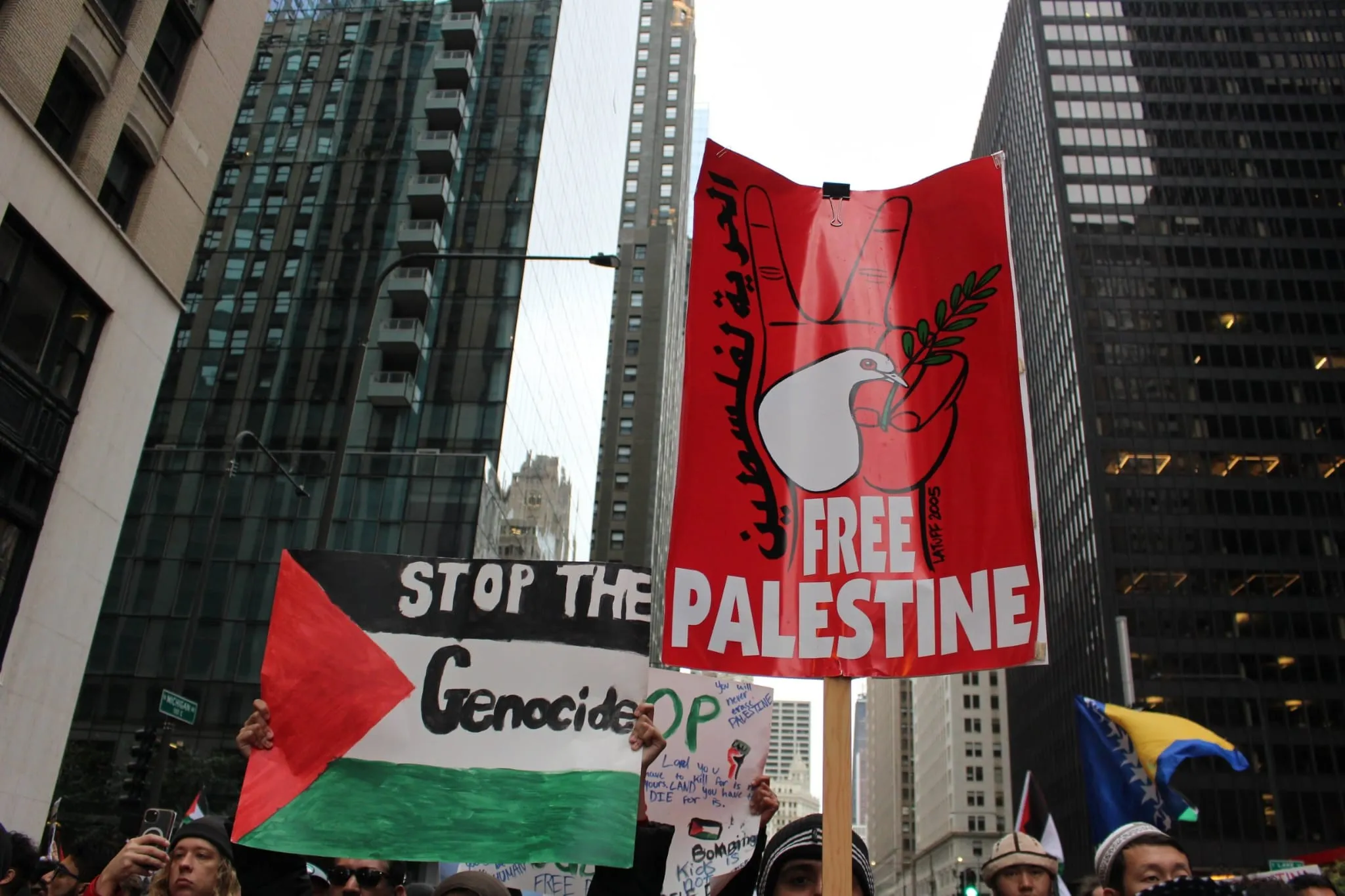
Source: WGN, Chicago

Moreover, the inability of Palestinian sympathizers to demonstrate even a shred of compassion for Israelis is simply stunning. The claims of some that they are rallying against “genocide” of the Palestinian people is obscene in light of a true genocide, the Holocaust.

It bears repeating that Hamas and Islamic Jihad have one purpose. That is to kill Jews (or at least drive them out of the land). And, staggeringly, they think nothing of sacrificing their own people as they pursue this. Thus, their efforts to discourage Gazans from evacuating areas Israel has said they should leave, reportedly even to the extent of blocking them. The heartlessness of the terrorists – much like that of ISIS – knows no bounds. Their misuse of Islam to justify their murderousness leaves one agog.

Tragically, many more people will die in this war on both sides. Israel seems determined to uproot Hamas and Islamic Jihad, perhaps through a ground invasion and, one hopes, a short-lived occupation. Even critics of the likely invasion, such as Thomas Friedman, implicitly acknowledge that replacing the terrorists with a legitimate government could be helpful (I would suggest essential).

Source: WFAA

Of course, the enormous question is, what comes after the terrorists are crushed or routed militarily? Who will run Gaza and care for its 2 million people, most of whom are innocents trapped in what critics understandably call an open-air prison? Certainly, Israel doesn’t want to be responsible for the place again. Indeed, if not for Hamas and Islamic Jihad, Gaza would likely be a more open and accessible place, with arrangements such as that of the West Bank, whose residents can work in Israel. Since Israel left Gaza in 2005, Hamas has squandered any opportunity to build its economy and move toward peaceful coexistence.

Some observers, such as Bret Stephens, argue that moderate Arab regimes could replace the terrorists in overseeing Gaza. Indeed, given the overtures Saudi Arabia had been making toward Israel, the kingdom could play a powerful role there, along with Jordan and, perhaps, Egypt. Wouldn’t it be wonderful if such nations rose to aid their fellow-Arabs? It appears that President Biden is thinking along those lines, at least in terms of the need to vanquish Hamas.

Even as Jewish-Arab strife enters its second century in and around Israel, it remains the case that wars do end in time – sometimes more quickly than one can imagine. Just look at Germany, Japan and the U.S. and the rest of Europe not so long ago. Is it Pollyannish to think that horrific ugliness Hamas has committed — and the response it is generating it — could ultimately lead to some sort of resolution? Might this battle over Gaza be a final one, or close to it? Might the innocents in Gaza get humane government?

First, though, a lot more ugliness is imminent. And it will be the media’s job to report on it – as fully, accurately and thoroughly as possible. That job involves sorting through inevitable misinformation and outlets such as the Associated PressReuters and The New York Times are doing their best to combat it. Fact-checking is necessary, but whether it makes a difference in hard-set public attitudes is arguable.
Where are the Palestinians Appalled by Hamas?

Some students on U.S. campuses appear extraordinarily callous

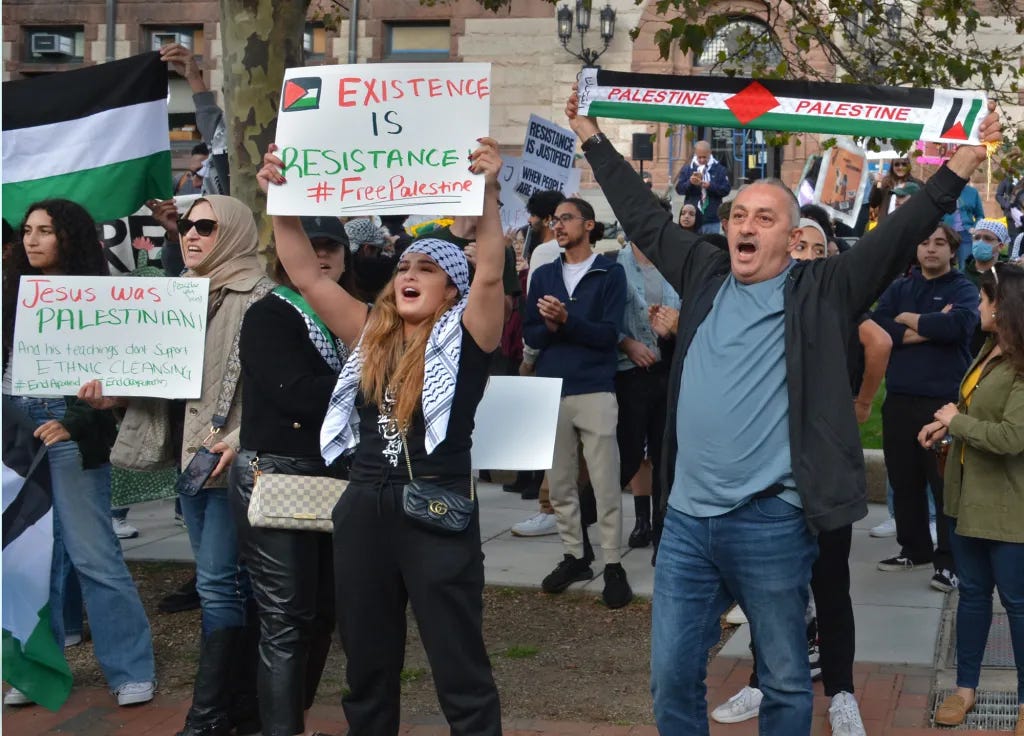
Demonstrators at Cambridge City Hall, Source: Boston Herald

As Palestinian voices have grown more strident at universities all across the country in recent years, misinformation has flourished. But the latest spate of statements from organizations on campuses ranging from Ohio State to Harvard reflects astonishing insensitivity to the brutality and immorality of Hamas.

At Ohio State, the campus affiliate of the Students for Justice for Palestine praised the “heroic resistance in Gaza.” At Harvard, over 30 student organizations signed a letter written by the Harvard Undergraduate Palestine Solidarity Committee and Harvard Graduate Students for Palestine saying they “hold the Israeli regime entirely responsible for all unfolding violence,” as reported by Inside Higher Ed.

At the University of Pennsylvania, a group has called for a protest against an alleged “pro-Israel narrative” at media outlets including the NPR affiliate WHYY. At the University of Virginia, Students for Justice in Palestine celebrated the Hamas attacks as “a step towards a free Palestine,” as reported by the Richmond Times-Dispatch.

At Tufts University, a Jewish student leader, Micah Gritz, told The Hill that the “campus environment” has been “horrifying.” He added: “On campus, we’re seeing students either turn a blind eye to the conflict, or we’re seeing those who are openly celebrating our pain, you know, glorifying it, justifying it … They’re casting the murder of Jews and Israelis as progressive, as liberation. It’s just honestly very, very scary as a Jewish student on campus who has friends and family in Israel.”

The moral blindness among some members of Palestinian student groups leaves one aghast. Have they not seen the horrors inflicted on innocents by Hamas? Surely, they cannot truly celebrate the ghastliness, as reported by The New York Times and media around the world.

Certainly, Palestinians have reason to protest conditions in the West Bank and in Gaza and to demand better. But for them to side with the wanton murderers of Hamas beggars belief – especially when the terrorists have done nothing to improve the lot of Gazans since Israel left the area in 2005. Instead, the group has focused on building rockets and arming their deluded followers. Siding with such vicious murderers boggles the mind.

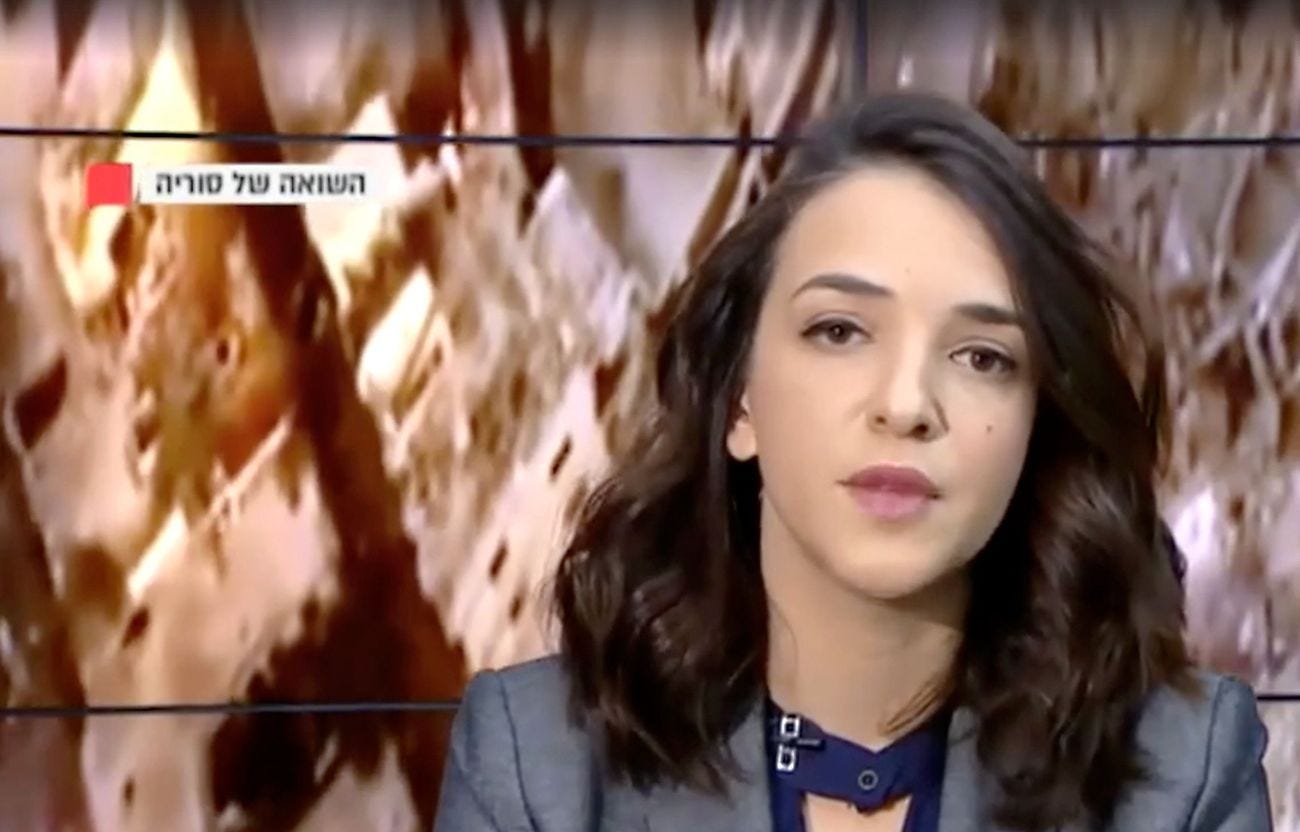
Where are the Palestinian voices on campus calling for an end to Hamas terrorism, demanding an end to its undemocratic tyranny in Gaza? Where are the Palestinians calling for peaceful coexistence with Israel (a prospect Hamas has all but destroyed for now)? Where are the Palestinians at U.S. universities decrying the savagery of recent days? Where are the Palestinians condemning Hamas for the awful retaliation to come, as Israel moves on Gaza to root out terrorists who surely knew they would bring such devastation on their own people?

Lucy Aharish, source: The Forward

Some Arabs have courageously spoken out against the actions of the terrorists. Perhaps the most eloquent is Lucy Aharish, an Arab-Israeli who spoke of “our beloved country” – Israel – and lambasted those who failed to condemn the Hamas attack. Hear her moving comments here.

Have similar sentiments been stifled, with Palestinians cowed into submission, as so many Gazans have been suppressed by Hamas? Public support for the terrorists has been common around the world, as The Times of Israel has reported: “From Ramallah to Beirut, Damascus, Baghdad and Cairo, people have distributed candies, danced and chanted prayers in support of the ‘resistance’ to Israel’s long-standing control of Palestinian land.”

And yet, backing for Hamas is hardly universal in Gaza. Half of Gazans agreed with the statement “Hamas should stop calling for Israel’s destruction, and instead accept a permanent two-state solution based on the 1967 borders” in a poll by The Washington Institute. As the FIKRA Forum reported: “In fact, Gazan frustration with Hamas governance is clear; most Gazans expressed a preference for PA administration and security officials over Hamas—the majority of Gazans (70%) supported a proposal of the PA sending ‘officials and security officers to Gaza to take over the administration there, with Hamas giving up separate armed units,’ including 47% who strongly agreed. Nor is this a new view—this proposal has had majority support in Gaza since first polled by The Washington Institute in 2014.”

Is anti-Hamas sentiment more common among Palestinians on campus than the latest headline-grabbing pronouncements by some groups suggest? Are they too fearful to speak out? A member of the Palestinian Solidarity Committee at Indiana University, asking for anonymity out of safety concerns, told the student newspaper: “We just stand for peace, it’s an emotional conflict … We don’t represent Hamas, and we don’t condone the actions of Hamas. But we also don’t condone the actions of the Israeli military. We do not want to see Palestinian children or Israeli children killed in this siege. It is a tragic event, and we hope things deescalate as soon as they can.”

One can only hope that there are other Palestinian students in the U.S. with more humanity than some of their local leaders and spokespeople appear to have. Surely, there are more Palestinians at such schools who share the revulsion of most in the civilized world. It would be heartening to hear more from them.

The Media and the Mideast

Journalists report on the horrors perpetrated by Hamas

Music festival attack aftermath, source: Wall Street Journal

It is so terribly difficult to write about the atrocities in Israel. For anyone who embraces idea of the Jewish homeland and her people, the horrors perpetrated by Hamas are beyond awful.

One hears echoes of the Gestapo in the maniacal, indiscriminate killings of hundreds at a music festival, in the raids on people’s houses all across the south, in the stealing of people from their children, in the stealing of children. In the rocket attacks, one hears the whistle of V-2s in London.

But even for non-Jews or those with no connection to Israel, the sheer monstrousness and inhumanity defies explanation. How could these terrorists be so heartless, so savage? Reared on hatred and propaganda, they acted like animals. And, as Israeli Defense Minister Yoav Gallant said of the severe and growing Israeli response, “We are fighting human animals and we are acting accordingly.” 

Hamas officials not only bear the stain of killing hundreds in Israel but will now have blood on their hands for the noncombatant Palestinians killed or to be killed in response. As the organization’s leaders cower in bunkers and safe hiding places, they are in effect victimizing their own people.

Journalistically, covering all this has been a huge challenge. The counts of dead and wounded climbed almost by the hour in the first few days and surely will never be precise. It seems inevitable that the figures will rise over coming days, perhaps weeks. And conveying the ugliness without tipping into gory displays – the violence porn that is Hamas’s wont – is a difficult task.

Hamas flooded social media with gruesome images of killings and kidnappings, of dragging bodies of Jewish noncombatants through their streets. No doubt, in coming days it will fill the media with videos of hostages as the terrorists use them as bargaining chips or tools to demoralize Israelis. Their sadism seems to know no bounds; their sense of morality is nonexistent.

Meanwhile, Israelis desperate to learn the fates of such hostages are posting images of them in pleas for their safety. How can one not feel for such innocents?

Israelis kidnapped by Hamas, source: Yuval Cohen, Facebook

While most accounts so far reflect the revulsion most journalists seem to feel about the actions of these terrorists, it is likely that in coming days we will see efforts to be “balanced,” to attempt to be evenhanded. Journalists are trained, of course, to see all sides and to reflect all sides in their coverage, and that’s usually a good thing.

But this “bothsidesism” can be blind to the causes of news events and thus be misleading.

For instance, an editor at The Colorado Sun in an email to subscribers wrote: “… it’s hard not to ache for those in Israel and Palestine as we see footage of the increasing violence in the region. In this somber time as we mourn those who were killed, let’s get caught up on the Colorado news and hope for a quick resolution to the tragedy and horror half a world away.”

Aside from the saccharine sentiments and naivete revealed in hoping for a “quick resolution” to a problem over a century in the making, the “ache” for those in Israel and Palestine neatly masks the truth about who the aggressor here has been. And the reference to “increasing violence in the region” is a feeble way of making note of a mass murder by terrorists. The news outlet needs to tell it like it is, perhaps by reporting well on the reactions of Coloradans whose loved ones were killed or kidnapped by Hamas.

Yes, media must report the reactions of Palestinians, even of terrorist supporters. Yes, sympathy is appropriate in such accounts for noncombatant Gazans, many of whom have been and will now be killed thanks to the acts of the terrorists. But the perpetrators of these awful acts must be identified as the aggressors and their cruelty must be noted at each turn, even if only in the questioning of their sympathizers.

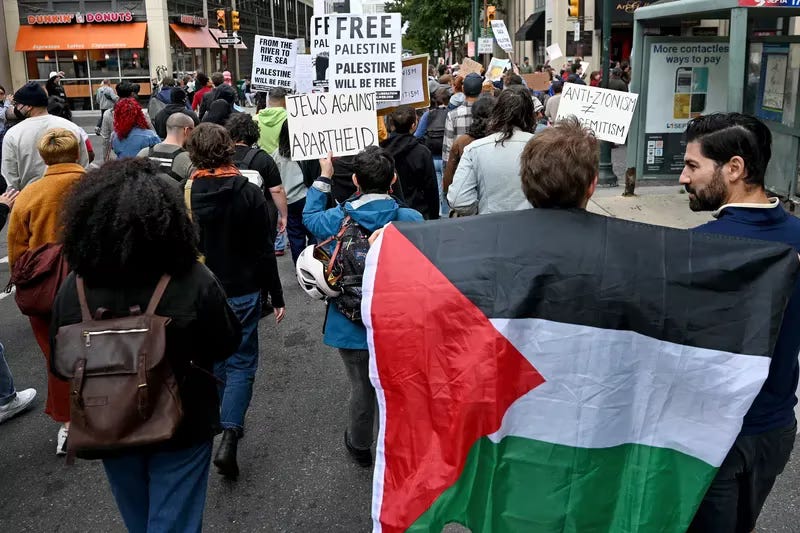
Philadelphia demonstration, source: The Philadelphia Inquirer

The Philadelphia Inquirer rightly gave prominence to the reactions of Jews to the monstrousness, even as it also covered Palestinian sympathizers. But it failed to probe and question the feelings of those sympathizers.

How could a couple hundred such sympathizers demonstrating for Palestine in Rittenhouse Square justify the murders of hundreds of innocents? Simply reporting their chants in favor of a Palestine “from the river to the sea” – a phrase used to deny Israel’s right to exist — and recording assertions by a spokesperson saying the demonstration “was about all oppressed people” was not enough. Why was she not pressed about the immorality of the attacks?

Straight and full reporting of the events will be criticized, although it’s essential. Heather Cox Richardson, a scholar and one of my favorite Substack commentators, did so in an Oct. 7 piece that simply recounted what had happened. She was criticized for that, writing in a more recent piece: “The volume of hate mail about last Saturday’s letter, pretty evenly divided between those accusing me of backing one side and those accusing me of backing the other, is about the highest I’ve ever received, but I was trying simply to present the verified events of Saturday alone, with a focus on how they affected the United States.”

As Israel moves against Gaza, the suffering of Gazans will be appropriately covered. And there will be analyses of the bloody history of both sides, including coverage of times when noncombatant Palestinians have been killed by Israeli soldiers as they sought to root out terrorists. That is reasonable, as one shows all sides.

However, a crucial distinction must be made. The killing of civilians is not Israeli policy. Tragically, they get in the way at times. Tragically, there are mistakes – usually owned up to by Israel.

The difference is that, for Hamas, murdering Israeli civilians is an end in itself. That is what the group is about, as it seeks to drive Jews from the land. There can be no more stark illustration of that than its actions at the music festival and in the terrorizing of people in their homes, something Jews, the media and the world should never forget as this sad story unfolds.

Higher Ed Under High Stress

Schools feel the pressures of politics, economics and demographics

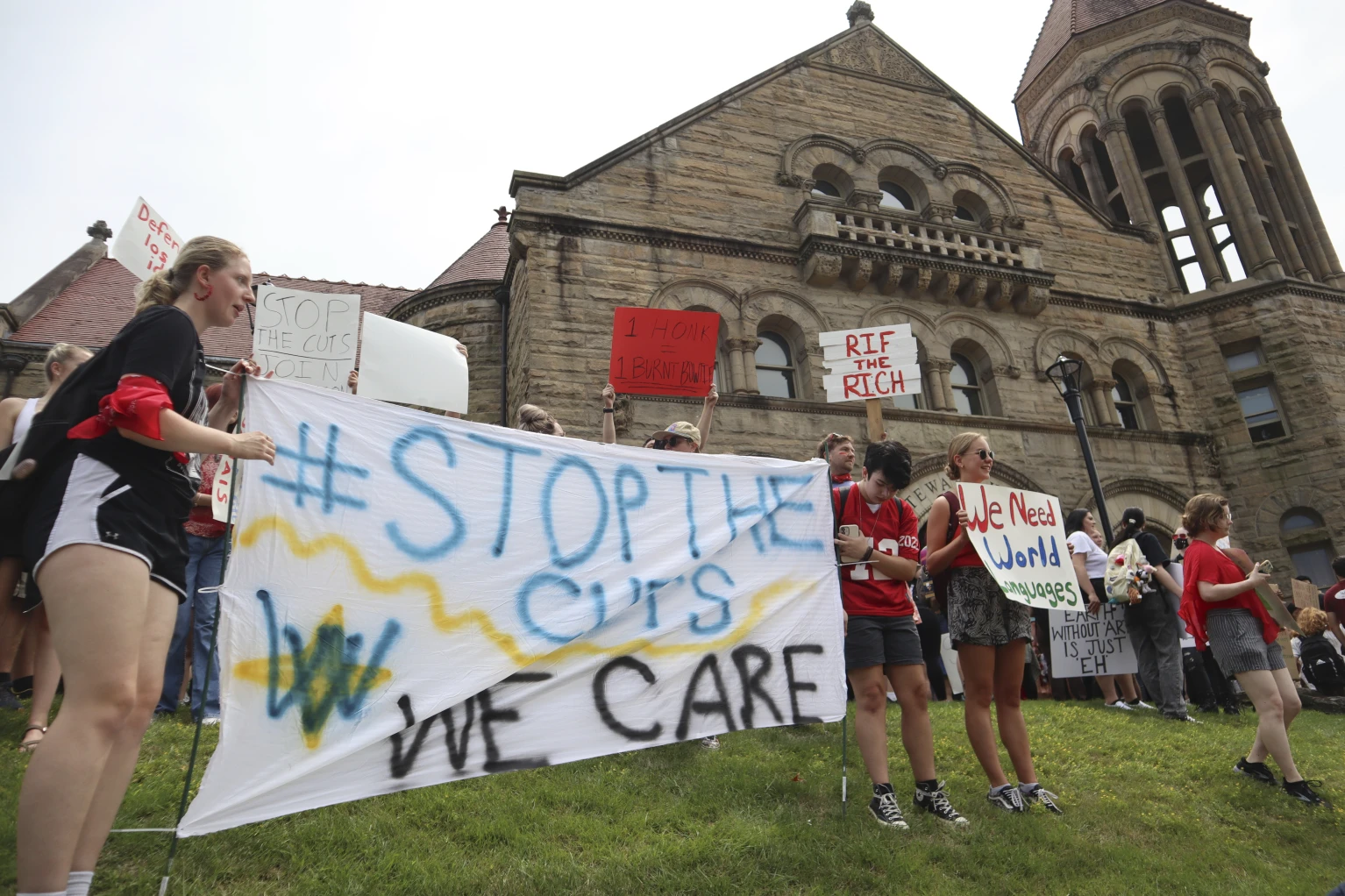
West Virginia University, source: AP

West Virginia University made national headlines in September when its board agreed to cut 28 academic majors (8%) and 143 faculty positions (5%). One-third of education department faculty and the entire world language department will be eliminated, according to the Associated Press.

And those trims come atop cuts made last June, when the board approved slashing 132 positions and cutting 12 graduate and doctorate programs, even while okaying a 3% tuition hike. Impassioned protests notwithstanding, the school will be a smaller place going forward and not only in terms of the 10% enrollment drop it has sustained since 2015.

Like so many other such institutions, WVU is caught in a vise that seems to make the move mandatory: declining enrollment on the demand side and deep trims in state funding on supply side. The cuts fell heavily in liberal arts, as university president E. Gordon Gee said the school needed to refocus to meet job requirements in the future. His argument: “aligning majors with future careers is a necessity in today’s world.”

This is a familiar tune that, sadly, is being replayed all over the country. Four-year state-funded schools are being squeezed on the one side by legislatures keen to cut taxes and on the other by enrollment declines driven by demographics and high tuitions and costs. Such high tabs for students often make two-year schools more attractive.

In Nebraska, for instance, the four-campus university system faces an estimated $58 million shortfall by the end of the 2024-25 fiscal year, “a gap brought on by inflation, muted revenue growth and enrollment declines,” as a report from the university’s Omaha campus explained. Times are tough for Huskers both on and off the football field.

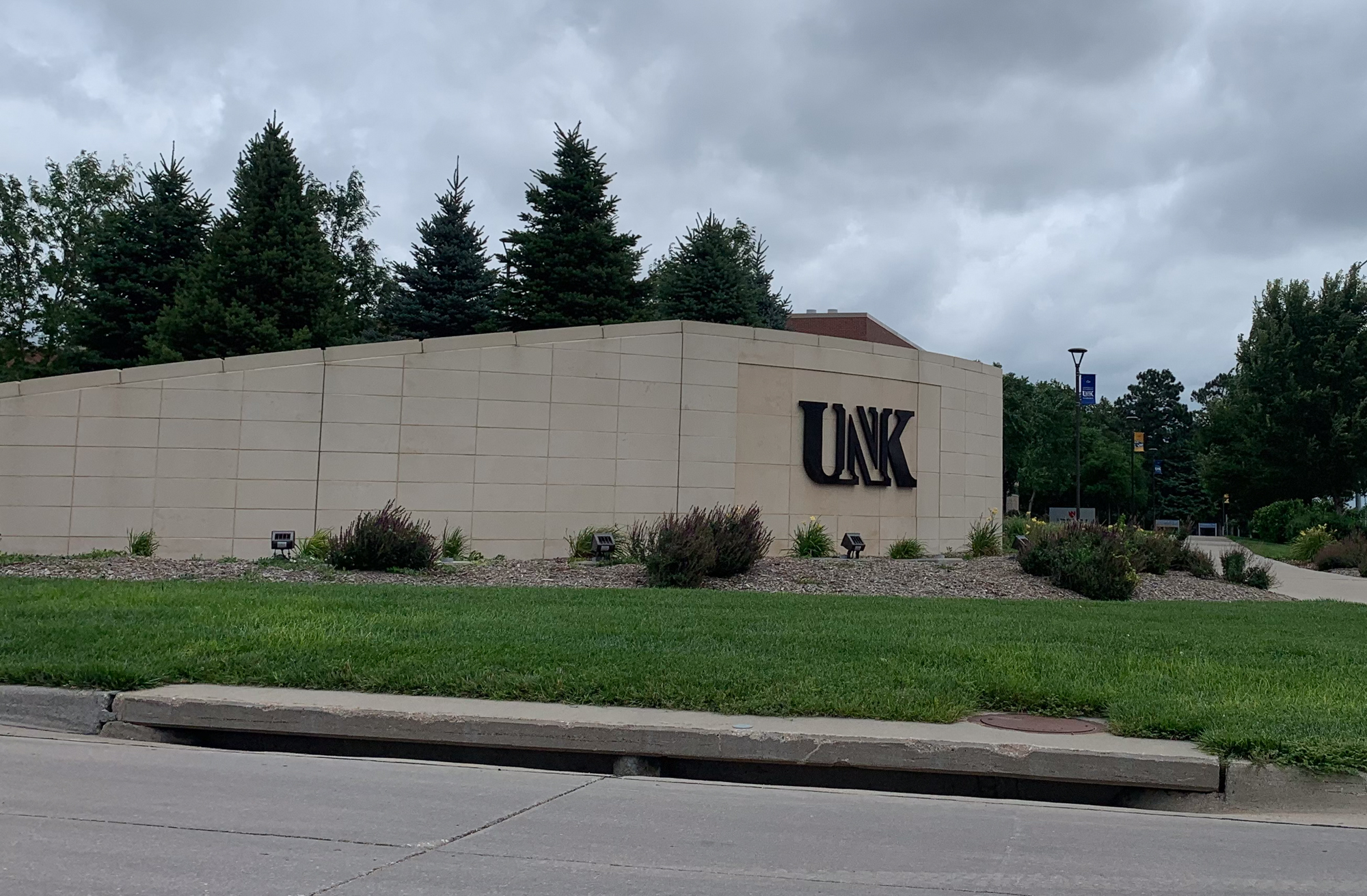
University of Nebraska at Kearney, source: Nebraska Examiner

While officials will step up recruitment to try to boost enrollments, program cuts seem inevitable. According to the Nebraska Examiner, administrators at the university’s Kearney campus have proposed to cut 30 faculty jobs in 14 departments, eliminating the departments of geography, philosophy and theater and killing degree programs in areas including journalism and some languages. So far, it’s not clear what cuts are planned for the flagship campus in Lincoln or in Omaha.

Private schools are feeling the pressure, too. Marymount University, a small Catholic school in northern Virginia, is phasing out majors in English, history and several other areas where student demand has lagged, for example. As The Washington Post reported, art, mathematics, philosophy, secondary education, sociology, and theology and religious studies all are being chopped, along with a master’s program in English and the humanities.

Indeed, some institutions have had to close altogether. The King’s College, a Christian liberal arts school located a block from the New York Stock Exchange, this year laid off its entire faculty and halted classes after a couple years of tumult, for instance. Even support from the DeVos family (famous for former Education Secretary Betsy DeVos) couldn’t spare it from what administrators hope will be a temporary closure. To read more about it, check out the richly detailed report by journalism students there, “Inside Story of The King’s College Death Spiral of 2023.”

Distressingly, permanent school shutdowns have become common. According to the National Center for Education Statistics, 296 four-year schools closed between the 2015-16 academic year and 2020-21, the most recent year with data available. That compares with just 32 in the prior five-year period. And in the latest half-decade stretch these closures included 71 nonprofit institutions, up from just 16 in the prior period, along with a bevy of for-profit schools. The situation has grown so worrisome nationally that U.S. News & World Report published a piece in 2021 counseling students on what to do if their schools shuttered.

Certainly, particular pressures on the for-profit schools account for most of the shutdowns, which included 224 such four-year schools in the latest five-year period. Headlines about so-called “predatory” institutions have hit them hard, and deservedly so. Indeed, only three four-year public universities or colleges have been forced to close since 2010-11.

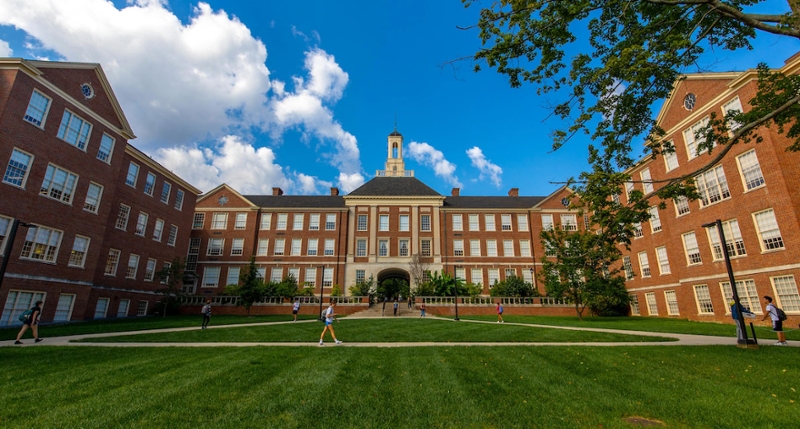
Miami University of Ohio, source: MU

Nonetheless, program trims seem all too common among both state and private schools, and they appear to be accelerating. Inside Higher Ed just reported on such cuts at the 150-year-old Christian Brothers University in Tennessee, which plans to “reallocate” its programs; at Delta State University in Mississippi, where a 48% decline in enrollment over the last 15 years is leading to plans to slash the annual $51 million budget to $40 million; and at Miami University of Ohio, which has told faculty members in 17 academic departments that they must merge, reorganize or close. The publication details still other schools in similar straits.

From a hard-headed economic viewpoint, many such retrenchments seem necessary. In the non-academic world, when demand for a product or service slows or disappears, companies drop the lines and often furlough people. Plant closings are not uncommon. So, why shouldn’t higher education behave in the same way? To keep their product lines – i.e., academic offerings – fresh, they should be able to shrink or eliminate some, and to grow others.

Indeed, one could argue that more such flexibility at universities would force them to innovate more to serve changing needs. On an individual level, professors would be required to update their curricula to keep up with the times (something we in journalism have had to do regularly as our industry changed). Even profs teaching, say, classics, history or literature would need to adapt to make their course offerings relevant to the lives of students as their lives, mores and challenges changed. Few if any teachers could simply recycle the lectures they’ve long used.

But in so many ways higher education doesn’t operate like the business world – and that’s mostly a good thing. Tenure, for instance, protects faculty members’ ability to speak and teach as they see fit (not as administrators or, worse, politicians, would dictate — Florida notwithstanding). On the flip side, state funding is notoriously subject to the whims of politicians, many of whom lately seem to be ratcheting up longstanding attacks on academia and who are all too glad to cut budgets.

Moreover, higher education in the United States long has been a magnet for foreign students. Schools in relatively few nations can match American university training, so much so that such education is one of the nation’s biggest service “exports.” That has been changing in recent years, due to Covid and the growth of solid programs in some other countries. Indeed, enrollment of foreign students peaked in the 2018-19 school year at 1.1 million, according to National Public Radio.

Happily, such enrollment seems to be clawing its way back, even as it remains prey to everything from geopolitics to fears of crime and concerns about immigration. China, for instance, has been the largest source of foreign-student enrollment and uncertainties abound about whether Chinese students will return in large numbers.

The bottom line, however, is that after decades of expansion it seems that higher education is hardly a growth industry overall anymore. Until and unless the numbers of high school students rebound and the political climates in varous states change, and until and unless universities can figure out how to deliver more for less money, dark clouds will hang over much of the sector. Painful as it is, the current shakeout seems like an unavoidable and in some ways necessary rebalancing.

Is Shouting ‘Em Down the Smartest Approach?

Should exponents of unpopular — but widely held — views get a forum on campus?

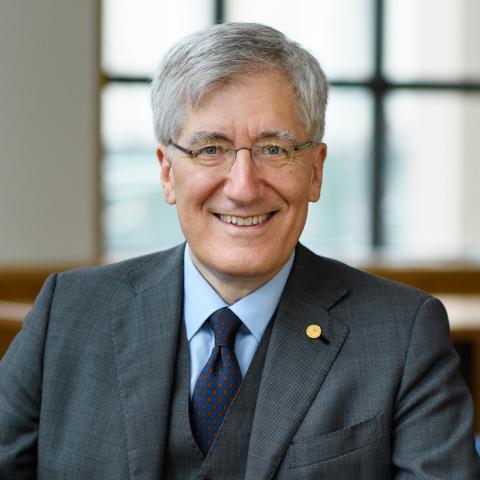
Prof. Robert P. George, source: Princeton University

Princeton University Professor Robert P. George, 68, boasts a resume few could equal.

After earning degrees from Swarthmore, Harvard and Oxford, this grandson of immigrant coal miners from Morgantown, West Virginia, went on to chair the U.S. Commission on International Freedom. Earlier, he served on President George Bush’s Council on Bioethics and was a President Bill Clinton appointee to the U.S. Commission on Civil Rights. He has also served as the U.S. member of UNESCO’s World Commission on the Ethics of Scientific Knowledge and Technology (COMEST) and as a former Judicial Fellow at the Supreme Court of the United States.

His honors include the U.S. Presidential Citizens Medal, the Honorific Medal for the Defense of Human Rights of the Republic of Poland, the Canterbury Medal of the Becket Fund for Religious Liberty, the Sidney Hook Memorial Award of the National Association of Scholars, the Philip Merrill Award of the American Council of Trustees and Alumni, the Bradley Prize for Intellectual and Civic Achievement, the Irving Kristol Award of the American Enterprise Institute, the James Q. Wilson Award of the Association for the Study of Free Institutions, Princeton University’s President’s Award for Distinguished Teaching, and the Stanley N. Kelley, Jr. Teaching Award of the Department of Politics at Princeton.

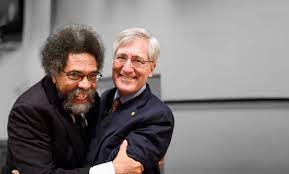
Despite the fact that he is an outspoken conservative, he counts among his friends Harvard Prof. and noted liberal philosopher Cornel West. The two have appeared in venues together.

Profs. Cornel West and Robert P. George, source: robertpgeorge.com

George seems like someone from whom students at Washington College might learn something.

But even when his subject was “Campus Illiberalism” – the trend of speakers being silenced because of views some find repugnant – he was shouted down at the small Maryland school on Sept. 7. As The Chronicle of Higher Education just reported, a small group of protesters entered the room, yelling and playing loud music. They ignored pleas for civility from the professor who invited George, Joseph Prud’homme, who heads the school’s Institute for Religion, Politics and Culture and who had earned his doctorate at Princeton.

Prud’homme led a silenced George out of the venue.

The Princeton prof’s cancellable offense: he has opposed same-sex marriage, abortion, and expansions of transgender rights. While he wasn’t slated to speak about those topics, per se, his very appearance was enough to merit him being shut down in the view of some students.

As The Chronicle reported, shortly before his talk, an associate professor of English at Washington emailed a student a link to George’s accountability profile from the Gay and Lesbian Alliance Against Defamation that carried several examples of George’s anti-LGBTQ remarks. The information spread on campus and the groundwork for the protest was set.

Certainly, many reasonable folks would be repulsed by comments attributed to him. Of transgenderism, he said in 2016, “There are few superstitious beliefs as absurd as the idea that a woman can be trapped in a man’s body and [vice versa].” When New Yorkers supported gay marriage in 2011, he hearkened back to a time when being gay was “beneath the dignity of human beings as free and rational creatures.” He had cofounded the National Organization for Marriage. And he argued that gay relationships have “no intelligible basis in them for the norms of monogamy, exclusivity, and the pledge of permanence.”

Moreover, it appears from a January 2023 piece in the Princeton Alumni Weekly that George hasn’t updated his views any. In that piece, titled “Crashing the Conservative Party,” he bemoaned the arrival at the university in recent years of students who “are just, you know, fully in line with — totally on board with — can give you chapter and verse as if it’s the catechism of — the whole ‘woke’ program: environmentalism, racial issues, sexual issues, and so forth.”

Of course, the students at Washington didn’t give him the chance to make his case against “illiberalism.” Nor did they challenge him to defend his views on sexual identity or abortion. They just made enough noise to drive him out.

FIRE, the Foundation for Individual Rights and Expression, complained about the “heckler’s veto” imposed on George, suggesting that college security officials should have escorted the protesters out of the room. The outfit said they were entitled to hold signs in the back the room or make “fleeting commentary,” so long as they weren’t disruptive.

Graham Piro, source: FIRE

“But when the event cannot proceed as planned because protesters talk over speakers, drown them out with other sounds, or cause other disruptions that substantially impede the ability to deliver remarks, Washington College must use the resources at its disposal to prevent this pernicious form of mob censorship, and to ensure audiences can, at the very least, hear the speakers talk,” FIRE Program Officer Graham Piro wrote. “When Washington College allows silencing of speakers like George, its message to all in the campus community is that those who engage in disruptive conduct have the power to dictate which voices and views may be heard on campus.”

One could argue that, despite his achievements and honors, George is simply an intellectual dinosaur whose views on sexual matters don’t even warrant conversation. Notwithstanding their roots in his apparently deep religious faith, those attitudes are simply well past their expiration dates. After all, same-sex marriage was legalized nationwide in 2015 and long before that was declared legal in many states.

But we would then face a conundrum. In fact, those views – however benighted they seem to many – are still shared by a fair number of Americans. A year ago, the Pew Research Center reported that 37% of those surveyed thought same-sex marriage to be bad for society, for instance. And abortion continues to polarize the public.

So, does shutting down a talk by someone who espouses such attitudes make the views disappear? Would it not be more sensible, instead, to hold those stances up to scrutiny? Would it not be better for protesters even to shun his appearance and, perhaps, set up a presentation by someone who could refute the ideas? Or, even better, to put someone such as George on a stage with an intellectual opponent to argue their different cases?

After all, isn’t one of the purposes of higher education to hash out difficult matters and to teach students to think about them critically? Wouldn’t such a session serve everyone better than just making noise?

Testing the Boundaries

When is free speech hate speech?

Source: Palestine Writes

When Woody Allen’s character in 1979’s “Manhattan” heard that a mocking piece in the New York Times devastated participants in a Nazi march, he answered that a better response would be to pick up bricks and baseball bats. That would “really explain things to them,” the character suggested.

Audiences – especially Jewish audiences – offered up sad, knowing laughter.

As one thinks about antisemites who are slated to appear at a Palestinian cultural event at the University of Pennsylvania this weekend – on the eve of the major Jewish holiday of Yom Kippur — it’s tempting to encourage Jewish students to stock up on the wood, as that character suggested. Tempting but, of course, no one should do that.

Still, something more than sad, knowing laughter is called for in response to appearances at the Palestine Writes Literature Festival by the likes of geriatric rocker Roger Waters, scheduled to appear by Zoom. He’s famous for leading Pink Floyd and infamous for floating a pig-shaped balloon with Jewish symbols, including a Star of David, at his concerts and for strutting on stage in Berlin in a Nazi-style uniform last spring.

But how does one counter that sort of viciousness and nonsense?

Certainly, one response is to raise the obvious point that the conference’s organizers appear to have had no reason to invite Waters other than that he flagrantly attacks and belittles Jews and their history. His bona fides as an expert on Palestinian culture are nonexistent, even skimpier than the recent musical creativity of this irrelevant pop music has-been. Indeed, Waters is so repulsive that after his Nazi-like uniform gambit the State Department released a statement condemning his performance because it had “minimized the Holocaust,” and noting his “long track record of using antisemitic tropes.”

Roger Waters, Source: SkyNews

 As the National Review reported, the festival’s website describes itself as being “dedicated to celebrating and promoting cultural productions of Palestinian writers and artists,” certainly a salutary aim. Who could argue with such a sentiment? Indeed, Jews and Palestinians of goodwill who would press for peaceful coexistence between peoples in Israel would endorse such events.

But, as the NR and several other outlets have noted, a close look at the festival’s roster of guests betray the true aims of its organizers – i.e., to denigrate and attack Israel and Jews. Along with Waters, marquee speakers include Australian writer Randa Abdel-Fattah, Rutgers University professor Noura Erakat, and Temple University professor Marc Lamont Hill.

Again to borrow from the piece by NR’s Zach Kessel, Abdel-Fattah has called Israel a “demonic, sick project” and said she “can’t wait for the day we commemorate its end,” as JewishInsider’s Matthew Kassel reported. Erakat has a history of comparing Zionism to Nazism and falsely accusing Israel of targeting Palestinian civilians in military operations. Hill — who was a CNN contributor until a 2018 speech he made at the United Nations calling for a “free Palestine from the river to the sea” led to his firing — has a history of palling around with noted antisemite Louis Farrakhan

Are these people celebrating and showcasing Palestinian culture? Surely that culture has more substance than just antisemitic vitriol. Surely, Palestinians have more to say than to slam Israel and Jews.

Perhaps needless to say, the event has drawn condemnation from many Jewish organizations. The Jewish Federation of Philadelphia castigated the “multiple presenters with a history of spreading inflammatory rhetoric and antisemitism that go against the fundamental principles of academic integrity and respectful discourse.” In fact, the federation sadly noted that “the festival has already emboldened antisemitism on Penn’s campus.” On the morning of Sept. 19, it said, “a perpetrator ran into the Penn’s Hillel building, spewing antisemitic tropes and vandalizing the Hillel lobby.” The vandal was arrested. 

“Freedom of speech and critical thinking are important and should be uplifted,” the federation statement said. “However, freedom to espouse antisemitism and teach hate cannot be tolerated. We are appalled by the global rise of antisemitism and anti-Israel sentiment and refuse to accept it in our community.”

The American Jewish Committee went a bit further. It called for “mandatory antisemitism awareness training across the University, including in new student orientation programming and DEI (diversity, equity and inclusion) programming – for students, faculty, and staff” at the university. 

The latter seems like one of the more useful suggestions to come from the arguments over the event – certainly better than calling for cancellation of the session or disinviting certain speakers.

Josh Gottheimer, a Jewish New Jersey Democratic congressman and Penn graduate, said in a letter to the university leadership that the university should disinvite Waters as well as Marc Lamont Hill, according to The Philadelphia Inquirer . That sort of cancellation is a step short of baseball bats, of course, but not so far.

Troublingly, stifling such speakers doesn’t make their ideas go away. Indeed, several Jewish organizations have echoed the attitude of the Penn administration about the importance of free speech — even repugnant speech. Officials have condemned the antisemitism that some of the speakers represent, but they’ve defended the rights to full discourse on campus – while pointedly noting that the event is not a university-sponsored affair.

University of Pennsylvania President Liz Magill, source: University of Pennsylvania

“While the Festival will feature more than 100 speakers, many have raised deep concerns about several speakers who have a documented and troubling history of engaging in antisemitism by speaking and acting in ways that denigrate Jewish people. We unequivocally — and emphatically — condemn antisemitism as antithetical to our institutional values,” wrote Penn president Liz Magill, Provost John L. Jackson, Jr., and Steven J. Fluharty, dean of the School of Arts & Sciences, as The Philadelphia Inquirer reported.

But they added an important caveat.

“As a university, we also fiercely support the free exchange of ideas as central to our educational mission,” they wrote. “This includes the expression of views that are controversial and even those that are incompatible with our institutional values.”

Indeed, the most useful response to the conference is not bricks and baseball bats, but smart counterprogramming.

According to the Inquirer, Penn’s Hillel is planning “a massive Shabbat Together” event Friday night when the conference officially begins to celebrate “Jewish pride, unity, and togetherness” with prominent politicians and alumni expected to attend.

Bigotry is difficult to resist. But it’s essential that it be condemned and routed at every turn. Unlike Allen’s clever movie, it is no laughing matter.

Keeping ’em in the dark

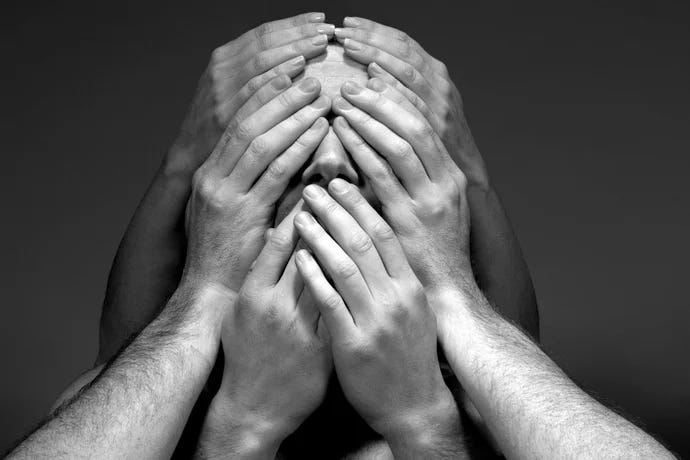
Image source: Getty Images via Scientific American

From elementary school up through college, schools have become hotbeds of political ferment. Right-wingers condemn, cancel or fire teachers who discuss such things as LGBTQ rights and race relations. The former seems to be anathema to evangelicals apparently unaware it’s 2023, while the latter falls into a weird area where whites seem oblivious to the way Black people have been treated and would rather ignore history.

An exceptional illustration of this trend appears in The Washington Post in “Her students reported her for a lesson on race. Can she trust them again?” The piece tells of a white teacher in South Carolina, Mary Wood, whose reading assignments included Ta-Nehisi Coates’s “Between the World and Me,” prompting two students in her all-white Advanced Placement English Language and Composition class to report her to the school board for teaching about race.

As the Post recounted: “The students wrote in emails that the book — and accompanying videos that Wood, 47, played about systemic racism — made them ashamed to be white, violating a South Carolina proviso that forbids teachers from making students ‘feel discomfort, guilt, anguish, or any other form of psychological distress’ on account of their race.”

Teacher Mary Wood, source: The Washington Post

So, in other words, if studying history and literature makes one feel uncomfortable, it’s better simply to not study such subjects. Better to remain ignorant and cozy, according to state legislators. One can only assume they are happily both.

Of course, versions of this tale are playing out all across the country. Teachers are being muzzled or censoring themselves in fear. Libraries are unshelving books that might make some readers squirm. Bans on books in schools are proliferating.

On the university level, right-wingers are finding new tools to prevent discomfiting history or viewpoints to be shared with students. Legislation all across the country would restrict academic freedom, with more than 50 bills popping up in 23 states, as of a midyear count. “The bills are being drafted in right-wing think tanks funded by dark money,” Irene Mulvey, president of the American Association of University Professors (AAUP) told Vox. “It’s a well-funded, well-orchestrated, decades-long campaign. It’s not just springing up out of nowhere since the language in the bills is very similar.”

It’s an extraordinary attempt whose end can only be to keep the next generation in the dark about their history, blocking them from hearing opinions and points of view that the rightists find unsettling. One wonders if whole sections of the country will be populated by ignoramuses while people in other areas manage to learn things the others simply won’t know.

During one of my last semesters teaching at the University of Nebraska-Lincoln, I was privileged to co-teach a class in which students investigated the racial and ethnic coverage of the Omaha World-Herald over the decades, going back to the late 1800s. The students looked into lynchings, a bus boycott, the treatment of native Americans and such immigrant groups as Greeks, among other things. As they talked with knowledgeable folks who assessed the paper’s work, the students produced exceptional material, which you can find here.

If rightists and white supremacists had their way, I’m sure, such a class would never have taken place. Indeed, students told me they were stunned that almost none of their coursework in college or in high school dealt with the topics they probed. Students of various backgrounds who had grown up in Nebraska were ignorant of their own state’s history and felt cheated for this lack of education. The course was, to them, eye-opening, as it was to me.

In a sense, today’s attempts to stifle teachers and suppress knowledge are repetitions of history. Book-banning, of course, has a long history in the United States, as does placing restrictions on teachers. Indeed, at my private high school in New Jersey there was considerable tension in the late 1960s and early 1970s between old-guard teachers (some of whom were active in the John Birch Society) and young folks formed by opposition to the Vietnam War and the cultural explosions and political unrest of that era. The oldsters loathed the newcomers with their new-fangled notions and rebellious spirits.

Richard Hofstadter, source: The New York Times

We as students were better off for the variety of viewpoints we heard. In fact, I am thankful — oddly perhaps — to have had an American History teacher who led a John Birch Society chapter in New Jersey because his conspiratorial and paranoid views of the world gave me great insights into the mental processes of Donald Trump and his ilk today. I’m just glad I was able to understand even then, thanks to some helpful academics outside of my school, about how bizarre but commonplace such attitudes were. Those academics turned me on to the works of the brilliant Richard Hofstadter.

I fear, however that in public schools across the country knowledgeable and rebellious teachers will be driven out. As a result, legions of ill-served students will remain as ignorant as their parents and their legislators probably are. Will democracy and society be well-served by such willful blindness? How could they be?

The dominance of dumbness

Anti-intellectualism has a long history in American culture

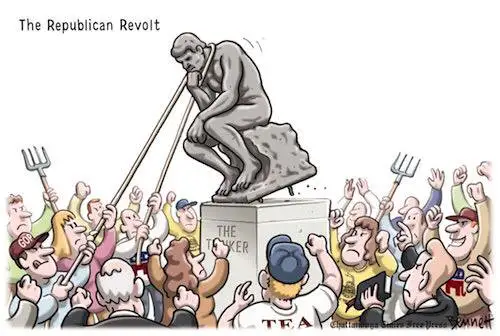
Source: HubPages

A friend set me to thinking about the long and unsavory history of anti-intellectualism in American life. This strand of our culture didn’t begin with Trumpism, of course, though the anti-science and anti-elites chords the former president strikes so powerfully are exceptional examples of it. Indeed, it’s not by accident that Donald Trump in 2016 singled out the group he had most affection for, saying: “We won with young. We won with old. We won with highly educated. We won with the poorly educated. I love the poorly educated.”

Nor has this phenomenon been exclusively a province of the right, which boasts of many ignorant folks but also the likes of the brilliant (if often distasteful) William F. Buckley. In fact, a most intriguing commentary on the phenomenon came in 2001 from conservative economist Thomas Sowell in “The Quest for Cosmic Justice,” where he wrote:

“From its colonial beginnings, American society was a ‘decapitated’ society—largely lacking the top-most social layers of European society. The highest elites and the titled aristocracies had little reason to risk their lives crossing the Atlantic, and then face the perils of pioneering. Most of the white population of colonial America arrived as indentured servants and the black population as slaves. Later waves of immigrants were disproportionately peasants and proletarians, even when they came from Western Europe … The rise of American society to pre-eminence, as an economic, political, and military power, was thus the triumph of the common man, and a slap across the face to the presumptions of the arrogant, whether an elite of blood or books.”

As a trip through Wikipedia reveals, there is much support for Sowell’s view. A minister in 1843 wrote about frontier Indiana (one of our most undereducated states): “We always preferred an ignorant, bad man to a talented one, and, hence, attempts were usually made to ruin the moral character of a smart candidate; since, unhappily, smartness and wickedness were supposed to be generally coupled, and [like-wise] incompetence and goodness.”

Such views have long infused our politics, sometimes with well-schooled leaders who either demagogued on this stream of thought or just warmed to it. Consider the 1912 thoughts of Woodrow Wilson, who, despite his doctorate from Johns Hopkins, said: “What I fear is a government of experts. God forbid that, in a democratic country, we should resign the task and give the government over to experts. What are we for if we are to be scientifically taken care of by a small number of gentlemen who are the only men who understand the job?”

American historian, author, and Columbia University professor Richard Hofstadter (1916 – 1970) poses for a portrait, New York, 1970. Two of his most important works are ‘Anti-Intellectualism in American Life’ (1963) and ‘The Paranoid Style in American Politics’ (1964). (Photo by Bernard Gotfryd/Getty Images)

A thorough discussion of this trend came in 1963 from Columbia historian Richard Hofstadter. In “Anti-intellectualism in American Life” he argued that anti-intellectualism was how the middle-class showed its feelings for political elites. As that group developed political power, he contended, it held up the ideal candidate for office as the self-made man, not a well-educated man born to wealth.

More recently, in 1980, author Isaac Asimov observed: “There is a cult of ignorance in the United States, and there has always been. The strain of anti-intellectualism has been a constant thread winding its way through our political and cultural life, nurtured by the false notion that democracy means that ‘my ignorance is just as good as your knowledge’.”

Susan Jacoby, Source: WBEZ

Since then, many folks have dusted off this theme. Journalist and author Susan Jacoby in her 2008 book, “The Age of American Unreason,” bemoaned what she called the resurgence of anti-intellectualism in the modern era. According to The New York Times, she blamed it on television, video games and the Internet, saying they created a “culture of distraction” that has shortened attention spans and left people with “less time and desire” for “two human activities critical to a fruitful and demanding intellectual life: reading and conversation.”

Certainly, the forces Jacoby pointed to exacerbate the cult of ignorance we are awash in. Still, history shows that it’s nothing new. The new media that preoccupy us now may just be building on that well-rooted base. One has only to look at the success of Fox News to see how deep that base is.

We might take heart, however, that there’s an ebb and flow at work. At various times in our history, we have swung from respecting (and electing) smart people to choosing ignoramuses. How else to explain descents such as that from Thomas Jefferson to Andrew Jackson (in just 20 years) and from Barack Obama to Donald Trump (in no time at all)?

It’s troubling, nonetheless, that politicians such as Ron DeSantis feel a need to play down or deride their elite-education credentials to try to harness votes from the masses that are less-schooled than they. After using Yale as a steppingstone to Harvard Law School and then entering politics, he soon realized that such credentials were “a political scarlet letter as far as a G.O.P. primary went,” as The New York Times reported. As he has sought to remake higher education in Florida, DeSantis has also said he would eliminate the federal Department of Education, among other agencies.

For his part, Trump has bragged — when it suited his purposes — about attending an Ivy League school, the University of Pennsylvania, even as he failed to mention that he had transferred there after two years at the less tony Fordham University, as The Daily Pennsylvanian reported. In fact, he claimed to have graduated first in his class in 1968 at the university’s Wharton School, though the school newspaper’s investigation of this did not bear that claim out. Indeed, he did not even make dean’s list that year.

He also has often derided intellectuals and pursuits such as reading. He told a reporter for The Washington Post in 2016 that he has never had to read very much because he can reach right decisions “with very little knowledge other than the knowledge I [already] had, plus the words ‘common sense.’ ” Moreover, Trump told the Post that he is skeptical of experts because “they can’t see the forest for the trees.”

Despite the choice of Joseph Biden in 2020, we seem now still to be perilously in a period when the pendulum remains far from valuing education in our leaders or elsewhere. Indeed, it’s troubling how few Americans today put a premium on schooling, a trend concomitant with the rise of book-banning nationwide. Our next election will be revealing about many things (not least of which are understandable concerns about the current president’s age), but it may also mark either a departure from the pendulum’s swing or its confirmation.

The marketplace of ideas: who gets in?

Interesting developments on the free-speech front in Arizona and Massachusetts

The battle royal over free speech on campuses is climbing a few decibels on both sides of the country, it seems. The fracas at Arizona State University is likely to grow louder in coming weeks with a reprise visit by a couple controversial conservatives. As for the East Coast, Harvard has distinguished itself by placing last in a ranking by a prominent free-speech organization.

Let’s turn to ASU. It has become a showcase of sorts for conservatives who feel aggrieved and abused, as well as for academics who find themselves uncomfortably in the crosshairs of today’s cultural warfare.

Source: Charlie Kirk X post

Conservative radio host Dennis Prager and Turning Point USA founder Charlie Kirk, who stirred up a hornet’s nest in February when they visited ASU, plan to speak there again on Sept. 27. Their “Health, Wealth & Happiness 2.0” session will be sponsored by a student organization, Turning Point USA at Arizona State University, rather than by an individual college such as Barrett, the honors college that controversially hosted them last time through a now-defunct center.

Conveniently setting the stage for their visit, a university report about the brouhaha over their last visit is expected to be released shortly. That report was demanded by Arizona State Sen. Anthony Kern, who led a hearing into the matter in July. Kern said the legislature’s judiciary committee will take so-far-unspecified action dealing with ASU, depending on the thoroughness of the report.

Kern, who co-chaired the Joint Legislative Ad Hoc Committee on Freedom of Expression at Arizona’s Public Universities, has already telegraphed his feelings that he expects little from ASU that would placate him. “I do not trust the Board of Regents,” Kern said at the July hearing. “I do not trust ASU. I do not trust our universities to teach our kids what needs to be taught.”

For their part, it’s not clear what Prager and Kirk plan to talk about in the coming confab, although the session will also feature at least one state legislator who served on Kern’s ad hoc committee, Austin Smith, who also is a former director of Turning Point USA. That suggests that free speech on campus could take center stage at the session, as well as hoary claims of a leftward tilt among faculty.

Source: Twitter

Smith had asked the regents to investigate the termination of the director of the T.W. Lewis Center for Personal Development at Barrett. That ex-official, Ann Atkinson, had complained about her firing in an op-ed in The Wall Street Journal, suggesting that it was in reprisal for her organizing the first Prager-Kirk session. In fact, the funding for her position fell away when donor Thomas W. Lewis pulled his backing, citing what he called “the radical ideology that now apparently dominates the college.” 

Shortly before the wintertime Prager-Kirk session, 39 faculty members at the college had written a letter to their dean complaining about the men’s visit, lambasting them as “purveyors of hate who have publicly attacked women, people of color, the LGBTQ community, as well as the institutions of our democracy, including our public institutions of higher education.”

Notably from a free-speech point of view, however, the Barrett faculty members didn’t call for the session to be cancelled. Instead, as some of them wrote in an op-ed in the Arizona Republic, some had slated a teach-in prior to the session called “Defending the Public University.” They maintained that they encouraged students to attend both events and claimed that many students did so. Nor were they party to the Lewis center’s shutdown, the authors said.

While that suggests an openness to free speech, Atkinson has argued that the faculty bullied students into staying away from both the Prager-Kirk talk and the ad hoc committee hearing in July. So far, though, no evidence proving such bullying has emerged (perhaps the university report will illuminate the matter). It may be that students just found the initial talk uninteresting and that, in July, few were on hand for the legislative hearing.

There are some crucial differences between the upcoming Prager-Kirk session and the February one. For one, a student organization is sponsoring the gathering, rather than a college. Thus, while it bears the imprimatur of that student group, it doesn’t need the blessings of a college where most of the faculty find the speakers reprehensible.

Certainly, the men have distinguished themselves as advocates of notions many find toxic. Prager has criticized homosexuality, for instance, writing “I, for one, do not believe that a man’s inability to make love to a woman can be labeled normal. While such a man may be a healthy and fine human being in every other area of life, and quite possibly more kind, industrious, and ethical than many heterosexuals, in this one area he cannot be called normal.” For his part, Kirk has praised Jan. 6, 2021, rioters at the U.S. Capitol as “patriots” whose travel to Washington, D.C., was funded by Turning Point USA, as the Daily Beast reported.

So far, it doesn’t appear as if ASU faculty members plan counterprogramming to rebut likely comments by the pair, which is an interesting approach. Would such programming elevate Prager and Kirk’s status and serve only to legitimize their ideas? One faculty member suggested to me that engaging them in debate would be akin to dignifying a member of the Flat Earth Society by sharing a stage with him or her, even if only to refute the person’s arguments.

Still, the views of Prager and Kirk raise a compelling question for advocates of free speech and those who see universities as places where conflicting ideas ought to be hashed out. When is someone’s speech so far beyond the pale that it doesn’t deserve an airing? And when a school, as opposed to a student group, brings such a person in front of students does that suggest an endorsement (indeed, might it be considered educational malpractice, if there were such a thing)? The challenge in this MAGA era is amplified because a substantial minority of the public share the ideas of such men.

A daughter-in-law of mine who teaches at Princeton frames this as a matter of progress over time. She contends that the line between acceptable ideas and those rightly consigned to history’s dustbin has consistently shifted. There was a time, for instance, when advocates of slavery (indeed slaveholders) could find a forum at universities. Similarly, pro-Nazi speakers and racists were tolerated on campuses. Has the line moved such that it’s left the likes of Prager and Kirk on the wrong side, irrespective of any followings they have in the general public?

Strolling at Harvard, source: the Boston Herald

Now, as to Harvard, the school has been named the worst for free speech among universities reviewed by the Foundation for Individual Rights and Expression. As the New York Post reported, Harvard scored poorly in large part because nine professors and researchers there faced calls to be punished or fired based on what they had said or written. Indeed, seven of them were disciplined.

Moreover, much of the trouble at Harvard has to do with self-censorship — not the type imposed by authority figures. The FIRE rankings rely in large part on surveys of students. And at the Boston school, the Boston Herald reported: “Self-censorship is pervasive across the board, according to the survey. More than a quarter of students (26%) said they censor themselves at least a few times a week in conversations with friends, and 25% said they’re more likely to self-censor now than they were when starting college.”

The atmosphere at the university has grown so troublesome to free-speech advocates there that more than 100 faculty members have joined a new Council on Academic Freedom on campus. Indeed, the debate about whether free discussion is stifled at Harvard has been joined – ironically but appropriately at Harvard.

Harvard Magazine sketched out the arguments last June. In part, it cited an op-ed that founders of the new council wrote in The Boston Globe: “The reason that a truth-seeking institution must sanctify free expression is straightforward,” they wrote.  “…The only way that our species has managed to learn and progress is by a process of conjecture and refutation: some people venture ideas, others probe whether they are sound, and in the long run the better ideas prevail.”

This notion, implying that the marketplace of ideas will weed out the intellectual dinosaurs, is a longstanding one, of course. For campuses nationwide, the question today is about who should be permitted into the marketplace and whose ideas deserve only to be shunned.

“Barbie” on the barbie

The movie strikes a nerve, but perhaps more for men than women

Source: Warner Bros. via British Vogue

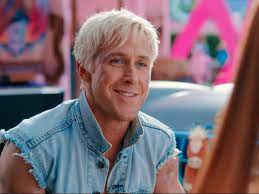
So, Donna and I got round to seeing “Barbie” last night. After reading much in newspapers and magazines about it over the last month, I was primed for a few things: a) the film is a feminist statement that both admires and criticizes the doll, b) Ryan Gosling’s performance as Ken is remarkable, and c) some evangelicals warn their flocks to stay away because in their eyes it trashes traditional female roles.

Now that I’ve seen it, I can add that cinematically the film is extraordinary. The sets and visual tricks knock your socks off. And the dance numbers are exceptional, reminiscent of Broadway and the heyday of the movies.

But the feminist message also seems too familiar: certainly, it is not new to anyone who has followed debates over how or whether women can have both families and careers, about how they should treat men, and how men treat them. So, some of that is a cliche, if perhaps a necessary reminder. As a father of two women juggling all that — one as a rabbi and the other as a federal prosecutor — I have seen first-hand how tough things are today for career-and-family women (and I’ve heard of some of the buffoonish men they have to deal with).

Indeed, until the sexes are treated equally, the message needs periodic refreshes and updates. To that point, the monologue by America Ferrara’s character about the many tightropes women have to walk was superb (if delivered a bit too fast). Moreover, it’s shameful that there are still so few women in the top ranks of companies, decades after we at BusinessWeek (and others) wrote about such things as The Mommy Track. And the ridiculous legion of black-suited male execs at the Mattel of the movie underscores that, if in exaggerated form.

Ryan Gosling as Ken, Source: The Guardian

Still, because of that message, it is Ken’s emotional and behavioral challenges that strike me as the most interesting (and Gosling’s performance is, indeed, superb). Take pity, please, on young men these days, as they try to figure out how to behave with other guys (the movie exaggerates bro culture, but not by much) and with women. The old trope of “what do women want?” seems sexist, but nowadays women want many different things, and, for some of them, guys are reduced to adjuncts (much as Ken was in the eyes of Barbie buyers).

Throughout the movie, Ken wants Barbie’s love and yet he remains just a bit player in her life. How sad for today’s young guys who might find themselves in a similar spot.

In fact, as we have seen at the University of Nebraska-Lincoln, things are not all that great for a lot of young guys. Yes, the patriarchy remains, and that is more than troublesome. But, more troubling, lots of young men (like Ken) seem confused about who they are and where to take their lives. This was less the case with many women I had the privilege of teaching.

Male matriculation and dropout rates are worrisome, as the boys continue to fall behind the girls at the college level and earlier. Many seem adrift in ways many women often aren’t (and perhaps that has to do with maturation differences, though I suspect larger cultural forces are at play, too).

Both sexes, moreover, now face challenges professionally that just weren’t so great when my wife and I came of age. Our careers could follow relatively straight lines, including at institutions that one could rely on to be around a long time. Indeed, I worked at BusinessWeek for 22 years, a stretch that today’s young people are likely to fill with several employers.

Certainly, journalism institutions are being remade constantly. Even in a time of relative stability, two of my employers (Dun’s Business Month and the Rocky Mountain News) disappeared years ago, while two others (The Home News and BW) were sold off to other entities and their impact has diminished. I’m not sure what the future holds for journalism colleges, such as the one that employed me for 14 years. (I hope I’m not the jinx).

The movie speaks eloquently to the confusion both about gender roles and professional ones that young folks feel now. Director Greta Gerwig, 40, and her co-writer, Noah Baumbach, 53, seem to have their fingers on the pulse of people younger than they are (as well as their generation). To some extent, they are indulging in the cliched battle of the sexes (spoiler alert for the three people who haven’t seen the movie: Barbie and her friends reinstate their matriarchy by tricking the men), but the filmmakers do also say smart things about it.

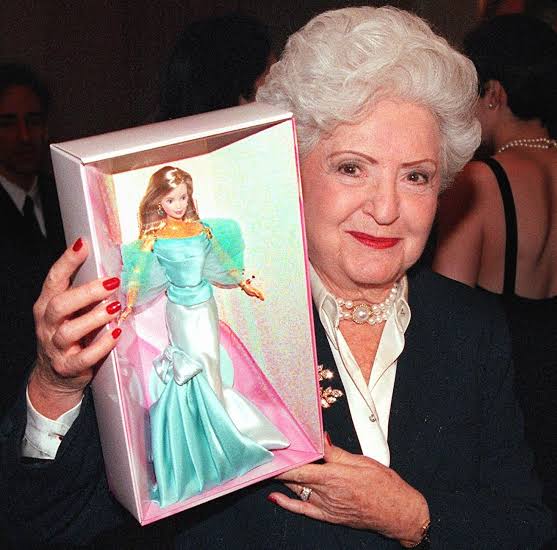
Ruth Handler and her creation, Source: Vanity Fair

Ruth Handler, the Denver native who created Barbie and Ken and named them for her children, added much to the imaginary play young girls could have by giving them a woman doll in 1959 (Ken came along later). Then, over the years, as women moved into lots of different jobs, Mattel gave girls things they could aspire to by churning out Barbies with costumes reflecting different jobs. The dolls also diversified ethnically. (Casting Rhea Perlman as Handler, the daughter of Polish-Jewish immigrants, was a great stroke, by the way).

Whether the change in the look of the dolls is as threatening to some traditional religious right-wingers as the movie has been is an interesting question. Still, it is sad that some of these folks can’t handle the idea of women achieving things outside their homes and churches. Even with Trumpism surging, it’s 2023, folks!

Finally, a personal note. At least one of our six granddaughters is a big fan of Barbie dolls. Because she’s only 5, it’s hard to see how she sees the doll or what impact, if any, it will have on her professional aspirations. I can only hope that the generational confusion that the movie taps into dissipates by the time she and our other grandkids begin to think about romantic partners and careers.

But I also expect that battles between the sexes that the movie depicts will long endure. For better or worse, it seems baked into our species. And movies such as this one are helpful — and wonderfully entertaining — reminders.