Just like old times — sort of

Are seductive advertiser tactics on YouTube hurting our kids?

Joseph Weber

Texaco Star Theater, source: Facebook

When radio and TV were in their infancy, it wasn’t uncommon for the line between the shows and their commercial sponsors to be as blurry as the old black and white pictures on a Philco set. For instance, we had the Texaco Star Theater, Philco Television Playhouse, The Colgate Comedy Hour, and the Gillette Cavalcade of Sports.

And the commercial messages were laced throughout the shows. For instance, at the opening of the Texaco show, men dressed in Texaco gas station uniforms – they really once had those – would introduce Milton Berle. And in the Colgate Comedy Hour, Jerry Lewis would sometimes poke fun at the sponsor, which apparently didn’t mind since it drew attention.

Over time, though, as single sponsorship gave way to multiple advertisers, the lines between the show’s content and ads became clearer. Indeed, in the early days, the single sponsors exercised control over the shows’ content, something that faded as multiple advertisers popped up. Product placement, however, still occasionally showed up, with Coke cups appearing on American Idol and Manolo Blahnik shoes being mentioned on Sex and the City, for instance.

But selling things – while entertaining people – seems to be in a new era now — perhaps a throwback time. YouTube shows, especially those pitched towards kids and young people, are marketing vehicles. Not only are advertisers appearing as integral parts of the shows, but there is no need for separate commercials – perhaps where young viewers could see distinctions, could realize they are the targets of pitchmen.

The question is, is this harmless and reasonable, a blend of commercial interests and entertainment that isn’t any different in kind than, say, the Texaco Star Theater? Or is there something insidious at play, especially in kid-oriented programming, that should trouble us? Should we bar our kids from watching the new sponsor-heavy stuff?

Azelart, source: YouTube

The questions occurred to me this weekend, as a six-year-old granddaughter and I watched a video created by YouTuber phenoms Ben Azelart and Hannah Thomas. Ben and a friend build a secret treehouse in which he can watch videogames while seeming to be “outside,” since Hannah harangues him about getting outdoors and away from the games.

The commercial outfits key to the plot include Starbucks, Home Depot, Target and a host of electronics companies, including a couple popular videogames. They all get prominent play and, presumably, paid to appear or at least provided the goods involved.

Azelart is a former skateboarder who has built a lucrative career on YouTube with videos such as the secret treehouse one. The fast-paced piece keeps viewers – young and old – engaged, for sure.

But, all the while, they get unapologetic commercial messages from the characters. They buy sugary drinks at Starbucks. They roam the aisles in Home Depot and Target. And they buy a hefty stack of videogames and electronic gear.

My six-year-old granddaughter was mesmerized. In fact, it was tough to get her to switch Azelart off when the video segued into another similar video. And I couldn’t help but wonder whether this flagrant consumerism had downsides, especially for her. After all, there were no commercial breaks that, perhaps, would allow even a child to make distinctions between the programming and ads. And it was all quite seductive.

Of course, many of us of all ages shop at Target and frequent Starbucks. Some of us pop into Home Depot at times. And lots of people play Fortnite and other games showcased on the show. But should those brands be seared into the heads of six-year-olds? And is there a problem with that?

There has been some research suggesting there are indeed problems.

“Children are extra vulnerable when it comes to this type of native advertising, as their advertising literacy is not fully developed yet,” a trio of academics wrote in a review of pieces about influencer marketing in Frontiers in Psychology in 2019. “This content overload makes it hard for children to focus their attention and discern relevant from irrelevant information, resulting in a depletion of self-regulatory resources and difficulties to critically reflect on commercial messages.”

They pointed to papers by colleagues that suggested that kids could not recognize and critically evaluate the ad messages they were getting. “The embedded nature of influencer marketing lowers both children’s ability and motivation to recognize it as advertising and critically reflect on it,” they noted.

In other words, kids might be drawn to the shops and the products mentioned – as the sponsors would like – without them or their parents realizing they are being sold on them. As the academics report, “… children may fail to recognize influencer content as advertising and cope with such persuasion tactics critically.”

Salish Matter, source: Parade

Research into the food-marketing power of video influencers has suggested there’s an unhealthy amount of promotion of sugary, fatty and salty foods. So, YouTube in 2020 banned food and drink advertising in and around content aimed at kids. In the Azelart video, however, that didn’t stop popular teen influencer Salish Matter – who plays a key role – from ordering a very unhealthy appearing Starbucks drink.

The Starbucks drink seems like small potatoes, so to speak. The videogames message might be more concerning, since Azelart celebrates his self-described addiction to such games. And the Target and Home Depot messages in and of themselves seem inconsequential, even if they encourage the kids to pester their parents to go to such places – as some of the research suggests they might.

But the Azelart video raises a separate, more subtle issue — sexist stereotyping. Azelart builds the house because his girlfriend nags him to “go outside.” So, are young girls (and boys) supposed to conclude that playing the scold, the nagging woman, is the normal role for women? That men must resort to clever ways to avoid that?

And, beyond that, these videos seem to deliver a potent message about the dubious joys of consumerism. Building a treehouse might be fun, but maybe it’s even more fun to play videogames and go shopping – at one point, the influencer Matter persuades Hannah Thomas to buy everything for her that she can dump into her cart in a minute. She, of course, grabs up stuff blindly — another sexist cliche.

Do such videos encourage unquestioning consumerism? Do they suggest that happiness is to be found that way? It’s hard to measure that, it seems. But, if so, the Azelart videos do it in ways that are both obvious and, perhaps, insidious.

Maybe they’re not all that different from the Texaco men introducing Uncle Miltie. But they surely are a long way from Sesame Street and, it seems, a long way down from it.

Preferring yesterday

To some, progress is so threatening that even bicycles are targets

Joseph Weber

Source: National Review

Seventy-one years ago, Yale-educated William F. Buckley, Jr. launched what has been called “the intellectual beacon of the conservative movement,” the magazine National Review. In his publisher’s statement, he wrote of the new weekly: “It stands athwart history, yelling Stop, at a time when no one is inclined to do so, or to have much patience with those who so urge it.”

The comment is revealing about the nature of conservatism. Many in the movement, it seems, put stumbling blocks in the way of progress, holding that the good old ways are inevitably best.

But what if the old ways really aren’t so good? What if they pollute our waterways and endanger our health? Even conservative darling Richard M. Nixon recognized such problems when he created the Environmental Protection Agency in 1970.

So why is it that the same EPA is now moving to roll back a three-year-old rule that requires coal-fired power plants to prevent the release of toxic heavy metals into streams and rivers through polluted groundwater? Do conservatives really want our waterways tainted with poisonous heavy metals?

“The AI and data center revolution is creating an electricity and baseload power demand that cannot be met under the overly restrictive policies of past administrations,” EPA Administrator Lee Zeldin said in a statement quoted by the Associated Press. “The Trump EPA will continue doing its part to address these burdensome regulations on the coal-fired power plant sector that hold American communities back from the new opportunities presented by this new 21st century energy reality.”

As AP reported, this plan is the latest step that Donald J. Trump’s administration has taken to pull back regulations on coal mining and coal-fired power and to empower fossil fuels as a primary energy source to feed the rapid growth of artificial intelligence data centers. But one wonders: why do the Trumpies so love fossil fuels, despite the planet-wide threat they pose?

Their efforts go well beyond yelling “Stop.” They are assailing environmental progress, turning back the clock.

Whether this involves contempt for electric vehicles, shutting down offshore wind farms or dismantling federal efforts in climate science with such moves as shutting down the National Center for Atmospheric Research in Boulder, Colorado, Trump and his minions are seeking to peel back any gains society has made in going green.

At times, their efforts plunge into the absurd. The Trumpists, for instance, don’t seem to like bikes.

Source: Bloomberg News’ “Governing”

Last year the Trump Administration canceled grants for street safety measures, pedestrian trails and bike lanes in communities around the country. As Bloomberg News reported, the problem for the Trumpies was that the projects weren’t designed for cars.

A San Diego County road project that included bike lanes “appears to reduce lane capacity and a road diet that is hostile to motor vehicles,” a U.S Department of Transportation official wrote, rescinding a $1.2 million grant it awarded nearly a year before, according to the news outlet. In Fairfield, Ala., converting street lanes to trail space on one road was also deemed “hostile” to cars, and “counter to DOT’s priority of preserving or increasing roadway capacity for motor vehicles.”

And in Boston, the administration pulled back a grant to improve walking, biking and transit in the Mattapan Square neighborhood in a way that would change the “current auto-centric configuration.”

With such bureaucratese, one wonders whether the officials also have trouble with basic English.

Sometimes, conservatives justify their moves by arguing the costs of protections are too high or thwart development. But sometimes, they just seem afflicted by a weird nostalgia, such as for gas-powered cars, or animus toward blue states. Such sentiments seem to underlay the recently filed Trump administration lawsuit against California over limits on tailpipe emissions.

“Gavin Newsom is determined to continue pushing Democrats’ radical E.V. fantasy — even if doing so is illegal,” Transportation Secretary Sean Duffy said in a statement quoted by The New York Times. He referred, of course, to Gov. Gavin Newsom of California, a Democrat likely to run for president and a frequent critic of Trump.

As the newspaper reported, the Trump administration has moved to slash federal support for electric vehicles, which do not emit planet-warming pollution. The Environmental Protection Agency has erased limits on greenhouse gases from vehicle tailpipes, and Trump signed a law last year eliminating a tax credit of up to $7,500 that had been available to people who bought a new electric car.

As has long been true, rightists often point to economics justify their defenses of the status quo. The current crew pair that with a loathing for the Biden Administration.

“Oppressive, expensive electric vehicle mandates drive up costs for American consumers and violate federal law,” former Attorney General Pam Bondi said at the time the suit against California was filed. “California is using unlawful policies from the last administration to create exorbitant costs for their citizens.”

But their efforts often fly in the face of common sense and science. For instance, the Omaha Public Power District has long planned to retire three of five power plants in north Omaha and switch the other two from coal-fired to natural gas. Nebraska’s rightwing Attorney General filed suit last fall to block the moves, though.

As reported by the Nebraska Examiner, AG Mike Hilgers said, “we should not be taking one electron off the grid.”

Hilgers’ 46-page lawsuit seeks to stop the changes, as well as prevent OPPD from pursuing any policy that prioritizes considerations other than price or reliability, including “environmental justice.” Residents of predominantly Black north Omaha have long complained of health risks from the plants, including asthma and respiratory issues.

The OPPD is a publicly owned utility that serves more than 900,000 people across 13 counties in eastern Nebraska, a region that includes Omaha.

As the Examiner reported, in 2014 and 2016, OPPD directors agreed to a plan that, by 2023, OPPD would retire the three North Omaha units in operation since the 1950s and switch the other two in operation since the 1960s from coal to natural gas. The oldest three units switched to natural gas in 2016. The plan was delayed in 2022 and then made contingent upon the construction of two new power-producing stations.

Why this conservative attachment to coal? Why this penchant for sticking with the status quo when harms have long been known?

Encouragingly, the power district in overwhelmingly red Nebraska could be in for changes in leadership that could make for progress. Three renewable energy advocates are advancing toward a fall general election and if they win, they and two other like-minded incumbents, would dominate the district board.

Sara Kohen, source: The Downballot

As The Downballot reported, the trio includes former state Sen. Carol Blood, the Democrats’ unsuccessful nominee for governor in 2022 who also lost a run for Congress in the conservative 1st District last cycle. The other is education professor Mark Gudgel, who failed in running for Omaha mayor in 2021. The third is attorney and school administrator Sara Kohen, who narrowly lost a bid for the Omaha City Council in 2021.

When they are defeated in high-profile runs, going for lower-profile utility regulatory posts might give such progressives toeholds for bigger offices later on. But, more important in the short run, they also could help restore environmental gains.

Environmentalists cheered in another red state, Arizona, when renewable energy supporters won an election to take charge of a Phoenix electrical utility company. In Georgia, a couple Democrats scored landslide victories last year in special elections for their state’s Public Service Commission, and Democrats now have the opportunity to flip the third seat they need to win control of the body this fall, The Downballot reported.

It will take a couple major elections to unseat those on the federal level who out of sentiment, nostalgia or just ignorance irrationally cling to the often-flawed past. But as the Nebraska, Arizona and Georgia elections demonstrate, grassroots victories in sometimes little-noted posts can help.

Sometimes, people who stand athwart history get steamrolled. Perhaps the time for that is long overdue.

The Revolution is feasting on its own

Trump’s penchant for firing his loyalists defines his movement

Joseph Weber

Goya’s “Saturn Devouring His Son”

Royalist and anti-revolutionary journalist Jacques Mallet du Pan, writing in 1793 about the French Revolution, coined a phrase that resounds today: “A l’exemple de Saturne, la révolution dévore ses enfants,” which translates to “Like Saturn, the revolution devours its children.”

We see this in Washington, where Donald J. Trump has been ruthless in metaphorically beheading acolytes.

So far, he has bounced three Cabinet members: Attorney General Pam Bondi, Labor Secretary Lori Chavez-DeRemer and Homeland Security Secretary Kristi Noem. Lower-level career fatalities include Border Patrol “commander at large” Gregory Bovino; Corey Lewandowski, an unpaid special staffer at the Department of Homeland Security, and Navy Secretary John Phelan.

More recently, Dr. Marty Makary quit as head of the Food and Drug Administration amid rumors that Trump was planning to can him. Health Secretary Robert F. Kennedy Jr. urged him to jump beforehand, it appears.

And Trump has pulled out all the stops — including a Justice Department probe — in trying to oust Federal Reserve Chairman Jerome Powell from the Fed board. Powell, whom Trump had appointed during his first term, will be succeeded by Kevin Warsh at the Fed’s helm, but he intends to stay on the Fed board for a couple years yet.

In his first term, Trump loved to wield his guillotine. Casualties included FBI Director James Comey, Secretary of State Rex Tillerson, Attorney General Jeff Sessions, National Security Adviser John Bolton and White House Communications Director Anthony Scaramucci – all of whom went on to disparage Trump (and some still do so).

Of course, such highly visible executions are nothing compared to over 200,000 firings of federal employees thanks to sometimes-Trump ally Elon Musk’s Department of Government Efficiency. Makary’s FDA was gutted by the voluntary departures of some 4,000 staffers, apparently out of distaste with the agency’s tumult and redirection under Kennedy and Makary.

In a sorry twist, at least some federal employees who got the ax were very surprised Trumpists.

An attorney advisor for the U.S. Department of Agriculture, for example, said he was “devastated” after voting for Trump and being assured that his job was safe. As CNN reported, he had moved to Little Rock, Arkansas, with his pregnant wife and toddler for the position. He said, “I was expecting to spend the rest of my life doing it.”

Some felt blindsided.

“I was thinking that there would be changes,” a two-time Trump voter and Department of Agriculture researcher told The Los Angeles Times. “But instead of being focused, this is just going completely off the rails, chopping and slicing up parts of the government that are protecting Americans.”

So much for loyalty. Trump, of course, is notorious for expecting it but rarely returning it.

Robert Evnen, source: NBC News

Even more intriguing, though, is when voters are involved and believe that Trump backers aren’t Trumpy enough. That was the case in the May 12 primary defeat of two-term Nebraska Secretary of State Robert Evnen.

Evnen lost to Omaha businessman Scott Petersen, who challenged the integrity of Nebraska’s electoral system on the Lincoln resident’s watch. The incumbent tried to tie himself to Trump’s national election overhaul efforts, but wound up defending the state’s voting systems – something that apparently doesn’t suit the Trump narrative that many in the state’s GOP seem to buy.

“People don’t trust election systems … and whether right or wrong, it’s a problem,” Petersen told the Nebraska Examiner. “It needs to be addressed.”

Petersen targeted Evnen’s handling of vote counting, the news outlet reported. He questioned whether the ballot-counting machines can access the internet and be hacked, argued that voting by mail should be restricted to only special circumstances and promised to conduct full hand counts of races.

Like other secretaries of state, Evnen regularly audited election results, the news outlet reported. But, by raising the specter of taints — in Trump-like fashion —Petersen undermined the incumbent.

That was so even as Evnen in the past year has tried to tie himself even more tightly to Trump. He handed over data the Trump administration requested to the U.S. Department of Justice that his Republican predecessor didn’t, including parts that critics say are potentially sensitive, according to the Examiner. He also started echoing some of Trump’s concerns over elections.

Evnen had supported a state constitutional amendment in 2022 requiring voter ID, and said he’d like such systems rolled out nationally. He pressed for more efforts to ensure noncitizens aren’t voting – a Trump hobbyhorse, but a nonproblem, according to outfits such as the Brennan Center at NYU. In desperate-seeming emails in recent weeks, Evnen pleaded for votes by arguing that he and Trump were “completely in-sync” on mail-in voting, something Trump has labeled “mail-in cheating.”

But Petersen apparently put Evnen on his back foot with suggestions of flaws in the system, despite providing no evidence. As the Examiner reported, Evnen was cast onto the defensive, describing Nebraska’s elections system as the “gold standard.” And he conducted a “transparency tour” across several counties describing the accuracy testing of Nebraska’s ballot-counting machines.

With a GOP rank and file that has been convinced by Trump and his backers that voting systems nationwide are rigged, such rational approaches are nonstarters, it seems. With people conditioned to be suspicious, those dogs just don’t hunt.

Rep. Don Bacon, source: NBC News

Never mind that Petersen’s approach earned him the title of “President of the TinFoil Hat Club” from outgoing U.S. Rep. Don Bacon, one of many GOP establishment figures to back Evnen. The Lincoln resident had a laundry list of endorsements from Republican elected officials, including Gov. Jim Pillen, Sens. Deb Fischer and Pete Ricketts, and all three of the state’s House lawmakers.

Evnen had long paid his dues to the state GOP by serving such figures in one way or another. But Petersen prevailed by out-Trumping him.

In the end, the revolution that Evnen backed devoured him, much as it has gobbled up so many in Washington. And, with 2 ½ years remaining for Trump’s tenure in Washington, still more are likely to fall prey to it.

While some of Trump’s followers paint in him in messianic imagery, perhaps it is Saturn he resembles more.

“Am Yisrael Chai”

But, as for the current Israeli government approach, some disagree

Joseph Weber

A Polish newspaper in 1791 published a phrase since handed down to us in a lot of forms: “Gdzie dwóch Polaków, tam trzy zdania” means “where there are two Poles, there are three opinions.” A more modern version, perhaps from the Borscht Belt or the long history of Judaism in Poland, tells us “two Jews, three opinions.”

I was reminded of this by a rabbi of my acquaintance who recently discussed a decision by her synagogue to change a pro-Israel banner that has graced the building since shortly after Hamas massacred Jews on Oct. 7, 2023. Some congregants objected to the “We Stand with Israel” message, either out of fear because synagogues nowadays are being attacked or out of distress at Israel’s military actions. Others took pride in the message, since lately Israel needs friends when it has become the target of much heat.

Some members, the rabbi wrote, felt all three things at once. This version of “two Jews, three opinions” has a counterpart in longstanding rabbinic tradition, “davar acher” – Hebrew for “a different thing,” she suggested. The phrase separates often differing, sometimes contradictory, commentaries on various matters and suggests that both views could be correct. The text allows for diverse opinions.

There’s little doubt that Jews are split on crucial matters involving Israel now. The killings of more than 70,000 people in Gaza, still others in Lebanon and still others at the hands of Israeli settlers or soldiers in the West Bank have many asking a version of “Israel: What Went Wrong?,” the title of a new book by an Israeli-born scholar teaching at Brown University, Omer Bartov.

Many American Jews disapprove of Israel’s conduct of the war in Gaza, with 61 percent saying Israel has committed war crimes, and about 4 in 10 saying the country is guilty of genocide against the Palestinians, according to a Washington Post poll from last fall. While more Israelis backed the Gaza actions, less than a third believe Israel won, and even fewer believe Hamas will lay down its arms, according to an Israeli poll published in January.

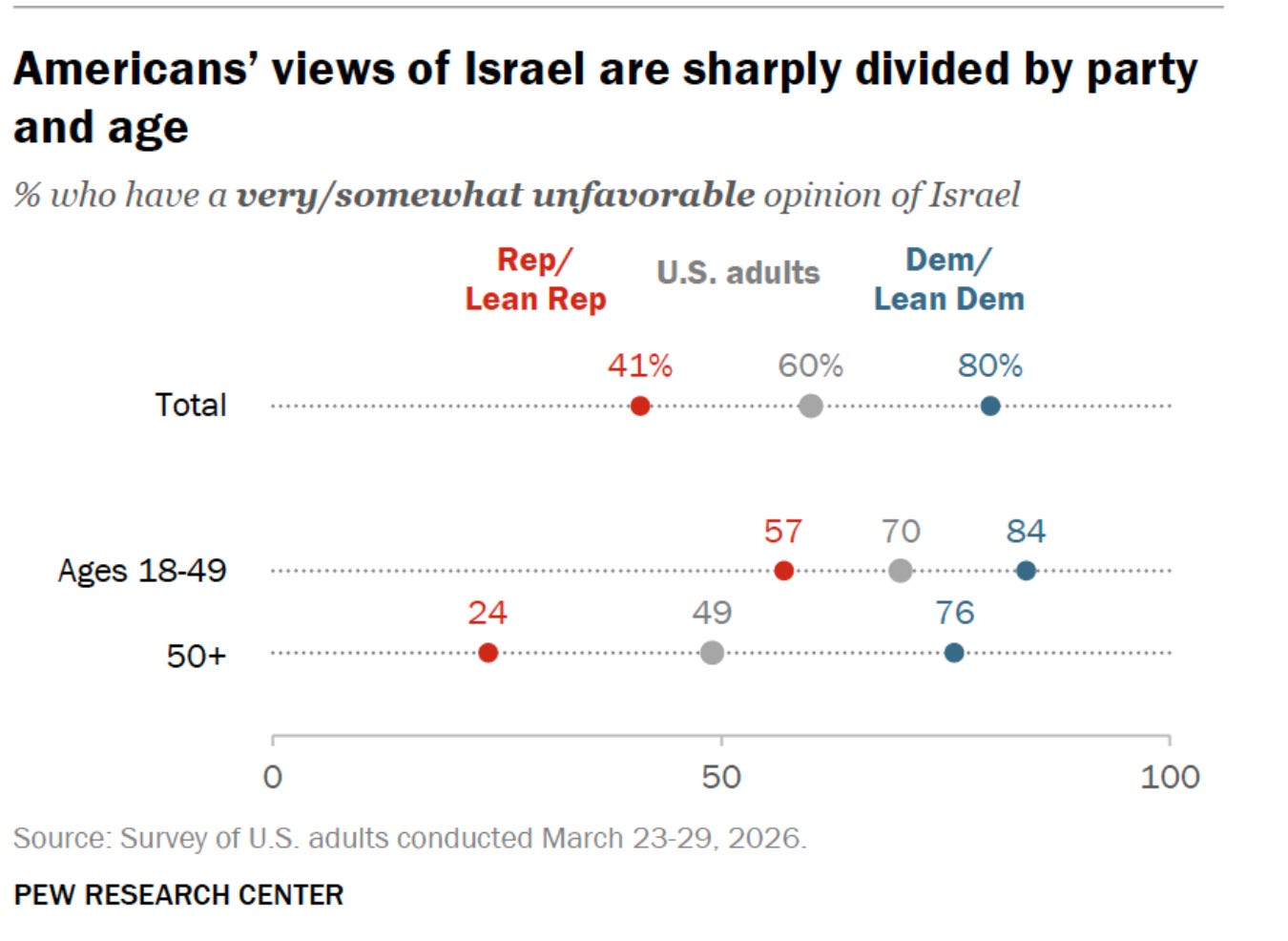
Among Jews in the U.S., opinions about Israel are particularly split by age. While 93 percent of those surveyed by Pew in the spring of 2024 condemned the Hamas attack that started the war, Jewish adults under 35 were divided over Israel’s military response: 52 percent said the way Israel carried out the war was acceptable, while 42 percent called it unacceptable, and 6 percent were unsure. Jews ages 50 and older were more likely to say Israel’s conduct of the war acceptable (68 percent).

So, lots of views. Can all be right? As it makes war so aggressively on its neighbors – albeit in response to real threats – can Israel’s actions be just and appropriate? Or has it lost the moral compass that once defined the nation along with its historically justified claims to the land, which underpinned Zionism?

Perhaps the most unsettling arguments come in Bartov’s new book. The work is especially troubling to defenders of Israeli because Bartov has a lot of street cred. A professor of Holocaust and genocide studies at Brown, he grew up in a Zionist home and served as an officer in the Israel Defense Forces during the Yom Kippur War in 1973. He argues that Zionism has morphed into an ideology of extremism that led in Gaza to genocide, a term he doesn’t use lightly.

Indeed, in the wake of the Oct. 7th savagery, Bartov published an opinion essay in The New York Times about Israel’s military response. “I believe that there is no proof that genocide is currently taking place in Gaza,” he wrote a month after the massacre, “although it is very likely that war crimes, and even crimes against humanity, are happening.”

But he has since then changed his view. Relying on a UN definition that says genocide involves acts carried out with the intent of destroying a particular group – whether national, ethnic, racial, or religious – he argues that Israel’s destruction in Gaza meets that tragic test.

Source: Amazon

As he told New Yorker editor David Remnick, Bartov notes that the population of Gaza lives in less than half of the territory now, with entire cities – such as Rafah – leveled. Unhoused, living in tents and with no infrastructure, the Gazans are “living there like dogs, and nobody is doing anything about it. The plan, the future of the genocide in Gaza seems to be to create a resort town for the rich and to have the Palestinians be the water carriers for that.”

But, long before the Gaza War, Bartov had doubts about how Zionism was evolving. “I served on the West Bank,” he said of his time in the IDF. “The sense, this question that you suddenly ask yourself, ‘What am I doing here? Why am I here? This is not my home.’ It would come up. I can’t say that it was a fully developed political understanding. It was a feeling that something was not right.”

Then, in the late 1980s with the outbreak of the first intifada when he was an officer in reserve, he was outraged by calls from the then-Minister of Defense, Yitzhak Rabin, to “go and break their bones.” He wrote Rabin a note comparing the IDF to the WWII Wehrmacht, referring to the process of brutalizing an army.

As many Israelis endorsed the idea of a two-state solution — or at least as Rabin saw it, a self-governing entity for Palestinians that was short of a full state – Bartov was more hopeful. That time, he recalled, was “the last moment of realism as opposed to messianism, which is what has taken over Israel now.”

But that ended with the assassination of Rabin in November 1995. “I remember it well because I was sitting there and holding my six-month-old daughter and crying, and I didn’t even like Rabin,” Bartov said. “He was the last hope, and he could have accomplished something because of his own record, because of his standing in Israeli society. I thought this is over for a generation. I was wrong because it’s more than a generation now, and things are only going the wrong way.”

Any chance of a course correction?

Bartov is pessimistic about change coming from within. As a New York Times reviewer noted, “he says that the leadership, whether Jewish or Palestinian, just isn’t there. Any initiative will have to come from the outside, and he credits President Trump for pressuring Prime Minister Benjamin Netanyahu to accept a 20-point plan last fall that at least gestures ‘toward a new political horizon.’” Even Germany, seeking its “greatest atonement” could play a role, he suggests.

As might be expected, ideas such as Bartov’s have their critics.

The American Jewish Committee, for instance, contends genocide – a term first used by a Polish Jewish lawyer to refer to the Nazis’ effort to destroy world Jewry – is a misnomer for the Gaza campaign. “Israel is not seeking to destroy the Palestinian people or the Palestinian population of Gaza, which is what would need to happen in order to correctly apply the term ‘genocide,’” the AJC maintains. “Israel’s leaders have repeatedly asserted that their campaign in Gaza is solely against the terrorist organization Hamas.”

Well, not all Israeli leaders say as much. If they don’t want to kill Palestinians, they at least want to drive them out.

“We must promote a solution to encourage the emigration of the residents of Gaza,” far-right National Security Minister Itamar Ben-Gvir said in 2024. And far-right Finance Minister Bezalel Smotrich, who also holds a position in the Defense Ministry, says that Israel “will rule there. And in order to rule there securely for a long time, we must have a civilian presence.” In other words, settlements much like those unsettling the West Bank.

And, as Bartov has noted, the big problem for Gazans is they have nowhere to go.

“The big difference between the Nakba of 1948 and what happened in ‘23, ‘24, ‘25 in Gaza is that at the time the borders were open, in ‘48, they could flee. They did flee, to Lebanon, to Jordan, to Syria,” the Holocaust and genocide scholar said. “In 2023, 2024, Israel, of course, did not open its borders. Egypt did not open its borders, and they had no place to flee. Ethnic cleansing, which was what the Israeli government wanted to carry out, became genocide.”

Source: Amazon

It’s all reminiscent of “Neighborhood Bully,” 1983 song about Israel by Bob Dylan (nee Zimmerman):

Well, he knocked out a lynch mob, he was criticized

Old women condemned him, said he should apologize

Then he destroyed a bomb factory, nobody was glad

The bombs were meant for him. He was supposed to feel bad

He’s the neighborhood bully.

Well, the chances are against it, and the odds are slim

That he’ll live by the rules that the world makes for him

‘Cause there’s a noose at his neck and a gun at his back

And a license to kill him is given out to every maniac

He’s the neighborhood bully.

Of course, Israel is surrounded by bullies who want nothing more than its destruction. Genocide for Israelis would be fine with them.

The synagogue that plans to remove its “We Stand with Israel” message will replace it with rotating banners. Some messages will be seasonal – “Shanah tovah!” around the holidays, for example. Others will be general, such as “BZBI: Where You Belong.” At times, it will display an “Am Yisrael Chai” banner, using a phrase that means “The People of Israel Live.”

Banners planned for Temple BZBI

“We look forward to having this new communication tool,” the rabbi wrote. “Rather than live under one banner, we will return again and again to davar acher, a new idea, a new approach.” That may accommodate several opinions.

Of course, it’s not clear what opinions will guide Israel’s future over time.

“Zionism is not reformable. The state of Israel is,” Bartov argues. “The state of Israel has to be reinvented, and it cannot be reinvented according to this ethnonationalist principle that has taken hold of it.… Israel, as a society, there has to be a society of all its citizens. As it was said at the time, in the 1990s, in the early 1990s, Eretz Kol Ezracheha, a country of all its citizens.”

A pivot point

Germany’s shift a century ago offers troubling lessons about how democracies fall

Joseph Weber

Reichstag, source: author photo

As we stood outside the Reichstag building in Berlin recently, the well-schooled guide who showed us the city’s major WWII sites spelled out the way Adolf Hitler and his cronies came to power. Today, nearly a century on, their techniques sound all too distressingly familiar.

The Nazis’ key tactics in the 1930s included scapegoating immigrants, Jews, Communists and others for the nation’s economic woes. They invoked a mythical Aryanism, saying they wanted to keep pure the blood and soil of the German nation – racist terms they frequently used. They promised to end ravaging inflation. In short, they promised to make Germany great again.

The desperate German public, suffering acutely in the global Great Depression, ate it up. Over several elections, by mid-1932 they voted in a large minority of seats for the once-fringe Nazi Party. Then, in early 1933, Hitler pressed 85-year-old German President Paul von Hindenburg to name him Chancellor in a coalition government. Hitler sidelined then ultimately jailed his political opponents.

Of course, that wasn’t enough. So, after a mysterious fire in the Reichstag – the seat of the German legislature – Hitler persuaded von Hindenberg to sign the Reichstag Fire Degree, gutting the German constitution. “The decree permitted the restriction of the right to assembly, freedom of speech, and freedom of the press, among other rights, and it removed all restraints on police investigations,” as the U.S. Holocaust Museum’s encyclopedia records.

“With the decree in place, the regime was free to arrest and incarcerate political opponents without specific charge, dissolve political organizations, and suppress publications,” the account continues. “It also gave the central government the authority to overrule state and local laws and overthrow state and local governments. This law became a permanent feature of the Nazi police state.”

Through that, the monomaniacal Hitler assumed the power of a dictator, ending Germany’s short post-WWI experiment in democracy. As he sought to expand his empire far beyond its national boundaries, he led the country into a devastating war. And he wound up ending his life in 1945 in an underground Berlin bunker with his city in ruins.

So, today, we have another monomaniac determined to expand the reach of his country, the United States – either politically by acquiring Greenland or Canada or militarily à la Venezuela and Iran. Donald J. Trump has led us into a war that seems mostly to have blown up in his face. He has scapegoated immigrants, detaining or deporting tens of thousands and claiming they are “poisoning the blood of our country.” And he is using techniques that echo Hitler’s.

History may not be repeating itself exactly, but it seems to be rhyming (to cite a comment often attributed to Mark Twain).

Source: The Week

While bending such agencies as the Department of Justice to his will, Trump controls a submissive legislature and wields exceptional influence on the Supreme Court. He and his followers in state governments have sought electoral changes that could compromise elections for years. And he has tried – so far only partly successfully – to stifle the critical press, almost daily filling the airwaves with misinformation.

Trump’s war on the press has a long history, but he and his minions come up with fresh battlegrounds regularly. The president’s Equal Employment Opportunity Commission just sued The New York Times, for instance, claiming the paper had engaged in “unlawful employment practices” and had discriminated against a white male employee denied a promotion. Trump’s Federal Communications Commission on April 28 ordered a review of station licenses owned by ABC, saying it was prompted by an investigation into the network’s diversity and inclusion policies, though the action also followed calls by the president to fire Jimmy Kimmel after he took offense at a joke by the comedian.

Trump has repeatedly sued news outlets, sometimes extracting legal settlements. Encouragingly, he has lost several times, with courts dismissing his suits. That happened with The Wall Street JournalThe Washington Post and CNN, for instance. A judge also dismissed a $15 billion case the president brought against The New York Times, though gave him leave to refile, which he has done.

The president or his toadies have also barred reporters at times from areas such as the Oval Office and the Pentagon. Courts have ruled against such limits, however. Federal courts have also set back the Justice Department’s investigation of a Washington Post reporter whose home federal agents raided in January as they tried to ferret out her sources on stories about Venezuela.

Source: The Today Show

Trump also has vindictively pursued political opponents, using the machinery of the state to advance his grudges. Latest case in point: James Comey’s seashellgate. “Is it plausible that … a former federal prosecutor, deputy attorney general, and FBI director, publicly threatened to murder President Donald Trump?,” asks libertarian Reason magazine. “No, it is not. But that is what W. Ellis Boyle, the U.S. attorney for the Eastern District of North Carolina, claims in an indictment filed on April 28.”

On our Berlin trip, a second well-schooled guide suggested that such efforts are textbook cases in how politicians manipulate the system. They do so, he argued, for self-enrichment — which Trump and his family are very much about, as a Pulitzer Prize-winning series of stories by The New York Times demonstrates — and to entrench their parties.

Some worried U.S. analysts agree:

“American democracy is gone—not under siege, not threatened, but vanquished, with a generous assist from a 2024 electorate that endorsed (wittingly or otherwise) the institution-wrecking that is on display every day in Washington,” Roosevelt University Professor David Faris argued last August in The Nation. Democrats, he adds, “need to understand that their task is not to defend an imperiled democracy but to prevent the GOP from further consolidating the autocracy that its craven politicians, reactionary intellectuals, complicit judges, and guileless voters have imagined for more than two decades and have finally put into practice …”

Discussing the “erosion” of American democracy, Brookings senior fellow Vanessa Williamson bemoaned a slide that she argued predates Trump. The anti-democratic moves have stretched from manipulative state legislatures to Washington.

“Since 2010, state legislatures have instituted laws intended to reduce voters’ access to the ballot, politicize election administration, and foreclose electoral competition via extreme gerrymandering,” the Brookings scholar maintains. “The United States has also seen substantial expansions of executive power and serious efforts to erode the independence of the civil service. Against these pressures, the gridlocked and hyperpartisan Congress is poorly equipped to provide unbiased oversight and accountability of the executive, and there are serious questions about the impartiality of the judiciary.”

But is the game really up yet? So far, many courts — short of the Supreme Court — have stood in the way of Trump’s overreaches.

And, even with all the manipulations and threats by Trump and his supporters in various states, the midterm elections in November could strip the president and his party of much of the power they have seized. As New York Times columnist Bret Stephens has written, as of early May, the Polymarket prediction market gives the Democrats a 51 percent chance of winning the Senate and an 83 percent chance of taking the House.

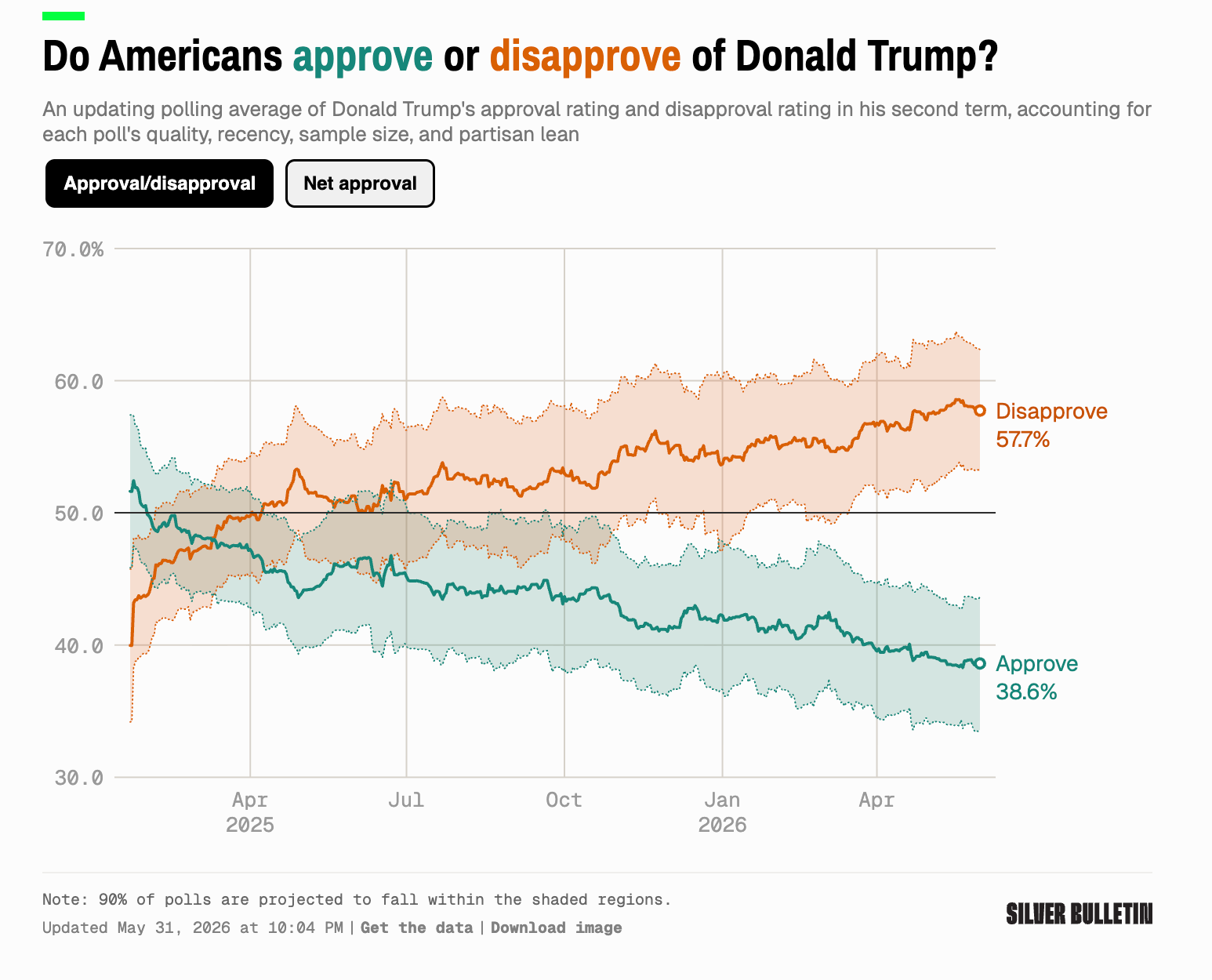
Contrary to general impressions about Trump’s hold on much of the public, the president lately is proving to be an albatross on the neck of his party. An ABC News/Washington Post poll released Sunday found that just 37 percent of Americans approve of his performance and 62 percent disapprove. “The war on Iran and its effects on prices at home — particularly at the gas pump — are pushing Trump’s ratings down,” The Hill reported.

Other polls concur. “In the polling average maintained by The Hill’s data partner, Decision Desk HQ (DDHQ), Trump is 17 points underwater, with 56.9 percent disapproving and 39.7 percent approving of his job performance. Nate Silver’s Silver Bulletin has Trump almost 19 points in negative territory — a deficit 8 points larger than where it stood at the start of the year. And, in the RealClearPolitics (RCP) average, Trump is 16 points underwater.

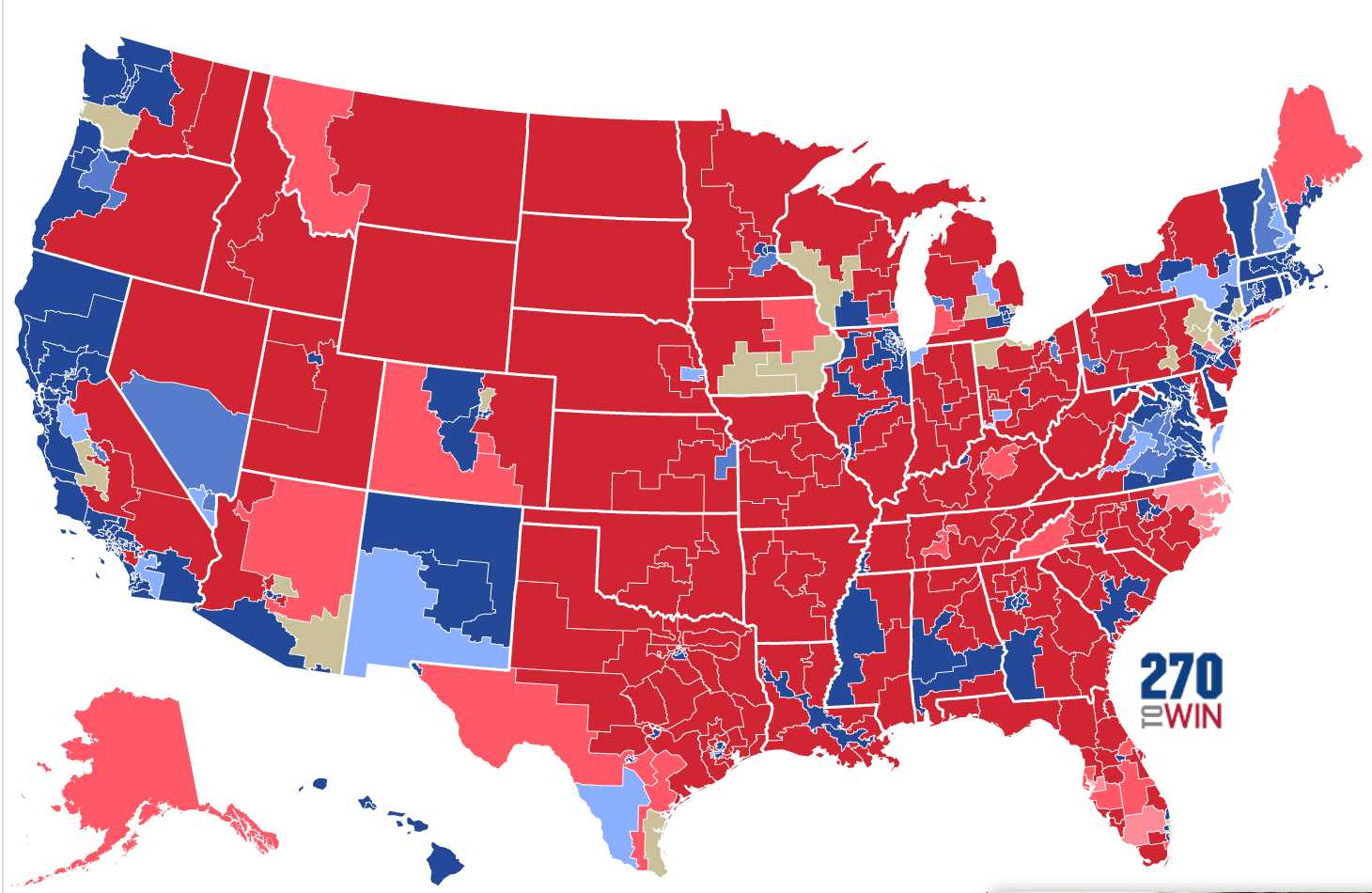
Of course, such general nationwide sentiments aren’t decisive. After all, Trump won with a minority of the popular vote, 49.8 percent, claiming a landslide by snaring 312 Electoral College votes to Kamala Harris’s 226. Great swaths of red cloud the Democrats’ prospects:

Map of House Districts, suggesting Democrats will prevail in the fall with 212 seats to the GOP’s 205. Source: 270 to Win

The Republican-dominated Supreme Court didn’t help the Democratic case with its recent further gutting of voting rights. In Louisiana v. Callais, the court struck down a Louisiana congressional map that a group of self-styled “non-African American” voters had challenged. The move barred the state from using a map that had created a majority-Black district, and accelerated the gerrymandering war Trump launched months ago.

“The Republicans on the Supreme Court have put the final nail in the coffin of the 1965 Voting Rights Act,” contends political scientist Fr. Thomas Reese. “Justices who claim to prize historical intent now interpret post-Civil War amendments to the Constitution as a defense of white rights.”

And yet, despite the all-too-real threats to democracy and the erosions we’ve seen, the Iran War debacle and its ability to hit Americans in their wallets could prove to be the undoing of the Trumpian forces. The election is six months away, so anything could happen, but some experts on authoritarianism are less dour than others.

Steven LevitskyLucan A. Way, and Daniel Ziblatt, professors who fret about the “competitive authoritarianism” the U.S. has slipped into, hold that democracy hasn’t yet fallen. “The fact that the United States has crossed the line into competitive authoritarianism does not mean that its democratic decline has reached a point of no return,” they argue in Foreign Affairs. “Trump’s authoritarian offensive is now unmistakable, but it is reversible.”

Yes, they say, it’s true that in 2025, the United States ceased to be a full democracy in the way that Canada, Germany, or even Argentina are democracies. But “as the Democratic Party’s success in the November 2025 elections shows, multiple channels remain through which opposition forces can contest—and potentially defeat—Trump’s increasingly authoritarian government.”

Trump, already showing signs of dementia, will be 82 when his term ends in January 2029. So, even though he has made noises about seeking a third term, it’s unlikely he’ll carry his party’s mantle again.

But others — notably Vice President JD Vance and Secretary of State Marco Rubio — seem hungry to do so. Their GOP backers certainly will try to cement the party’s control of Washington, whatever the cost.

It’s possible that Trump and his minions could be salvaged by some dramatic development akin to the Reichstag fire of 1933. It may be foolish to put staging something like that past them.

For now, though, we seem near a pivot point that either will prove the pessimists right or will bring American democracy back from the brink. The choice we all face six months hence is every bit as consequential as that Germans faced nearly a century ago.

Read all about it

A storied newspaper gets a lifeline

Joseph Weber

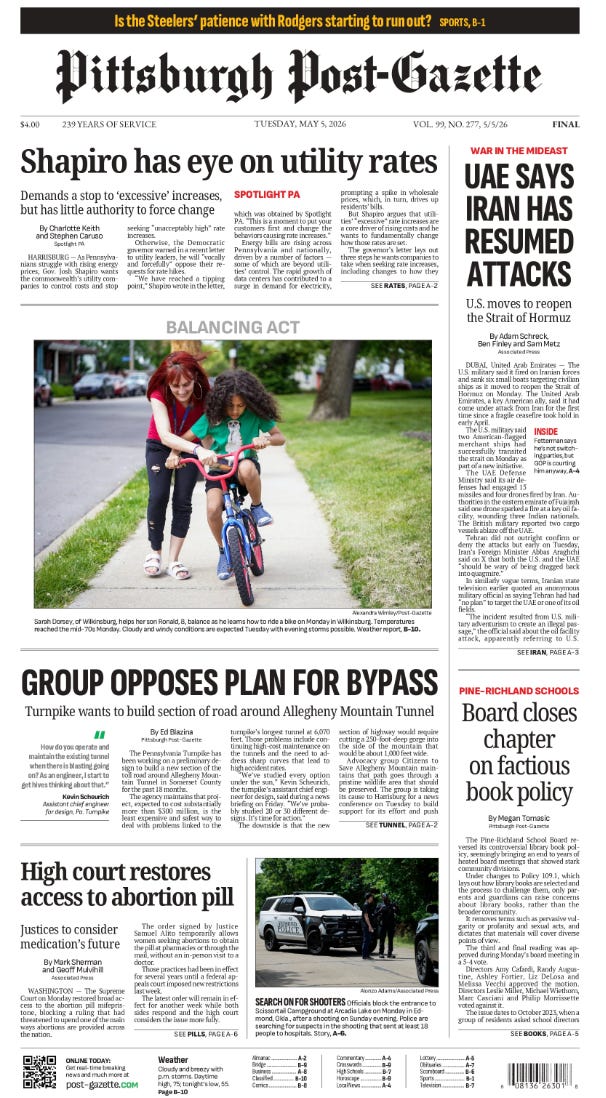
The Sunday, May 3, edition of the Pittsburgh Post-Gazette was supposed to be the 239-year-old paper’s last. But, since a Baltimore-based nonprofit came to the rescue, the PG has kept offering its regular mix of local, national and international news. It plans to do so, although mostly on its website, with print editions only on Sundays and Thursdays.

For Pittsburghers and anyone interested in seeing a well-informed public, that’s great news, of course.

Newspapers have been dying for decades, a trend accelerated by the onslaught of the Net and the advance of cellphones. Since 2005, the number of papers published in the United States has dropped from 7,325 to 4,490 now, according to the Medill State of Local News report. As AP reported, in the year leading up to October 2025 alone, some 136 papers shut down, with daily newspaper circulation now down to just over 15 million from an average of between 50 and 60 million people at the turn of the century.

And, not coincidentally, our politics have grown more demagogic and ill-informed. Donald J. Trump, a longtime hater of the press, seems to have persuaded millions of his followers that the news media is “the enemy of the American people,” as he famously started saying in 2017, mostly referring to broadcasters. He has escalated his attacks since, with his broadsides becoming “the tap water of his political rhetoric,” as The New York Times noted.

With such prominent assaults and declines in readership, is it any wonder that Americans’ confidence in the mass media has plummeted? That faith edged down to a new low last fall, with just 28 percent of those polled expressing a “great deal” or “fair amount” of trust in newspapers, television and radio to report the news fully, accurately and fairly, according to Gallup. This is down from 31% last year and 40% five years ago.

Source: Gallup

So, it is encouraging that the Venetoulis Institute swept in to keep the Post-Gazette alive. The nonprofit also owns The Baltimore Banner, a Pulitzer Prize-winning news site that – in contrast to other media outlets — has been expanding. Under the institute – named for former Baltimore County Executive and media champion Ted Venetoulis – the Banner has doubled its newsroom to about 80 journalists since 2022.

The Banner gives The Baltimore Sun a run for its money, offering readers a centrist alternative to the rightist environment now fostered at The Sun. The storied Sun, owned for a time by the media vultures at Alden Global Capital, in 2024 became a mouthpiece for the right-wing head of Sinclair Broadcast Group, David D. Smith, and Clarence Thomas chum Armstrong Williams.

As reported by NPR media correspondent David Folkenflik, The Sun now has no foreign bureaus and a far smaller newsroom. Local union officials pegged the number of journalists working there in 2024 at about 60, down from more than 300 when Folkenflik reported for the paper two decades earlier. Shortly before that, its newsroom topped 400 reporters.

And, according to Poynter, sentiment in the newsroom has dropped as the paper’s political tilt has shifted. “New ownership at the Sun has driven staff and some readers away. Since its former managing editor retired in June, at least 18 journalists have quit. Morale is low in the 56-person newsroom,” the journalism foundation reported early last year.

“Sinclair is known for forcing stories with a right-leaning agenda onto its more than 180 television stations across the country,” Poynter journalist Angela Fu reported. “Sinclair-acquired stations increase their coverage of national politics at the expense of local politics, a 2019 study found, and coverage overall undergoes a significant rightward shift.’”

The Banner won a Pulitzer in 2025 for a series of pieces that likely would not have appeared in The Sun. As the Pulitzer folks described it, the package was a “compassionate investigative series that captured the breathtaking dimensions of Baltimore’s fentanyl crisis and its disproportionate impact on older Black men, creating a sophisticated statistical model that The Banner shared with other newsrooms.”

Before the current owners took over, The Sun in a 2022 editorial apologized for having, “sharpened, preserved and furthered the structural racism that still subjugates Black Marylanders in our communities today.” The paper added that “Reporting that arises directly from sources in the region’s Black communities has long been lacking in The Sun, largely because the connection is lacking. We’re not out there enough, and we’re not trusted enough. We are working on that, and looking into an impression some hold that The Sun is harder on Black officials than white.”

Now, however, The Sun seems to be adopting the “if it bleeds, it leads” approach taken by Sinclair’s Baltimore TV station, WBFF, a Fox affiliate, the City Journal reported. That style appears to exploit Black community problems, rather than explore them.

“The Sun has moved closer to that sensibility, with a ‘Spotlight on Maryland’ TV–newspaper partnership that highlights stories such as police ignoring drug crimes even after mass overdoses,” the City Journal said. “The paper’s reporters have covered juveniles arrested and released with no oversight, ready to commit violent crimes again. Instead of glossing over those stories, the paper asks bluntly, ‘How did that happen?’”

A retired Sun reporter, Michael Hill, told NPR that the formula reflects a business judgment about who the paper serves. “They have picked an audience they want, which is a suburban audience, and they want to tell them how terrible the city is, and that they’re right to live in the suburbs,” Hill said. “And that, I think, is their sort of commercial approach that is reflected in their news business.”

A former staffer at the TV station put the approach this way: “You amplify the negativity.”

Regardless of a media outlet’s political slant, the question arises about whether its staffing gives it the firepower it needs to do its work well. Fifty-six journalists just can’t be in as many places as 400.

Despite the lifeline that Venetoulis has thrown the Post-Gazette, staffing has been hit hard. About 40 percent of the roughly 120-member news staff were recently told that their jobs are gone, according to the Columbia Journalism Review. “I don’t know how the Post-Gazette is going to cover a city the size of Pittsburgh, effectively, with half the staff,” a now-former PG reporter Andrew “Goldy” Goldstein told CJR.

The same can be said of cities all over the country.

The Los Angeles Times, which boasted more than 1,200 journalists just before the turn of the century, is down to perhaps 235 nowThe Boston Globe gets by with less than half the 550 journalists it employed in 2002, while The Philadelphia Inquirer’s 200-member news staff is down from 700The Denver Post makes do with a news staff that was cut in the last decade from above 300 to an estimated 75 or so, according to Westword.

Recall that in Denver, the Post’s longtime rival, the Rocky Mountain News, folded in 2009. (Full disclosure: I worked as a reporter at the Rocky in the first half of the 1980s, an exhilaratingly fierce newspaper war period.)

The problem with such reductions in forces, of course, is that readers don’t know what exactly they are missing – but they can see that the menu is smaller. It’s obvious that once-fat newspapers are thinner (and that their websites carry comparatively few articles).

But subscribers don’t know that, for instance, local town council meetings may not be followed closely unless there’s a major scandal. They may have a sense that feature pages are skimpier now, but there’s no real count on column inches that anyone can cite.

And, since newspapers are offering less, no one should be surprised that readership is down, along with credibility. Give people thin soup and they’ll look for something else – especially when their phones are packed with plenty to read and watch, even if much of it is trash.

Source: Nebraska Examiner

To be sure, the technology changes have created enormous opportunities for news coverage, too. State governments, for instance, are well covered by online affiliates of the nonprofit States Newsroom. The Nebraska Examiner, one such affiliate, reshaped the state’s governor’s race in 2022 by reporting on sordid doings by the Trump-backed leading Republican., for instance.

And online operations such as Nebraska’s Flatwater Free Press and The Colorado Sun fill in some of the gaps created by the declines of The Omaha World-Herald and The Denver Post – even though the newcomers’ small staffs simply can’t be in as many places as sprawling reporting staffs once were.

It’s also clear that top-notch journalism is still getting done. Just check out the Pulitzer Prizes recently awarded.

The Washington Post, beleaguered by cuts imposed by owner Jeff Bezos, topped the list with its Public Service Pulitzer for reporting on the Trump Administration’s “chaotic overhaul of federal agencies and chronicling in rich detail the human impacts of the cuts and the consequences for the country.” The New York Times took the award for investigative reporting with “deeply reported stories that exposed how President Trump has shattered constraints on conflicts of interest and exploited the moneymaking opportunities that come with power, enriching his family and allies.” And Reuters won the national reporting prize for “documenting how the president used the U.S. government and the influence of his supporters to expand executive power and exact vengeance on his foes.”

None of the awards will endear Trump to those news outlets – and supporters of the president would likely look on them as proof of the media’s bias against their boy. But the fact-based journalism in those pieces also demonstrates how independent reporting can — indeed must — hold people in power to account.

Over its history, the Post-Gazette has won three Pulitzers, snaring its last one in 2019 for breaking news reporting on the massacre at the Tree of Life synagogue. The Pulitzer judges saluted the paper’s “immersive, compassionate coverage of the massacre … that captured the anguish and resilience of a community thrust into grief.”

With Venetoulis behind it now – and the possibility that the PG’s shrunken staff could grow again – perhaps the paper will soon capture another such prize. Count it already as a victory that the paper won’t disappear.