
But, as for the current Israeli government approach, some disagree
A Polish newspaper in 1791 published a phrase since handed down to us in a lot of forms: “Gdzie dwóch Polaków, tam trzy zdania” means “where there are two Poles, there are three opinions.” A more modern version, perhaps from the Borscht Belt or the long history of Judaism in Poland, tells us “two Jews, three opinions.”
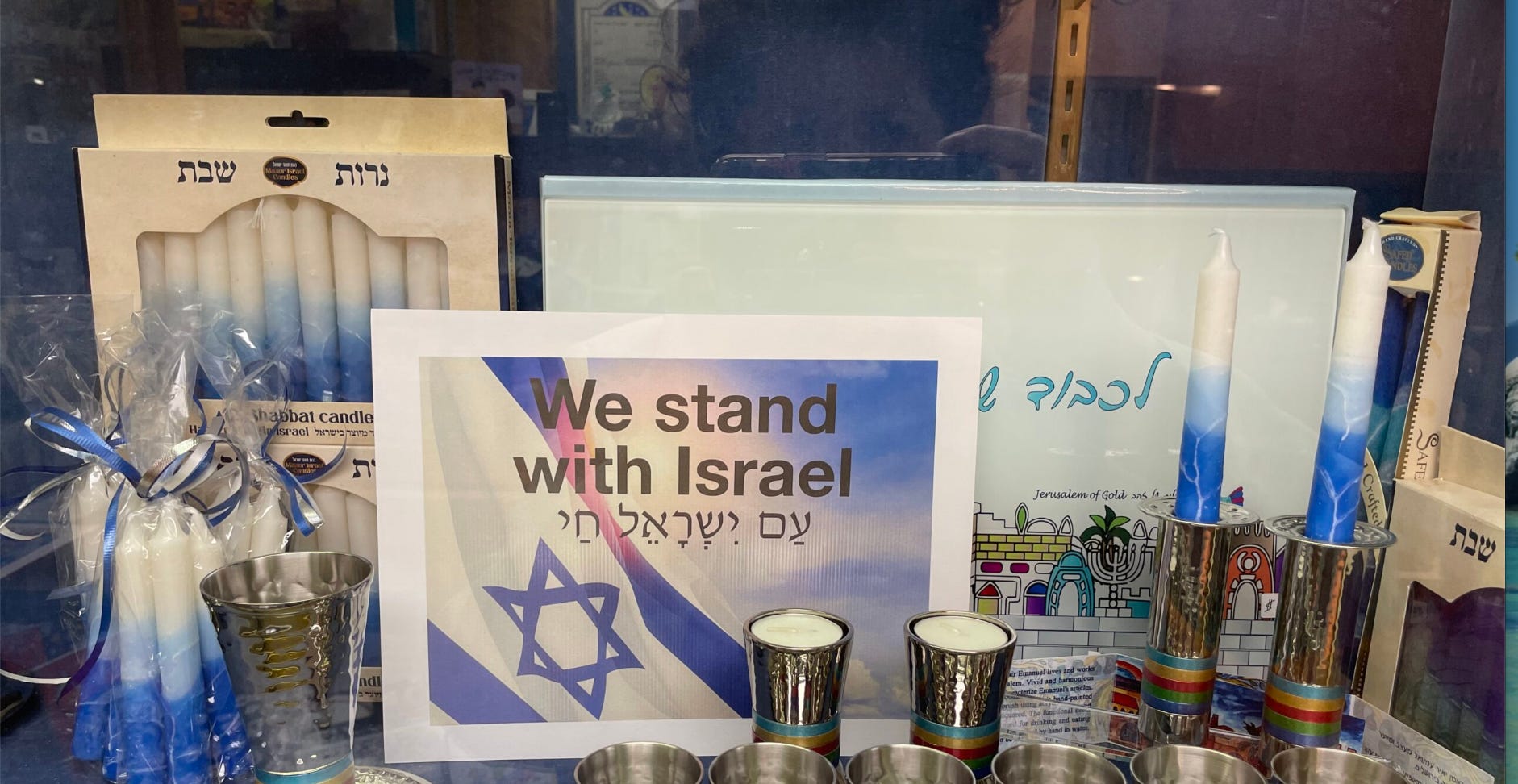
I was reminded of this by a rabbi of my acquaintance who recently discussed a decision by her synagogue to change a pro-Israel banner that has graced the building since shortly after Hamas massacred Jews on Oct. 7, 2023. Some congregants objected to the “We Stand with Israel” message, either out of fear because synagogues nowadays are being attacked or out of distress at Israel’s military actions. Others took pride in the message, since lately Israel needs friends when it has become the target of much heat.
Some members, the rabbi wrote, felt all three things at once. This version of “two Jews, three opinions” has a counterpart in longstanding rabbinic tradition, “davar acher” – Hebrew for “a different thing,” she suggested. The phrase separates often differing, sometimes contradictory, commentaries on various matters and suggests that both views could be correct. The text allows for diverse opinions.
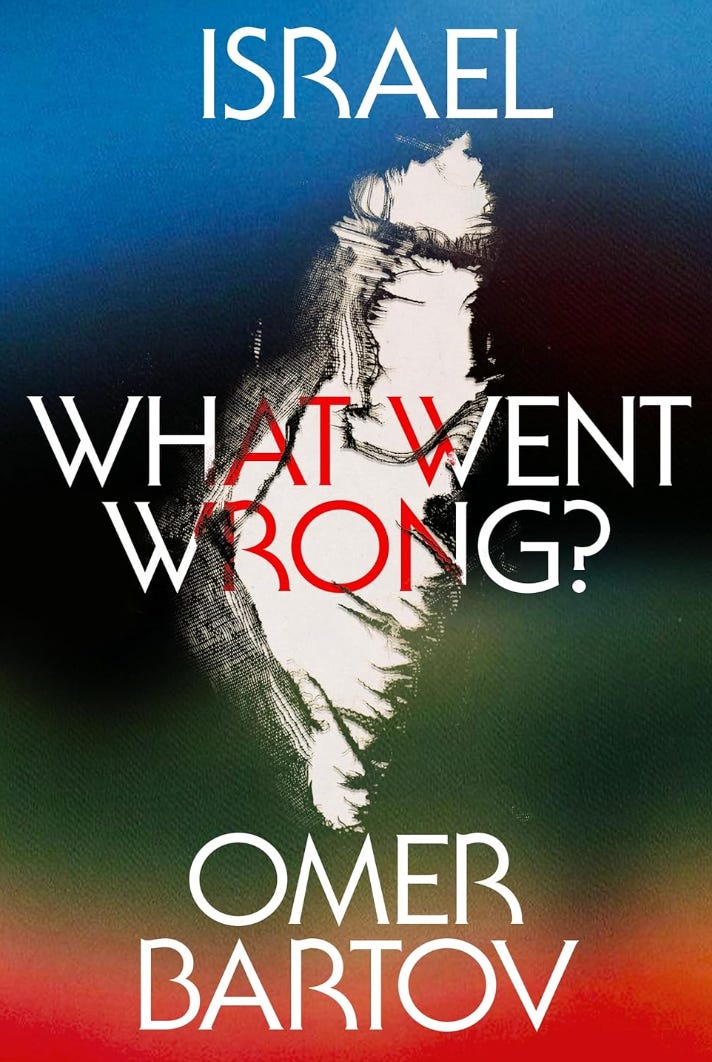
There’s little doubt that Jews are split on crucial matters involving Israel now. The killings of more than 70,000 people in Gaza, still others in Lebanon and still others at the hands of Israeli settlers or soldiers in the West Bank have many asking a version of “Israel: What Went Wrong?,” the title of a new book by an Israeli-born scholar teaching at Brown University, Omer Bartov.
Many American Jews disapprove of Israel’s conduct of the war in Gaza, with 61 percent saying Israel has committed war crimes, and about 4 in 10 saying the country is guilty of genocide against the Palestinians, according to a Washington Post poll from last fall. While more Israelis backed the Gaza actions, less than a third believe Israel won, and even fewer believe Hamas will lay down its arms, according to an Israeli poll published in January.
Among Jews in the U.S., opinions about Israel are particularly split by age. While 93 percent of those surveyed by Pew in the spring of 2024 condemned the Hamas attack that started the war, Jewish adults under 35 were divided over Israel’s military response: 52 percent said the way Israel carried out the war was acceptable, while 42 percent called it unacceptable, and 6 percent were unsure. Jews ages 50 and older were more likely to say Israel’s conduct of the war acceptable (68 percent).
So, lots of views. Can all be right? As it makes war so aggressively on its neighbors – albeit in response to real threats – can Israel’s actions be just and appropriate? Or has it lost the moral compass that once defined the nation along with its historically justified claims to the land, which underpinned Zionism?
Perhaps the most unsettling arguments come in Bartov’s new book. The work is especially troubling to defenders of Israeli because Bartov has a lot of street cred. A professor of Holocaust and genocide studies at Brown, he grew up in a Zionist home and served as an officer in the Israel Defense Forces during the Yom Kippur War in 1973. He argues that Zionism has morphed into an ideology of extremism that led in Gaza to genocide, a term he doesn’t use lightly.
Indeed, in the wake of the Oct. 7th savagery, Bartov published an opinion essay in The New York Times about Israel’s military response. “I believe that there is no proof that genocide is currently taking place in Gaza,” he wrote a month after the massacre, “although it is very likely that war crimes, and even crimes against humanity, are happening.”
But he has since then changed his view. Relying on a UN definition that says genocide involves acts carried out with the intent of destroying a particular group – whether national, ethnic, racial, or religious – he argues that Israel’s destruction in Gaza meets that tragic test.
As he told New Yorker editor David Remnick, Bartov notes that the population of Gaza lives in less than half of the territory now, with entire cities – such as Rafah – leveled. Unhoused, living in tents and with no infrastructure, the Gazans are “living there like dogs, and nobody is doing anything about it. The plan, the future of the genocide in Gaza seems to be to create a resort town for the rich and to have the Palestinians be the water carriers for that.”
But, long before the Gaza War, Bartov had doubts about how Zionism was evolving. “I served on the West Bank,” he said of his time in the IDF. “The sense, this question that you suddenly ask yourself, ‘What am I doing here? Why am I here? This is not my home.’ It would come up. I can’t say that it was a fully developed political understanding. It was a feeling that something was not right.”
Then, in the late 1980s with the outbreak of the first intifada when he was an officer in reserve, he was outraged by calls from the then-Minister of Defense, Yitzhak Rabin, to “go and break their bones.” He wrote Rabin a note comparing the IDF to the WWII Wehrmacht, referring to the process of brutalizing an army.
As many Israelis endorsed the idea of a two-state solution — or at least as Rabin saw it, a self-governing entity for Palestinians that was short of a full state – Bartov was more hopeful. That time, he recalled, was “the last moment of realism as opposed to messianism, which is what has taken over Israel now.”
But that ended with the assassination of Rabin in November 1995. “I remember it well because I was sitting there and holding my six-month-old daughter and crying, and I didn’t even like Rabin,” Bartov said. “He was the last hope, and he could have accomplished something because of his own record, because of his standing in Israeli society. I thought this is over for a generation. I was wrong because it’s more than a generation now, and things are only going the wrong way.”
Any chance of a course correction?
Bartov is pessimistic about change coming from within. As a New York Times reviewer noted, “he says that the leadership, whether Jewish or Palestinian, just isn’t there. Any initiative will have to come from the outside, and he credits President Trump for pressuring Prime Minister Benjamin Netanyahu to accept a 20-point plan last fall that at least gestures ‘toward a new political horizon.’” Even Germany, seeking its “greatest atonement” could play a role, he suggests.
As might be expected, ideas such as Bartov’s have their critics.
The American Jewish Committee, for instance, contends genocide – a term first used by a Polish Jewish lawyer to refer to the Nazis’ effort to destroy world Jewry – is a misnomer for the Gaza campaign. “Israel is not seeking to destroy the Palestinian people or the Palestinian population of Gaza, which is what would need to happen in order to correctly apply the term ‘genocide,’” the AJC maintains. “Israel’s leaders have repeatedly asserted that their campaign in Gaza is solely against the terrorist organization Hamas.”
Well, not all Israeli leaders say as much. If they don’t want to kill Palestinians, they at least want to drive them out.
“We must promote a solution to encourage the emigration of the residents of Gaza,” far-right National Security Minister Itamar Ben-Gvir said in 2024. And far-right Finance Minister Bezalel Smotrich, who also holds a position in the Defense Ministry, says that Israel “will rule there. And in order to rule there securely for a long time, we must have a civilian presence.” In other words, settlements much like those unsettling the West Bank.
And, as Bartov has noted, the big problem for Gazans is they have nowhere to go.
“The big difference between the Nakba of 1948 and what happened in ‘23, ‘24, ‘25 in Gaza is that at the time the borders were open, in ‘48, they could flee. They did flee, to Lebanon, to Jordan, to Syria,” the Holocaust and genocide scholar said. “In 2023, 2024, Israel, of course, did not open its borders. Egypt did not open its borders, and they had no place to flee. Ethnic cleansing, which was what the Israeli government wanted to carry out, became genocide.”

It’s all reminiscent of “Neighborhood Bully,” 1983 song about Israel by Bob Dylan (nee Zimmerman):
Well, he knocked out a lynch mob, he was criticized
Old women condemned him, said he should apologize
Then he destroyed a bomb factory, nobody was glad
The bombs were meant for him. He was supposed to feel bad
He’s the neighborhood bully.
Well, the chances are against it, and the odds are slim
That he’ll live by the rules that the world makes for him
‘Cause there’s a noose at his neck and a gun at his back
And a license to kill him is given out to every maniac
He’s the neighborhood bully.
Of course, Israel is surrounded by bullies who want nothing more than its destruction. Genocide for Israelis would be fine with them.
The synagogue that plans to remove its “We Stand with Israel” message will replace it with rotating banners. Some messages will be seasonal – “Shanah tovah!” around the holidays, for example. Others will be general, such as “BZBI: Where You Belong.” At times, it will display an “Am Yisrael Chai” banner, using a phrase that means “The People of Israel Live.”

“We look forward to having this new communication tool,” the rabbi wrote. “Rather than live under one banner, we will return again and again to davar acher, a new idea, a new approach.” That may accommodate several opinions.
Of course, it’s not clear what opinions will guide Israel’s future over time.
“Zionism is not reformable. The state of Israel is,” Bartov argues. “The state of Israel has to be reinvented, and it cannot be reinvented according to this ethnonationalist principle that has taken hold of it.… Israel, as a society, there has to be a society of all its citizens. As it was said at the time, in the 1990s, in the early 1990s, Eretz Kol Ezracheha, a country of all its citizens.”