A storied newspaper gets a lifeline
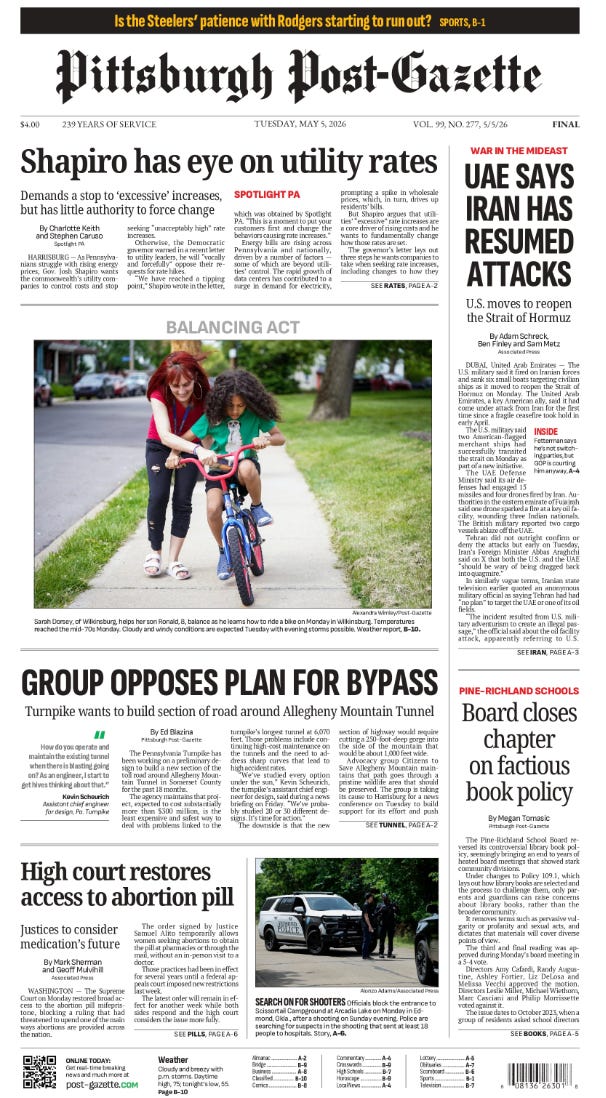
The Sunday, May 3, edition of the Pittsburgh Post-Gazette was supposed to be the 239-year-old paper’s last. But, since a Baltimore-based nonprofit came to the rescue, the PG has kept offering its regular mix of local, national and international news. It plans to do so, although mostly on its website, with print editions only on Sundays and Thursdays.
For Pittsburghers and anyone interested in seeing a well-informed public, that’s great news, of course.
Newspapers have been dying for decades, a trend accelerated by the onslaught of the Net and the advance of cellphones. Since 2005, the number of papers published in the United States has dropped from 7,325 to 4,490 now, according to the Medill State of Local News report. As AP reported, in the year leading up to October 2025 alone, some 136 papers shut down, with daily newspaper circulation now down to just over 15 million from an average of between 50 and 60 million people at the turn of the century.
And, not coincidentally, our politics have grown more demagogic and ill-informed. Donald J. Trump, a longtime hater of the press, seems to have persuaded millions of his followers that the news media is “the enemy of the American people,” as he famously started saying in 2017, mostly referring to broadcasters. He has escalated his attacks since, with his broadsides becoming “the tap water of his political rhetoric,” as The New York Times noted.
With such prominent assaults and declines in readership, is it any wonder that Americans’ confidence in the mass media has plummeted? That faith edged down to a new low last fall, with just 28 percent of those polled expressing a “great deal” or “fair amount” of trust in newspapers, television and radio to report the news fully, accurately and fairly, according to Gallup. This is down from 31% last year and 40% five years ago.

So, it is encouraging that the Venetoulis Institute swept in to keep the Post-Gazette alive. The nonprofit also owns The Baltimore Banner, a Pulitzer Prize-winning news site that – in contrast to other media outlets — has been expanding. Under the institute – named for former Baltimore County Executive and media champion Ted Venetoulis – the Banner has doubled its newsroom to about 80 journalists since 2022.
The Banner gives The Baltimore Sun a run for its money, offering readers a centrist alternative to the rightist environment now fostered at The Sun. The storied Sun, owned for a time by the media vultures at Alden Global Capital, in 2024 became a mouthpiece for the right-wing head of Sinclair Broadcast Group, David D. Smith, and Clarence Thomas chum Armstrong Williams.
As reported by NPR media correspondent David Folkenflik, The Sun now has no foreign bureaus and a far smaller newsroom. Local union officials pegged the number of journalists working there in 2024 at about 60, down from more than 300 when Folkenflik reported for the paper two decades earlier. Shortly before that, its newsroom topped 400 reporters.
And, according to Poynter, sentiment in the newsroom has dropped as the paper’s political tilt has shifted. “New ownership at the Sun has driven staff and some readers away. Since its former managing editor retired in June, at least 18 journalists have quit. Morale is low in the 56-person newsroom,” the journalism foundation reported early last year.
“Sinclair is known for forcing stories with a right-leaning agenda onto its more than 180 television stations across the country,” Poynter journalist Angela Fu reported. “Sinclair-acquired stations increase their coverage of national politics at the expense of local politics, a 2019 study found, and coverage overall undergoes a significant rightward shift.’”
The Banner won a Pulitzer in 2025 for a series of pieces that likely would not have appeared in The Sun. As the Pulitzer folks described it, the package was a “compassionate investigative series that captured the breathtaking dimensions of Baltimore’s fentanyl crisis and its disproportionate impact on older Black men, creating a sophisticated statistical model that The Banner shared with other newsrooms.”
Before the current owners took over, The Sun in a 2022 editorial apologized for having, “sharpened, preserved and furthered the structural racism that still subjugates Black Marylanders in our communities today.” The paper added that “Reporting that arises directly from sources in the region’s Black communities has long been lacking in The Sun, largely because the connection is lacking. We’re not out there enough, and we’re not trusted enough. We are working on that, and looking into an impression some hold that The Sun is harder on Black officials than white.”
Now, however, The Sun seems to be adopting the “if it bleeds, it leads” approach taken by Sinclair’s Baltimore TV station, WBFF, a Fox affiliate, the City Journal reported. That style appears to exploit Black community problems, rather than explore them.
“The Sun has moved closer to that sensibility, with a ‘Spotlight on Maryland’ TV–newspaper partnership that highlights stories such as police ignoring drug crimes even after mass overdoses,” the City Journal said. “The paper’s reporters have covered juveniles arrested and released with no oversight, ready to commit violent crimes again. Instead of glossing over those stories, the paper asks bluntly, ‘How did that happen?’”
A retired Sun reporter, Michael Hill, told NPR that the formula reflects a business judgment about who the paper serves. “They have picked an audience they want, which is a suburban audience, and they want to tell them how terrible the city is, and that they’re right to live in the suburbs,” Hill said. “And that, I think, is their sort of commercial approach that is reflected in their news business.”
A former staffer at the TV station put the approach this way: “You amplify the negativity.”
Regardless of a media outlet’s political slant, the question arises about whether its staffing gives it the firepower it needs to do its work well. Fifty-six journalists just can’t be in as many places as 400.
Despite the lifeline that Venetoulis has thrown the Post-Gazette, staffing has been hit hard. About 40 percent of the roughly 120-member news staff were recently told that their jobs are gone, according to the Columbia Journalism Review. “I don’t know how the Post-Gazette is going to cover a city the size of Pittsburgh, effectively, with half the staff,” a now-former PG reporter Andrew “Goldy” Goldstein told CJR.
The same can be said of cities all over the country.
The Los Angeles Times, which boasted more than 1,200 journalists just before the turn of the century, is down to perhaps 235 now. The Boston Globe gets by with less than half the 550 journalists it employed in 2002, while The Philadelphia Inquirer’s 200-member news staff is down from 700. The Denver Post makes do with a news staff that was cut in the last decade from above 300 to an estimated 75 or so, according to Westword.
Recall that in Denver, the Post’s longtime rival, the Rocky Mountain News, folded in 2009. (Full disclosure: I worked as a reporter at the Rocky in the first half of the 1980s, an exhilaratingly fierce newspaper war period.)
The problem with such reductions in forces, of course, is that readers don’t know what exactly they are missing – but they can see that the menu is smaller. It’s obvious that once-fat newspapers are thinner (and that their websites carry comparatively few articles).
But subscribers don’t know that, for instance, local town council meetings may not be followed closely unless there’s a major scandal. They may have a sense that feature pages are skimpier now, but there’s no real count on column inches that anyone can cite.
And, since newspapers are offering less, no one should be surprised that readership is down, along with credibility. Give people thin soup and they’ll look for something else – especially when their phones are packed with plenty to read and watch, even if much of it is trash.

To be sure, the technology changes have created enormous opportunities for news coverage, too. State governments, for instance, are well covered by online affiliates of the nonprofit States Newsroom. The Nebraska Examiner, one such affiliate, reshaped the state’s governor’s race in 2022 by reporting on sordid doings by the Trump-backed leading Republican., for instance.
And online operations such as Nebraska’s Flatwater Free Press and The Colorado Sun fill in some of the gaps created by the declines of The Omaha World-Herald and The Denver Post – even though the newcomers’ small staffs simply can’t be in as many places as sprawling reporting staffs once were.
It’s also clear that top-notch journalism is still getting done. Just check out the Pulitzer Prizes recently awarded.
The Washington Post, beleaguered by cuts imposed by owner Jeff Bezos, topped the list with its Public Service Pulitzer for reporting on the Trump Administration’s “chaotic overhaul of federal agencies and chronicling in rich detail the human impacts of the cuts and the consequences for the country.” The New York Times took the award for investigative reporting with “deeply reported stories that exposed how President Trump has shattered constraints on conflicts of interest and exploited the moneymaking opportunities that come with power, enriching his family and allies.” And Reuters won the national reporting prize for “documenting how the president used the U.S. government and the influence of his supporters to expand executive power and exact vengeance on his foes.”
None of the awards will endear Trump to those news outlets – and supporters of the president would likely look on them as proof of the media’s bias against their boy. But the fact-based journalism in those pieces also demonstrates how independent reporting can — indeed must — hold people in power to account.
Over its history, the Post-Gazette has won three Pulitzers, snaring its last one in 2019 for breaking news reporting on the massacre at the Tree of Life synagogue. The Pulitzer judges saluted the paper’s “immersive, compassionate coverage of the massacre … that captured the anguish and resilience of a community thrust into grief.”
With Venetoulis behind it now – and the possibility that the PG’s shrunken staff could grow again – perhaps the paper will soon capture another such prize. Count it already as a victory that the paper won’t disappear.