Read all about it

A storied newspaper gets a lifeline
Joseph Weber

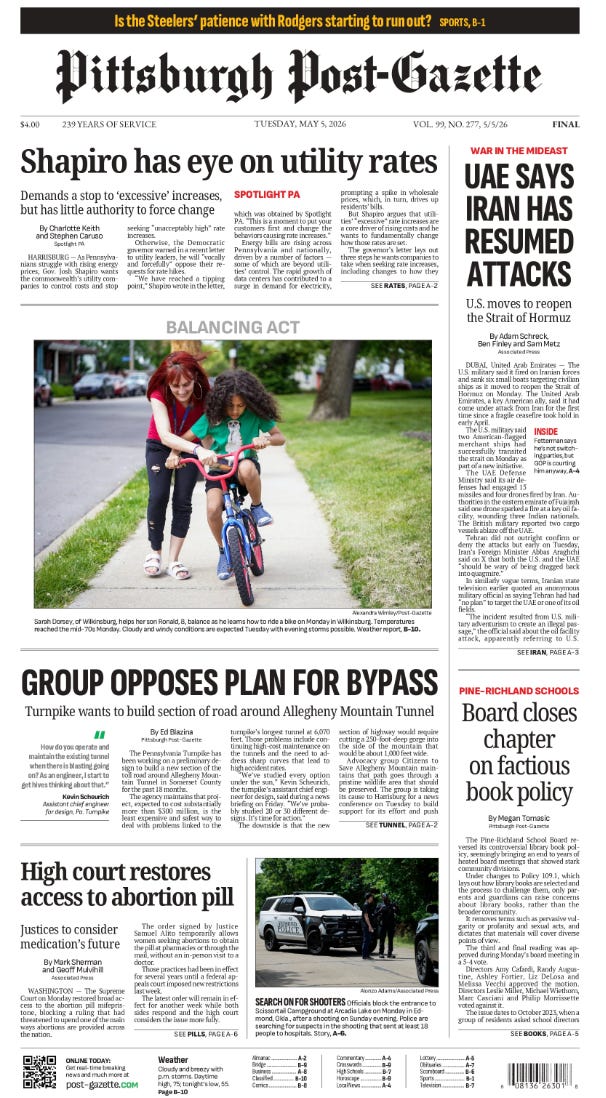
The Sunday, May 3, edition of the Pittsburgh Post-Gazette was supposed to be the 239-year-old paper’s last. But, since a Baltimore-based nonprofit came to the rescue, the PG has kept offering its regular mix of local, national and international news. It plans to do so, although mostly on its website, with print editions only on Sundays and Thursdays.

For Pittsburghers and anyone interested in seeing a well-informed public, that’s great news, of course.

Newspapers have been dying for decades, a trend accelerated by the onslaught of the Net and the advance of cellphones. Since 2005, the number of papers published in the United States has dropped from 7,325 to 4,490 now, according to the Medill State of Local News report. As AP reported, in the year leading up to October 2025 alone, some 136 papers shut down, with daily newspaper circulation now down to just over 15 million from an average of between 50 and 60 million people at the turn of the century.

And, not coincidentally, our politics have grown more demagogic and ill-informed. Donald J. Trump, a longtime hater of the press, seems to have persuaded millions of his followers that the news media is “the enemy of the American people,” as he famously started saying in 2017, mostly referring to broadcasters. He has escalated his attacks since, with his broadsides becoming “the tap water of his political rhetoric,” as The New York Times noted.

With such prominent assaults and declines in readership, is it any wonder that Americans’ confidence in the mass media has plummeted? That faith edged down to a new low last fall, with just 28 percent of those polled expressing a “great deal” or “fair amount” of trust in newspapers, television and radio to report the news fully, accurately and fairly, according to Gallup. This is down from 31% last year and 40% five years ago.

Source: Gallup

So, it is encouraging that the Venetoulis Institute swept in to keep the Post-Gazette alive. The nonprofit also owns The Baltimore Banner, a Pulitzer Prize-winning news site that – in contrast to other media outlets — has been expanding. Under the institute – named for former Baltimore County Executive and media champion Ted Venetoulis – the Banner has doubled its newsroom to about 80 journalists since 2022.

The Banner gives The Baltimore Sun a run for its money, offering readers a centrist alternative to the rightist environment now fostered at The Sun. The storied Sun, owned for a time by the media vultures at Alden Global Capital, in 2024 became a mouthpiece for the right-wing head of Sinclair Broadcast Group, David D. Smith, and Clarence Thomas chum Armstrong Williams.

As reported by NPR media correspondent David Folkenflik, The Sun now has no foreign bureaus and a far smaller newsroom. Local union officials pegged the number of journalists working there in 2024 at about 60, down from more than 300 when Folkenflik reported for the paper two decades earlier. Shortly before that, its newsroom topped 400 reporters.

And, according to Poynter, sentiment in the newsroom has dropped as the paper’s political tilt has shifted. “New ownership at the Sun has driven staff and some readers away. Since its former managing editor retired in June, at least 18 journalists have quit. Morale is low in the 56-person newsroom,” the journalism foundation reported early last year.

“Sinclair is known for forcing stories with a right-leaning agenda onto its more than 180 television stations across the country,” Poynter journalist Angela Fu reported. “Sinclair-acquired stations increase their coverage of national politics at the expense of local politics, a 2019 study found, and coverage overall undergoes a significant rightward shift.’”

The Banner won a Pulitzer in 2025 for a series of pieces that likely would not have appeared in The Sun. As the Pulitzer folks described it, the package was a “compassionate investigative series that captured the breathtaking dimensions of Baltimore’s fentanyl crisis and its disproportionate impact on older Black men, creating a sophisticated statistical model that The Banner shared with other newsrooms.”

Before the current owners took over, The Sun in a 2022 editorial apologized for having, “sharpened, preserved and furthered the structural racism that still subjugates Black Marylanders in our communities today.” The paper added that “Reporting that arises directly from sources in the region’s Black communities has long been lacking in The Sun, largely because the connection is lacking. We’re not out there enough, and we’re not trusted enough. We are working on that, and looking into an impression some hold that The Sun is harder on Black officials than white.”

Now, however, The Sun seems to be adopting the “if it bleeds, it leads” approach taken by Sinclair’s Baltimore TV station, WBFF, a Fox affiliate, the City Journal reported. That style appears to exploit Black community problems, rather than explore them.

“The Sun has moved closer to that sensibility, with a ‘Spotlight on Maryland’ TV–newspaper partnership that highlights stories such as police ignoring drug crimes even after mass overdoses,” the City Journal said. “The paper’s reporters have covered juveniles arrested and released with no oversight, ready to commit violent crimes again. Instead of glossing over those stories, the paper asks bluntly, ‘How did that happen?’”

A retired Sun reporter, Michael Hill, told NPR that the formula reflects a business judgment about who the paper serves. “They have picked an audience they want, which is a suburban audience, and they want to tell them how terrible the city is, and that they’re right to live in the suburbs,” Hill said. “And that, I think, is their sort of commercial approach that is reflected in their news business.”

A former staffer at the TV station put the approach this way: “You amplify the negativity.”

Regardless of a media outlet’s political slant, the question arises about whether its staffing gives it the firepower it needs to do its work well. Fifty-six journalists just can’t be in as many places as 400.

Despite the lifeline that Venetoulis has thrown the Post-Gazette, staffing has been hit hard. About 40 percent of the roughly 120-member news staff were recently told that their jobs are gone, according to the Columbia Journalism Review. “I don’t know how the Post-Gazette is going to cover a city the size of Pittsburgh, effectively, with half the staff,” a now-former PG reporter Andrew “Goldy” Goldstein told CJR.

The same can be said of cities all over the country.

The Los Angeles Times, which boasted more than 1,200 journalists just before the turn of the century, is down to perhaps 235 nowThe Boston Globe gets by with less than half the 550 journalists it employed in 2002, while The Philadelphia Inquirer’s 200-member news staff is down from 700The Denver Post makes do with a news staff that was cut in the last decade from above 300 to an estimated 75 or so, according to Westword.

Recall that in Denver, the Post’s longtime rival, the Rocky Mountain News, folded in 2009. (Full disclosure: I worked as a reporter at the Rocky in the first half of the 1980s, an exhilaratingly fierce newspaper war period.)

The problem with such reductions in forces, of course, is that readers don’t know what exactly they are missing – but they can see that the menu is smaller. It’s obvious that once-fat newspapers are thinner (and that their websites carry comparatively few articles).

But subscribers don’t know that, for instance, local town council meetings may not be followed closely unless there’s a major scandal. They may have a sense that feature pages are skimpier now, but there’s no real count on column inches that anyone can cite.

And, since newspapers are offering less, no one should be surprised that readership is down, along with credibility. Give people thin soup and they’ll look for something else – especially when their phones are packed with plenty to read and watch, even if much of it is trash.

Source: Nebraska Examiner

To be sure, the technology changes have created enormous opportunities for news coverage, too. State governments, for instance, are well covered by online affiliates of the nonprofit States Newsroom. The Nebraska Examiner, one such affiliate, reshaped the state’s governor’s race in 2022 by reporting on sordid doings by the Trump-backed leading Republican., for instance.

And online operations such as Nebraska’s Flatwater Free Press and The Colorado Sun fill in some of the gaps created by the declines of The Omaha World-Herald and The Denver Post – even though the newcomers’ small staffs simply can’t be in as many places as sprawling reporting staffs once were.

It’s also clear that top-notch journalism is still getting done. Just check out the Pulitzer Prizes recently awarded.

The Washington Post, beleaguered by cuts imposed by owner Jeff Bezos, topped the list with its Public Service Pulitzer for reporting on the Trump Administration’s “chaotic overhaul of federal agencies and chronicling in rich detail the human impacts of the cuts and the consequences for the country.” The New York Times took the award for investigative reporting with “deeply reported stories that exposed how President Trump has shattered constraints on conflicts of interest and exploited the moneymaking opportunities that come with power, enriching his family and allies.” And Reuters won the national reporting prize for “documenting how the president used the U.S. government and the influence of his supporters to expand executive power and exact vengeance on his foes.”

None of the awards will endear Trump to those news outlets – and supporters of the president would likely look on them as proof of the media’s bias against their boy. But the fact-based journalism in those pieces also demonstrates how independent reporting can — indeed must — hold people in power to account.

Over its history, the Post-Gazette has won three Pulitzers, snaring its last one in 2019 for breaking news reporting on the massacre at the Tree of Life synagogue. The Pulitzer judges saluted the paper’s “immersive, compassionate coverage of the massacre … that captured the anguish and resilience of a community thrust into grief.”

With Venetoulis behind it now – and the possibility that the PG’s shrunken staff could grow again – perhaps the paper will soon capture another such prize. Count it already as a victory that the paper won’t disappear.

“All of Germany hears the Fuhrer”

Trump’s war on the press has antecedents

German poster promoting the People’s Receiver. It reads “All of Germany hears the Führer with the People’s Receiver.” Source: U.S. Holocaust Memorial Museum

Germany in the early 1930s was a global leader in mass communications. It had more newspapers than other European nations and an influential film industry, one of the world’s largest. But, as we all know, Adolf Hitler soon trampled on all that.

“Within months of Hitler becoming chancellor, his regime destroyed the country’s free press,” historians at the U.S. Holocaust Memorial Museum report. “It shut down hundreds of opposition newspapers. The propaganda ministry issued daily orders dictating what could be published. Oversight of radio, film, newsreels, theater, and music likewise fell under its rule… After 1933, the Nazi regime broadcast propaganda over the radio to homes, factories, and even city streets.”

Hitler’s propaganda chief, Joseph Goebbels, made his intentions clear in a speech at the Reich Broadcasting Co. on March 25, 1933. “We make no secret of it: broadcasting belongs to us, no one else,” he said. “And we will place broadcasting in the service of our ideas, and no other idea will be given a chance to speak.”

Are we seeing a similar effort now in Donald J. Trump’s Washington? Recall that the president made attacking the press a pillar of both his presidential campaigns and a hallmark of his first term in office. To Trump, the media are “truly the enemy of the people.” And, certainly, he now is doing his best to stifle American journalism, both domestically and abroad.

Source: AP

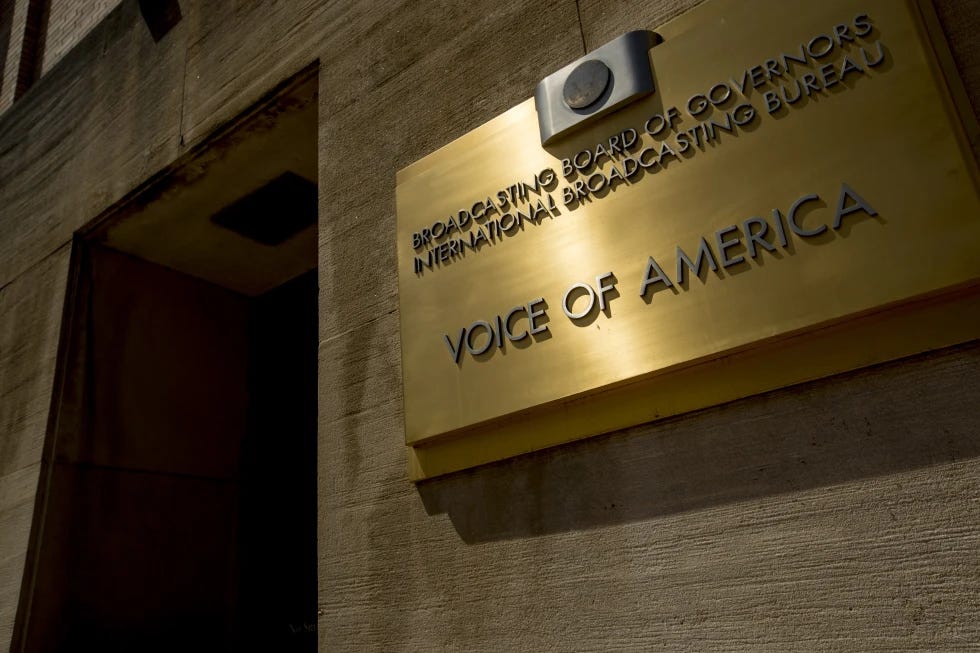
Internationally, Trump has just all but shuttered the Voice of America, using an executive order to put on leave some 1,300 journalists there. All full-time staffers at the VOA and the Office for Cuba Broadcasting, which runs Radio and Television Martí, were affected, as NPR reported. The move followed a late Friday night edict from President Trump that the VOA’s parent agency, the U.S. Agency for Global Media, must eliminate all activities that are not required by law (it’s a minor inconvenience for Trump that Congress chartered the agency).

VOA delivers news coverage to countries where a free press is threatened or nonexistent, according to The Washington Post. “At its start, VOA told stories about democracy to people in Nazi Germany,” the paper reported. “VOA and affiliates such as Radio Free Europe and Radio Free Asia are designed as a form of soft diplomacy, a way to tout the United States’ free-press values in countries where antidemocratic forces prevail.”

The service’s impact, has been huge. In effect, it has carried America’s pro-democratic and free-press values to some 420 million people in 63 languages and more than 100 countries each week.

“VOA promotes freedom and democracy around the world by telling America’s story and by providing objective and balanced news and information, especially for those living under tyranny,” the now-suspended VOA director Michael Abramowitz, wrote in a post on social media. “For more than 80 years, Voice of America has been a priceless asset for the United States, playing an essential role in the fight against communism, fascism, and oppression, and in the fight for freedom and democracy around the world.”

But as it has covered antidemocratic regimes that Trump admires, such as those in Russia and Hungary, the service appears to have offended the president. “It is another chilling sign of Trump’s desire to upend the U.S.’s relationship with the world, press freedom advocates say — and to eliminate the flow of information he doesn’t like,” The Washington Post reported.

Of course, Trump can’t directly control what America’s independent media say about him — but he’s doing his best.

He has barred the Associated Press and Reuters from some White House events, for instance. His White House substituted two Trump-friendly outlets, Newsmax and Blaze Media, in the small group of correspondents who have access to the Oval Office for some press conferences. The press office ousted HuffPost from the group after one of its reporters posed a critical question to Trump on Air Force One.

He’s also using his bully pulpit to bludgeon critical outlets, habitually singling out some for verbal whippings. In his recent Justice Department speech, he said: “I believe that CNN and MSDNC, who literally write 97.6% bad about me, are political arms of the Democrat Party. And in my opinion, they are really corrupt and they are illegal. What they do is illegal.” Of course, he meant MSNBC, using his trademark — and juvenile — slur style for it.

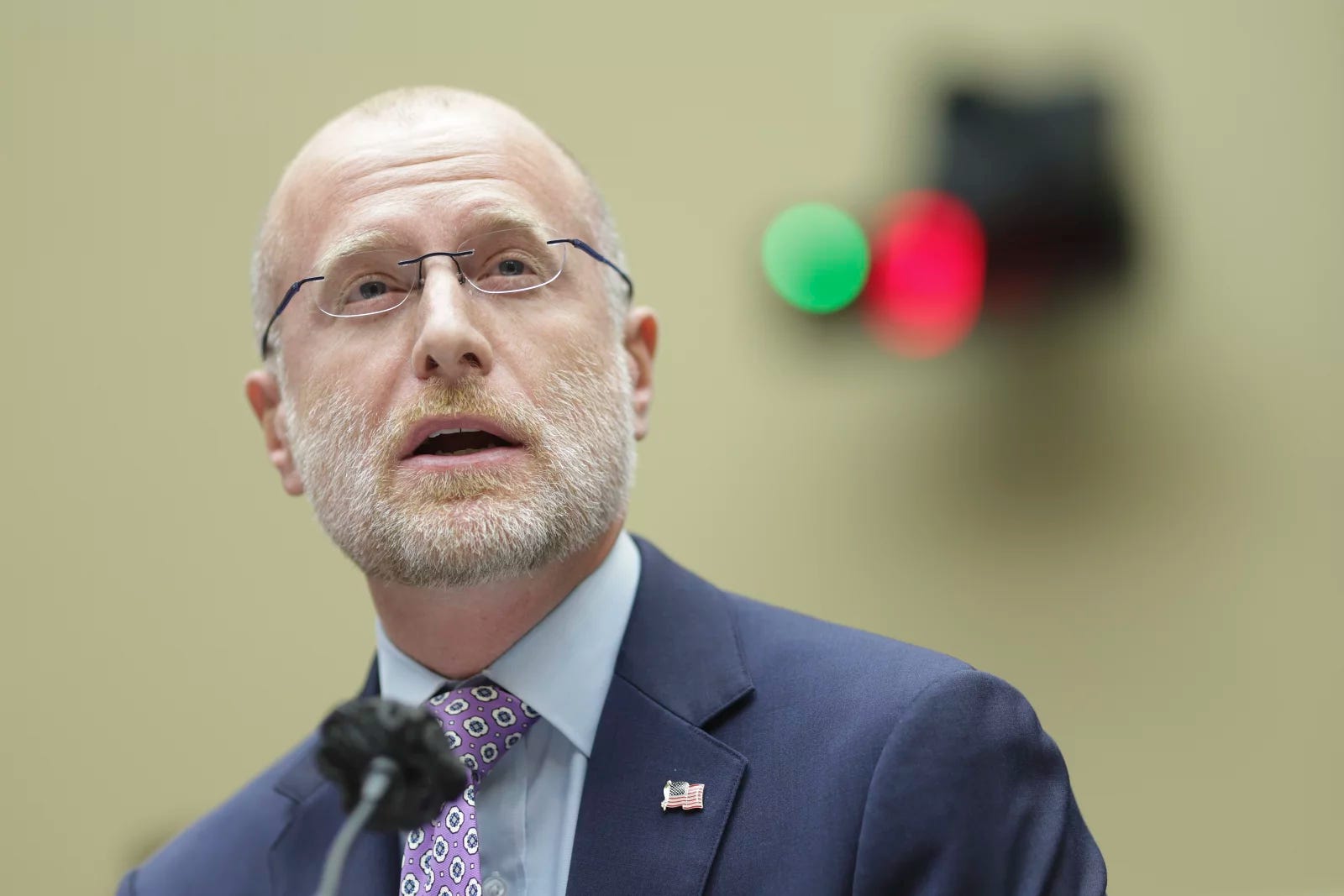
Brendan Carr, source: NPR

But, as Just Security has recounted, Trump has also moved far beyond words. His Federal Communications Commission reinstated previously dismissed complaints against CBS, NBC, and ABC relating to Trump’s claims of unfair pre-election coverage. FCC chief Brendan Carr, who wrote the Project 2025 chapter on the commission, also launched an investigation into National Public Radio (NPR) and the Public Broadcasting Service (PBS), following up on Trump’s repeated calls to yank broadcasting licenses of outlets he disdains.

NPR, in particular, is facing an assault by Trump minion (or, perhaps, puppetmaster) Elon Musk “Defund NPR,” Musk wrote on X. “It should survive on its own.” Carr’s FCC probe is attacking the legality of the radio network’s underwriting. And in petty slights, the Department of Defense ordered NPR, The Washington Post, CNN and The Hill to give up their offices at the Pentagon. Trump-friendly Breitbart News will fill NPR’s space, while Newsmax replaces CNN and The Free Press replaces The Hill.

Earlier, Trump brought a $20 billion lawsuit against CBS for its “60 Minutes” pre-election show, alleging “partisan and unlawful acts of voter interference.” He took umbrage at an October 2024 interview with then Vice-President Kamala Harris. Even as it has pursued a settlementCBS-parent Paramount is seeking dismissal of the suit. Meanwhile, Trump sicced his FCC on the network with an investigation. The stakes are high for Paramount, as it depends on Washington for a proposed merger with Skydance Media.

Before taking control of various levers of power in Washington, Trump sued a slew of publishers, broadcasters, and platforms including MetaABCCBS, and Gannett’s Des Moines Register. As Just Security reported, Meta settled with Trump for $25 million, Disney parent ABC settled for $15 million. Both had business and legal reasons – not journalistic ones — for settling. Meta chief Marc Zuckerberg has been cozying up to the president, perhaps hoping that he will quash a multistate lawsuit against Meta that the Federal Trade Commission, for now, is leading. And Disney could have faced a hostile jury in Florida.

Trump has also cowed Jeff Bezos, the owner of The Washington Post who triggered an exodus among subscribers and several editorial page departures by forcing the paper’s editorial page to be less critical of Trump. Let’s remember that in 2018, Trump threatened to punish Bezos’s Amazon, possibly by changing its tax treatment.

To be sure, the Trump onslaught has ignited some pushback — although it’s an open question about how effective statements of protest can be against someone who wields the power of Washington.

Some 40 media organizations on Feb. 21 issued a joint statement condemning his efforts in barring AP from the White House press pool. “When leaders try to silence reporters through intimidation, legal threats and denial of access, they are not protecting the country; they are protecting themselves from scrutiny,” the statement said. “This is how authoritarian regimes operate — by crushing dissent, punishing those who expose inconvenient facts and replacing truth with propaganda.”

Recall that Trump imperiously barred AP from the press pool because he was offended that it refused to refer to the “Gulf of Mexico” as the “Gulf of America,” as he unilaterally coined it. AP is continuing to pursuit a lawsuit in the matter. And, fortunately, the judge handling the case has suggested that Trump might lose that fight, saying: “It might be a good idea for the White House to think about whether what they’re doing is really appropriate given the case law.”

There’s even more to be concerned about than the exclusion of reporters. The Trump Administration is training its guns on what has been reliable government information. Its efforts could mask the economic effects of Trump’s antigovernment and economy-dampening measures, such as tariffs.

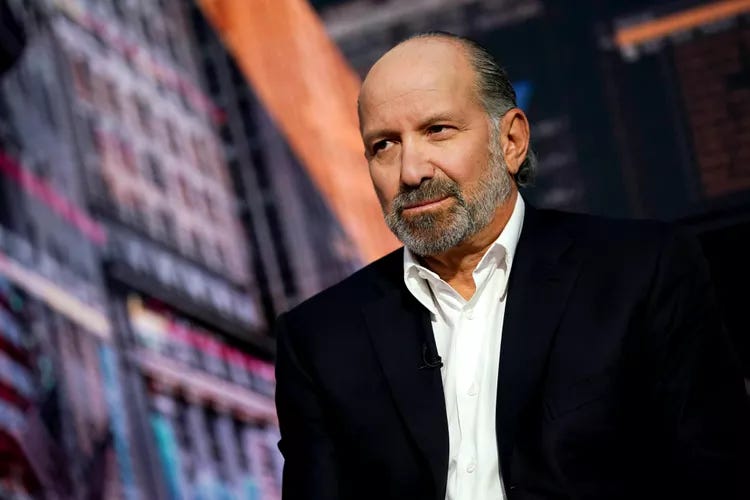
Howard Lutnick, source: Bloomberg

Trump’s Commerce Department Secretary, Howard Lutnick, wants statisticians to remove government spending from reports of gross domestic product. Federal government spending accounts for about 6.5% of GDP and it contributed 0.25 percentage point to the economy’s 2.3% annualized growth rate in the fourth quarter, according to Reuters.

The Society for Advancing Business Editing and Writing, a nationwide group of business journalists, warned that this “raises the possibility that GDP and other economic data will be distorted, particularly if the Bureau of Economic Analysis eliminates the government accounts from its releases.” In other words, Lutnick wants to monkey with the data to put a happier face on a likely economic slowdown in the coming year, a contraction that may top 2 percent in the opening quarter, according to the Federal Reserve Bank of Atlanta.

“We don’t think it is a coincidence that the administration has curbed access to the White House for Bloomberg, Reuters and the Associated Press while simultaneously suggesting it may want to obscure the effect of its cost-cutting measures on the overall economy,” SABEW said. “There is the potential for long-term damage to the public’s right to know what’s going on with the economy – and the ability to make sound decisions based on accurate, complete data.”

Cooking the books has some history with Trump. Recall that the Trump Organization was convicted in 2022 on 17 counts of criminal tax fraud and falsifying business records. His chief financial officer, Allen Weisselberg, was jailed for five months in connection with lying for his boss. And separately Trump personally was convicted last year on 34 felony counts based on falsifying business records to cover up hush money payments to a porn star.

After Hitler came to power, he used the might of the state to crush dissent. Is it overwrought to contend that Trump is doing the same now, albeit by more subtle means than seizing the media outright? Trump’s approach seems more akin to that of Hungarian despot Viktor Orbán, who has used media buyouts by government-friendly oligarchs to control the messages Hungarians hear.

“He’s a very great leader, very strong man,” Trump has said of Orbán, who has held power as Hungary’s prime minister since 2010, with a prior four-year stint from 1998-2002. “Some people don’t like him ’cause he’s too strong.”

Of course, Trump sees himself in the same mold. Trump, whom critics see as delusional on many fronts, has also cast himself as akin to another strong leader, Britain’s Sir Winston Churchill.

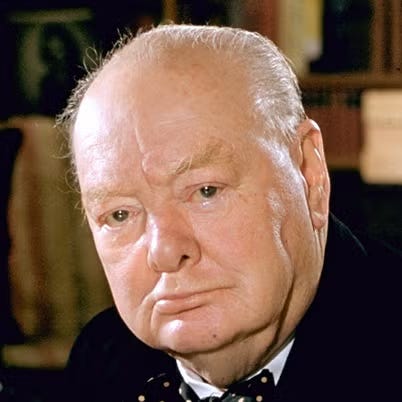
Churchill, source: Biography

But, before going into politics, Churchill worked as a journalist. As a part-time war correspondent, he traveled to Cuba, Afghanistan, Egypt and South Africa. And, while he insisted on wartime censorship for military reasons, he also defended the press.

“A free Press is the unsleeping guardian of every other right that free man prize; it is the most dangerous foe of tyranny,” Churchill reportedly said in 1949. “Where men have the habit of liberty the Press will continue to be the vigilant guardian of the rights of the ordinary citizen.”

By contrast, Trump has nothing but loathing for the liberty of the Press.