
… but Nebraska’s version isn’t quite so endearing
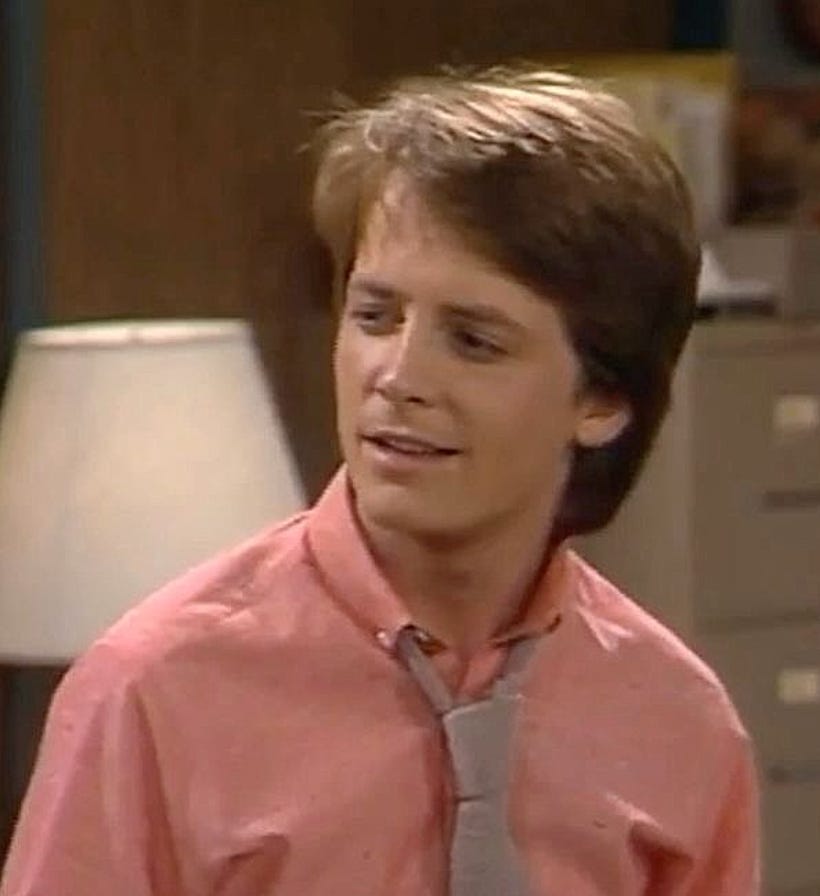
In the 1980s, Michael J. Fox earned his acting spurs in “Family Ties,” a sitcom in which he played Alex P. Keaton, the right-wing young son of a pair of ex-hippies. Throughout the show’s seven-season run, the buttoned-down tie-wearing character clung to Reagan-style conservatism.
But Fox in 2020 said Keaton would have shunned Donald J. Trump. George W. Bush or Mitt Romney might have flown, perhaps, but not Trump.
I’m reminded of this because Robert B. “Bob” Evnen, a fellow we knew in Lincoln, Nebraska, was something of a Keaton-like figure to his family. While Bob’s family consisted mostly of liberal Jews, he took a different path. An attorney schooled at the liberal-leaning Gould School of Law at USC, he became a fire-breathing MAGA-backing rightist who got quite active in Nebraska Republican politics.
One longtime friend of his family once bemoaned Bob’s turn from his family’s values. How could this black sheep have gone so far astray, she wondered?
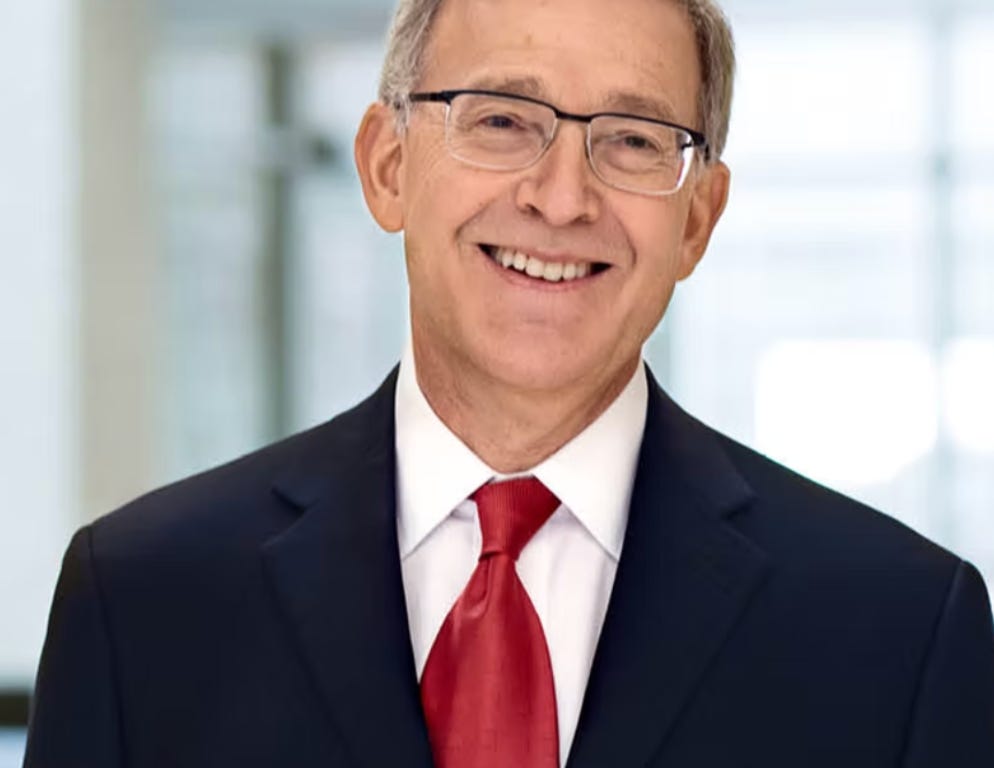
But Bob’s shift certainly paid off for him professionally. He won election as Nebraska’s Secretary of State first in 2018 and again in 2022. He’s now seeking a third term, with three candidates – one Republican and two Democrats – vying to take his job in a May 12 primary. He recently emailed me, seeking my vote, even though, as a resident of Colorado now, I no longer vote in Nebraska.
Not that he’d get my vote anyway.
Bob is a fascinating study in how enablers of Donald J. Trump – often otherwise bright people – contort themselves so they can ride on the coattails of the president and other highly placed Trump toadies. They do so despite facts and logic, sometimes despite their own experiences.
They do so, perhaps, because opportunism pays off.
For instance, Bob won the state post in 2018 championing requirements that voters in Nebraska show identification in order to vote. Never mind that the numbers on voter fraud in the state – and nationally for that matter – were and continue to be minuscule.
One group that tracks such voter fraud cases listed just two Nebraska men who voted twice in 2016, each once by mail and once in person. No cases were listed for any other year except 2020, when three members of one family voted in one county while living in another.
In that 2020 Nebraska case, prosecutors said the family patriarch had become angry with the village board in a nearby community where he owned several properties but didn’t live. The board had passed an ordinance pertaining to junk on lots and nuisance properties. The man, who presumably voted against the board candidates, was fined $10,000 while his son and daughter-in-law got probation.
Voter ID, which Nebraskans endorsed by ballot question in 2022 and which was enacted into law in mid-2023, may have prevented the man from voting. Indeed, on its face, voter ID seems as reasonable as requiring a driver’s license or some other photo identification to buy booze or fly.
Bob claims he wrote the state’s voter ID law, by the way, though it appears that a few more folks were involved. His staff and a legislative committee, for instance, had their hands in.
Of course, facts are slippery things with MAGA folks. More important, as the League of Women Voters noted, the issue is that time and time again, voter photo ID laws have proven ineffective in fighting voter fraud — in the rare instances it does take place.
“While voter photo ID laws aim to prevent in-person voter impersonation, an almost non-existent form of voter fraud, other types of voter impersonation are similarly rare and not cause for significant concern,” the league reported. “According to the Brennan Center, the rate of in-person voter impersonation is extremely low: only 0.00004% of all ballots cast. It’s worth noting that this rate is even significantly lower than other rare forms of voter fraud, such as absentee ballot fraud, which voter photo ID laws do not address.”
Indeed, the league traced the history of such efforts as voter ID laws back to the Jim Crow era in the South. That was “when many states employed various tactics — including literacy tests, poll taxes, and extralegal measures such as violence and intimidation — to prevent Black Americans from voting. Following the enactment of the Voting Rights Act (VRA) in 1965, many of these tactics were outlawed, but efforts to restrict voting access persisted, including implementing voter ID laws.”
Voter ID measures also restrict voting by Native American communities, low-income, elderly, and rural voters, according to the league. “This is partially because photo IDs aren’t as common as many people assume: 18 percent of all citizens over the age of 65, 16 percent of Latino voters, 25 percent of Black voters, and 15 percent of low-income Americans lack acceptable photo ID.”
But, on the right, fraudulent voting remains a hot-button issue. That’s chiefly because Trump – egomaniac that he is – could not believe that he lost the 2020 election to Joe Biden. Even today, he espouses the lie that really he won.
In a laughable case of “how far right can I be?,” Bob Evnen faced a couple Republican opponents in the 2022 primary who attacked the integrity of the vote in Nebraska in 2020. His state post then included ensuring an honest election.
Both of Bob’s opponents had based their campaigns on claims that the state’s vote-counting machines had been compromised, the Nebraska Examiner reported. They argued that fraudulent voting had occurred on Bob’s watch. Both questioned whether Biden had truly won an electoral vote in Nebraska’s 2nd Congressional District, where he outpolled Trump by more than 22,000 votes.
But Bob, a former general counsel for the Nebraska Republican Party, maintained that he had fully investigated all the claims by the two and by a group called the Nebraska Voter Accuracy Project and found no validity to any of them, the news outlet reported.
Had Bob faced just one of the other GOP primary contenders, it’s an open question whether he would have won. Together, the two garnered just over 56 percent of the party vote, though they split the voting with smaller shares each, of course, leaving Bob to prevail with just under 44 percent of his party’s support.
Ah, the delicious irony. What goes around comes around, eh Bob? Of course, he coasted to success in the fall 2022 general election in heavily red Nebraska with no opposition from Democrats or others.
But this is a drum that even today Bob keeps beating, usually as he marches in lockstep with Trump. For instance, he praised a presidential executive order titled “Preserving and Protecting the Integrity of American Elections” as opening “a new and hopeful chapter.”
Trump signed the executive order in late March of last year, aligning it with a House Republican priority to pass the Safeguard American Voter Eligibility Act. The SAVE Act would require proof of citizenship in federal elections. While the House passed that act, it is expected to die in the Senate.
Election watchdogs have said that some MAGA Republicans base their contentions about fraud at the ballot box on the “myth” of widespread voting by non-citizens. That’s so even though the Heritage Foundation, a conservative think tank, analyzed election conduct from 2000 to 2025 and found just 99 instances nationally of noncitizens voting out of hundreds of millions of votes cast.
Still, this bogeyman remains one Bob is happy to raise, even as he lets in just a smidge of daylight between himself and Trump. “It’s very important that we assure ourselves that non-citizens are not voting,” Bob recently said. “But we don’t need to nationalize elections to do it.”
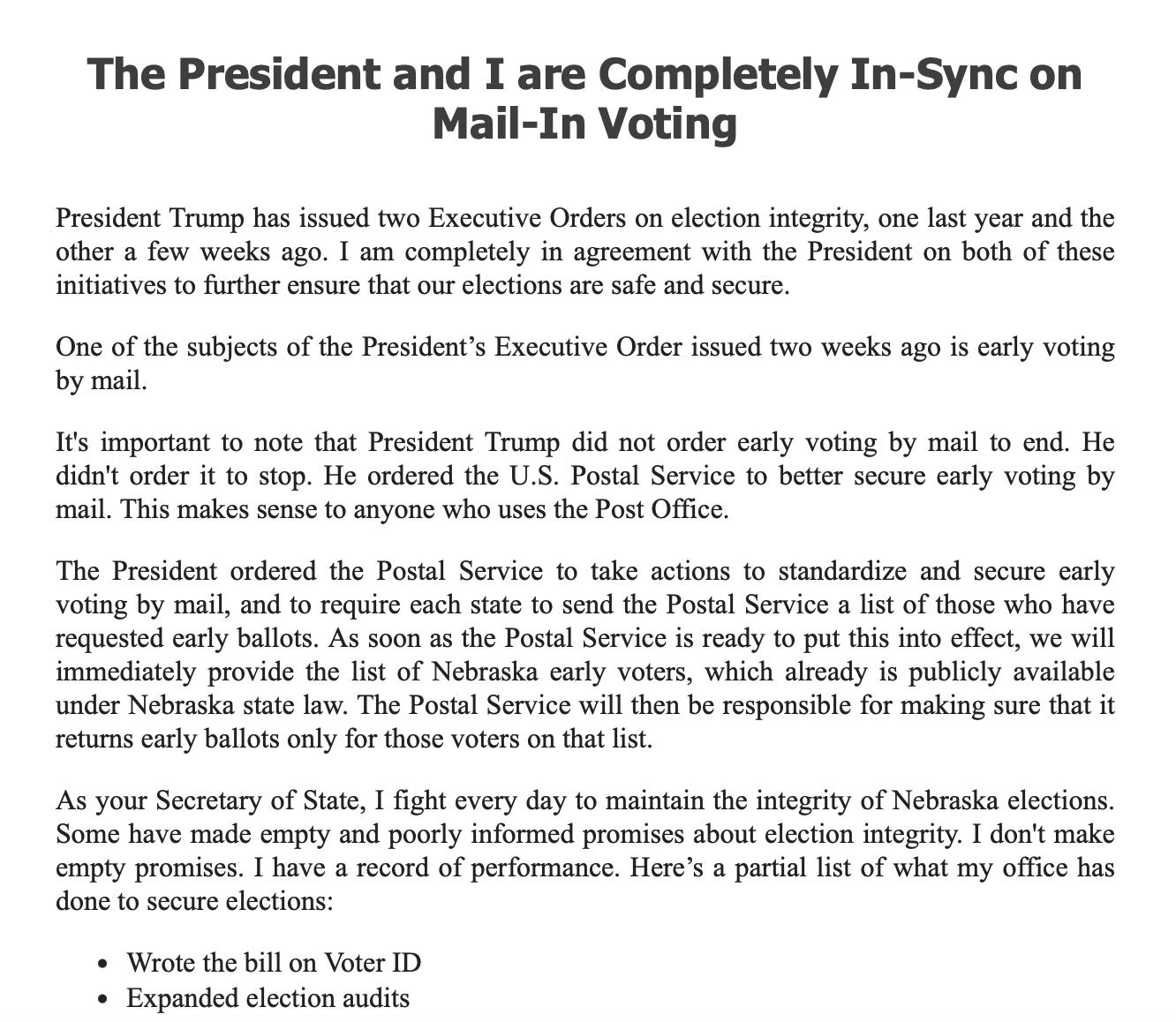
Apparently concerned about that sliver of daylight seeming too bright, in his email he assured me – and others he sent the note to – that “The President and I are Completely In-Sync on Mail-In Voting,” another of Trump’s hobbyhorses. Trump rode that pony with a second executive order, titled “Ensuring Citizenship Verification and Integrity in Federal Elections.”
Bob likes this one a lot. He said it would “require each state to send the Postal Service a list of those who have requested early ballots. As soon as the Postal Service is ready to put this into effect, we will immediately provide the list of Nebraska early voters, which already is publicly available under Nebraska state law. The Postal Service will then be responsible for making sure that it returns early ballots only for those voters on that list.”
Imagine how efficiently that all would work.
But you don’t have to imagine that, since the Brennan Center at NYU’s School of Law did so already: “If implemented, the executive order would inject chaos into our elections, block eligible American citizens from voting, undermine voter privacy, and expose election officials and others to criminal prosecution simply for doing their jobs,” the center reported.
Oh, and recall that Trump has himself voted by mail, including just recently. Still, he calls it “mail-in cheating.”
But such measures all fall under what a former journalist and longtime observer of Nebraska politics, Steve Smith, calls “the Integrity Narrative.” Smith, who directs communications for The Good Life Institute, writes that this narrative “opens with a claim that the system needs protection. It then builds a tool to measure risk. Finally, it closes with a report that appears to confirm the original concern. Each step feels reasonable; all told, they shape how voters are treated in real time.”
Of course, the ultimate game is to drive down voter participation in a bid to help Republicans.
“It helps to ask a simple question,” Smith adds. “What problem is this system solving? Claims about widespread illegal voting always end up being debunked, overblown, or downright fictional.”
Still, such issues offer opportunists their chances to shine and to cozy up to people in power. A decade ago, Bob distinguished himself in Nebraska politics — and won over the heart of then-Gov. and now Sen. Pete Ricketts — by co-founding and leading a 2016 drive that successfully reinstated the death penalty in the state. The state legislature had abolished it.
“Capital punishment is the only penalty that is repeated in all five of the Books of Moses,” Bob told a group of Omaha Republicans. “The Old Testament is composed of three parts. The five Books of Moses, the Prophets and the Writings. The Five Books of Moses, in each of those five books you’ll find capital punishment is prescribed for certain crimes. And so we begin with capital punishment is morally required.”
“Required?” Never mind that a famous passage in the Mishnah, an early collection of traditional writings, cites a religious court’s view that one execution in 70 years was considered destructive. Or that the rabbis in the Talmud fashioned legal hurdles that made the death penalty exceedingly rare — something Bob as a knowledgeable Jewish person should have known.
Sounds a bit like JD Vance, the Catholic convert, telling the pope to “be careful when he talks about matters of theology.” Ah, the hubris of MAGA, from the top on down.
Since Bob’s death-penalty effort paid off, Nebraska has executed one man, Carey Dean Moore. Moore killed two Omaha cab drivers in 1979, when he was 21. He was sentenced to die, but the decree was twice reversed and then stayed in 2007, when Nebraska’s Supreme Court had reservations about electrocution, and again in 2011, that time over concerns about lethal injections. After 38 years on death row, Moore was killed by injection in 2018.
Moore’s death drew the ire of death-penalty opponents.
They included Sister Helen Prejean, a Roman Catholic nun whose novel about a Louisiana execution was made into the movie “Dead Man Walking.” Prejean pilloried Ricketts over his championing of the death penalty. “‘An important tool,’ Gov. Ricketts calls it,” Prejean said. “A tool for what? To show that we’re capable as a state of imitating the worst possible violence under the worst possible conditions, the most pre-meditated death of a human being you can imagine?”
“What’s going to happen after the execution … is anybody really safer? Has it really helped the state? All these things come to mind when I think of this and what’s about to happen in Nebraska,” she said. “Nothing will be accomplished by it, and that’s hardly what you call pro-life.”
By the way, Bob proudly claims to be pro-life, too. Never mind the moral and intellectual inconsistency – as one might politely call it – of advocating state-sponsored killing while calling oneself pro-life.
Inconsistency – perhaps we might call it hypocrisy — isn’t a problem for many MAGA Republicans, though. They claim they are furthering democracy with their efforts to restrict voting. They argue that gerrymandering is fine in Texas, but not in blue states. And they back a philandering felon’s invocations of law and order when his minions murder protesters in Minnesota.
So, Bob, Alex P. Keaton was entertaining and appealing in the 1980s. But your version of him just isn’t all that charming. I won’t be voting for you, volunteering or donating to your reelection bid. As your president might say, thank you for your attention to this matter.