Trump’s badly timed opportunism is anything but PresidentiaL
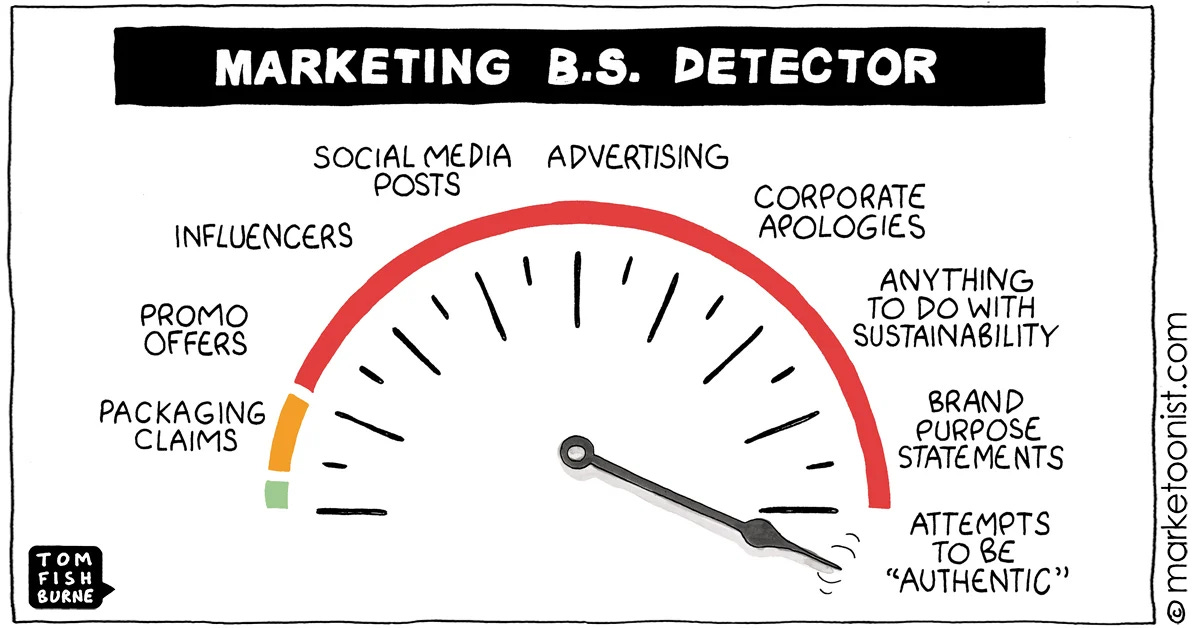
Source: Marketoonist
On a recent Southwest flight, the attendant gave out little bags of pretzels bearing some peculiar language. “My mom and I created Stellar Snacks in 2019 with a dream of crafting pretzels infused with passion,” the writing on the bag said. “It’s not just a pretzel … it’s a labor of love.”
Oh, really now.
Yes, marketing is important. And yes, it’s normal for marketers to stretch the truth just a bit to sell their wares.
Source: WhoWhatWhy
But there are times when we must call BS for what it is. That’s kinda the way it is in our presidential election race now, too.
There’s an extraordinary amount of BS out there as we get closer to Nov. 5. Today, for instance, Donald J. Trump offered this reaction to the missile attack by Iran on Israel:
“Under ‘President Trump,’ we had NO WAR in the Middle East, NO WAR in Europe, and Harmony in Asia, No Inflation, No Afghanistan Catastrophe,” Trump posted on his Truth Social outlet. “Instead, we had PEACE. Now, War or the threat of War, is raging everywhere, and the two Incompetents running this Country are leading us to the brink of World War III. You wouldn’t trust Joe or Kamala to run a lemonade stand, let alone lead the Free World.”
Never mind that in 2018 Trump pulled the U.S. out of a U.S.-Iran nuclear deal, ratcheting up hostilities between the countries. Ignore the fact that an Iran-backed group then, in December 2019, launched rockets at an Iraqi military base, killing a U.S. contractor and wounding our soldiers and others, and provoking retaliatory strikes in Iraq and Syria by the U.S. Never mind that in the following month, the U.S. killed the head of Iran’s elite Quds Force, triggering missile attacks on U.S. forces and killing some of them.
This was peace?
The truth – as opposed to the marketing – is that tensions between Israel and Iran, as well as between Iran and the U.S. have been a constant for many years. They are erupting now, all in the wake of the October 7, 2023,invasion in Israel by Iran-backed Hamas. That triggered Israel’s Gaza invasion and led to increasing rocket attacks on Israel by Hezbollah. And that, in turn, set off the Israeli reaction in Lebanon that has led us to today’s missile attacks by Iran.
But none of those historical facts deter Trump from arguing that these eruptions — and others — would never have happened had he been in the White House again.
“If I was in charge, October 7th never happens, Russia/Ukraine never happens, Afghanistan Botched Withdrawal never happens, and Inflation never happens,” Trump claimed. “If I win, we will have peace in the World again. If Kamala gets 4 more years, the World goes up in smoke.”
His claims sound wonderful. They are also ahistorical nonsense.
A Hamas tunnel in 2016, source: NPR
How would Trump have halted Hamas, whose members built extraordinary tunnel networks in Gaza for years, including during his term? What could he have done to deter the group that he hadn’t done before, as it burrowed beneath Gaza? The terrorist group’s timing likely had more to do with it seeing a chance to take advantage of tumult in Israel over Prime Minister Benjamin Netanyahu’s domestic problems. Indeed, Hamas’s war-triggering actions likely had even more to do with the threat it saw in then-growing Saudi-Israel rapprochement and diminishing support in Gaza for the group.
As for Russia and Ukraine, the latest war’s roots go back at least to 2014, a couple years before Trump’s ascension to power. Back then, Russian paramilitaries took over Ukraine’s Donetsk and Luhansk areas and Russia then invaded Crimea, taking control of the region. Thousands of Russian soldiers flooded in over the next several years and fierce fighting raged between 2017 and 2019, during Trump’s term. Did Trump do anything to toss Russia out? Despite a peace agreement, Russia then began its fullscale invasion in early 2022. It was all of a piece.
And, as for Afghanistan, one can only wonder why Trump maintained U.S. troops there during his entire term. It was clear for many years that the U.S. had won nothing enduring in the country since 2001. So why did Trump leave the withdrawal from one of America’s longest and least successful wars to his successor? Why were American soldiers still dying there on his watch?
Source: Amazon
Trying to rewrite history in the self-serving way Trump is doing may fool some of his backers. After all, they likely see him as a strongman who can set the world aright and cure domestic and foreign ills. In his rhetoric, Trump offers strength, harmony and peace.
But was there really harmony and peace during his tenure – at home or overseas? Recall that George Floyd, a Black man, was killed by police in May 2020, in Minnesota, during Trump’s last year in office. The event triggered protests nationwide, with disturbances in well over 100 cities. As for peaceful relations overseas, recall the coronavirus tensions with China in 2020 and Beijing’s clampdown on Hong Kong, as tensions between the U.S. and China grew. Were these times of tranquility?
For all of his business failures – which include six bankruptcies – Trump is a clever marketer. “The Apprentice” turned him from a struggling developer with a bad rep in New York into a national emblem of tough-minded leadership, never mind that the show was a venue in which facts never mattered.
Now, Trump’s efforts to rewrite history will likely con some of his devotees just as the “reality” show did. Perhaps they are the sort of folks who can believe that pretzels can be “infused with passion.”
But will he fool anyone with a passing acquaintance with facts? Anyone who has some understanding of history?
What is happening now in the Middle East is extraordinarily dangerous. Keeping full scale war at bay will require delicate diplomacy, and even with that a far greater explosion may well be unavoidable. If Trump were a decent leader, he would keep his mouth shut about that and, maybe, even support President Biden’s efforts.
Source: Google Finance
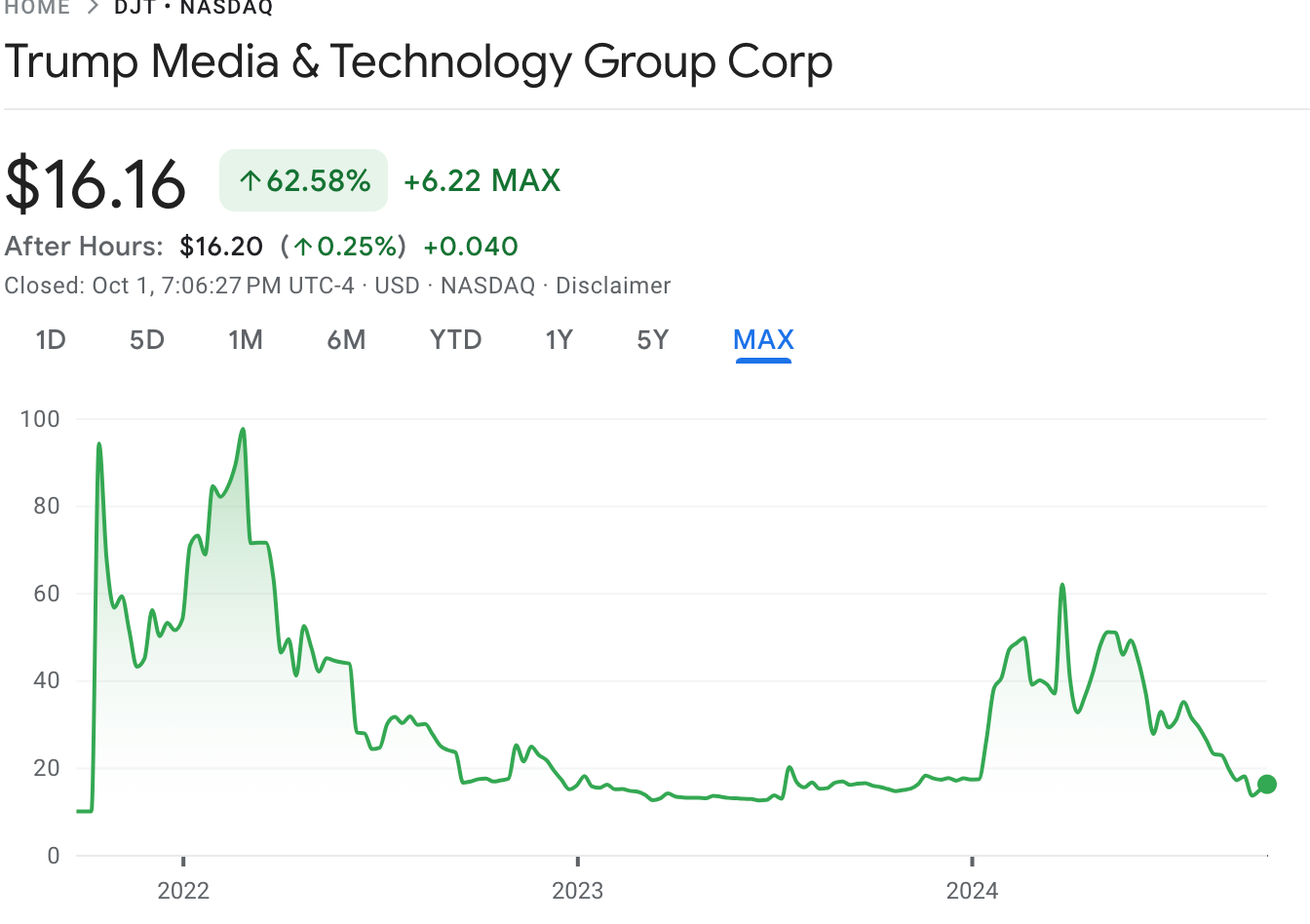
But then, this is a man who sells sneakers, Bibles and even a picture book bearing a cover with the image of him raising his fist after being grazed by a bullet. You can get Trump’s signature on the book for $499. This is a man who brought public a social media company, Trump Media & Technology Group, through a shady offering, only to have it fall from its March 2022 high of $97.54 a share to the current $16 (no doubt, with many of his followers taking the hit).
The would-be president’s marketing is shameless. Now, at a time of global peril, it’s also dangerous.
A Connecticut teacher faces heat over refusing to share a stage with a Jewish autho
Aisha Abdel Gawad, source: her website
When I attended an all-boys prep school in New Jersey many decades ago, one of my history teachers was a chapter leader in the John Birch Society. He routinely spouted bizarre Communist-infiltration theories, had us read conspiracy-oriented books and tried to recruit students to sell for Amway.
He lost his job at the school.
Should that happen now to Aisha Abdel Gawad at the prestigious all-girls Greenwich Academy in Connecticut? Should parents at the K-12 school think twice about sending their daughters there, as an alum of the school suggests in The Wall Street Journal?
Gawad is the writer who refused last weekend to appear on a literary panel discussion at an Albany book festival with a Jewish writer, Elisa Albert, who supports Israel. The festival director cancelled the session, saying Gawad and another writer didn’t want to share the stage with a Zionist.
Never mind that the panel had nothing to do with Zionism or Judaism. It was about “Girls, Coming of Age.”
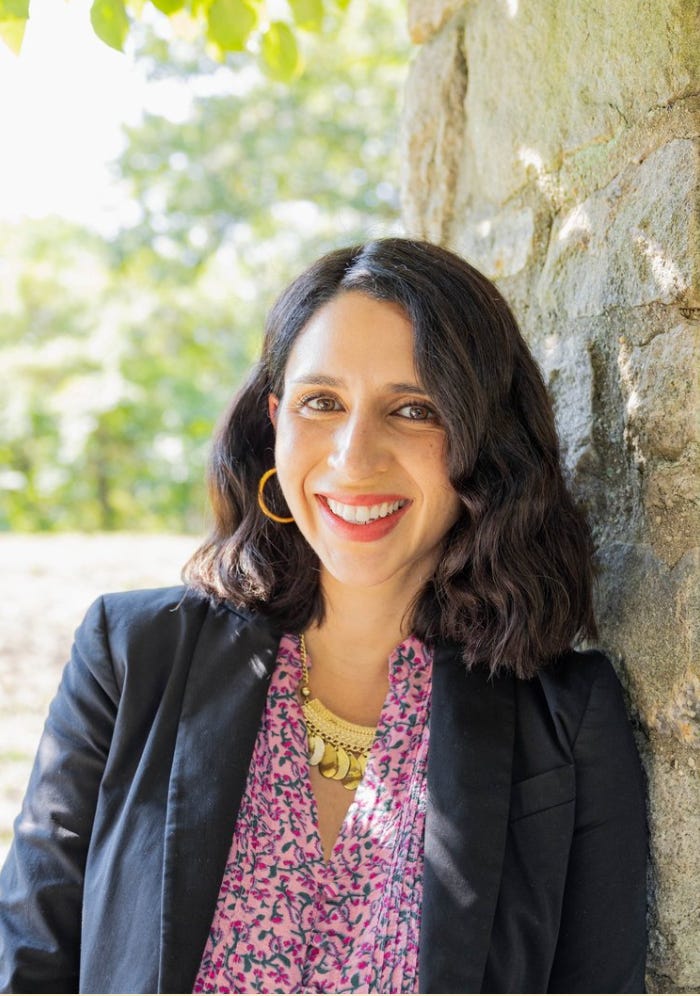
Elisa Albert, source: her website
And never mind that, to Gawad, Albert’s unpardonable sin was to write a piece lambasting those who defended Hamas after it murdered some 1,200 people and carried off a couple hundred hostages nearly a year ago.
Never mind that Albert’s piece, “An Open Letter to Hamas’ Defenders” in Tablet magazine expressed sympathy for Palestinians, even as it condemned their terrorist oppressors. “We weep for the plight of the Palestinian people and for the ignorance and naïveté of so many who believe that anyone but Hamas is responsible for their current suffering,” Albert wrote.
To Gawad, Albert’s criticism of Hamas and its supporters “mocked anyone who expressed grief over Palestinian life.” To be sure, Albert used sarcasm to make her point, as she began with “Hi terror apologist!” That was enough for Gawad to say that sharing the dais with such an outspoken Jew “did not feel like a safe forum.”
What would Albert have done, one wonders? Would she have pulled out an Uzi? Would she have strapped on a suicide vest? Would she have kidnapped Gawad and taken her off to a tunnel for 11 months?
More likely, Albert would have discussed her latest book of essays, “The Snarling Girl.” Her collection of 16 essays deal with feminism, childbirth, medicine, life in Los Angeles and Albany and, yes, her Judaism. The last includes things such as the stress of being a “perfect hostess, perfect Jewess” at a Passover seder, the legacy of Philip Roth, a visit to a mikvah, and antisemitic comments she’d received.
Still more likely, Albert would have sought to bridge the gulf between her and Gawad.
In fact, in a new Tablet post, Albert invites Gawad to her Shabbos table, offering to break bread and talk to one another. Albert writes “… the last thing on earth anyone needs is more anger, more resentment, more fighting, more hatred, more blood, more violence, heads to roll. Haven’t we had enough, yet, of anger, fear, suspicion, hatred, fighting, bloodshed?”
In that same piece, Albert defends Zionism. To her, it “is the belief that the State of Israel has the right to exist. Zionism is the belief that the Jewish people (literally aka ‘Israel’) has the right to self-determination, peace, and safety in our ancestral homeland.”
And, as a proponent of a two-state solution, she adds: “Zionism precludes no other peaceful nationalist ambitions or aspirations.”
Would that sort of conciliation be enough for Gawad? Would she join Albert in sharing challah so they could civilly air their disagreements?
Probably not.
Source: AZ Mirror
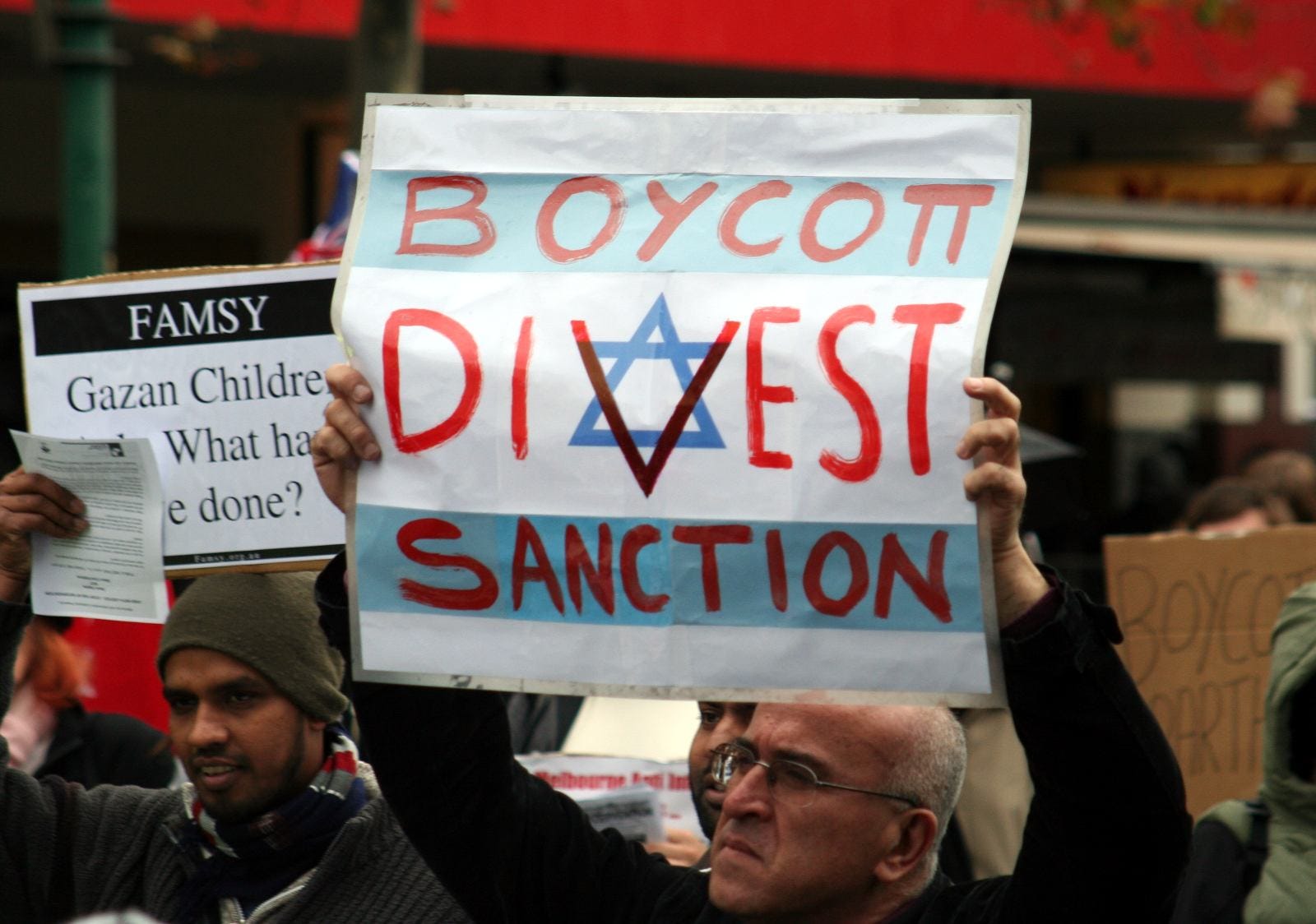
Gawad’s refusal to share a platform with Albert is a new wrinkle on the longstanding Boycott, Divestment, Sanctions effort. That’s the 18-year-old drive that blacklists Jews, especially Israelis in academic institutions and others. The aim is to pressure Israel to accept, among other things, a right for Palestinians who fled in 1948 to return to their homes. That, of course, would destroy Israel. It would make it impossible demographically for the Jewish state to exist.
Indeed, BDS co-founder Omar Barghouti has said “we oppose a Jewish state in any part of Palestine. No Palestinian, rational Palestinian, not a sell-out Palestinian, will ever accept a Jewish state in Palestine.”
Gawad’s decision to boycott a panel that would include Albert is of a piece with some of the more bizarre BDS efforts. Backers sought to boycott McDonald’s because a franchise in Israel offered free meals to Israeli soldiers. And BDS called for a boycott of an upcoming Disney movie that that features an Israeli superhero, Sabra, a fictional member of spy-agency Mossad. And some have called on supporters to shun Disney altogether.
Over the last few years, BDS backers have risen to the fore in several academic organizations. They won a vote for a resolution last May in the American Sociological Association, by a 58.8 percent margin, condemning Israel’s actions in Gaza and criticizing “Zionist occupation.” For all of its fury over the deaths in Gaza, however, there was no condemnation of Hamas in the resolution — its murderousness, apparently, wasn’t worth noting.
More recently, in August, BDS backers succeeded in getting the American Association of University Professors to support academic boycotts, rescinding its longstanding opposition to them. In a case of Orwellian logic, the AAUP argued that “when faculty members choose to support academic boycotts, they can legitimately seek to protect and advance academic freedom.”
So, should Gawad continue to teach at the Greenwich Academy? Should she be shunned for her refusal to sit next to a Zionist? Should her boycott of Albert lead to the school, in effect, boycotting her?
Well, Emma Osman, an editor at The Wall Street Journal and a graduate of the academy, puts the matter in terms of how some of Gawad’s students may be affected. She wonders what things might be like for some of them now.
“I imagine myself back in school, seated around Ms. Gawad’s table,” she writes. “Would I feel my voice was ‘heard and valued’? Would I feel comfortable raising a view that I knew Ms. Gawad disagreed with? Could she grade my essay objectively knowing it was written by someone she might label a ‘Zionist’?”
The head of the school, Margaret Hazlett, defended Gawad initially. But, as pressures have grown, she more recently said that the teacher’s actions “showed a lack of judgment” and “reflected poorly on GA.”
Indeed, Gawad has already lost another prestigious gig as a result of her action. The Wilton Library terminated her as its first writer in residence, a $30,000 position. In explaining the move, officials there write: “We continue to be passionate about the free exchange of ideas. We remain dedicated to our mission to ‘inform, enrich, connect, and inspire our community,’ and to maintain an environment where everyone is made to feel safe and welcome.”
So, should she be fired from Greenwich Academy, as well, because it’s entirely possible some students will now feel unsafe and unwelcome in her classroom? Under intense fire now, Gawad claims that she, in fact, opposes all forms of discrimination and hatred.
“I oppose anti-Semitism and have dedicated my professional and personal life to not only fighting anti-Semitism, but also racism, Islamophobia, and hatred of all kinds,” Gawad wrote in a response to press inquiries. “I find it deeply hurtful and saddening that the festival chose to make public my private choice.”
But does she oppose the venomous hatred that led a terrorist group to murder hundreds of innocents? To rape and kill wantonly? There’s been no word from her on that, at least not publicly. Not a hint of criticism from her of Hamas and its ilk.
My former history teacher’s wrong-headed, at-times vicious and certainly ill-informed views made many of us in the classroom pretty uncomfortable. His attacks on some of us over our opposition to the Vietnam War at times got quite personal. And, in the end, his intellectual and emotional shortcomings and attitudes did him in.
Ultimately, that teacher’s position was untenable, his views were just too noxious. Gawad’s antisemitic act — whether she sees it as that or not — may in the end have the same effect.
Politicians like easy-sounding solutions to complex problems, particularly on the economic front. Their fixes often are aimed at pleasing voters who know little or nothing of economics. At times, their efforts smack of pandering and might even be harmless.
But, at other times, they can be quite dangerous — as seems likely with the plans of Donald J. Trump. Just mull over what 16 Nobel laureate economists have to say:
“The outcome of this election will have economic repercussions for years, and possibly decades, to come,” warns a letter signed by Columbia Prof. Joseph Stiglitz, former chief economist at the World Bank; Harvard Prof. Claudia Goldin, former director of the Development of the American Economy program at the prestigious National Bureau of Economic Research, and 14 other Nobelists. “We believe that a second Trump term would have a negative impact on the U.S.’s economic standing in the world and a destabilizing effect on the U.S.’s domestic economy.”
They caution that Trump’s plans, including his goal to impose tariffs of 10 percent to 20 percent on foreign goods and 60 percent on Chinese-made products, will do exactly the opposite of what he’s been promising as he has attacked the Biden-Harris administration for inflation. Just as inflation rates are coming down, those duties would kickstart a price-spiral anew.
Source: Dividend Power
“Many Americans are concerned about inflation, which has come down remarkably fast,” the economists argue. “There is rightly a worry that Donald Trump will reignite this inflation, with his fiscally irresponsible budgets. Nonpartisan researchers, including at Evercore, Allianz, Oxford Economics, and the Peterson Institute, predict that if Donald Trump successfully enacts his agenda, it will increase inflation.”
And listen to some of those folks, who’ve crunched the numbers on Trump’s plans:
“The Peterson Institute for International Economics think-tank in Washington calculates that 20 per cent across-the-board tariffs combined with a 60 per cent tariff on China would trigger a rise of up to $2,600 a year in what the average household spends on goods,” reports the Financial Times. “They say that the tariffs would disproportionately hit the low-income households that Trump claims his economic policies help protect.”
And the Peterson Institute is hardly alone. The Tax Policy Center, concurs, albeit with slightly different figures because Trump has floated both 20 percent and 10 percent global tariffs.
“A worldwide 10 percent tariff and a 60 percent tariff on Chinese goods proposed by Republican presidential candidate Donald Trump would lower average after-tax incomes of US households in 2025 by about $1,800, or 1.8 percent,” writes center senior fellow Howard Gleckman, a former BusinessWeek colleague. “They’d reduce imports into the US by about $5.5 trillion, or 15 percent, from 2025–2034.”
The consensus among the experts is that Trump’s plan would hit consumers hard. The effect would show up not only in finished goods made overseas, but in anything manufactured in the U.S. with foreign-made components, as the higher costs would filter through the system. Thus, there would be no escaping the higher prices.
Beyond just ratcheting up inflation, Trump’s plans could drive down gross domestic product and employment.
“Candidate Trump has proposed significant tariff hikes as part of his presidential campaign; we estimate that if imposed, his proposed tariff increases would hike taxes by another $524 billion annually and shrink GDP by at least 0.8 percent, the capital stock by 0.7 percent, and employment by 684,000 full-time equivalent jobs,” says another nonpartisan group, the Tax Foundation.
The kick in the teeth that Trump could deliver to the nation may also come at a tough time, as the economy slows under the Federal Reserve’s so-called “soft-landing” approach. The Fed, the independent group that has the job of reining in inflation, recently lowered interest rates by a substantial half-point in the federal funds rate. That’s because its leaders believe that inflation is moving toward a sustainable 2 percent annual rate, the Fed’s target, without driving unemployment up to unacceptable levels.
The Federal Reserve, source: Investopedia
As the Fed tries to balance employment and inflation, it is no doubt mindful that the national jobless rate recently rose to 4.2 percent after dipping as low as 3.4 percent, a 54-year-low, earlier in the year. The Fed is following classic economic theory: when the jobless rate is too low, higher wages kick up inflation; when unemployment is too high, of course, that’s a red light for the economy.
In time, the lower interest rates that the Fed has engineered should deliver an upward jolt to the economy. That will set the stage for the next president – whoever that is – to bask in the glow of sustainably low unemployment with reasonable inflation. But that president’s policies, if they are inflationary, could tip the balance.
As the experts see it, the outlook under a Trump presidency is hardly cheerful, particularly if his tariffs trigger an all-out global trade war. “The last time we were in a trade war under Trump, the global manufacturing cycle went into a recession,” Julia Coronado, a former Fed economist who now runs the MacroPolicy Perspectives consultancy, told the Financial Times.
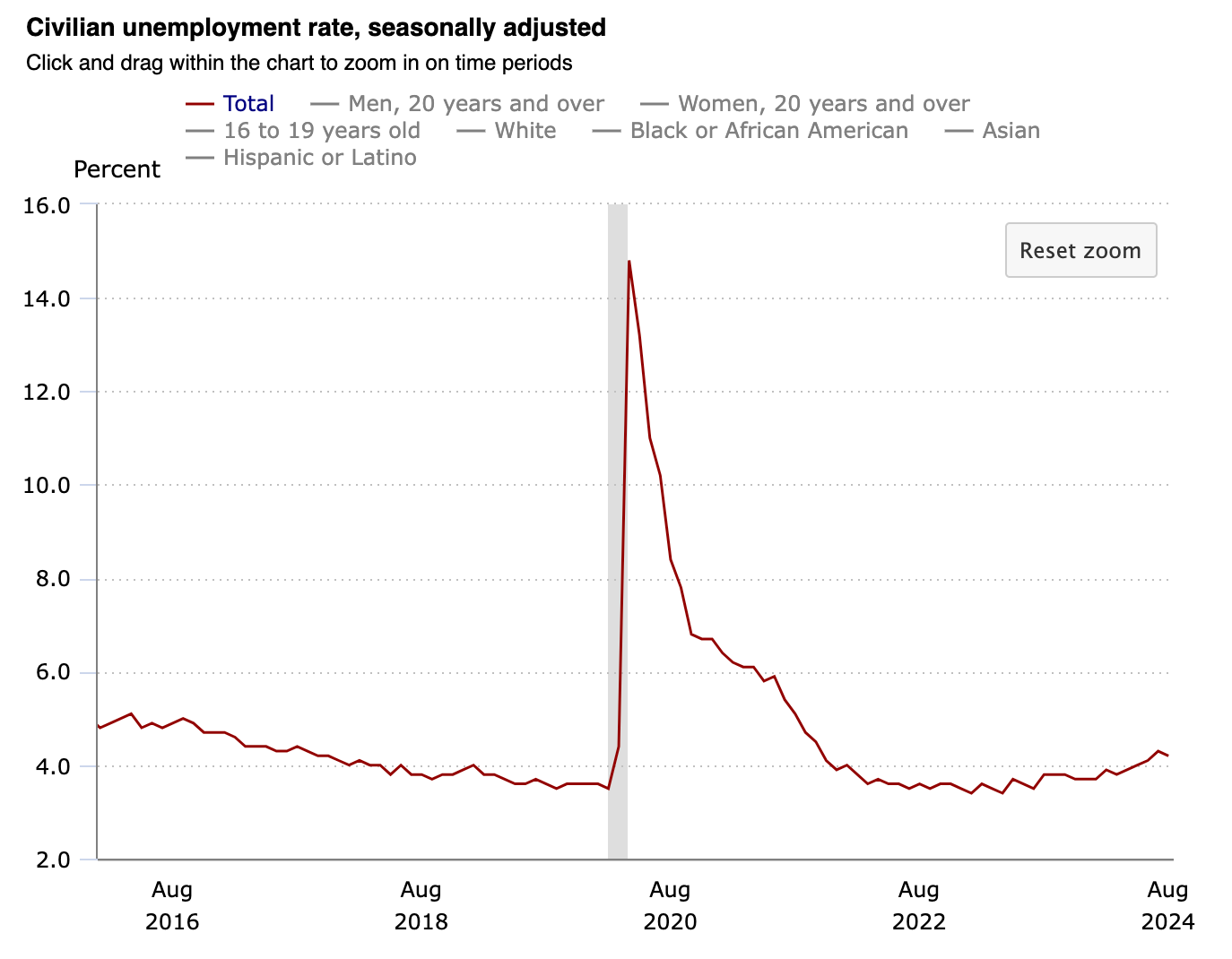
Recall that, during Trump’s term, the economy slipped into recession from February to April 2020, a few months before his tour in the White House ended. Covid drove that downturn, which was marked by a jobless rate of 14.8 percent in April of 2020. When Trump left office, the jobless rate had fallen to 6.4 percent and it fell substantially after that, in part thanks to the infrastructure-spending policies of President Joe Biden.
Source: Bloomberg
Contrast Trump’s plan with Harris’s blueprint for stimulating housing construction, particularly for the middle class. She wants to boost housing supply by expanding the Low-Income Housing Tax Credit, providing incentives for state and local investment in housing and creating a $40 billion tax credit to make affordable projects feasible for builders. Mark Zandi, chief economist at Moody’s, and Jim Parrott, a housing adviser under the Obama administration, estimate that America has a shortfall of three million homes right now, and Harris aims to close that gap. The two are advising her campaign on these plans.
Ben Harris of the Brookings Institution, a former chief economist of the U.S. Treasury, concurs that the plan is sound. “Critics assail the high cost of subsidies to developers, but they are the best tool the federal government has to incentivize homebuilding,” he writes. “We desperately need more affordable homes in America – millions of them – and the only practical way to boost supply quickly and meaningfully is to offer financial incentives to local governments to expand zoning for affordable housing and to developers to build it. The vice president proposes to do both.”
To be sure, Harris’s plan to provide $25,000 to first-time homebuyers is drawing less praise.
Calling that “a really bad idea,” Michael Strain, an economist at the American Enterprise Institute, says: “The ultimate beneficiary of that credit is not going to be first-time home buyers. It’s going to be people selling homes.” Economics writer Peter Coy of The New York Times echoes that, saying the plan would do nothing to boost housing stock, but only demand. “Sellers surely would take advantage of the increased demand by raising their prices,” Coy writes. “So a big portion of the taxpayer money that was intended for home buyers would wind up in the pockets of sellers.”
But it’s far from clear how the construction stimulation efforts and the aid to homebuyers would offset one another. A rush of homebuilding in theory should lead to lower prices, and the numbers of people likely to be involved in her $25,000 support effort seem relatively small.
Moody’s estimates that Harris’s down-payment plan would help some 11.7 million more first-time homebuyers, including 2.75 million first-time Black and Latino homeowners. This is just 3.2 million more first-time homebuyers and 1 million more Black and Latino first-time homebuyers than would take place without her plan.
For her part, Harris is doing some pandering by proposing to attack alleged price-gouging, particularly in grocery costs. Quoting a campaign statement, The Washington Post reported that Harris wants to implement “the first-ever federal ban on price gouging on food and groceries — setting clear rules of the road to make clear that big corporations can’t unfairly exploit consumers to run up excessive corporate profits on food and groceries.”
The details were not clear, the Post reported. But it said Harris would aim to enact the ban within her first 100 days, in part by directing the Federal Trade Commission to impose harsh penalties on firms that break new limits on so-called gouging. The statement did not define gouging or excessive profits.
As Alexander Henke, an economics professor at Howard University, told the school newspaper, Harris’s “vague” plan appears to be more like a political economy move than an economic one, tapping into popular sentiment against price gouging by delivering poll-tested messaging. And Harris should know better — she studied economics at Howard and her father, Donald, is a retired Stanford University economics professor.
What’s more, this horse long ago left the barn. Most of the inflation is now behind us, suggesting that the economy is resolving the inflation on its own and there would be few prosecutions.
Just look at the numbers. Prices for food overall rose 9.9 percent in 2022, faster than in any year since 1979, according to the U.S. Department of Agriculture. The hike was especially sharp in so-called food-at-home prices, up 11.4 percent. But the rises have slowed since then, climbing last year by 5.8 percent overall and by 5 percent for food-at-home. This year, the department expects prices for all food to increase 2.3 percent, with food-at-home prices rising just 1.2 percent.
What drove up prices in prior years? Were greedy corporations taking advantage of consumers? Were nefarious or misguided Biden-Harris policies driving up the price of eggs (something VP nominee JD Vance embarrassingly got wrong in a Pennsylvania grocery store photo-op)?
Not according to experts at the Federal Reserve Bank of New York. They point to post-Covid volatility in global commodity prices and a sharp rise in wages for grocery-store workers (likely related to a shortage of such workers). When such “input” costs rise, everyone in the production and retail chain tries to sustain their profit margins. As it happened, foodmakers showed no margin gain in recent years, while retailers showed only a modest uptick in already-thin margins.
Other key elements of the plans of both candidates suggest far different approaches — Trump would take a largely top-down tack while Harris, as she puts it, aims to build the economy from the middle class out. She hit hard on this theme in a Sept. 25 address on the economy and her idea are spelled out on her website.
Source: The New York Times
Harris would boost the corporate tax rate from 21 percent to 28 percent and she has promised not to raise taxes on people making less than $400,000 per year. She wants to restore and expand the earned income tax credit and the child tax credit, including a $6,000 child tax credit for the first year of a newborn’s life. She would also increase the tax deduction for start-up businesses from $5,000 to $50,000, a move she argues would stimulate innovation among all-important small businesses.
By contrast, Trump wants to reduce the corporate tax rate from 21 percent to 15 percent for companies that make their products in the U.S. He already cut the rate from 35 percent during his 2017-2021 presidency. It’s long been known that such moves deplete government revenues. Trump also said he would end taxes on overtime pay and on tips (the tips idea is one Harris also suggests). And Trump also aims to exempt Social Security income from taxes, unmindful apparently of how the Social Security system, even under the current system, will likely be insolvent by 2035 unless policymakers impose a fix.
Trump also wants to extend individual tax cuts he pushed through Congress in 2017, including for the wealthiest Americans. Experts estimate that would reduce revenue over a decade by about $3.3 trillion to $4 trillion.
Harris has also proposed hiking taxes on high-income earners. Americans earning below about $100,000 annually would continue to pay no taxes on long-term capital gains and higher-income families earning up to $1 million would continue paying up to a maximum rate of 20 percent. But those who earn $1 million a year or more would see a rise in the tax rate on their long-term capital gains to 28 percent.
Whether soaking the rich a bit, as Harris proposes, is good or bad economically, it may sell politically. And, if nothing else, it’s likely to do far less harm than Trump’s tariffs would.
Consider 1968 and 2024. There are big differences, of course, but in some ways the years are echoing one another, especially in the pivotal role Nebraska may again play in a presidential election.
Nebraska’s public TV station in 2008 produced a documentary about the state’s key role in the election of over a half-century ago. The piece, “‘68: The Year Nebraska Mattered,” ably charted the ways presidential contenders courted support in the state.
The documentarians may have even more reason to revisit the theme about this year.
Source: Nebraska Public Media
Recall that in 1968, the country was beset by often-violent polarization. Vietnam was tearing us apart, pitting young people against old, conservatives against liberals. Racism was a huge issue, as the assassination of the Rev. Martin Luther King Jr. provoked rioting across the country.
An openly racist strongman candidate for president thought Nebraska was so important to his campaign that he appeared in Omaha. George Wallace, the segregationist governor of Alabama, came to the state to court voters for his American Independence Party. His visit triggered rioting in the then-small city and he drew condemnation from the state’s Republican governor, Norbert Tiemann, among many others.
Meanwhile, Democrats also stormed the state for their primary. Sens. Robert F. Kennedy and Eugene McCarthy both came to woo convention delegates, hoping to beat incumbent Vice President Hubert Humphrey for the nomination. On the Republican side, Richard Nixon vied with New York Gov. Nelson Rockefeller to his left and Ronald Reagan on the party’s right. Nixon, who was trying for a comeback after losing the 1960 presidential election, stumped for voters in Omaha, too.
As it turned out, Nixon swept Nebraska for the GOP ticket. While Kennedy won over the Nebraska Democrats, his assassination on June 5 left the party ultimately with Humphrey. And, in the end, Nixon prevailed nationally, overwhelming both Wallace and Humphrey that November.
Source: Lincoln.org
Now, Nebraska is looming large again – even larger this time — as Donald J. Trump presses legislators in the state to overturn its practice, dating back to legislation in 1991, of splitting its Electoral College votes by Congressional district. Nebraska will have five such electoral votes and Trump fears that he will lose one such vote, that of the 2nd District, comprising Omaha and its suburbs. While the state overall went for Trump in 2020, he lost that Omaha area electoral vote.
The district has gone twice for Republicans and twice for Democrats in the last four presidential elections, as reported by the Nebraska Examiner. To avoid a repeat of his 2020 loss, Trump wants the state legislature to switch over to the winner-take-all system that prevails in other states, a change that would, in effect, disenfranchise many Omaha-area voters, as the rest of Nebraska tends to go GOP.
As polls suggest that there will be a tight vote nationally, just a single vote in the Electoral College could put Harris over the top, giving her the 270 she would need. Thus, Trump’s electoral gamesmanship.
Unsurprisingly, the opportunistic Republican governor of Nebraska, Jim Pillen, backs Trump’s efforts. But, so far, he hasn’t amassed enough support among the state’s legislators to do this. Pillen went so far as to bring a couple dozen Republican legislators to his mansion to hear an in-person pitch for eliminating the electoral rule from Sen. Lindsey Graham, as the Examiner reported. Trump also spoke by phone beforehand with some of the attendees.
The only other state to have a similar split-vote rule is Maine, which has taken that approach since 1969. So far, however, legislators in the Democratically dominated state have balked at making a change, even though that could help Democrats by taking away a likely GOP single electoral vote. Trump carried a single Maine district in both 2016 and 2020, getting one of the state’s four votes.
The states each award a single Electoral College vote to the winner in each of their congressional districts, plus two votes to the statewide winner of the popular vote.
Maine pioneered the split-vote system as part of an effort to push the country toward a system where the popular vote matters more than the Electoral College does, as the Bangor Daily News reported. Recall that five presidents, including George W. Bush in 2000 and Trump in 2016, lost the popular vote but prevailed in the college vote. Trump was swamped in both in 2020, though he continues to deny that.
Source: The Guardian
Trump’s effort to overturn the Nebraska split-vote practice is of a piece with his general antidemocracy approach, of course. His supporters recently enacted a rule in Georgia to require counting ballots by hand, which would likely delay results and, according to critics, could lead to many errors. The change is being challenged in court.
Recall that Trump infamously tried to pressure Georgia Secretary of State Brad Raffensperger to “find” 11,780 votes to put him over the top in the state in 2020. Trump’s phone call to the official was filled with a slew of false claims by the former president, as the Brennan Center documented.
Recall, too, Trump’s efforts to discredit elections all across the country. More than 60 court cases went against him, including many that involved judges appointed by Trump and other Republicans.
If he does win this fall, Trump’s intentions to subvert democracy are troubling, whether they involve electoral manipulation, concentrating more power in the White House or summoning the military to suppress dissent. His plans — some of which are based on Project 2025, despite his disavowal of the document — have been criticized by such nonpartisan groups as the ACLU and Protect Democracy, along with Democratic leaders from President Biden on down.
If Trump defeats Harris — with or without overturning the Nebraska system — his bid to upend the longstanding split-vote approach in Nebraska may just be a sign of what more is to come. Much has changed since the state made a difference in 1968, but we again see a racist demagogue with a strongman approach trying to make a mark in Nebraska at a time of great polarization. The biggest difference this time is that he’s got much of the state’s Republican establishment behind him.
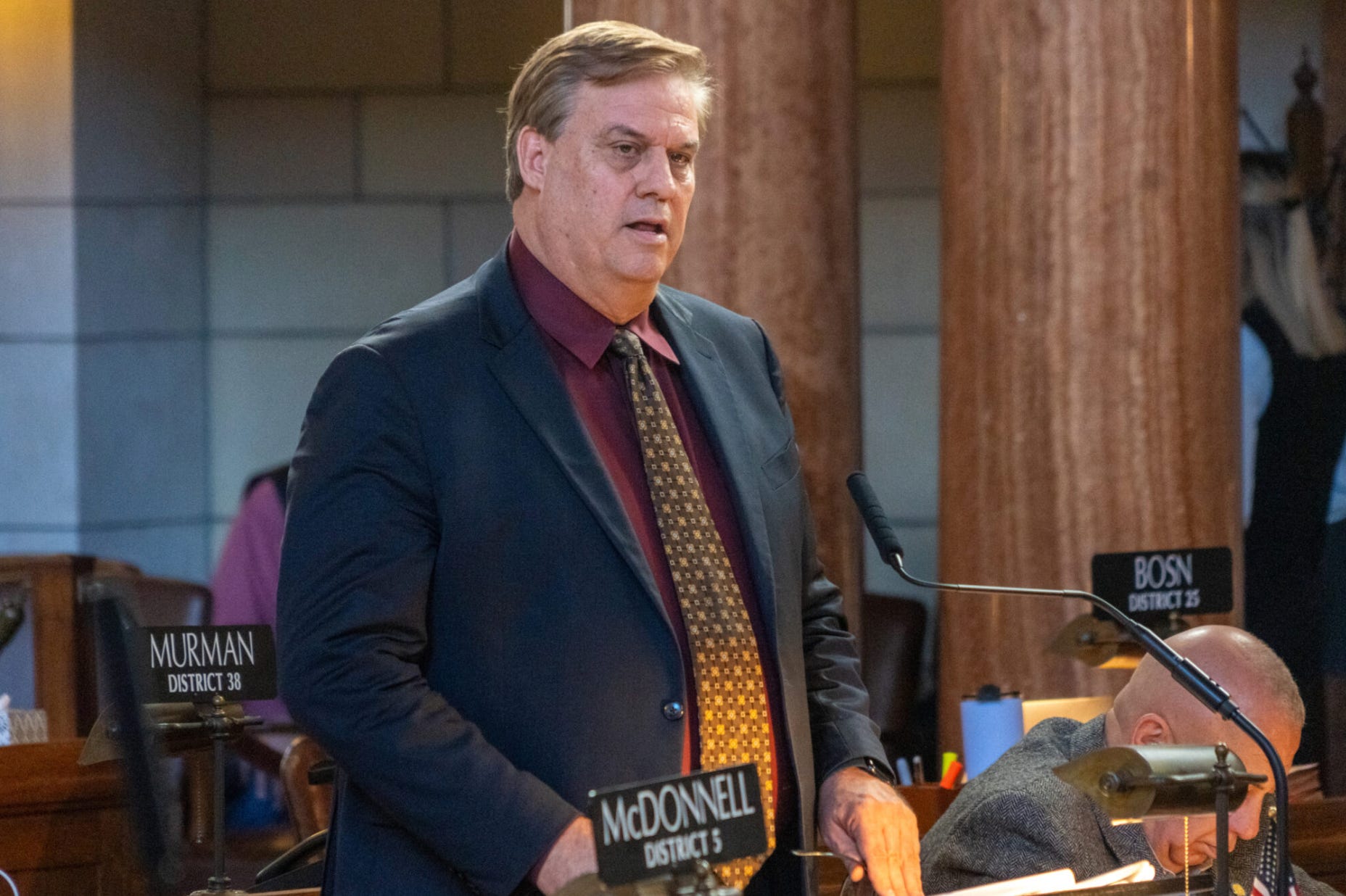
State Sen. Mike McDonnell, source: Nebraska Examiner
The choice of whether to toss out split-voting could be close — maybe even a matter of a single vote in Nebraska’s Republican legislative ranks. Fittingly, that may hinge on local Omaha politics, according to the Examiner. State Sen. Mike McDonnell, a labor leader and Democrat-turned-Republican, aspires to run for mayor of the city.
Would his constituents want to support someone who made their votes irrelevant? When he switched parties, McDonnell said he opposed a shift to winner-take-all. A spokesman said he’s sticking with that stance — for now.
And will antidemocratic efforts prevail nationally? If so, the path to those may begin in the state capitol of Lincoln, Nebraska.
On D-Day in June 1944, J.D. Salinger landed at Utah Beach with 23,000 other Allied soldiers. They were the lucky ones, as the Germans only lightly defended that stretch of seafront. Some 197 of them were killed or wounded, far less than the 2,400 gunned down at Omaha Beach, five miles away. Still, the trauma of that battle – and gorier ones to come – left deep scars on the budding writer, then 25.
Salinger explored his wounds a bit in “The Magic Foxhole,” an unpublished short story in the archives at the Princeton University Library. In the piece, a chaplain wanders among the dead and wounded on that bloody beach, frantically searching for his eyeglasses. He is shot to death.
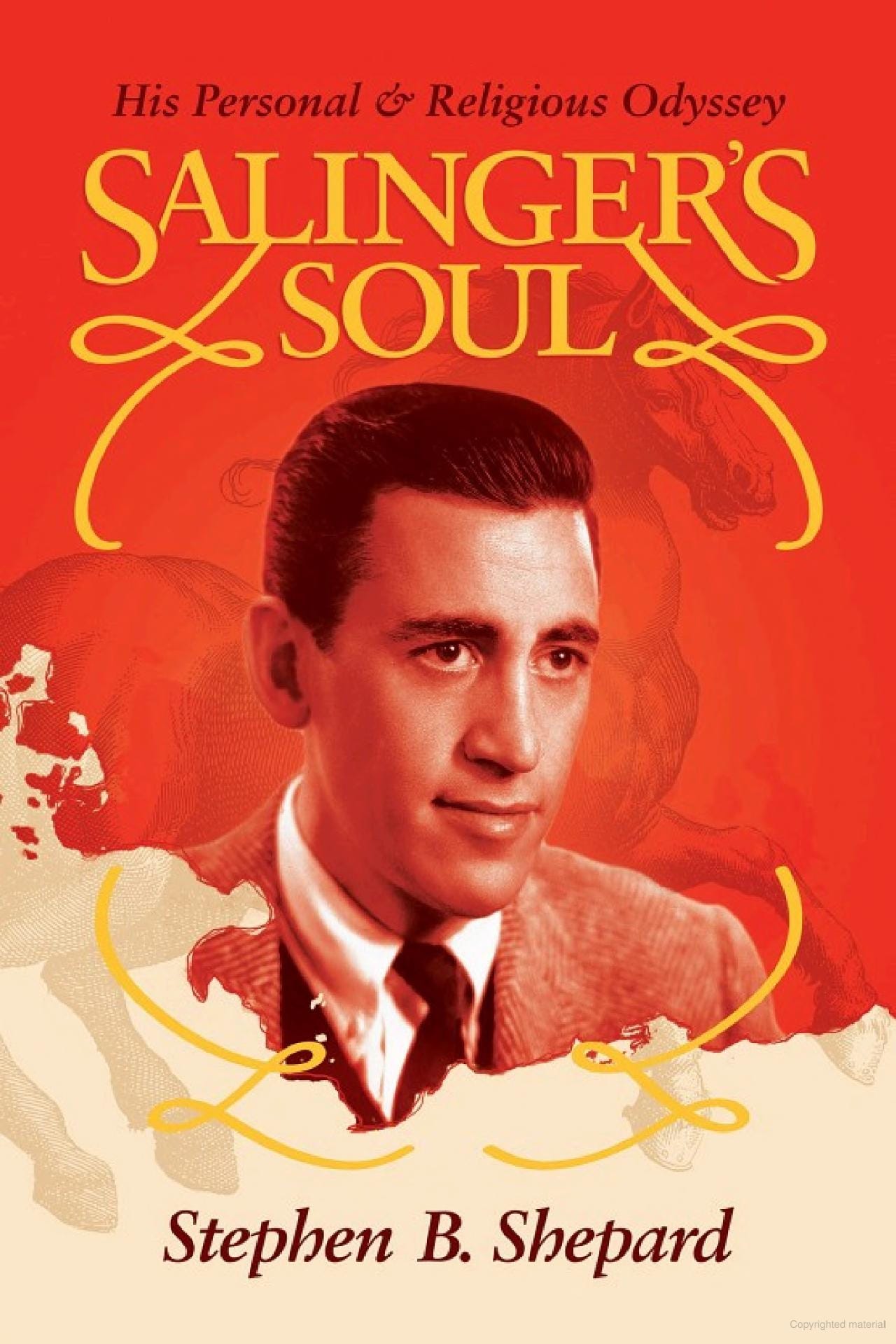
“Critics have pointed out the symbolism of God’s messenger finally being killed—the death of God—after searching for the clarity of battle that his eyeglasses might have provided,” Stephen B. Shepard writes in Salinger’s Soul: His Personal and Religious Odyssey.
In Shepard’s superb analysis of this enigmatic and much-read writer, Salinger comes across as something like that fictional chaplain. Spiritually lost and seeking relief amid the ugliness of the world, he wanders about, damaged and confused.
Salinger, for his part, abandoned the religion of his youth, trying to soothe his chronic depression in various Eastern creeds. He ran through a string of wives and lovers. He alienated or cut off friends and family.
It’s no wonder that he lived most of his life in hermitic seclusion on a mountaintop in New Hampshire.
“Passionate yet detached. Raised Jewish, but a practitioner of mystical Hinduism,” Shepard writes about Salinger’s many contradictions. “No sex in his books, but plenty in his life. A great believer in the power of love, but not so ready to give it. An adult with sophisticated views, but a man of arrested development in his romantic interests. A person with ‘a cast-iron ego’ who spent a lifetime seeking solace in God.”
Under Shepard’s unsparing eye in this short but absorbing work of literary analysis and journalism, Salinger emerges as self-centered and selfish, often disloyal, more than a bit creepy, and sometimes quite cruel.
Of course, he gave us memorable characters, most notably Holden Caulfield of The Catcher in the Rye and Franny and Zooey Glass and their family. Indeed, Catcher still sells 200,000 copies a year, totaling 65 million, making it one of the best-selling books of all time. Salinger made the cover of Time in 1961, whenFranny and Zooeywas published.
Joyce Maynard, now 70. Source: The New Yorker
But the writer’s life was a mess. To take just one example, Salinger famously seduced an 18-year-old college freshman Joyce Maynard, when he was 53. Then, after living with her for 10 months, he callously dismissed her.
While vacationing with him in Florida, Maynard broached the idea of having children. “I can never have any more children,” the father of two told her. “You better go home now. You need to clear your things out of my house.” He gave her $100 the next morning and put her in a cab to the airport.
Maynard was one of many young women the thrice-married Salinger wooed and won. Each was “in the last minute of her girlhood,” a phrase he memorably wrote in one of his stories
Claire Douglas, source: Digital Commonwealth
Salinger couldn’t abide pregnancy, it seems, perhaps because it shattered his idealized vision of (or one might say his lechery for) girls on the cusp of adulthood. His marriage to Claire Douglas, whom he had met when she was a high school student and he was in his thirties, ended in 1967, a few years after she gave birth to their second child. Salinger’s sister told his daughter Peggy that Douglas had “a suicidal depression when she realized that her pregnancy only repulsed him.”
Claire couldn’t handle the isolation he imposed on them in their home in rural Cornish, New Hampshire. When their daughter was born, Claire was 22 and he was 37, and he seemed to leave her largely alone, abandoning her to spend his days in a cinderblock writing studio he had built.
“Up by 6:00 AM, he ate breakfast, packed his lunch, then went to his writing bunker, where he worked nonstop—draft after draft—until dinnertime, often returning to his bunker after dinner,” Shepard writes. “He had a phone installed in his bunker, along with an army cot, but made it clear to Claire that he didn’t want to be disturbed for anything less than a dire emergency.”
Salinger racked up a lot of broken relationships, often with people who had helped his career.
As a 20-year-old taking night courses at Columbia University’s School of General Studies, he was mentored by an adjunct professor, Whit Burnett, who cofounded Story magazine and published a few Salinger stories. But, when Burnett ‘s partner in a book imprint, the Lippincott Company, vetoed the idea of publishing a collection of Salinger’s pieces in a book, Salinger blamed the late Burnett and didn’t speak to him for years.
A.E. Hotchner
Salinger in 1948 told A.E. Hotchner, an editor at Cosmopolitan, that he planned to submit a story he called “Scratchy Needle on a Phonograph Record” about the death of blues singer Bessie Smith. Sounding much like a prima donna, Salinger said not one word could be changed.
Unbeknownst to Hotchner, however, the title was changed to “Blue Melody.” When Hotchner shared the magazine with him, Salinger blew up, accused the editor of deceit. The late Hotchner never saw him again.
Margaret “Peggy” Salinger, source: Simon & Schuster
Salinger even became estranged from his only daughter, who described him in a memoir as cold, manipulative and abusive, as Shepard tells us. The father Peggy describes is weird, drinking his own urine and sitting in an “orgone box,” a closet-sized cabinet for storing psychic energy.
Perhaps his driven self-absorption was necessary for Salinger to give us such fascinating and enduring characters. Despite his many successes, he endured a lot of rejections in the competitive post-war publishing world, one dominated by such figures as Ernest Hemingway, whom Salinger befriended in wartime Paris, and Norman Mailer (who dismissed him as “no more than the greatest mind ever to stay in prep school”).
The wartime experiences of both the latter writers – and many others — did much to shape their work. With Salinger, only a modest bit of his combat experiences appears in his fiction. Indeed, as he focused on young fictional characters, he seems to have tried to suppress the ugliness he saw in Europe. Instead, he seemed to immerse himself in imagined youthful innocence, perhaps taking refuge in it.
But the psychic ravages of the war may well be the key to understanding this peculiar man.
After landing on D-Day, Salinger’s regiment fought its way toward a French port city, Cherbourg, Shepard tells us. As the men moved street by street, under German fire the whole way, many were slaughtered. Of some 3,000 of Salinger’s fellow soldiers, only 1,100 remained by the end of June 1944; the rest were killed, wounded or missing. The regiment suffered the highest rate of casualties of any in the war.
Soon after, in January 1945, Salinger fought in the especially ghastly Battle of the Bulge. Then, in April, came what Shepard calls the author’s most devastating wartime experience. He saw the horrors that fleeing Nazis left at a slave labor camp that was a satellite of Dachau. Bodies of Jews, starved or shot, lay about the camp. Others, too sick to leave, were burned to death in their barracks.
“You never really get the smell of burning flesh out of your nose entirely, no matter how long you live,” Salinger told his daughter. He was hospitalized for a time in Germany for combat stress,
Salinger did draw on such wartime experiences in crafting a few of his stories, including one of his most famous, “A Perfect Day for Bananafish.” In it, the fictional Seymour Glass, an ex-sergeant like Salinger, suffers a nervous breakdown and commits suicide.
Of course, Salinger didn’t kill himself. He died in 2010 at 91. At the time, he was married to Colleen O’Neill, whom he had met when she was 22 and he was in his early 60s. They married in 1988, and that marriage endured.
Whether Salinger ever found the personal peace that he thought his Eastern religion, Vedanta, promised is unclear. His son Matt, in a family statement upon his death, said: “Salinger had remarked he was in this world but not of it,” evoking that philosophy.
Matt, a successful actor, has been combing through his father’s unpublished work with an eye toward releasing it in the next couple years. Though he wrote constantly, Salinger didn’t publish anything after 1965, so we may soon see a wealth of material emerge.
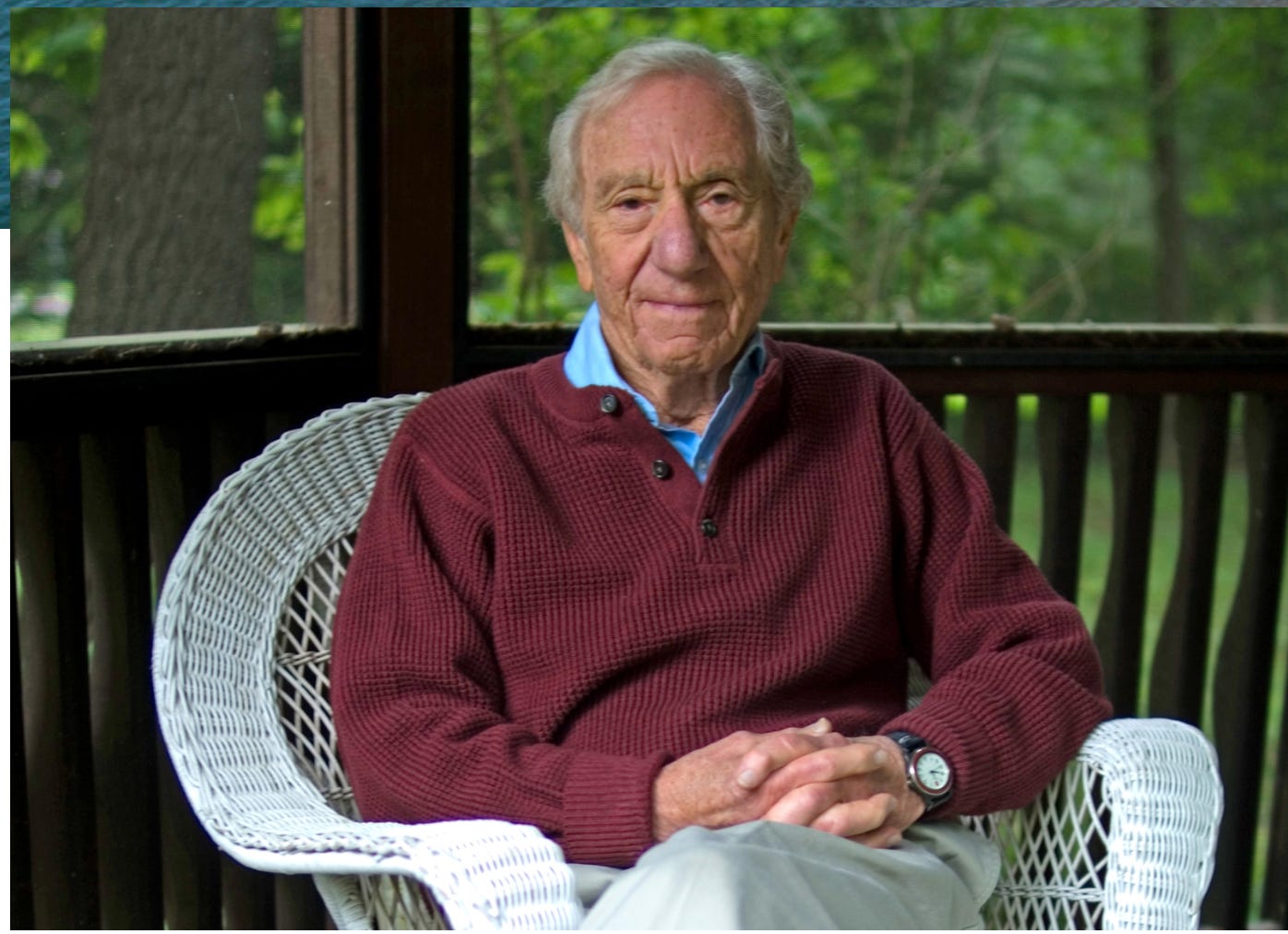
Stephen B. Shepard; source: CUNY
Shepard’s work is well-timed to anticipate the flood.
The former longtime editor of BusinessWeek (full disclosure: I worked for him for about 20 years) and the founding dean emeritus of the graduate journalism school at City University, Shepard draws on biographies of Salinger. He also alludes to most of the author’s work, using it to flesh out his personality.
Much about the man still puzzles Shepard. But this reclusive figure who made an enduring mark on American literature has given us all much to puzzle over.
As the Trump-Harris race shows us, sexism remains alive and well
Source: New York Times
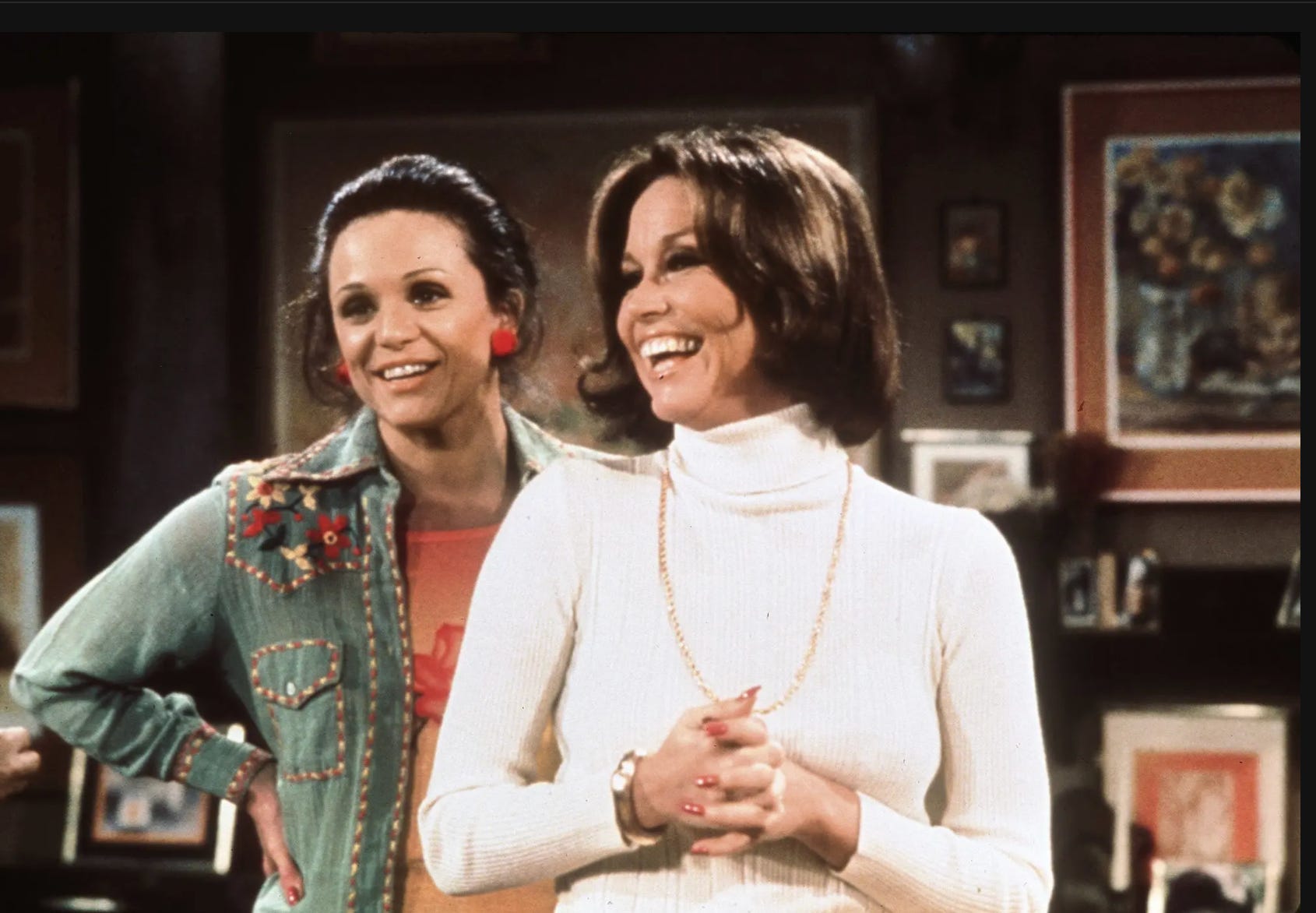
Fifty-four years ago this Sept. 19, Mary Tyler Moore launched an eponymous hit series on CBS about a young woman who was “gonna make it after all” as a TV journalist in Minneapolis. “Mary Richards” would build a life for herself as an independent woman. The show ran for seven seasons and won a stunning 29 Emmys. Widely hailed for being part of so-called Second Wave Feminism, which focused on equality and discrimination, the series dealt with sex, sexism, birth control and other hot-button topics of the time.
Debuting as women were surging into the workplace in larger numbers, the Mary Tyler Moore Show paved the way for other TV efforts that revolved around women demanding to be on equal footing with men. Among them were “Rhoda,” “Murphy Brown,” “30 Rock” and, in some respects, “Friends” and “Cheers,” all heavily influenced by Moore’s groundbreaking effort.
How can it be that a half-century on from then America has still not left the battles over sexism behind? How can it be that for the current generation of women political figures such as Donald J. Trump and his running mate, JD Vance, are doing their best to remind us of what, in many respects, were the bad old days? How can it be that gender remains an issue for many Americans as they ponder whether a woman can serve as president?
Women now approaching their 60s — such as Vice President Kamala Harris, 59 — were children when “Mary Richards” was challenging glass ceilings on Moore’s show. But, all around them, real women were doing the same.
Source: Instagram
Harris’s late mother, Shyamala Gopalan Harris, for instance, came to the United States from India alone at 19, earned a doctorate in nutrition and endocrinology from the University of California Berkeley, and went on to make important contributions as a researcher focusing on breast cancer. As a single mom, moreover, she raised Harris and her sister after splitting up with Harris’s father.
As gains that women have made are under siege now, it’s no surprise that Harris should adopt as one of her campaign mantras “We are not going back.” In counterpoint to Trump’s “Make America Great Again” evocation of a mythical American past, Harris’s tagline suggests progress in matters such as reproductive freedom, LGBTQ rights, Black and other minority rights, and a modern version of feminism — one in which a woman can become not only the first female vice president, but president.
Harris would have America “turn the page” — another tagline — on Trumpism. That, pathology, as she sees it, is the 78-year-old former president’s use of racial divisiveness, his juvenile treatment of opponents, and his well-recorded disrespect for the military, his disregard for the law (as his felony criminal convictions suggest) — along with his sexism.
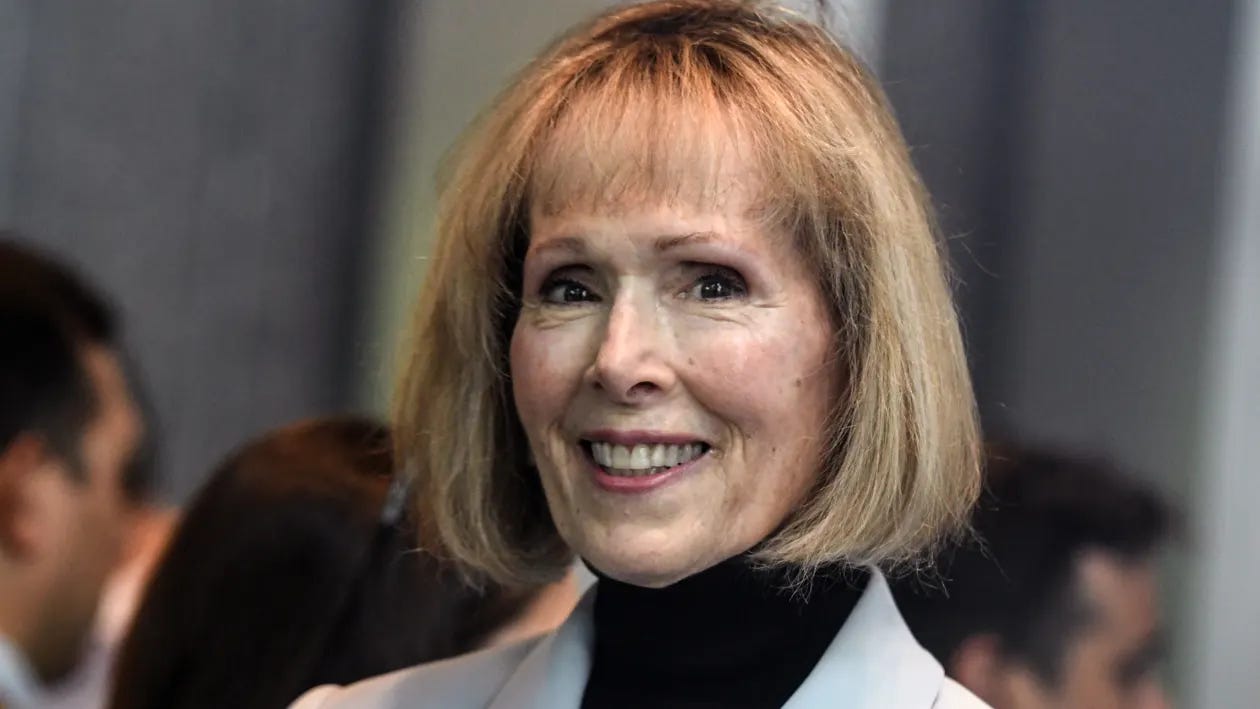
E. Jean Carroll, source: CNBC
Trump’s attitudes and actions toward women, of course, seem like something on which turning the page seems well overdue. Recall Trump’s lewdness in the infamous “Access Hollywood” tape. Take note of his sexual abasement of E. Jean Carroll, after which juries found him liable for abuse and defamation, costing him more than $90 million. Don’t dismiss his hush money payments to porn star Stormy Daniels and his extramarital affair with Playboy model Karen McDougal, part of his well-documented pattern of cheating on three wives.
Remember that about two dozen women have accused Trump of sexual misconduct dating back to the 1970s. Recall that his first wife, Ivana, accused him of rape during their 1990 divorce (she later retracted her claim). Another woman accused him of “attempted rape” in 1993 at his Mar-a-Lago resort, but settled a separate breach of contract case and forfeited the rape claim. Still another alleged that Trump attacked her on a flight to New York. Trump denied it all.
Just how vile is he? He looks on own daughter, Ivanka, in, well, a less than fatherly way. “If Ivanka weren’t my daughter, perhaps I’d be dating her. Isn’t that terrible? How terrible? Is that terrible?,” he said in 2006 on ABC’s “The View.” And, in a 2015 interview with Rolling Stone, Trump reportedly celebrated her “beauty,” adding, “If I weren’t happily married and, ya know, her father …” He was even rebuked by his former chief of staff for sexual remarks about Ivanka in front of White House staff.
Source: AP
Trump’s extraordinary litany of public comments define him, too. To pick three from a very long list, he labeled his own former U.S. Ambassador to the U.N. and former Gov. Nikki Haley “birdbrain,” said “If Hillary Clinton can’t satisfy her husband, what makes her think she can satisfy America?,” and said of talk show host Megyn Kelly “You could see there was blood coming out of her eyes, blood coming out of her wherever.” He slandered Harris as “Dumb as a Rock,” only to be humiliated by the former California State Attorney General and former U.S. Senator’s brilliance in skewering him in their debate.
Fortunately, many American women have long had Trump’s number. “President Joe Biden won women by 15 points over Trump in 2020, according to exit polls, up from former secretary of state Hillary Clinton’s 13-point victory among women in 2016,” The Washington Post reported. “Polls suggest that this year, women prefer Democratic presidential nominee Kamala Harris over Trump by similar margins. Harris led Trump by 13 points among women in an ABC News/Ipsos poll” released in early September.
Disdain for Trump is especially pronounced among younger women — even while younger men don’t shun him quite as much. “Sixty-seven percent of women 18 to 29 supported Vice President Kamala Harris in a New York Times/Siena College poll in six swing states last month, compared with 40% of young men,” The New York Times reported. “Fifty-three percent of young men in those states backed Donald J. Trump, compared with 29% of young women.”
Still, substantial numbers of women back Trump, in spite of his misogyny and coarseness. Trump has implied that Harris’s former romantic relationship with Willie Brown, a former San Francisco mayor, fueled her political success. And as the Times reported, he recently shared a screenshot on Truth Social showing an image of Harris and Hillary Clinton, appended with commentary from another user, with a reference to oral sex.
Asked by a Times reporter what she thought about Trump posting that image, co-founder of Moms For Liberty Tiffany Justice stammered: “You know what, I think that, uh, a lot of people say a lot of things. And we’re focused on the issues that are hurting American voters.”
Women who support Trump seem willing to turn their eyes away from a lot. Like Melania Trump, who suggested that her husband’s celebration of sexual assault in the Hollywood Access tape was just “locker room talk,” they wave aside his depravity.
Evangelical women who back him may see Trump as the sinner who is G-d’s tainted vehicle in areas such as abortion, although his waffling on the matter — declining to endorse a national ban — lately has irked many of them and smacked of betrayal. As he has sought to win over women concerned about such bans, Christian leaders have suggested his backpedaling could dissuade religious voters from showing up on Election Day. R. Albert Mohler, president of The Southern Baptist Theological Seminar, told The New York Times’ The Run-Up podcast that Trump faces the “grave danger” of evangelicals staying home on Nov. 5.
Harris and her team, however, are busy reminding voters that Trump just last spring proudly claimed to have destroyed the protections of Roe v. Wade by appointing Supreme Court justices who gutted the longstanding legal precedent. “After 50 years of failure, with nobody coming even close, I was able to kill Roe v. Wade, much to the ‘shock’ of everyone,” Trump said on his social media platform.
Source: Evangelicals for Harris
Trump, moreover, has lost some of his base even among evangelical women. The Rev. Billy Graham’s granddaughter, Jerushah Duford, famously condemned Trump in 2020. “How did we get here?,” she asked in a USA Today piece exhorting others to abandon him. “How did we, as God-fearing women, find ourselves ignoring the disrespect and misogyny being shown from our president? …. Jesus loved women; He served women; He valued women. We need to give ourselves permission to stand up to do the same.”
In mid-August, Duford made her support of Harris clear, taking part in an “Evangelicals for Harris” Zoom call. “Voting Kamala, for me, is so much greater than policies,” Duford said. “It’s a vote against another four years of faith leaders justifying the actions of a man who destroys the message Jesus came to spread, and that is why I get involved in politics.”
Will more women turn out for Harris? They might if they look into Trump’s history more closely, along with the views of his “childless cat ladies” running mate, Vance. The GOP vice presidential nominee apparently would have many women of the Mary Tyler Moore generation revisit their child-rearing days with grandchildren and give parents more voting power than childless Americans.
“In 2020, [Vance] did not demur when the podcast host Eric Weinstein asserted that helping care for youngsters was ‘the whole purpose of the postmenopausal female, in theory,’” The Atlantic reported. “The next year, Vance suggested that parents should have ‘more power—you should have more of an ability to speak your voice in our democratic republic—than people who don’t have kids.’ He also tweeted, “‘Universal day care’ is class war against normal people.’”
In past elections when Trump ran, the gender gap was substantial. This time around, it could prove to be a yawning chasm. And when one explores why, the question arises: How could any self-respecting woman, of any age and any religion and any race, support this man?
The facts don’t bear out Trump’s doomsaying — at least in economic terms
Source: Los Angeles Times
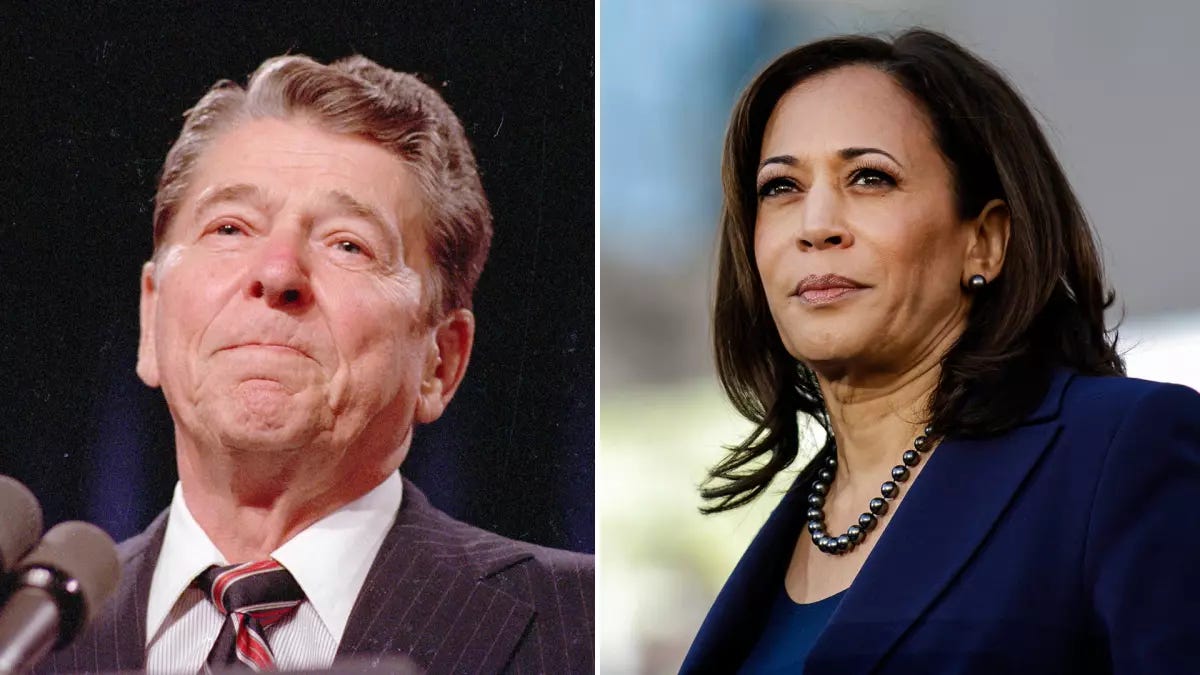
In a memorable election debate with President Jimmy Carter on Oct. 28, 1980, GOP nominee Ronald Reagan asked Americans: “Are you better off today than you were four years ago?”
Amid the stagflation and rising unemployment of the time, many were not. So Reagan went on to turn Carter into a one-term president. Reagan even won the popular vote (unlike Donald J. Trump in 2016). And he went on to serve two terms.
That “better-off” question is rising again, of course (as it often has in presidential races). As one might expect, Fox News has bruited it, citing a poll the outlet took last spring that suggested 52% of voters felt worse off. Still, in a poll a bit later by The New York Times, The Philadelphia Inquirer and Siena College, the outlook was similar, as more than half of registered voters in six battleground states rated the economy as “poor.” Many Americans even wrongly think we’re in recession.
Like many of those voters, some of my relatives are answering “No” to the “better-off” question, saying they felt richer during the Trump years than they have during the Biden-Harris term. And a libertarian friend argued the same point, contending that the reasons many Americans back Trump are not based in racism or sexism, but rather on economics. They just don’t think Democratic policies have helped them, he said.
But are we, in fact, better off? Do the data substantiate or undercut the often-partisan feelings, deeply felt as they may be?
Without seeing their tax returns, of course, we can’t know whether certain individuals have fared better or not since January 2021. We don’t know how their businesses have done or how they have coped if they are on fixed incomes (though Social Security boosts for costs of living of 8.7% in 2023 and 3.2% this year may have helped).
But we can explore the so-called national “vibecession” to see if it is based in facts or is just a matter of hazy memories. And recall that some of those memories have been demagogically reinforced by Trump’s inaccurate bravado about overseeing the greatest economy in world history.
“Nostalgia’s rosy glow makes almost all presidents more popular after they leave office,” Los Angeles Times journalist David Lauter writes. “[T]hat effect may have been especially sharp this time because the steep inflation of 2021 and 2022 caused voters to fondly recall the good economy of Trump’s first three years in office; and younger voters may have only vague memories of Trump controversies that took place in their teenage years.”
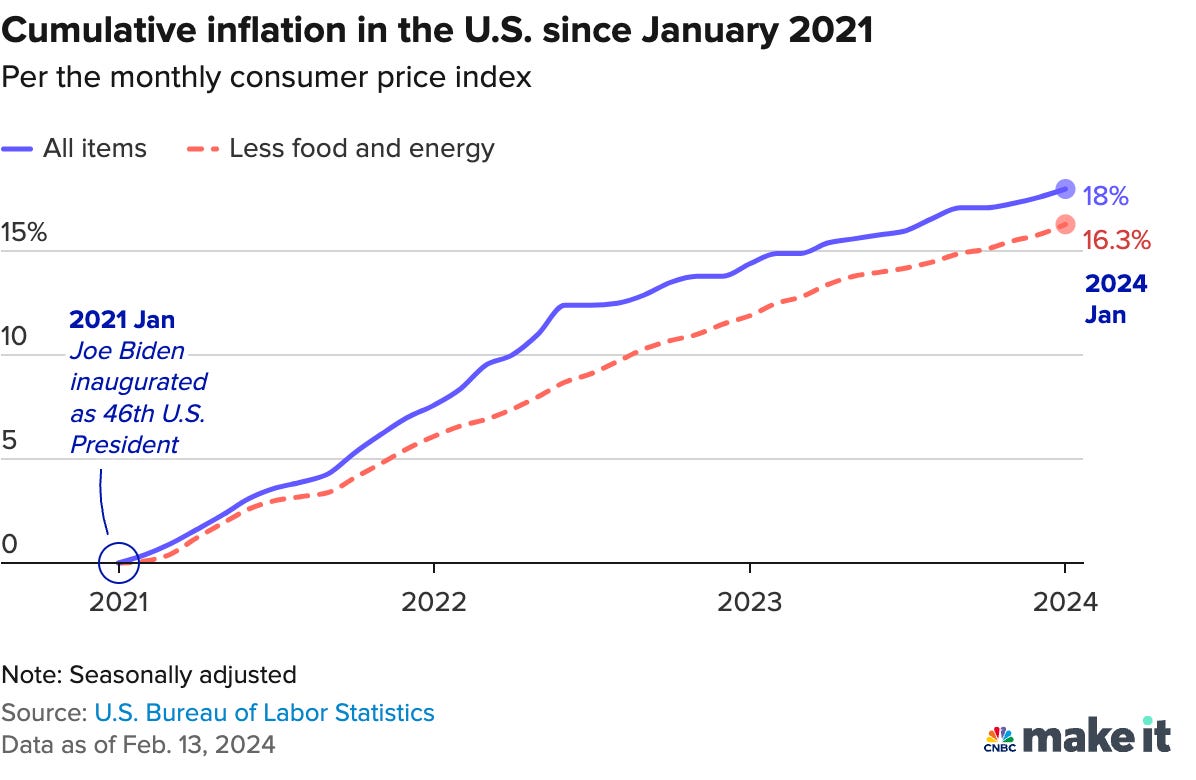
Certainly, we must concede that inflation has been a bear, especially for lower-income folks:
Indeed, because higher prices are baked in, it may not help former Vice President Kamala Harris that inflation has moderated substantially this year. As the Bureau of Labor Statistics reported on Sept. 11, the Consumer Price Index for All Urban Consumers rose just 0.2% on a seasonally adjusted basis in August, the same increase as in July. Over the last 12 months, the all-items index increased just 2.5% before seasonal adjustment.
It also may make little difference to voters that presidents don’t control inflation and can only modestly influence it. Reining in price hikes is the province of the independent Federal Reserve, which is poised to lower interest rates for the first time in four years because of recent progress on the price front. The rollback could make housing and other things more affordable for many, though not for a while yet.
Despite that, of course, Trump has trumpeted inflation as a reason Americans should elect him. He knows all too well that a price spiral has cost incumbent presidents — notably Carter and Gerald Ford — the White House. It helped Reagan to get in, too, so Trump understandably figures it could be a winning issue for him.
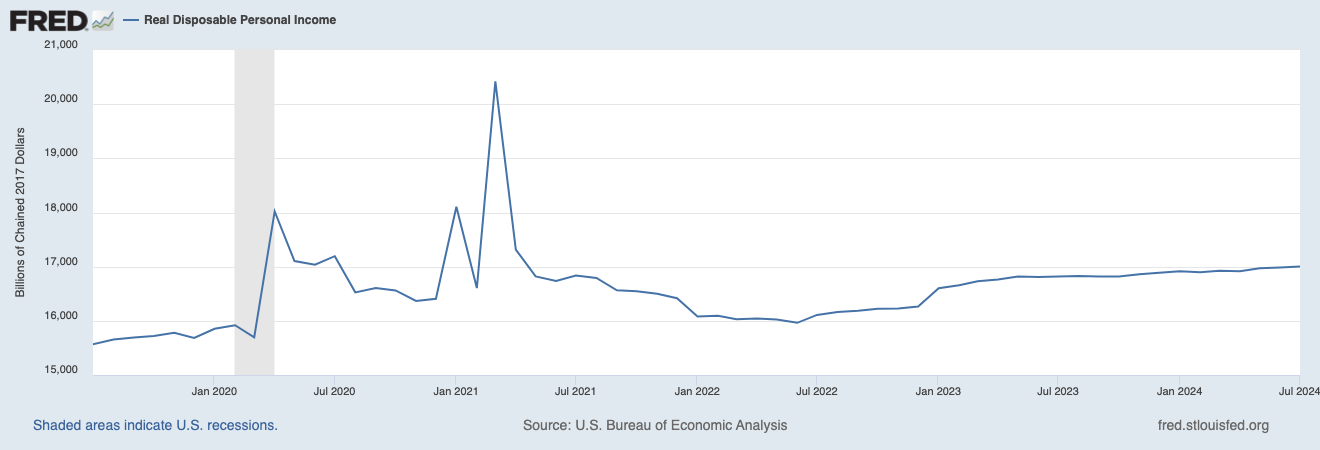
What’s more, real incomes haven’t been growing much. As polls expert Nate Silver writes, real disposable personal income, basically how much money people have left after taxes and inflation, is historically one of the best predictors of election outcomes. And it’s been flat during Biden’s tenure: people’s incomes aren’t growing much. Part of that, he notes, was due to spikes caused by COVID stimulus spending — but even over the past year, it’s barely kept up with population growth:
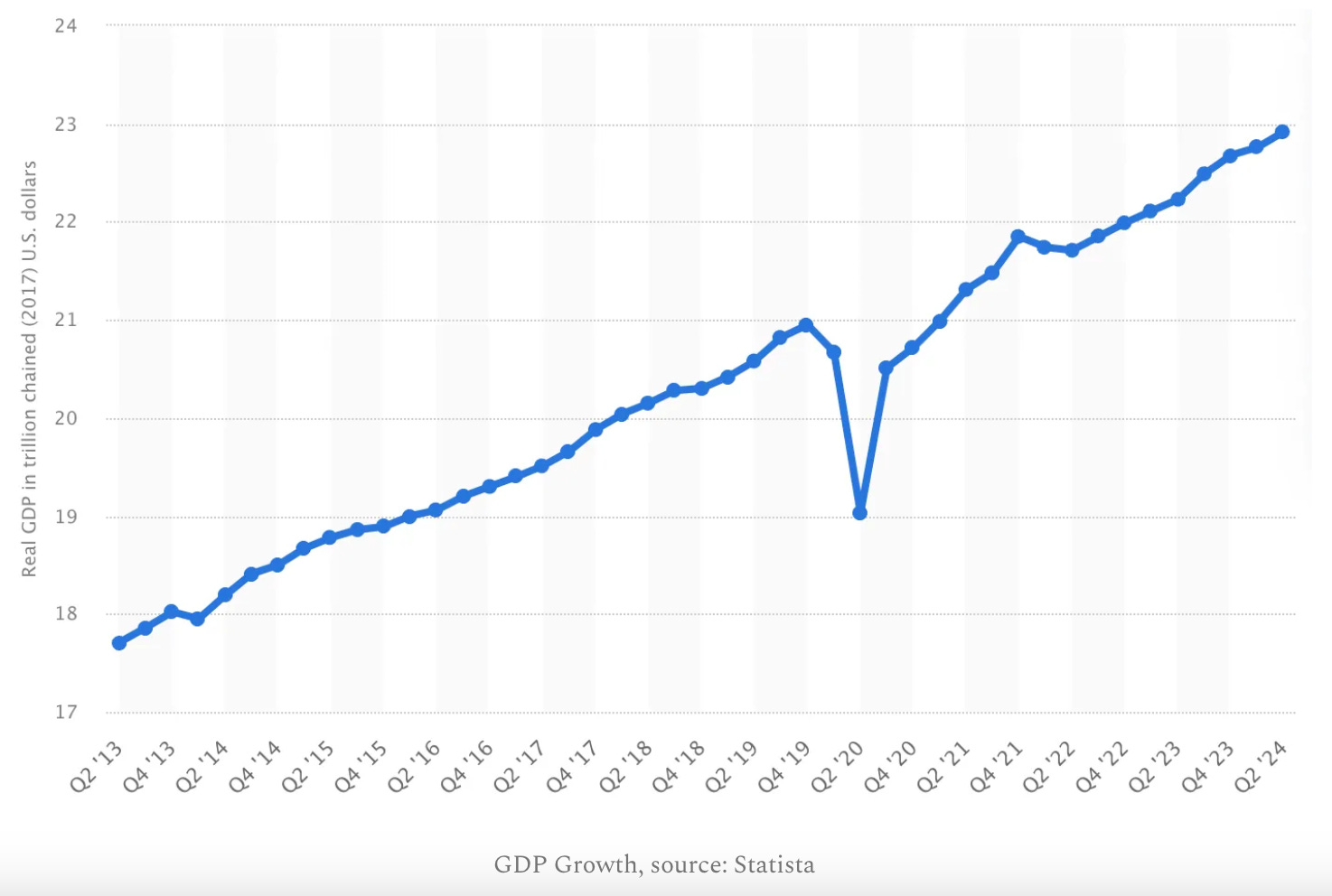
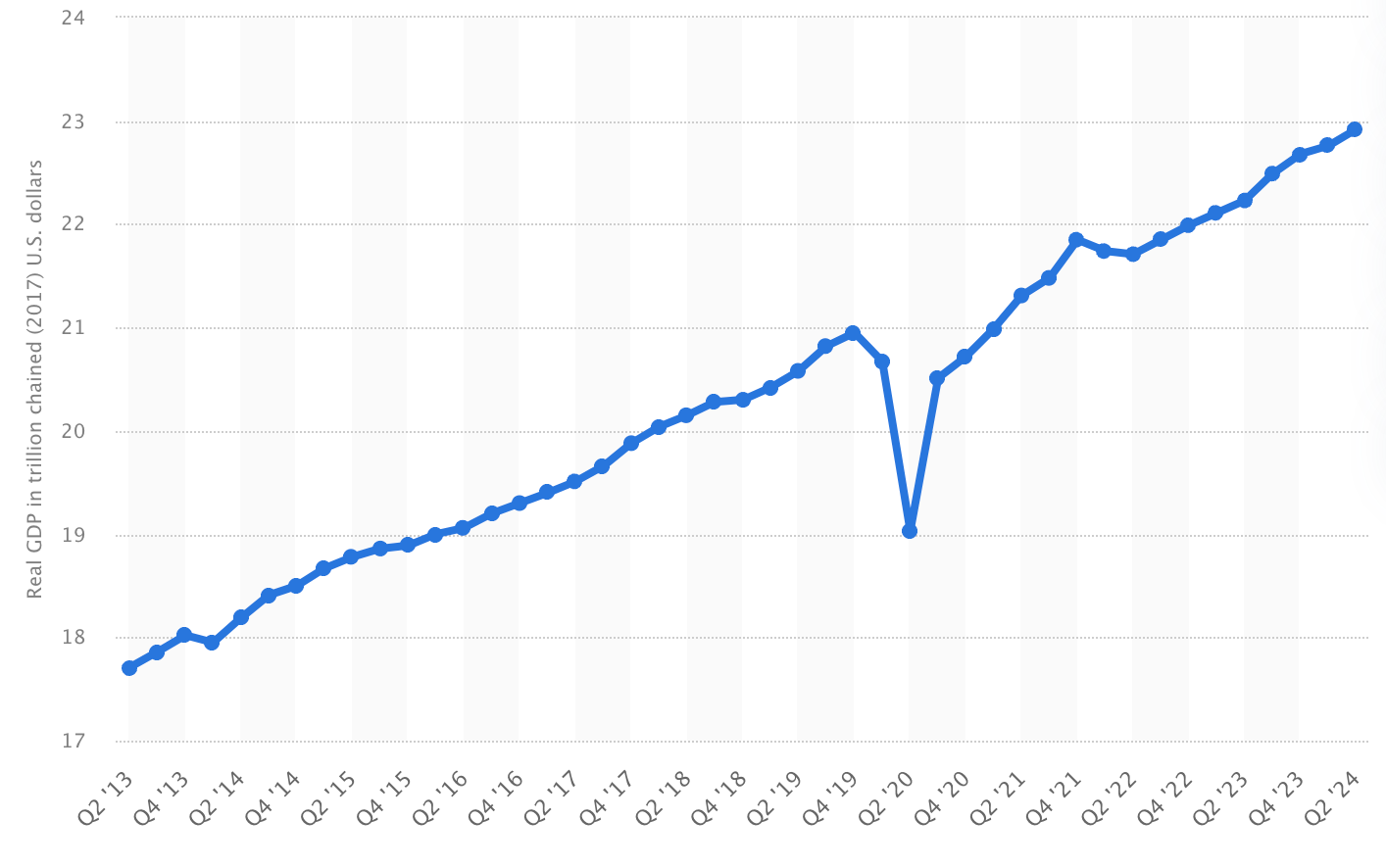
But to maintain that things haven’t been getting better economically — overall — is simply false. If one looks at gross domestic product, for instance, the trend line has been markedly up:
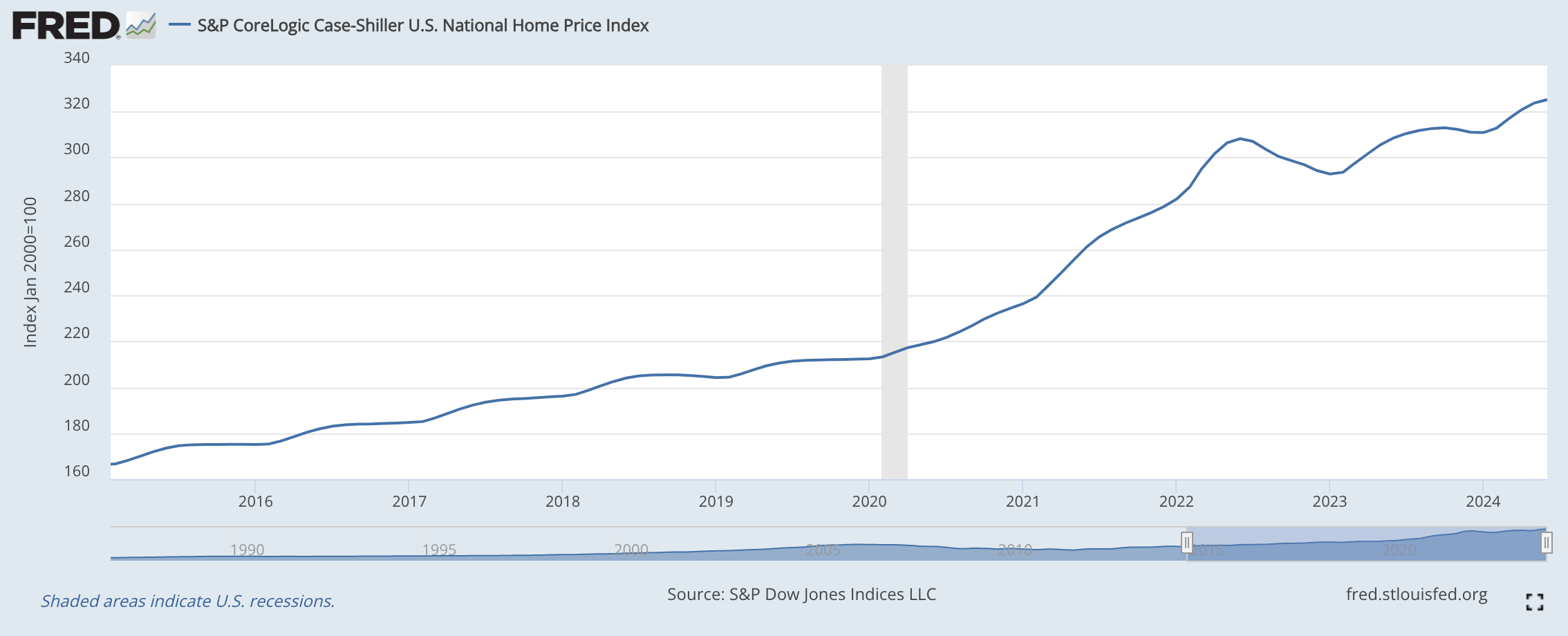
Moreover, one’s feeling of well-being has a lot to do with housing costs and prices. And for homeowners, times could scarcely be better, at least insofar as their wealth is tied to the value of their homes (the story is different, of course, for renters and would-be home buyers):
To point to just one example, the home of my relatives in suburban Jackson, New Jersey, is now worth $570,000, a good bit more than the $120,000 they paid in 1990 (and that $120K equals $296,500 today, so they’ve had dramatic inflation-adjusted gains), according to Redfin. By that measure alone, they are much better off than in the past.
But much of that data above is backward looking. At the moment, it seems, many consumers are hardly feeling impoverished, and some are beginning to believe Harris would be a better choice than Trump on the economic front.
“Consumer sentiment was essentially unchanged for the fourth consecutive month, inching up 1.4 index points,” the director of the much-watched University of Michigan consumer survey reported in an early assessment of August survey results. “With election developments dominating headlines … sentiment for Democrats climbed 6% in the wake of Harris replacing Biden as the Democratic nominee for president. For Republicans, sentiment moved in the opposite direction, falling 5% … Sentiment of Independents, who remain in the middle, rose 3%.”
Source: Econlib
“The survey shows that 41% of consumers believe that Harris is the better candidate for the economy, while 38% chose Trump,” survey director Joanne Hsu writes. “Overall, expectations strengthened for both personal finances and the five-year economic outlook, which reached its highest reading in four months….”
Of course, big-picture facts may matter little to folks who are convinced the past was better. Indeed, with its Make America Great Again theme, the Trump candidacy is based on a rosy view of the past, one that under scrutiny seems beyond saccharine and, for many Americans, is just inaccurate. His negativism, with comments such as “we are a nation in decline,” play well with some, but will they with most?
To be sure, there is plenty of reason to be concerned about various social pathologies in the United States — school shootings come to mind first and foremost. Despite my libertarian friend’s view that racism and sexism are well back in the country’s rear-view mirror, moreover, many Americans are concerned about such ingrained traits in our national psyche — even if we have had progress there.
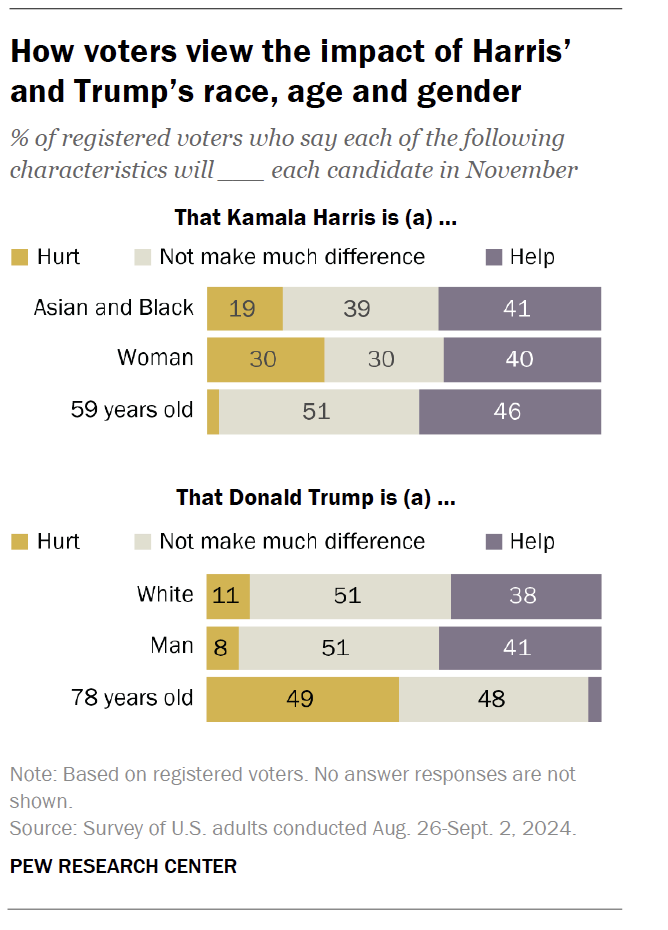
“Voters overall have mixed views of the impact of Harris’ gender and race and ethnicity on her candidacy,” a recent report by the Pew Research Center finds. “More say the fact that Harris is a woman and that she is Black and Asian will help her than hurt her with voters this fall. Somewhat more voters see Harris’ gender as a potential negative (30%) than see her race and ethnicity this way (19%).”
“Harris supporters are far more likely than Trump supporters to say the vice president’s gender and race will be a liability,” the report continues. “More than twice as many Harris supporters (42%) as Trump supporters (16%) say the fact that Harris is a woman will hurt her with voters. Fewer Harris supporters think her race and ethnicity will be a hindrance (31%), but just 8% of Trump supporters say the same.”
With comments such as “she happened to turn Black,” Trump is doing his best to rouse the racists among his devotees while trying to undercut Harris’s support among Blacks. Certainly, Trump doesn’t seem to be succeeding in the latter regard, with some 82% of Black voters “definitely” or “probably” in her corner, according to a Washington Post-Ipsos poll.
In the end, to the extent that Harris can get people to focus on facts, she may even persuade some that things have been getting better, Trump’s incessant focus on the negative notwithstanding. And there’s a decent shot things will get even better going forward. Focusing on a sunny future — America as a “shining city on the hill” — helped Reagan. Might that work for Harris, too?
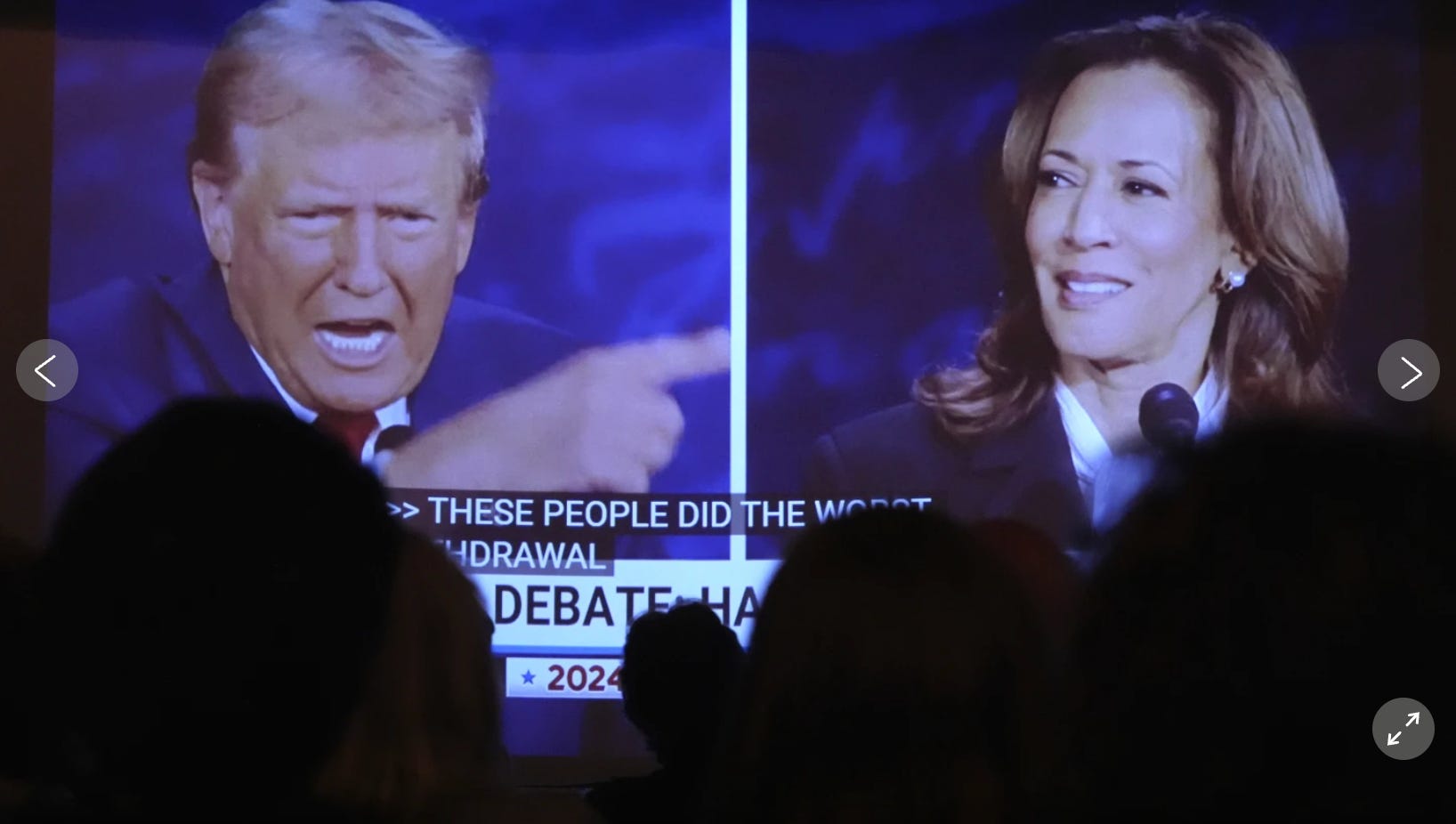
For the benefit of his followers and his ego, Donald J. Trump declared that he bested Kamala Harris in a debate that even conservatives – smart ones anyway – declared was a hands-down disaster for him.
“Kamala Harris baited Trump with surgical precision, triggering his insecurities — about his crowd sizes, his wealth, his racism, his criminal record — while giving him full scope to wallow in his delusions. In the 90-minute debate, she exposed Donald Trump and broke him,”Charlie Sykes wrote on Substack. “Trump was undisciplined, unprepared, and easily goaded into his signature tantrums of grievance, which were as incoherent as they were divorced from reality … Tens of millions of voters watched a live reality television show in which a bitter, confused, and diminished old man was falling apart in front of their eyes.”
Another conservative, David Frum, weighed in in The Atlantic: “He repeated crazy stories about immigrants eating cats and dogs, and was backwards-looking, personal, emotional, defensive, and frequently incomprehensible. Harris hit pain point after pain point: Trump’s bankruptcies, the disdain of generals who had served with him, the boredom and early exits of crowds at his shrinking rallies. Every hit was followed by an ouch.”
Source: AP
Certainly, much of the public appeared to agree that Vice-President Harris mopped the floor with Trump. Shortly after the Sept. 10 fracas, a CNN poll showed Harris winning 63% to 37% among debate-watchers and a YouGov poll showed her winning 54% to 31% among registered voters who watched at least some of the melee, with 14% unsure, according to The Washington Post.
So, with his animalistic smarts, Trump is wise to avoid a second debate. How could he possibly want a second round of his angry squinting, venting and waxing irrational and conspiratorial? By contrast, when he controls the stage and speaks to true believers in his rallies, he’s the master of his own domain (reference intentional), the TV-savvy demagogue who can appear slick and poised (despite many slips).
Source: 538
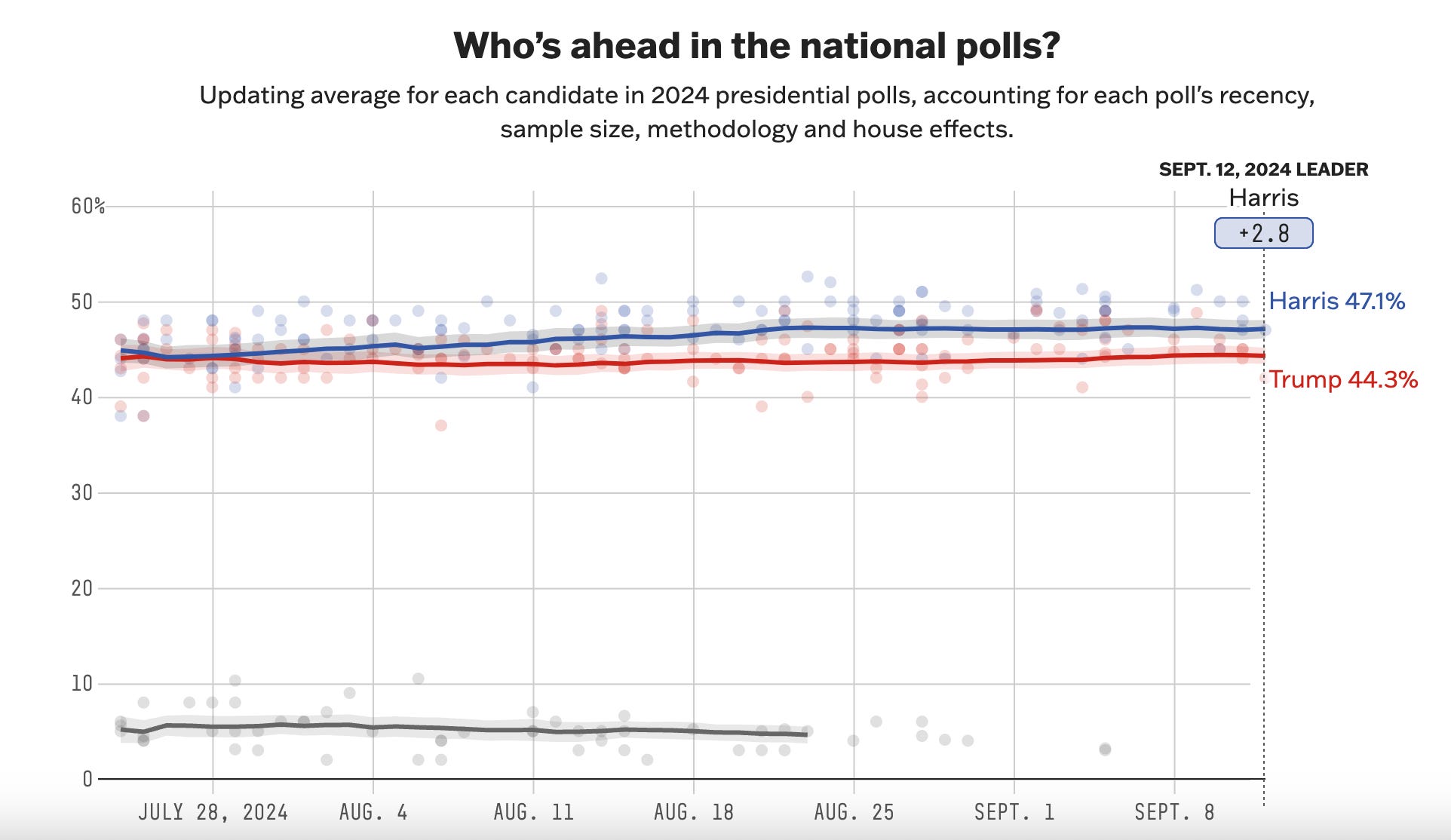
For Harris backers, however, the problem is that the debate may not have moved the needle much with the few undecided folks out there. The latest polls barely budged, with Harris ahead of Trump by just 2.8 points, at 47.1% to Trump’s 44.3%.
Despite Harris’s national lead, the model that polls expert Nate Silver uses still gives Trump a higher chance of winning the necessary 270 Electoral College votes in November, as Newsweek reported. It shows Trump taking the critical battleground states of Arizona, Georgia, Pennsylvania, Nevada and North Carolina. The other swing states, Wisconsin and Michigan, are a toss-up.
How can this be? How can such an inarticulate boor, a proven criminal and business and political failure, still have the slightest bit of credibility? After his disastrous performance, how can his party still rally around him, unlike the Democrats and President Biden?
The answer is complicated. But I suggest it starts, paradoxically, with the fact that Harris won the debate. In her triumph, she is many things that Trump’s followers can’t abide: smart, young, female and Black.
On the smart point, Trump has long been popular with undereducated voters. In 2016, only 29% of Trump voters had college degrees, compared with 43% of Hillary Clinton’s voters. And while non-college whites made up a majority of Trump’s voters (63%), they constituted only about a quarter of Clinton’s (26%). As Trump famously said after winning a Nevada primary in 2016, “I love the poorly educated.”
Did many of them even watch the debate? Some 67.1 million Americans tuned in, more than the 53.1 million who watched Biden self-destruct in the June 27 faceoff with Trump, but less than the 73 million who watched the first Trump-Biden match in 2020 and far less than the 84 million who watched Clinton and Trump battle the first time in 2016.
Source: NPR
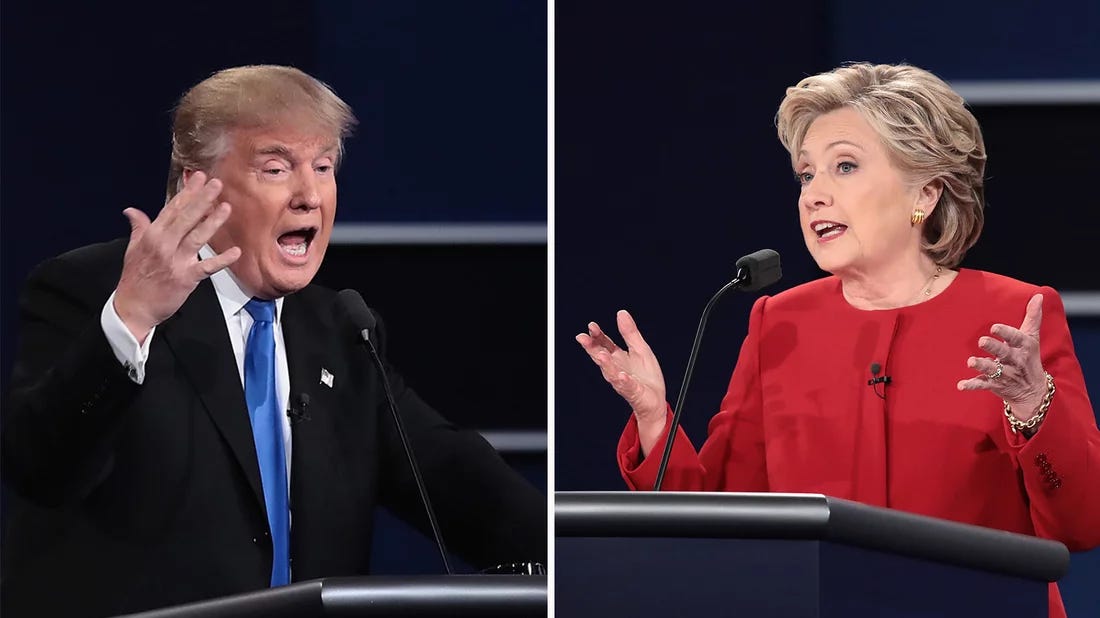
And let’s remember that Clinton was widely pronounced the winner in her three debates with Trump back then. Only some 32% of those polled pronounced him the winner in his best performance in the second debate. Just 24% judged him favorably in his first outing with Clinton.
With both Clinton and Harris, I submit, the fact that both women ran circles around Trump intellectually was a negative with much of the undereducated electorate. Recall that such folks likely spent much of their time in school resenting the smart kids, so they likely would give Clinton and Harris little credit for their debating savvy.
Second, Harris at 59 is relatively young, especially compared with the 78-year-old Trump. Middle-aged voters tend to support Trump, while those over 65 are split evenly, and are up for grabs. Thus, we see Harris pounding away on the Biden Administration’s efforts to cut insulin costs, its moves to let Medicare negotiate with drugmakers and its $2,000 cap on out-of-pocket drug costs. We also see Trump’s plan to exempt Social Security payments from income taxes.
A lot of the older folks turned away from President Biden after his debate debacle. Will the Trumpers among them do so now after the former president’s poor performance? Will they see the signs of cognitive decline that have long been evident to mental health professionals?
Psychiatrist Richard A. Friedman, source: Weill Cornell Medical College
“If a patient presented to me with the verbal incoherence, tangential thinking, and repetitive speech that Trump now regularly demonstrates, I would almost certainly refer them for a rigorous neuropsychiatric evaluation to rule out a cognitive illness,” Weill Cornell Medical College professor and psychiatrist Richard A. Friedman wrote in The Atlantic. “A condition such as vascular dementia or Alzheimer’s disease would not be out of the ordinary for a 78-year-old.”
Still, let’s not forget the potent impact of identity politics. For all her brilliance, her achievements and her skills, Harris is female and Black, guaranteeing an uphill fight. According to the latest Pew Research Center polling, most Harris supporters say Trump’s race will help him (59%), as will his being male (56%). Most Trump supporters, by contrast, say the former president’s race and gender will not make much of difference (66% say this about Trump’s race, 61% say the same of his gender), but the latter numbers are hardly encouraging in a tight race.
Another element in Trump’s favor is the weariness many voters feel about the race, a sentiment the non-stop headline-grabbing nonsense and divisiveness from Trump has fueled. Some Trump supporters in my family, for instance, are just tired of it all and want the election behind them. They don’t want to hear criticisms of their golden boy, no matter how valid. As Harris has noted, even Trump rally-goers drift out of his gatherings early out of exhaustion and boredom.
Finally, there’s the matter of faulty memories. Despite such evidence as the Covid-induced rise in unemployment to 14.8% in 2020 and the 6.4% rate Trump left to Biden, Trump claims his tenure produced the greatest economy in the history of the world. That is simply false, and yet his repetition of the claim appears to have lulled Trumpers into believing it.
GDP Growth, source: Statista
“In the U.S., average annual GDP growth during the past eight years has been almost constant in real terms, except for the Covid period (2020 and 2021): 2.6% in 2017-2019 and 2.3% since 2022,” economist Enrico Colombatto wrote in August.
When Biden took office in January 2021, the unemployment rate was 6.4%, Colombatto added. The rate gradually declined to the low of 3.4% in early 2023 before climbing to 4.2% under an inflation-fighting economic slowdown engineered by the high interest rates set by the Federal Reserve.
Let’s recall, moreover, that presidents can influence economies but they don’t control them. The Fed has far more to do with inflation – admittedly very high under Biden – than a president does. And lately it appears that the Fed will move to lower interest rates.
Back in 2016, Trump’s demagoguery and stagey anger proved remarkably effective. But is the sequel playing badly now? It’s possible that Harris’s efforts to paint an optimistic future, with programs to help housing get on track and tax credits for parents of young children – “the opportunity economy,” as she calls it – will sell better than Trump’s rage. So, too, may her plans for reviving a border-fixing bill that Trump quashed early this year so he could run on that troubling issue.
Nonetheless, given all the possible pitfalls in coming weeks and the shortcomings of polling, it would seem the election remains either candidate’s to win. It may prove to be a matter of voter turnout, which could rest on which candidate can generate more enthusiasm. It may be a matter of knocking on doors, the key for Barack Obama’s victories. So far, Trump’s “ground game” seems weak, as he relies on rallies and headlines.
Certainly, Democrats have been winning the dynamism race ever since Biden yielded to Harris. Can Harris sustain that? Can she convince voters that the exhausting politics of division and the chaos that Trump tends to sow are better left behind rather than repeated for another four years? The questions remain open.
A Brown trustee’s resignation doesn’t help the fight against antisemitism
Brown students discuss divestment; source: Brown Daily Herald
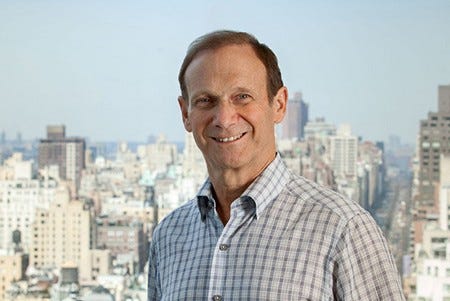
Hedge fund manager Joseph Edelman has made a lot of good decisions in his career. Forbes pegs his net worth at $2.5 billion.
But this week he made a bad choice with respect to Brown University, where he served as a trustee from 2019 until now. He quit the board, angry that it will hold a vote on whether the school should divest itself of securities related to Israel.
Brown President Christina H. Paxson agreed last April 30 to consider divestment after anti-Israel protests erupted at the school, as they did on many campuses.
“I find it morally reprehensible that holding a divestment vote was even considered, much less that it will be held—especially in the wake of the deadliest assault on the Jewish people since the Holocaust,” Edelman wrote in a Sept. 8 Wall Street Journal op-ed. “The university leadership has for some reason chosen to reward, rather than punish, the activists for disrupting campus life, breaking school rules, and promoting violence and antisemitism at Brown.”
He added: “I consider the willingness to hold this vote a stunning failure of moral leadership at Brown University. I am unwilling to lend my name or give my time to a body that lacks basic moral judgment.”
Joseph Edelman, source: Spiking
Edelman’s stance, in my view, is principled, understandable and wrong.
There should be a trustee vote, as is expected on Oct. 17-18; fittingly, that is within two weeks of the anniversary of Hamas’s animalistic savagery in Israel. And that vote should be preceded by a full-throated, campus-wide discussion of the issues involved. After all, isn’t education all about discussing the big things?
And aren’t the 120 or so Brown students who set up an encampment to protest the war in Gaza last spring sorely in need of education, in dire need of learning some big things? Shouldn’t those who are pressing anew for divestment be taught why the idea is so damn wrong?
That discussion, if it occurs, needs to be based on facts. It should begin, for instance, with some history about Israel and Jews:
For starters, the discussion should explore how long Jews have been in the land. The oldest Hebrew text ever found was discovered at the ancient Israelite settlement, near modern-day Beit Shemesh, that dates to between 1050 and 970 BCE. The academic consensus, based on archeological and other evidence, is that a United Kingdom of Israel existed in the 10th and 9th centuries BCE.
Of course, Jews moved in and out of what is now Israel over many centuries since then. Exiles followed the two destructions of the Temple in Jerusalem, in 586 BCE by the Babylonians and in 70 CE, when the Romans sacked the place. But, even through those events, Jews remained, keeping a consistent presence, as scholars have long noted.
As Cornell University Prof. Barry Strauss has written, for instance, in a piece detailing that continuous presence: “To sum up, the Jews have an ancient history in Palestine going back three thousand years. Their yearning for Zion goes back well more than two thousand years. Jews are indigenous to Palestine.”
So, in other words, the oft-shouted argument that Israel is a colonial project is hogwash. Brown students and many others need to learn that.
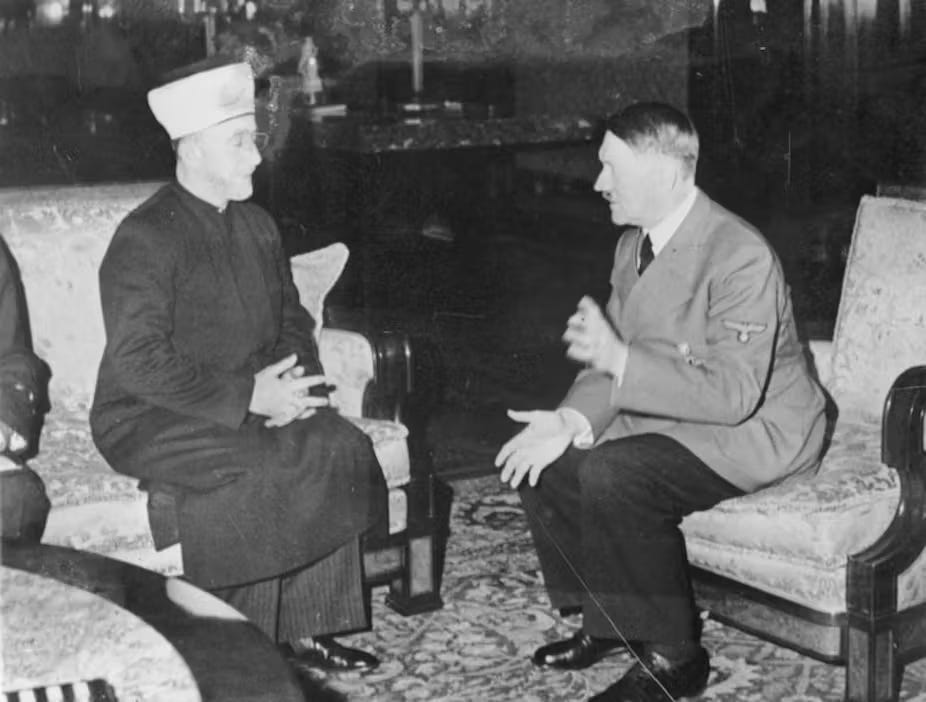
Second, the discussion should deal with the number of times Arabs have refused deals that could have settled the century-long fighting between them and Jews in the region. Palestinian rejectionism dates back at least to 1937, when the Jerusalem Mufti Hajj Amin Husseini suggested to the British that Jews should be deported. He went so far as to make his case against the Jews with a soulmate, Adolf Hitler, in 1941:
A few years later, the Jerusalem Arab leader rejected a UN partition plan to create two states. A long string of Palestinian leaders has echoed that rejection of various deals since. Their intransigence gave rise to the often-noted comment by Israeli diplomat Abba Eban in 1973: “The Arabs never miss an opportunity to miss an opportunity.”
Hamas, of course, has squandered many opportunities. Among others, in its effort to build tunnels and its war machine, it blew the chance to turn Gaza into something like a Singapore on the Mediterranean over the last couple decades. Instead of using millions of global aid dollars to develop an economy, it created a subterranean fortress, and it repeated its rejectionism of coexistence publicly as recently as 2017:
“Palestine, which extends from the River Jordan in the east to the Mediterranean in the west and from Ras al-Naqurah in the north to Umm al-Rashrash in the south, is an integral territorial unit,” Hamas asserted. “It is the land and the home of the Palestinian people. The expulsion and banishment of the Palestinian people from their land and the establishment of the Zionist entity therein do not annul the right of the Palestinian people to their entire land and do not entrench any rights therein for the usurping Zionist entity.”
Hamas at that point declared null and void the Balfour Declaration, the British Mandate Document, the UN Palestine Partition Resolution “and whatever resolutions and measures that derive from them or are similar to them.” It rejected the Oslo Accords, signed by the PLO in 1993 and 1995.
Third, turning to current issues, the discussion should detail how rape and savagery were the means that Hamas used on Oct. 7th to kill some 1,200 Jews, as verified by the United Nations, among others. The discussion should include video evidence of those crimes that students should be required to watch. They should appreciate the monstrousness of the group some of them are championing, should understand what the popular “by any means necessary” placards really mean.
The discussion should include details about the more than 240 hostages the group took, many of whom are now dead. Some, of course, were wantonly slaughtered recently, within days of rescue. It should address how Hamas released videos of the murdered afterward in bids to torment their families and pressure Israel into a bad deal that would assure Hamas’s rearmament and continued existence.
Yes, the discussion should also explore the areas where Israel has fallen short. Its treatment of Palestinians in the West Bank and other areas needs to be examined, as does the country’s right-wing settler policies. Many of those are opposed by Israelis, though Palestinians in the territories hardly help their cause by allying with Hamas. The state isn’t perfect and its problems need to be fully aired, as well.
But there’s no excuse for the ignorance that gives prominence to those problems and not to other more compelling realities. For instance, the discussion should elaborate on the meaning of the oft-chanted phrase “from the river to the sea.” The slogan refers, of course, to purging the land between the Jordan and the Mediterranean of Jews and replacing them with Muslims, as described in the Hamas documents; that would be a real genocide.
Once that sort of discussion takes place at Brown, there should be a vote on divestment. The trustees, of course, should oppose it unanimously.
If most of Brown’s 38 trustees vote otherwise, Edelman might then have been morally obligated to quit – as other dissenting trustees might then be, as well. But they would have had the chance to make their case based on the points above. And they could then feel assured that the antisemites simply outnumber sensible people at the school — a sign that, maybe, sensible folks of any persuasion or creed should avoid Brown for good.
Taking one’s marbles and going home before the game is done, however, doesn’t solve the problems of antisemitism, nor does it remedy the historical and political ignorance that plague many American campuses, especially the elite ones. Academics at schools such as Brown should know better than to propagate the ahistorical anti-Zionist nonsense that too many students appear to be swallowing.
And, if they don’t, trustees and administrators need to install academics who do.
Universities exist to educate. As proven in last year’s national turmoil, they need to do a far better job of that. In their ignorance, students last year broke university rules at Brown, albeit for a relatively short time (less than a week). One idea is that during this term, those students should be required to take and pass coursework that explores the matters raised above, taught by professors who do know their stuff.
As for trustees and administrators, their job is fix the problems. Unless Edelman was pretty sure the problems are irreparable at Brown, he should have stuck around and cast his vote. It would have helped.
Fall, leaves, fall; die, flowers, away; Lengthen night and shorten day; Every leaf speaks bliss to me Fluttering from the autumn tree. I shall smile when wreaths of snow Blossom where the rose should grow; I shall sing when night’s decay Ushers in a drearier day.
To Autumn
John Keats
Season of mists and mellow fruitfulness, Close bosom-friend of the maturing sun; Conspiring with him how to load and bless With fruit the vines that round the thatch-eves run; To bend with apples the moss’d cottage-trees, And fill all fruit with ripeness to the core; To swell the gourd, and plump the hazel shells With a sweet kernel; to set budding more, And still more, later flowers for the bees, Until they think warm days will never cease, For summer has o’er-brimm’d their clammy cells.
Who hath not seen thee oft amid thy store? Sometimes whoever seeks abroad may find Thee sitting careless on a granary floor, Thy hair soft-lifted by the winnowing wind; Or on a half-reap’d furrow sound asleep, Drows’d with the fume of poppies, while thy hook Spares the next swath and all its twined flowers: And sometimes like a gleaner thou dost keep Steady thy laden head across a brook; Or by a cyder-press, with patient look, Thou watchest the last oozings hours by hours.
Where are the songs of spring? Ay, Where are they? Think not of them, thou hast thy music too,— While barred clouds bloom the soft-dying day, And touch the stubble-plains with rosy hue; Then in a wailful choir the small gnats mourn Among the river sallows, borne aloft Or sinking as the light wind lives or dies; And full-grown lambs loud bleat from hilly bourn; Hedge-crickets sing; and now with treble soft The red-breast whistles from a garden-croft; And gathering swallows twitter in the skies.
Sonnet 73 (‘That time of year thou mayst in me behold’)
William Shakespeare
That time of year thou mayst in me behold When yellow leaves, or none, or few, do hang Upon those boughs which shake against the cold, Bare ruin’d choirs where late the sweet birds sang. In me thou seest the twilight of such day As after sunset fadeth in the west, Which by and by black night doth take away, Death’s second self, that seals up all in rest. In me thou seest the glowing of such fire That on the ashes of his youth doth lie, As the death-bed whereon it must expire, Consum’d by that which it was nourished by. This thou perceiv’st which makes thy love more strong, To love that well which thou must leave ere long.
Autumn Fires
Robert Louis Stevenson
In the other gardens And all up in the vale, From the autumn bonfires See the smoke trail!
Pleasant summer over, And all the summer flowers, The red fire blazes, The grey smoke towers.
Sing a song of seasons! Something bright in all! Flowers in the summer, Fires in the fall!
Nothing Gold Can Stay
Robert Frost
Nature’s first green is gold, Her hardest hue to hold. Her early leaf’s a flower; But only so an hour. Then leaf subsides to leaf. So Eden sank to grief, So dawn goes down to day. Nothing gold can stay.
Pleasant Sounds
John Clare
The rustling of leaves under the feet in woods and under hedges; The crumpling of cat-ice and snow down wood-rides, narrow lanes and every street causeway; Rustling through a wood or rather rushing, while the wind halloos in the oak-toop like thunder; The rustle of birds’ wings startled from their nests or flying unseen into the bushes; The whizzing of larger birds overhead in a wood, such as crows, puddocks, buzzards; The trample of robins and woodlarks on the brown leaves. and the patter of squirrels on the green moss; The fall of an acorn on the ground, the pattering of nuts on the hazel branches as they fall from ripeness; The flirt of the groundlark’s wing from the stubbles – how sweet such pictures on dewy mornings, when the dew flashes from its brown feathers.
Whim Wood
Katherine Towers
into the coppery halls of beech and intricate oak to be close to the trees as they whisper together let fall their leaves, and we die for the winter