
The Washington Post will surely not find success that way
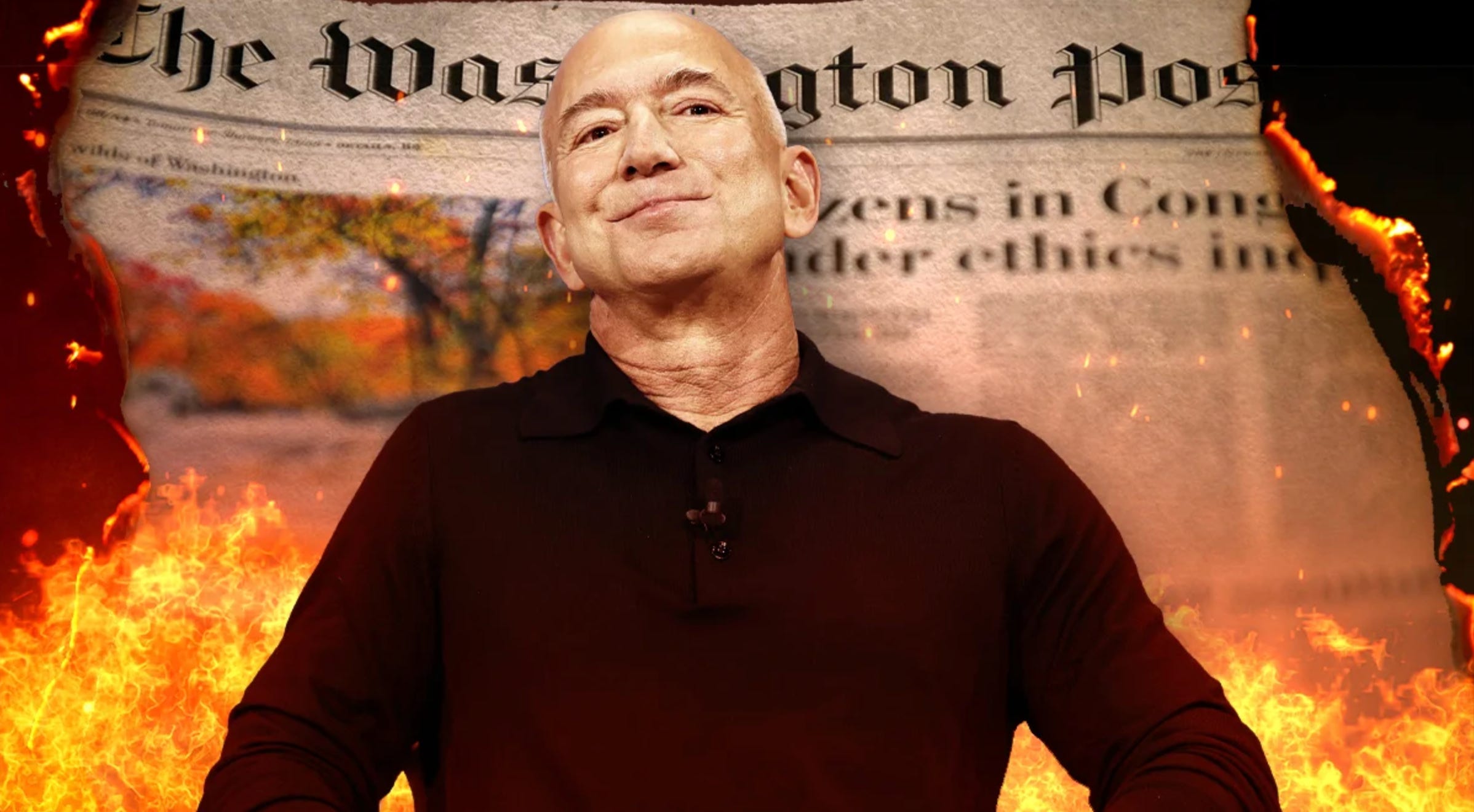
Someday, a smart academic will cooly analyze the rival game plans that enabled The New York Times to thrive while, just down the road, The Washington Post slipped into what has been looking like a slow-motion death spiral.
But it’s likely that two things on that list will include an owner committed to great journalism and a passion for innovation, even at great cost.
Consider first the nonstop innovation that has kept the Times vibrant. The New York paper’s website is a cornucopia of offerings from the news of the day and in-depth magazine offerings to games, consumer advice in Wirecutter, exceptional sports coverage in The Athletic, audio offerings that range from The Daily to Opinions, along with entertainment, cooking and health news.
The soup-to-nuts menu of the paper could keep a reader, listener or video-watcher engaged for hours. Just picking out the best things to tap into takes a while each day.
By contrast, the best that can be said of the Post is that it tries.
In unoriginal ways, the Post mimics some of the same offerings, but with far less content. While on a given day the Times might have whole subsections devoted to the Trump Administration, the Epstein files, the Russia-Ukraine war, the Super Bowl and more, along with the top stories of the day in its many categories, the Post offers short lists of pieces that take no time to scan through.
It could hardly be otherwise given the yawning gap in staff at the papers. While the Times employs more than 2,800 people in its journalism operations, the Post shrank its newsroom in multiple downsizings in recent years to 800 and now is losing more than 300 of them, along with more on the business side.
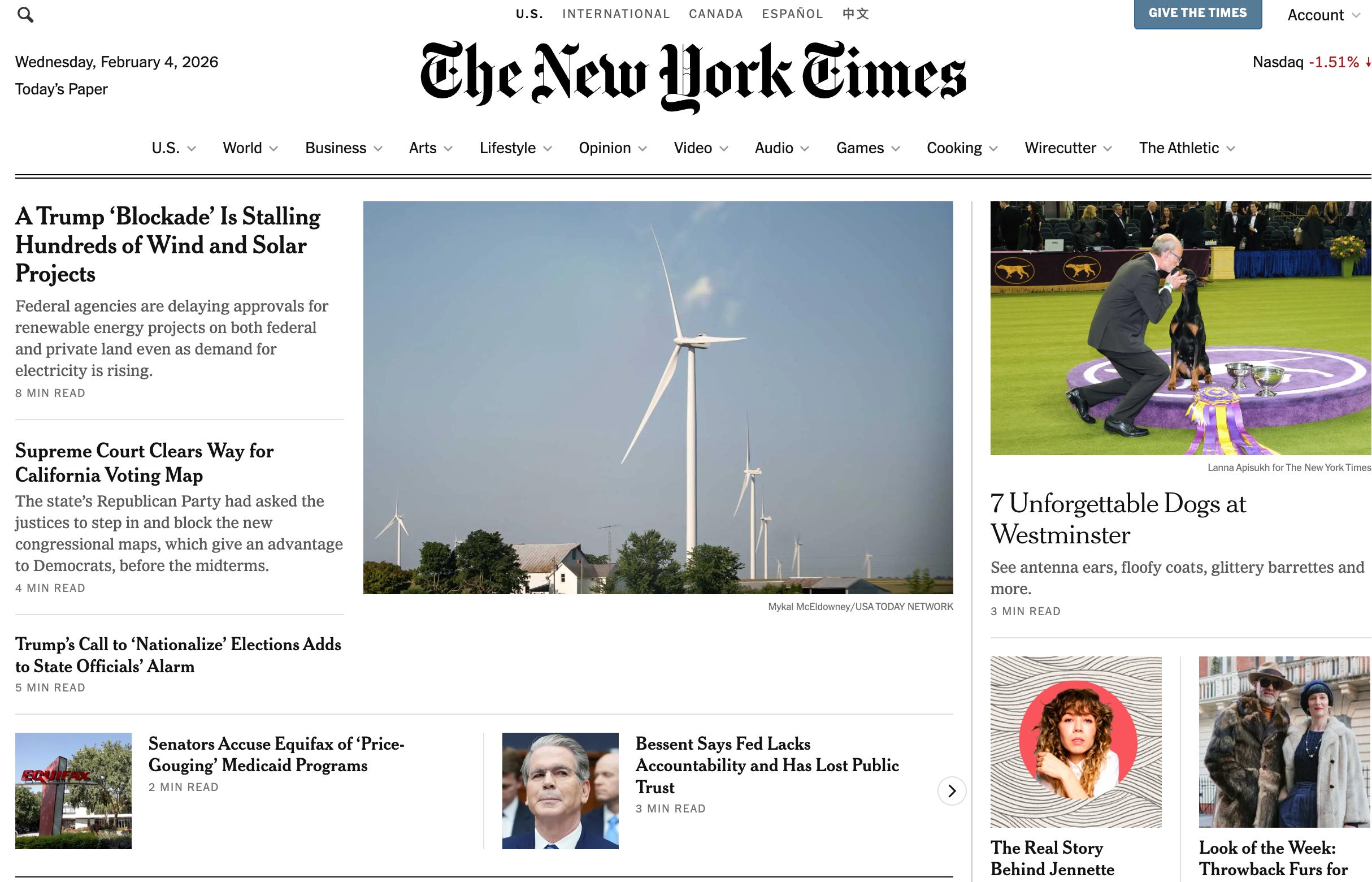
With its extraordinary breadth, the Times has been on a roll in adding digital subscribers and is now up to 12.78 million total subscribers as it aims for 15 million by the end of next year. By contrast, the Post is believed to be down to about 2 million subscribers.
Sadly, the soup is thin in the D.C. paper and the latest trimming could hardly bulk it up. As the Times reported about its competitor, the Post’s sports and books sections will close, its metro section and international staff will shrink. In a sharp contrast with the growing Daily podcast at the Times – which just added a Sunday version – the daily “Post Reports” podcast will disappear.
Just how will all that make for a better, more relevant and profitable product? The Post, as of Feb. 4, hadn’t even reported on its layoffs. Instead, it posted an Associated Press story that quoted editor Matt Murray saying in a note to the staff: “We can’t be everything to everyone.”
Just what the Post will be to anyone, going forward, is tough to see. Ashley Parker, a Post veteran now at The Atlantic, offered hints, though, and they are hardly optimistic.
“Today’s layoffs provide a whiff of the latest alleged strategy: an almost-exclusive focus on politics and national-security coverage, though even that explanation defies credulity, as the growing list of those laid off includes some of the nation’s finest political and international reporters and editors,” she wrote. “To the extent that a plan exists, it seems to be to transform the Post into a facsimile of Politico.”
Parker noted that Politico was born out of the Post nearly 20 years ago. Two Post reporters launched it as a “fast-paced, scoop-driven, win-the-morning publication,” she wrote.
Parker also quoted a longtime Post reporter bemoaning the new cuts. “We’re changing and trimming and cutting our way toward a much more mundane product, and one that doesn’t seem to attract more readers,” the journalist told her.
And what’s especially disheartening is that Post owner Jeff Bezos could easily underwrite the sorts of innovation that the Sulzberger family has done at the Times. Indeed, after he bought the paper in 2013, he backed ambitious efforts and the paper was gaining in leaps and bounds.
Ralph E. Hanson, a professor at the University of Nebraska Kearney, described some of the surge. Instead of focusing narrowly on D.C., he noted, Bezos and his editors pushed the paper into becoming a national or even international paper, much as the Times is.
By 2016, under Bezos’ ownership, Hanson wrote, the paper had a growing audience, increasingly ambitious reporting, and was gaining recognition as a national read. Politico’s Ken Doctor said that the Post was joining the ranks of The New York Times, The Wall Street Journal, and USA Today as having nationwide appeal.
While other papers were laying journalists off, in fact, the Post was hiring, Hanson noted. He cited Politico’s estimates that the Post’s newsroom grew by more than 60 positions, or 8 percent. This gave the Post a news staff in excess of 750, compared with 1,307 at the NY Times, 450 at USA Today, and the Wall Street Journal with about 1,500.
And 2016 delivered a 75 percent increase in new subscribers over the year and doubled digital subscription numbers. Under the guidance of Marty Baron, who joined in January 2013, that growth was driven by exceptional journalism, the sort that won 11 Pulitzer Prizes before he retired in 2021.
Of course, the paper was punching above its weight in terms of staffing. It had always done so, compared with the Times. “Not being The New York Times, being forced to do more with less, was freeing,” contended Post veteran Parker. “It created—required—a culture of collegiality and collaboration, a willingness to experiment and take risks, a certain puckishness.”
A former colleague, now at The Athletic, told Parker: “There’s sort of an Avis mentality at the Post: ‘We try harder.’” The quip recalled the Hertz-Avis ad campaign of decades past.
But lately, Bezos has apparently not seen much reason to try hard at all. “Over recent years, they’ve repeatedly cut the newsroom—killing its Sunday magazine, reducing the staff by several hundred, nearly halving the Metro desk—without acknowledging the poor business decisions that led to this moment or providing a clear vision for the future,” Parker wrote.

Baron, in a post on Facebook, acknowledged “acute business problems that had to be addressed.” As anyone in the industry knows, and Baron noted, we are in “a period of head-spinning change in media consumption.” It is one that requires “radical innovation,” which, of course, demands money.
More than that, it requires courage and values – of the sort that the Sulzbergers have long had. In recent years, Donald J. Trump has filed at least three major lawsuits against the Times, including a pending $15 billion defamation suit filed last September. Two were dismissed.
Bezos, instead, has sought to cozy up to Trump, perhaps mindful of the power Washington has over his financially far more important Amazon business and other interests.
“The Post’s challenges, however, were made infinitely worse by ill-conceived decisions that came from the very top —from a gutless order to kill a presidential endorsement 11 days before the 2024 election to a remake of the editorial page that now stands out only for its moral infirmity,” Baron wrote. “Loyal readers, livid as they saw owner Jeff Bezos betraying the values he was supposed to uphold, fled The Post. In truth, they were driven away, by the hundreds of thousands.”
As readers lost faith in the paper, journalists were losing trust in Bezos, as well. “Similarly, many leading journalists at The Post lost confidence in Bezos, and jumped to other news organizations,” Baron wrote. “They also, in effect, were driven away.”
The former editor, known for his grace, said he remained grateful for Bezos’s support during his tenure.
“During that time, he came under brutal pressure from Trump,” Baron wrote. “And yet he spoke forcefully and eloquently of a free press and The Post’s mission, demonstrating his commitment in concrete terms. He often declared that The Post’s success would be among the proudest achievements of his life. I wish I detected the same spirit today. There is no sign of it.”
There also seems no sign of an editorial vision at the diminishing newspaper. Perhaps one will emerge, but it’s likely impossible for the Post to shrink its way to prosperity.
“This ranks among the darkest days in the history of one of the world’s greatest news organizations,” Baron wrote. “The Washington Post’s ambitions will be sharply diminished, its talented and brave staff will be further depleted, and the public will be denied the ground-level, fact-based reporting in our communities and around the world that is needed more than ever.”
The odds are that the academic who someday analyzes the Post’s rise and fall will, in effect, be conducting an autopsy. And that is sad for us all.