Shrinking its way to greatness?

The Washington Post will surely not find success that way
Joseph Weber

Illustration source: The Wrap

Someday, a smart academic will cooly analyze the rival game plans that enabled The New York Times to thrive while, just down the road, The Washington Post slipped into what has been looking like a slow-motion death spiral.

But it’s likely that two things on that list will include an owner committed to great journalism and a passion for innovation, even at great cost.

Consider first the nonstop innovation that has kept the Times vibrant. The New York paper’s website is a cornucopia of offerings from the news of the day and in-depth magazine offerings to games, consumer advice in Wirecutter, exceptional sports coverage in The Athletic, audio offerings that range from The Daily to Opinions, along with entertainment, cooking and health news.

The soup-to-nuts menu of the paper could keep a reader, listener or video-watcher engaged for hours. Just picking out the best things to tap into takes a while each day.

By contrast, the best that can be said of the Post is that it tries.

In unoriginal ways, the Post mimics some of the same offerings, but with far less content. While on a given day the Times might have whole subsections devoted to the Trump Administration, the Epstein files, the Russia-Ukraine war, the Super Bowl and more, along with the top stories of the day in its many categories, the Post offers short lists of pieces that take no time to scan through.

It could hardly be otherwise given the yawning gap in staff at the papers. While the Times employs more than 2,800 people in its journalism operations, the Post shrank its newsroom in multiple downsizings in recent years to 800 and now is losing more than 300 of them, along with more on the business side.
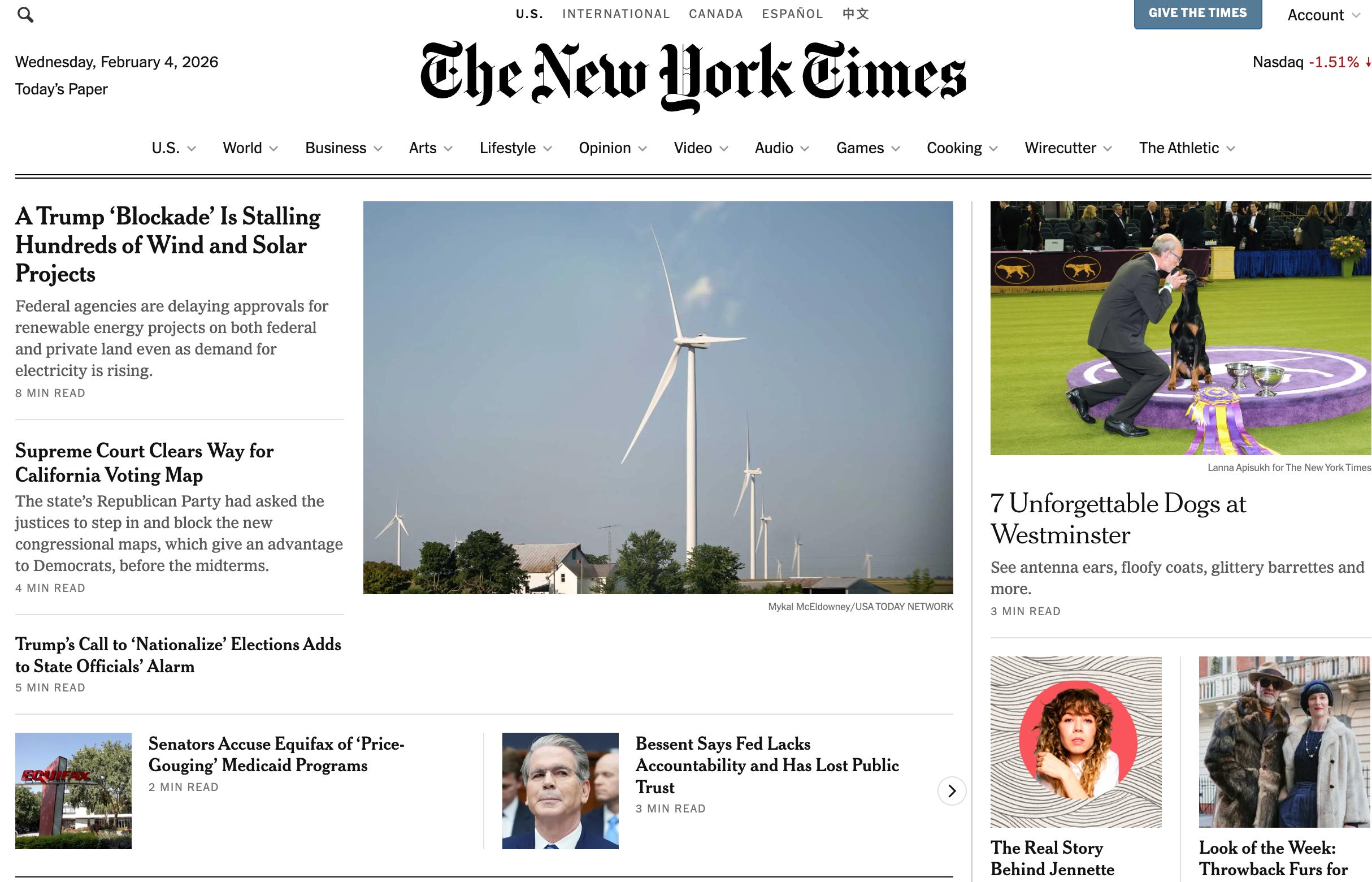
With its extraordinary breadth, the Times has been on a roll in adding digital subscribers and is now up to 12.78 million total subscribers as it aims for 15 million by the end of next year. By contrast, the Post is believed to be down to about 2 million subscribers.

Sadly, the soup is thin in the D.C. paper and the latest trimming could hardly bulk it up. As the Times reported about its competitor, the Post’s sports and books sections will close, its metro section and international staff will shrink. In a sharp contrast with the growing Daily podcast at the Times – which just added a Sunday version – the daily “Post Reports” podcast will disappear.

Just how will all that make for a better, more relevant and profitable product? The Post, as of Feb. 4, hadn’t even reported on its layoffs. Instead, it posted an Associated Press story that quoted editor Matt Murray saying in a note to the staff: “We can’t be everything to everyone.”

Just what the Post will be to anyone, going forward, is tough to see. Ashley Parker, a Post veteran now at The Atlantic, offered hints, though, and they are hardly optimistic.

“Today’s layoffs provide a whiff of the latest alleged strategy: an almost-exclusive focus on politics and national-security coverage, though even that explanation defies credulity, as the growing list of those laid off includes some of the nation’s finest political and international reporters and editors,” she wrote. “To the extent that a plan exists, it seems to be to transform the Post into a facsimile of Politico.”

Parker noted that Politico was born out of the Post nearly 20 years ago. Two Post reporters launched it as a “fast-paced, scoop-driven, win-the-morning publication,” she wrote.

Parker also quoted a longtime Post reporter bemoaning the new cuts. “We’re changing and trimming and cutting our way toward a much more mundane product, and one that doesn’t seem to attract more readers,” the journalist told her.

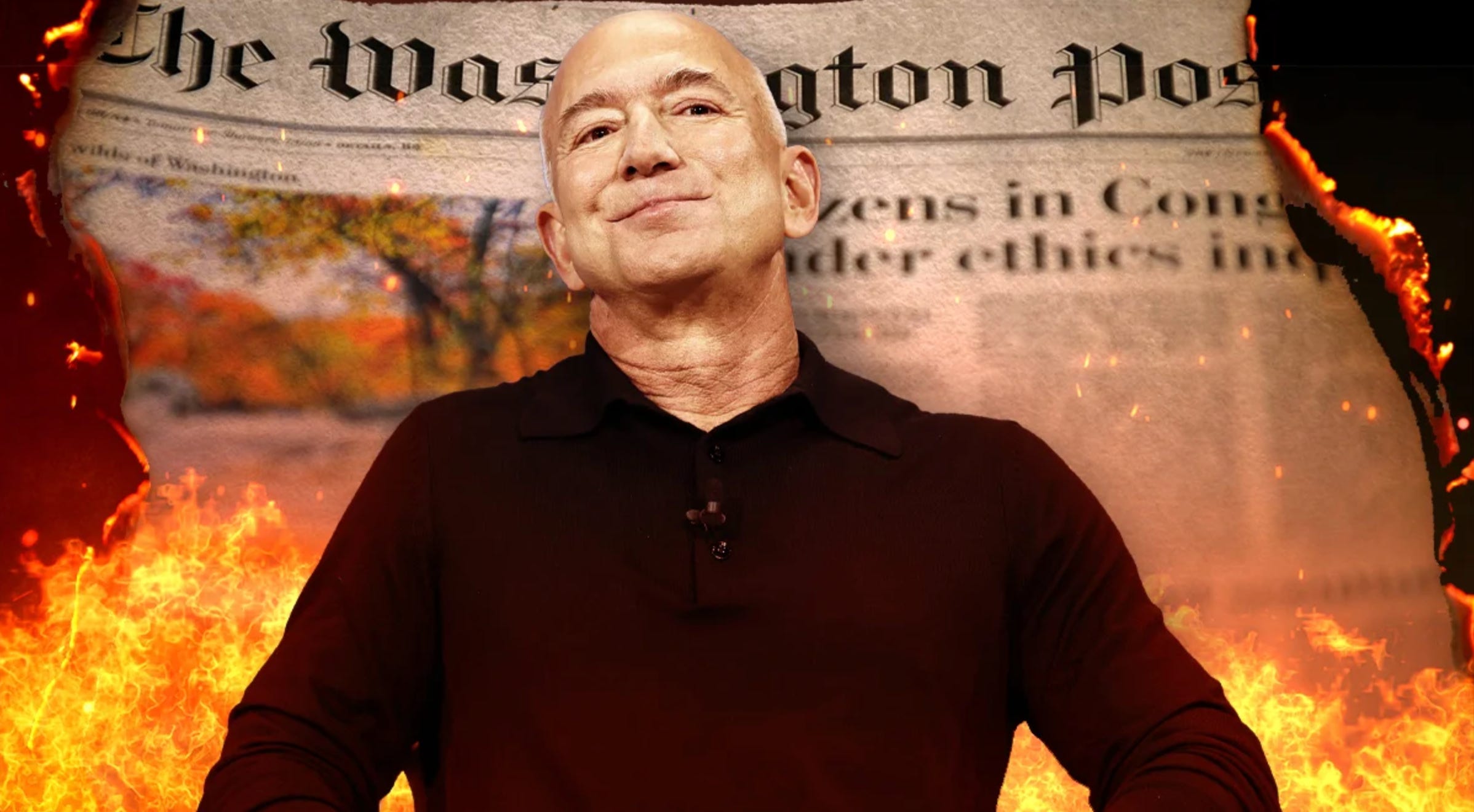
And what’s especially disheartening is that Post owner Jeff Bezos could easily underwrite the sorts of innovation that the Sulzberger family has done at the Times. Indeed, after he bought the paper in 2013, he backed ambitious efforts and the paper was gaining in leaps and bounds.

Ralph E. Hanson, a professor at the University of Nebraska Kearney, described some of the surge. Instead of focusing narrowly on D.C., he noted, Bezos and his editors pushed the paper into becoming a national or even international paper, much as the Times is.

By 2016, under Bezos’ ownership, Hanson wrote, the paper had a growing audience, increasingly ambitious reporting, and was gaining recognition as a national read. Politico’s Ken Doctor said that the Post was joining the ranks of The New York Times, The Wall Street Journal, and USA Today as having nationwide appeal.

While other papers were laying journalists off, in fact, the Post was hiring, Hanson noted. He cited Politico’s estimates that the Post’s newsroom grew by more than 60 positions, or 8 percent. This gave the Post a news staff in excess of 750, compared with 1,307 at the NY Times, 450 at USA Today, and the Wall Street Journal with about 1,500.

And 2016 delivered a 75 percent increase in new subscribers over the year and doubled digital subscription numbers. Under the guidance of Marty Baron, who joined in January 2013, that growth was driven by exceptional journalism, the sort that won 11 Pulitzer Prizes before he retired in 2021.

Of course, the paper was punching above its weight in terms of staffing. It had always done so, compared with the Times. “Not being The New York Times, being forced to do more with less, was freeing,” contended Post veteran Parker. “It created—required—a culture of collegiality and collaboration, a willingness to experiment and take risks, a certain puckishness.”

A former colleague, now at The Athletic, told Parker: “There’s sort of an Avis mentality at the Post: ‘We try harder.’” The quip recalled the Hertz-Avis ad campaign of decades past.

But lately, Bezos has apparently not seen much reason to try hard at all. “Over recent years, they’ve repeatedly cut the newsroom—killing its Sunday magazine, reducing the staff by several hundred, nearly halving the Metro desk—without acknowledging the poor business decisions that led to this moment or providing a clear vision for the future,” Parker wrote.

Marty Baron, source: The Harvard Gazette

Baron, in a post on Facebook, acknowledged “acute business problems that had to be addressed.” As anyone in the industry knows, and Baron noted, we are in “a period of head-spinning change in media consumption.” It is one that requires “radical innovation,” which, of course, demands money.

More than that, it requires courage and values – of the sort that the Sulzbergers have long had. In recent years, Donald J. Trump has filed at least three major lawsuits against the Times, including a pending $15 billion defamation suit filed last September. Two were dismissed.

Bezos, instead, has sought to cozy up to Trump, perhaps mindful of the power Washington has over his financially far more important Amazon business and other interests.

“The Post’s challenges, however, were made infinitely worse by ill-conceived decisions that came from the very top —from a gutless order to kill a presidential endorsement 11 days before the 2024 election to a remake of the editorial page that now stands out only for its moral infirmity,” Baron wrote. “Loyal readers, livid as they saw owner Jeff Bezos betraying the values he was supposed to uphold, fled The Post. In truth, they were driven away, by the hundreds of thousands.”

As readers lost faith in the paper, journalists were losing trust in Bezos, as well. “Similarly, many leading journalists at The Post lost confidence in Bezos, and jumped to other news organizations,” Baron wrote. “They also, in effect, were driven away.”

The former editor, known for his grace, said he remained grateful for Bezos’s support during his tenure.

“During that time, he came under brutal pressure from Trump,” Baron wrote. “And yet he spoke forcefully and eloquently of a free press and The Post’s mission, demonstrating his commitment in concrete terms. He often declared that The Post’s success would be among the proudest achievements of his life. I wish I detected the same spirit today. There is no sign of it.”

There also seems no sign of an editorial vision at the diminishing newspaper. Perhaps one will emerge, but it’s likely impossible for the Post to shrink its way to prosperity.

“This ranks among the darkest days in the history of one of the world’s greatest news organizations,” Baron wrote. “The Washington Post’s ambitions will be sharply diminished, its talented and brave staff will be further depleted, and the public will be denied the ground-level, fact-based reporting in our communities and around the world that is needed more than ever.”

The odds are that the academic who someday analyzes the Post’s rise and fall will, in effect, be conducting an autopsy. And that is sad for us all.
If editorialists had their way …

… things would have been far different

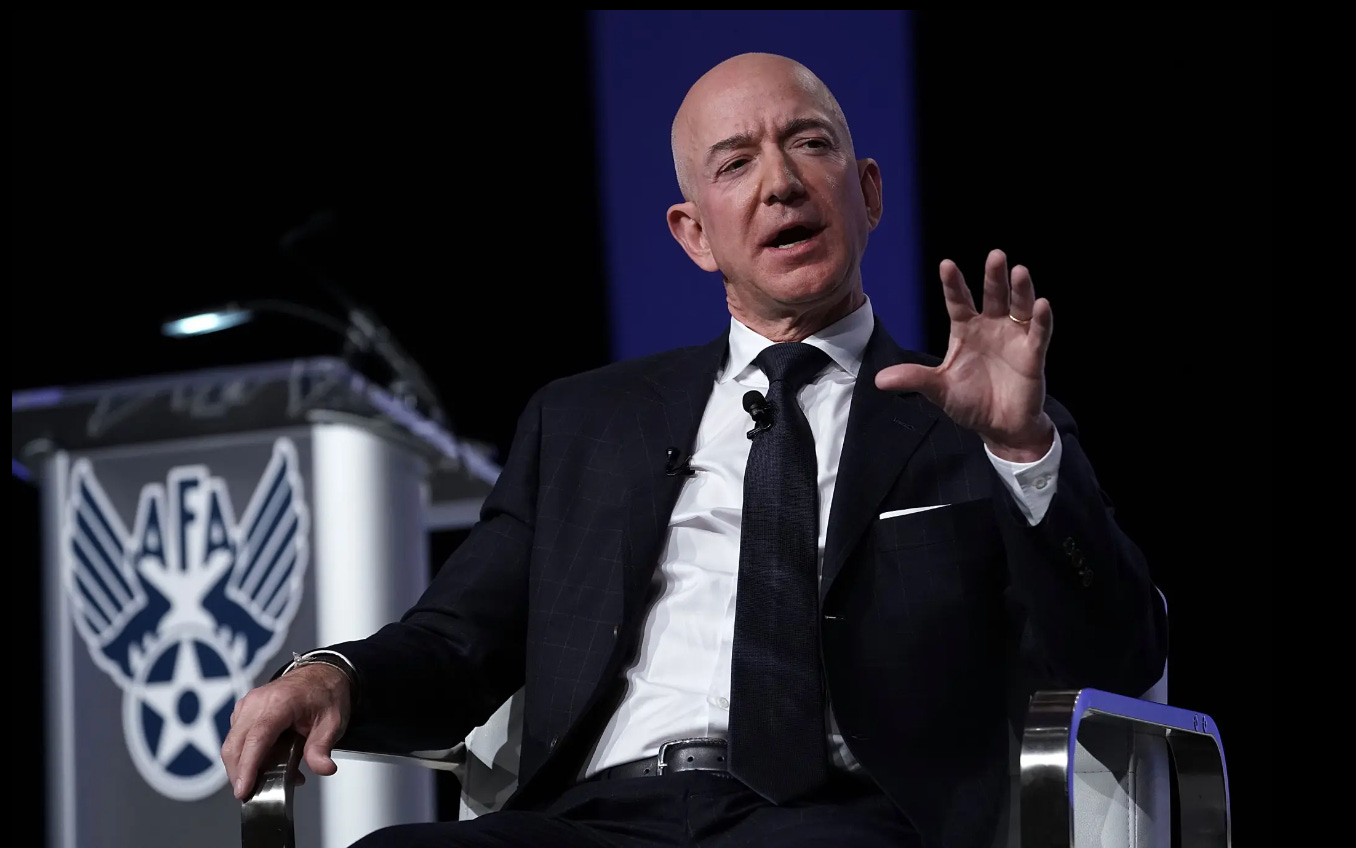
Jeff Bezos, source: New York Post

Jeff Bezos is half right. Newspaper endorsements don’t sway elections. If they did, Donald J. Trump would not have won in 2016.

Eight years ago, the gap between editorialists and the public made the Grand Canyon look like a roadside ditch. Only two of the nation’s top 100 newspapers – the Las Vegas Review-Journal and The Florida Times-Union – supported Trump for president. Fifty-seven editorialized for Hillary Clinton, while 31 (perhaps surprisingly) didn’t endorse anyone, four supported others and three just opposed Trump, according to The American Presidency Project.

“Presidential endorsements do nothing to tip the scales of an election,” Bezos, the owner of The Washington Post, tells us in explaining why he has taken the paper out of the endorsement business. “No undecided voters in Pennsylvania are going to say, ‘I’m going with Newspaper A’s endorsement.’ None.”

Clearly, Trump wasn’t the choice of the smart set in 2016. Enough Americans thumbed their noses at editorial writers that Trump could plant his ample bottom behind the Resolute Desk the following January. Yes, it’s true that more voters lined up behind Clinton (48.2 percent) instead of Trump (46.2 percent), but the GOP candidate, nonetheless, swept the Electoral College vote by 56 percent.

So, does this mean that more newspaper opinion writers should go the way of Bezos’s Post? Will the lack of an editorial page thumbs-up make any difference to readers?

Editorial writers at a number of major papers say no on the first point. With Election Day a week away, The New York Times, The Philadelphia Inquirer, The Houston Chronicle, the Seattle Times, The Boston Globe and the Las Vegas Sun have weighed in for Harris. Stumping for Trump so far are the New York Post, The Washington Times and the Las Vegas Review-Journal.

But the endorsers are among a shrinking number of papers advising voters on how to cast their ballots. As recently as 2008, 92 of the nation’s 100 largest newspapers endorsed either Democrat Barack Obama or Republican John McCain for president, according to the Associated Press. But by 2020, only 54 made a choice between Trump and Joe Biden, AP reported, citing the presidency project (47 went for Biden, seven for Trump and 44 took no stance).

Some publishers and editors may side with the Amazon billionaire, who bought the Post in 2013, and who argues that the only thing presidential endorsements do is “create a perception of bias. A perception of non-independence.” Readers, he implies, don’t distinguish between editorial pages, which are devoted to opinion, and news pages, ideally devoted to unbiased reporting.

Source: Gallup

That, he suggests, is at the root of widespread public mistrust of the media. Such mistrust, of course, has been growing for decades. Indeed, Trump capitalizes on it with his incessant attacks on “fake news” and, worse, his latest threats to punish media that offend him.

“We must be accurate, and we must be believed to be accurate,” Bezos maintains. “It’s a bitter pill to swallow, but we are failing on the second requirement. Most people believe the media is biased. Anyone who doesn’t see this is paying scant attention to reality, and those who fight reality lose. Reality is an undefeated champion.”

But does it follow that withholding endorsements will help change that view of bias? Even Bezos equivocates: “By itself, declining to endorse presidential candidates is not enough to move us very far up the trust scale, but it’s a meaningful step in the right direction,” he writes.

His argument raises a host of questions. Would newspaper readers be more likely to believe what they read on the front pages because of the absence of calls to action by editorial boards? Do they now disbelieve those front pages just because of opinionated material on the inside of the papers?

Well, consider some recent headlines from the news section of The Washington Post. On the paper’s website, we find “On Elon Musk’s X, Republicans go viral as Democrats disappear,” “Poop artist strikes again with neo-Nazi tiki torch statue for Trump,” “Trump to speak in Florida amid fallout from comedian’s Puerto Rico insult,” and “Autocracy and ‘enemy from within’ are thrust to center of campaign’s final days,” to name a few.

Certainly, Trump supporters would scarcely warm to such pieces. Would such readers believe the outlet to be impartial? Or would they – when fed a steady diet of such headlines over time – just turn away from the paper, deeming it unfair to their golden boy?

Would they, instead, turn to Fox News? There, they could find “news” pieces headed “Momentum shifts against Kamala Harris just days before election and here’s why,” “Harris caught on hot mic admitting her campaign is struggling with male voters,”  and “Trump merchandise outsells pro-Harris by striking margin, as Election Day draws near.”

Bezos is demonstrably correct that editorialists – and columnists, for that matter – don’t make much of a difference in elections, at least once perceptions are set. More than that, though – and far more troublingly — it seems news coverage doesn’t make all that much of a difference.

Citizens nowadays either find media that suits their biases or they just disregard whatever discomfits them, regardless of whether the information is opinionated. Some of my Trump-backing relatives simply dismiss news coverage, either unaware of journalistic ethics of impartiality or blinded by cable TV so much that they argue that all media outlets have agendas. Thus, none are trustworthy.

Source: AIB

But where Bezos may be wrong is in implying that viewpoint-oriented material isn’t important, that it can’t change minds. Support for the Vietnam War waned on newspaper editorial pages (and on network TV, for that matter) long before widespread public support did, for instance, but eventually the public came round.

The editorialists just got there early.

More recently, editorialists in places such as The New York Times urged withdrawal from Afghanistan as far back at least as 2019. This was while Trump was in office and long before the Biden Administration drove its poorly executed abandonment of the 20-year war in 2021. Even then, at the time of the withdrawal, a substantial minority of Americans – 29 percent – did not think the war was a failure. And a surprisingly low 62 percent thought the war wasn’t worth fighting.

Truth be told, some of us who have worked in both straight news and in viewpoint-oriented journalism don’t look on editorials (or op-eds and other commentaries) as all that useful in changing minds on elections. Partisan loyalties and personalities often dictate there. But the edits are vehicles where insights are distilled, where the flood of facts that hit us daily can be sifted, put in context, and, yes, where smart analysis can lead to judgments.

Indeed, Bezos is not barring opinion writers from the Post pages. There, one nowadays still finds “Only care about your pocketbook? Trump is still the wrong choice,” “The U.S. can learn from other countries’ encounters with fascism,” “The Black vote will signal a change, but what kind?: A turn toward nativism among Black voters would send America in the wrong direction,” and more such hardly Trumpian views.

Moreover, he is not barring editorialists from criticizing candidates. On the same day that he explained his rationale in his owner’s note, Oct. 28, the Post’s editorial board lambasted Trump anew and praised Harris in “The right place to make the best case against Trump.” This was in an editorial, an “official” stance of the paper:

“Vice President Kamala Harris will deliver her closing argument in a speech Tuesday at the Ellipse in D.C.,” the editorialists wrote. “This location, where President Donald Trump incited a mob to ransack the Capitol on Jan. 6, 2021, is fitting and proper. Mr. Trump’s unprecedented efforts to overturn his defeat in the 2020 election, combined with promises to pardon supporters convicted of crimes committed that day, represent Ms. Harris’s strongest argument for why voters shouldn’t return him to the White House. Mr. Trump has shown no contrition for what happened during the worst assault on the Capitol since the British set it ablaze in 1814. Instead, he’s attempted to rewrite history.”

Is that not a condemnation of Trump, if not an endorsement of Harris?

In fairness to Bezos, a longstanding industry view about editorials (and news coverage) suggests that outlets should not get too far ahead of their readers on controversial matters or they simply will lose them. But that doesn’t mean they can’t lead the crowd or try to.

If Denis Morton or Jenn Sherman push too hard or too fast, Peloton riders will just avoid them, as exercise fans know. But riders do expect to be nudged a bit out of their comfort zones.

Back in the day, my editors at BusinessWeek bristled at the idea of letting focus groups of readers determine our editorial content. The argument was that such readers might not know what they want until they see it, and it was up to writers and editors to provide that. Journalists brought judgment that readers needed.

Similarly, when editors at The Wall Street Journal a few decades ago were asked whom they were editing the paper for, they answered “for ourselves.” Of course, that view seems to have changed under editor Emma Tucker, who has remade the paper. Our user-friendly choice-filled days seem to make such responsiveness necessary.

As it happens, both the BusinessWeek I worked for and the Journal long declined to make election endorsements. At BW, the non-stance stance had to do with whether such an endorsement would reflect the views of then-owner McGraw-Hill and the McGraw family or the editors of the magazine – which would likely differ. In the case of the WSJ, the paper hasn’t endorsed a candidate since 1928 (embarrassingly, it backed Hoover). The Journal did say in a recent editorial, though, that it wished that the GOP had chosen someone other than Trump as its nominee for 2024.

“His rhetoric is often coarse and divisive,” the journal wrote. “His praise for the likes of Vladimir Putin and Xi Jinping is offensive, and betrays his view that he can by force of personality cut favorable deals with them. He indulges mediocrities who flatter him, and his attempt to overturn the 2020 election was disgraceful. These columns preferred any other Republican nominee.”

Hardly warm praise for Trump, whom the writers called “flawed.” But this fell short of an endorsement of Harris.

For its part, The Washington Post until 1976 had mostly avoided endorsements. Even in the critical 1972 election of Richard Nixon, the editorial board stayed neutral.

“In talking about the choice of a President of the United States, what is a newspaper’s proper role?,” the Post board wrote then, as noted recently by current publisher William Lewis. “Our own answer is that we are, as our masthead proclaims, an independent newspaper, and that with one exception (our support of President Eisenhower in 1952), it has not been our tradition to bestow formal endorsement upon presidential candidates. We can think of no reason to depart from that tradition this year.”

Source: The Atlantic

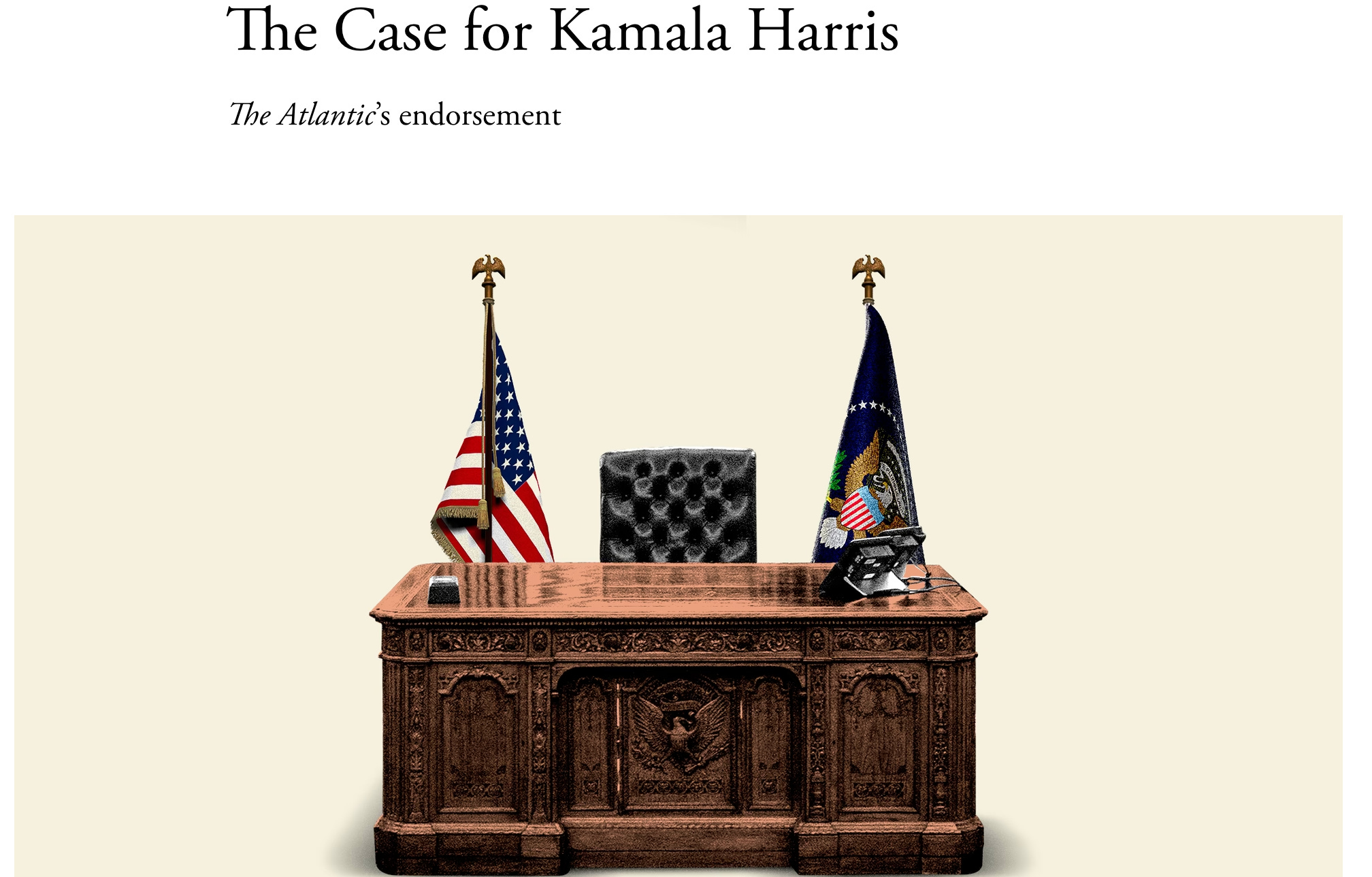
But, given the starkly different options today and the high stakes of this election, is there not reason to think that some smart judgment in an editorial would be useful? The editors at The Atlantic this year decided, for only the fifth time in the magazine’s history, to make an endorsement. Calling Trump “one of the most personally malignant and politically dangerous candidates in American history,” it backed his opponents in 2016 and 2020.

“This year, Trump is even more vicious and erratic than in the past, and the ideas of his closest advisers are more extreme,” the editors wrote. “Trump has made clear that he would use a second term to consolidate unprecedented power in his own hands, punishing adversaries and pursuing a far-right agenda that most Americans don’t want. ‘We believe that this election is a turning-point in our history,’ the magazine prophesied correctly when it endorsed Abraham Lincoln in 1860. This year’s election is another.”

Bezos, along with peers at papers including the Los Angeles Times, the Minnesota Star Tribune, USA Today, The Tampa Bay Times and the Gannett, McClatchy and Alden chains, have taken a different course. Gannett argued that “readers don’t want us to tell them what to think,” as a Poynter Institute analyst reported. The others offered variations on the same theme.

An editor whose paper, The Oregonian, took a different route suggested to Poynter that trying to stay above the fray sometimes doesn’t play well with readers. “Our decision to endorse in this race reverses our policy in 2012 and 2016,” Therese Bottomly said in explaining her paper’s Harris support. “We heard the community’s disappointment over our past non-endorsements loud and clear. Particularly at this precipitous moment, we recognize both the privilege and obligation we have to advocate for the candidate who can best lead our country forward.”

Plenty of folks have been disappointed with Bezos’s decision to sit on the fence this year, with many suggesting he was feeling cowed by ever-increasing threats by Trump to punish his critics. Bezos drew heat from within and without.

Eighteen columnists signed a dissenting column against his choice, calling it “a terrible mistake.” Watergate reporters Carl Bernstein and Bob Woodward called the move “disappointing, especially this late in the electoral process.” And former Washington Post executive editor Marty Baron said in a post on X: “This is cowardice with democracy as its casualty.”

As The Guardian reported, the cartoon team at the paper even published a dark image protesting the non-endorsement decision. This was a play on the “democracy dies in darkness” slogan that the Post adopted in 2017, five years after Bezos bought the paper. Author Stephen King and former congresswoman and Trump critic Liz Cheney announced they were cancelling their Post subscriptions, just as more than 200,000 digital subscribers reportedly have.

In the end, this contretemps may amount to just another painful blow to a declining industry. But it could also be a distressing harbinger of the rising threat America faces if the public makes the wrong choice next Tuesday.