Rage, rage against the dying of the light

Ben Sasse reminds us of grace in the face of death
Joseph Weber

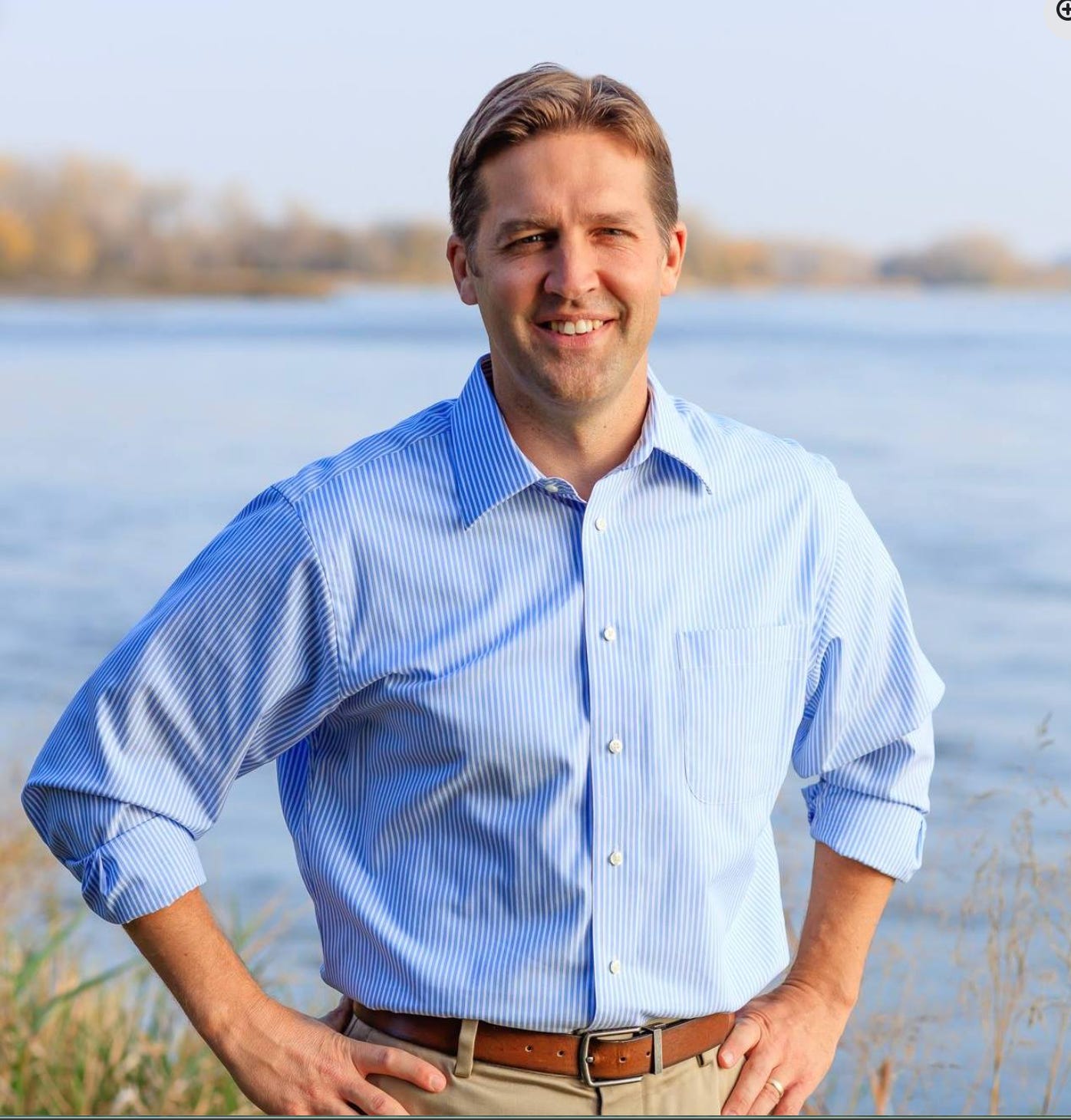
Ben Sasse, source: Facebook

Do not go gentle into that good night,

Old age should burn and rave at close of day;

Rage, rage against the dying of the light.

Dylan Thomas wrote those words, in “Do Not Go Gentle into That Good Night,” in 1947. This was five years before the death of his father, in mid-December 1952, after a 20-year battle with throat cancerIt’s widely thought that he was speaking to his dad, longtime English teacher D.J. Thomas, who had introduced him to poetry.

His father’s death, at 76, plunged Thomas, just 38 at the time, into a tailspin from which he never recovered. While on a reading and lecture tour in the United States, the self-described “roistering, drunken and doomed poet” drank himself into a coma. Barely 11 months after his dad’s passing, Thomas died on Nov. 9, 1953, in St. Vincent’s Hospital in New York.

Morbid as this is, I’m reminded of it after reading a remarkable post by Ben Sasse, my former Nebraska senator, letting people know about his terminal diagnosis. Far from “roistering,” it is a powerful reminder of how we all face the inevitable and how we can do that with grace.

“Last week I was diagnosed with metastasized, stage-four pancreatic cancer, and am gonna die,” Sasse wrote on X. “Advanced pancreatic is nasty stuff; it’s a death sentence. But I already had a death sentence before last week too — we all do… Death is a wicked thief, and the bastard pursues us all.”

Sasse, 53, wrote that he doesn’t know how much time he has left, though he said it’s less than he wants. And, while striking a realistic tone — saying he’s “now marching to the beat of a faster drummer” – Sasse also echoed Dylan Thomas:

“I’m not going down without a fight,” he wrote. “One sub-part of God’s grace is found in the jawdropping advances science has made the past few years in immunotherapy and more. Death and dying aren’t the same — the process of dying is still something to be lived.”

Dylan Thomas, source: discoverdylanthomas.com

Sadly, death – and thoughts of it — are all too common at this time of the year. As a young obituary writer for a newspaper in New Jersey decades ago, I was struck by the surge in deaths, usually among the elderly, that we reported on in December and January. My colleagues and I often speculated about the cause – bad weather, loneliness at a time of supposed great joy, the spread of viruses and other infections and the lack of sunshine and the depression that can bring.

Indeed, scientists have long known that winter is the cruelest season for mortality, with January the deadliest month. “The seasonal swings are substantial,” The Washington Post reported in a midwinter piece last year. “About 20 percent more people die in January than in August, which is typically the least lethal month.” One researcher quoted blamed heart disease and respiratory problems.

The phenomenon is personal for me, too. My father, who had suffered with smoking-related lung problems, died at 70 on Christmas Eve in 1998. My mother, who suffered from similar problems, died in February, four years later, at 69.

Given both their ages when they left us, I’m thankful that I recently surpassed them (though I remain wary and, as they say, cautiously optimistic). In his post, Sasse, a devout Christian, addressed the optimism point head on – again realistically, in light of his diagnosis:

“To be clear, optimism is great, and it’s absolutely necessary, but it’s insufficient,” he wrote, reflecting on the Christian pre-Christmas season of Advent. “It’s not the kinda thing that holds up when you tell your daughters you’re not going to walk them down the aisle. Nor telling your mom and pops they’re gonna bury their son. A well-lived life demands more reality — stiffer stuff. That’s why, during advent, even while still walking in darkness, we shout our hope — often properly with a gravelly voice soldiering through tears.”

Every faith tries to come to terms with death, of course. For some creeds, it is a gateway to better things, including reunification with those lost and closeness with one’s G-d. Others admit that we simply don’t know what comes next, if anything.

For most of us left behind, though, the passing of a loved one is just a barely bearable loss. It’s the sad recognition that we won’t have that person as a part of our life anymore (except in warm recollections and, if we’re lucky, in occasional happy dreams).

And this time of the year ratchets it all up.

In some ways, the holiday period can be especially cruel and not solely because of the rise in deaths. For those who celebrate, Christmas can be a time of unrealistic expectations. There seems to be so much pressure on people – Christians, at least – to feel the cliched joy of the season that one wonders if it’s simply impossible to clear the high bar. It’s all a lot too noisy and demanding, it seems.

A decade ago, researchers confirmed this. A 2015 survey conducted by Healthline, a consumer health information site based in San Francisco, found that 62 percent of respondents described their stress level as “very or somewhat” elevated during the holidays. They pointed to financial demands, negotiating the interpersonal dynamics of family, and maintaining personal health habits such as an exercise regimen.

“The holidays are filled with both joy and stress,” Dr. Ellen Braaten, then an associate professor of psychology at Massachusetts General Hospital and associate director of its Clay Center for Young Healthy Minds, said in a Harvard Medical School piece.

For many of us, too, the holidays may always carry a dark side. We acutely feel the absence of those who seemingly were always there and now are not.
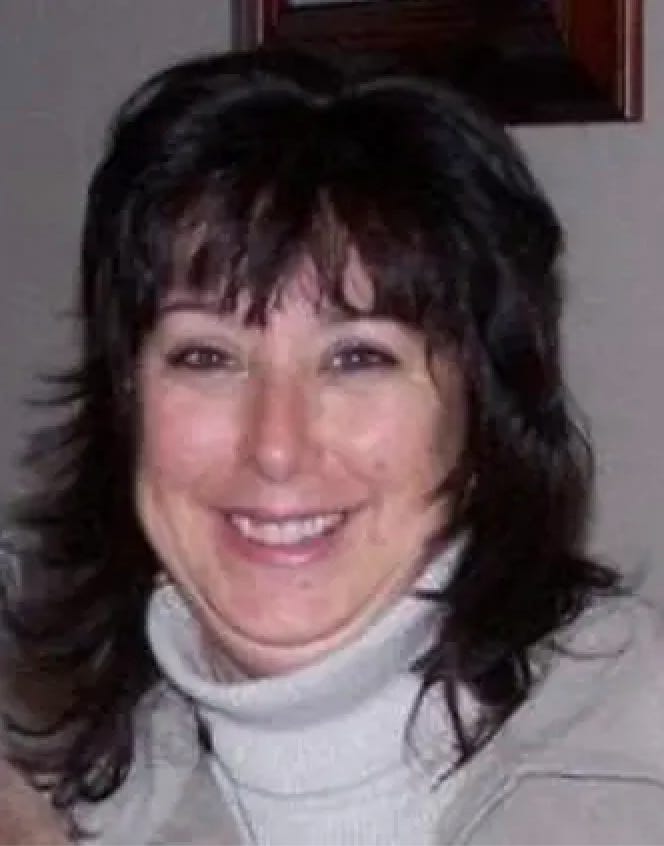
Madeline (Weber) Ebinger

In the case of my family, that revolves about the loss of our parents years ago and, more recently, of our dear sister, Madeline. She fell to cancer during the summer. All of us — her siblings — will long grieve for her, though her absence is especially tough for her husband, sons and daughters-in-law, of course. And that grief is amplified at this time of year, when around us so many are smiling and celebrating.

We who survive such losses must endure, of course. We cannot let ourselves plunge into paralyzing grief, perhaps as Thomas did.

Sasse in his post was cold-eyed about the reality of imminent treatments and the strains to come, but he ended by offering his friends peace and referring to “great gratitude.” He and his family, he wrote, have “gravelly-but-hopeful voices.”

May his suffering be bearable and may his family’s memories be a blessing for them in years to come.
A leap of faith

What does religion have to do with a presidential election? A lot, for some.

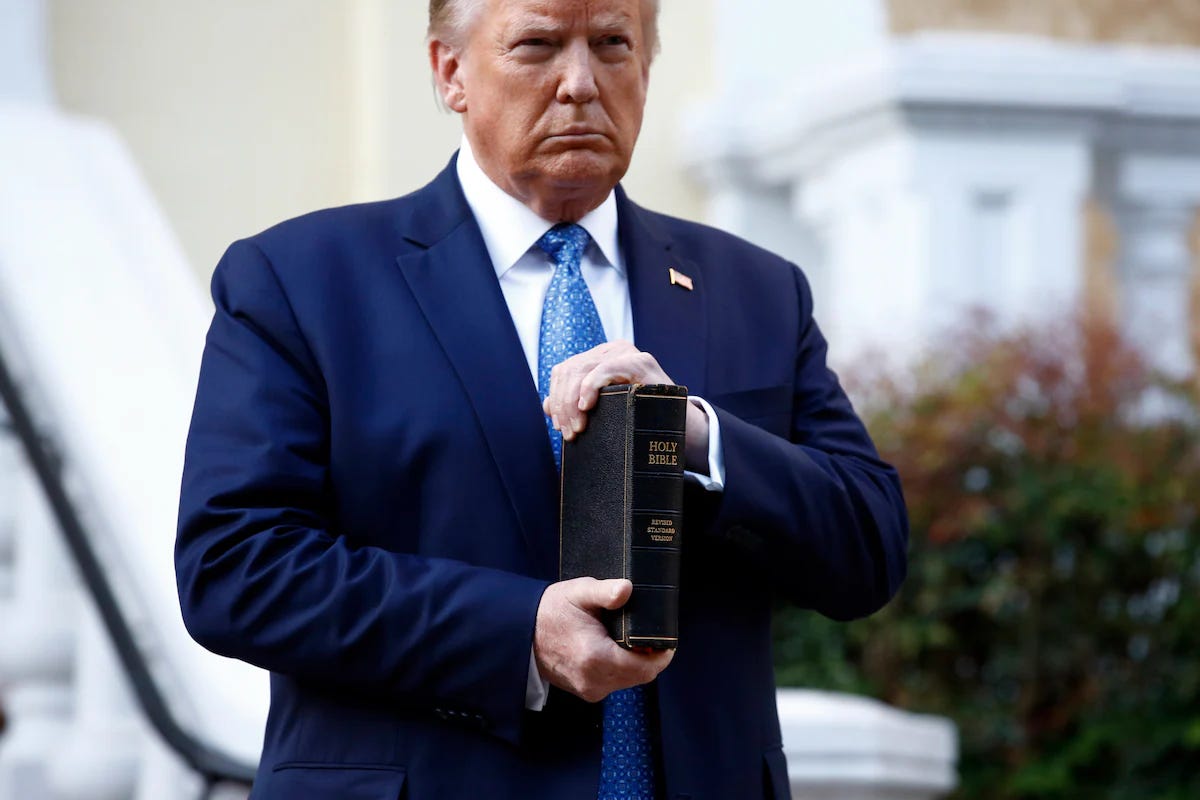
Trump in 2020: source: The Washington Post

Religion and politics make for a combustible mix. Just as the Bible can be invoked to support almost any side of an argument, so can partisans – especially Christian evangelicals – use religion as they see fit to make their political cases.

Just ask journalist McKay Coppins of The Atlantic. He attended scores of rallies for Donald J. Trump and analyzed the prayers people offered at them. His conclusion: many evangelicals see America as a chosen land that has fallen into sin and they see Trump as the country’s divinely anointed redeemer.

“Trump’s supporters attribute America’s fall from grace to a variety of national sins old and new—prayer bans in public schools, illegal immigration, pro-transgender policies, the purported rigging of a certain recent election,” Coppins writes. “Whatever the specifics, the picture of America they paint is almost universally—biblically—bleak.”

Opening a Trump gathering last winter in Durham, New Hampshire, for instance, one minister invoked both the former president and the Divine: “We know what he did for us and how he strove to lead us in honorable ways during his term as our president—in ways that brought your blessings to us, rather than your reproach and judgment …. We know the hour is late. We know that time grows shorter for us to be saved and revived.”

At another rally, a woman offered the following prayer shortly before New Hampshire’s Republican primary: “Lord, you have a servant in Donald J. Trump, who can lead our nation … Help us to overcome any obstacles tomorrow so that we may deliver victory to your warrior.”

And in Iowa, at yet another gathering of the faithful, a minister waxed passionate. “Be afraid,” he told the crowd. “For rulers do not bear the sword for no reason. They are God’s servants of wrath to bring punishment on the wrongdoer. And when Donald Trump becomes the 47th president of the United States, there will be retribution against all those who have promoted evil in this country.”

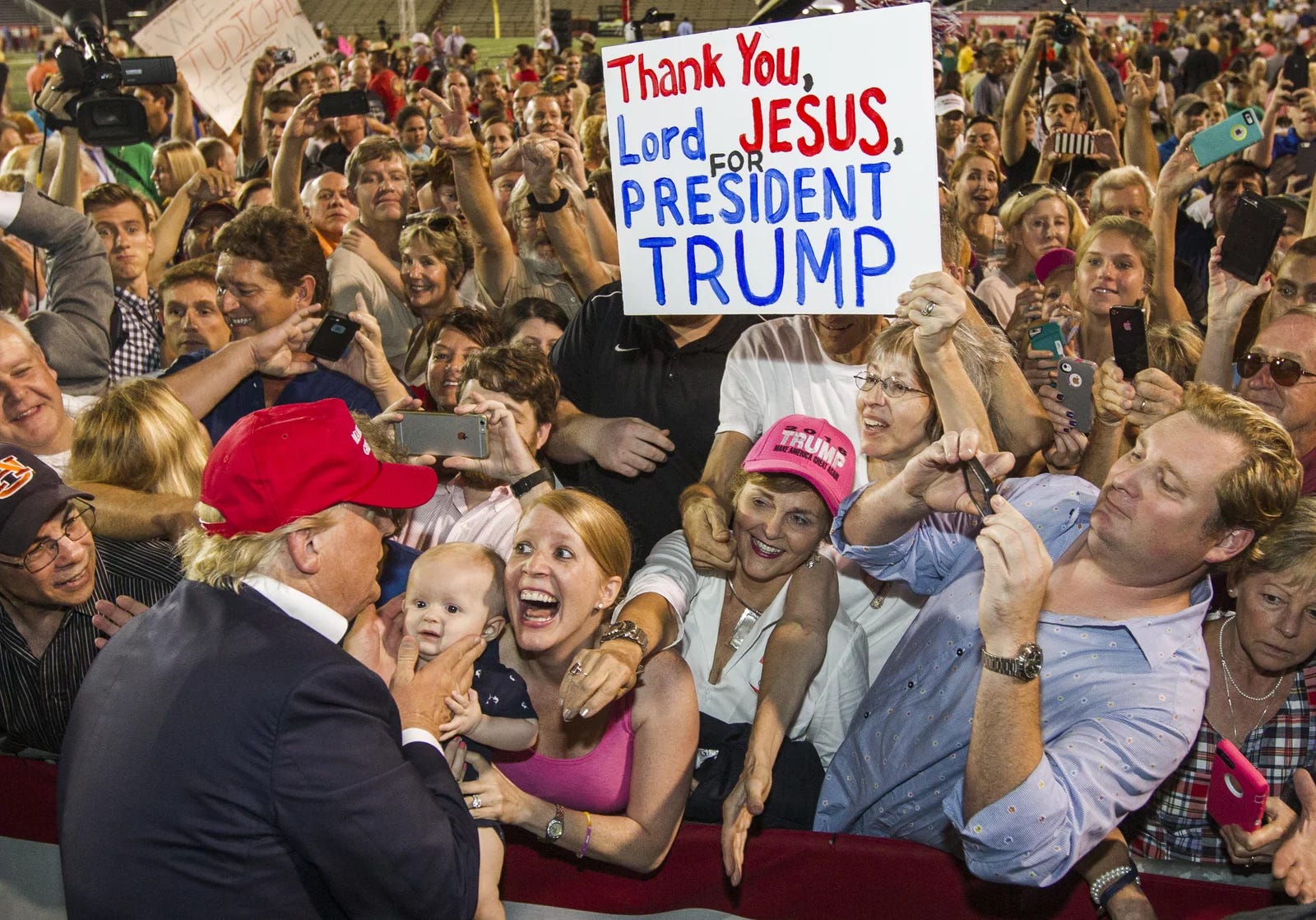
Trump in 2015, source: Getty Images via NPR

To such folks, American voters will not just hire an executive to oversee affairs of state for the next four years. No, Europeans and other foreigners may do that prosaic sort of thing. But Americans, instead, will choose a sword wielder in a pitched battle of good versus evil, a person who can carry forward the divinely appointed role the U.S. occupies in the world.

The notion that the U.S. has a blessed mission may seem bizarre to many – certainly to those living in other perfectly fine and, in some ways, more civilized countries. But the idea of a supernatural connection is baked into our national consciousness.

Think about how we begin many sporting and other public events by singing “God Bless America,” that patriotic plea Irving Berlin wrote in wartime 1918 and revised in prewar 1938. Consider how the motto “Annuit Coeptis” (‘He favors our undertakings’) is carved into the wall above a doorway in the U.S. Senate chamber and how “In God We Trust” appears above the Speaker’s rostrum in the U.S. Capitol’s House chamber, as well as on U.S. currency. Mull over the 1954 addition to the Pledge of Allegiance of the phrase “under God.”

That idea of a divine connection even puts a halo of sorts around the nation’s founding. “Faith in America,” a 2022 survey by the Deseret News and the Marist Poll, reported that 55% of Americans believe the U.S. Constitution was inspired by G-d. The figure rises to 65% among Christians and to 70% among those who practice some religion. But even 45% of those who do not practice a religion believe the Constitution was divinely inspired.

And, as perhaps has been reflected by the embattled Louisiana law mandating displays of The Ten Commandments in publicly funded K-12 and university classrooms, nearly half of Americans (49%) say the Christian Bible should have “a great deal” of or “some” influence on U.S. laws. That’s according to a 2024 Pew Research Center survey. This is so, even though 49% of U.S. adults say that religion is losing influence and that this is a bad thing, Pew reported.

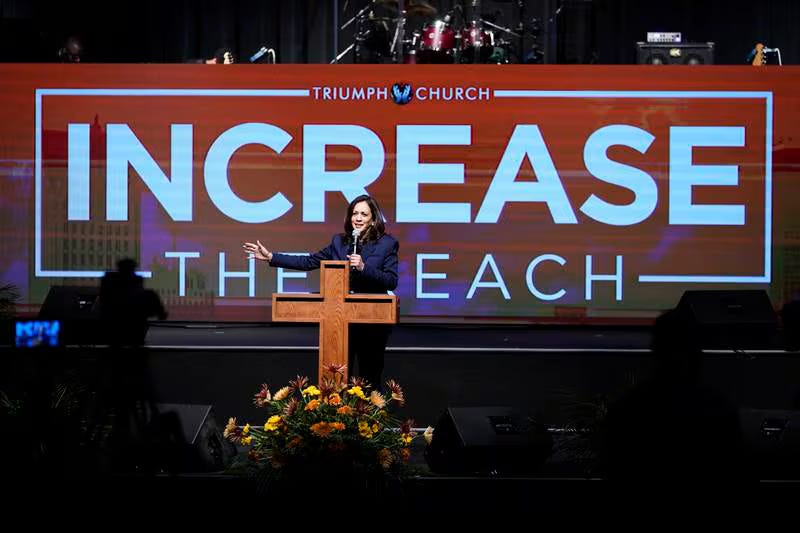
Harris, source: AP via WFTV9

While the fervor Trump generates among Christian evangelicals gets a lot of attention – and while some of his religious backers see Kamala Harris and the Democrats as nothing short of demonic – Harris hasn’t been deserted by people of faith. Emerging groups such as “Evangelicals for Harris” urge Christians to back Harris, extolling her religious commitment.

“Her faith journey started when she was a little girl, singing in the children’s choir at the 23rd Avenue Church of God in Oakland, California, where she was born and raised,” the pro-Harris group says in describing “Kamala’s Faith Story.” “This was where she learned to have a living faith, one that expresses itself through one’s life, especially through service to others, particularly the vulnerable and powerless.”

In a nod to the varied religious influences on her, the site’s writers add: “While a deeply committed and faithful Christian, Vice President Harris has great respect for other faith traditions. Her mother Shyamala Gopalan and relatives in India took her to Hindu temples. She joins her husband, Doug Emhoff, in Jewish traditions and celebrations.”

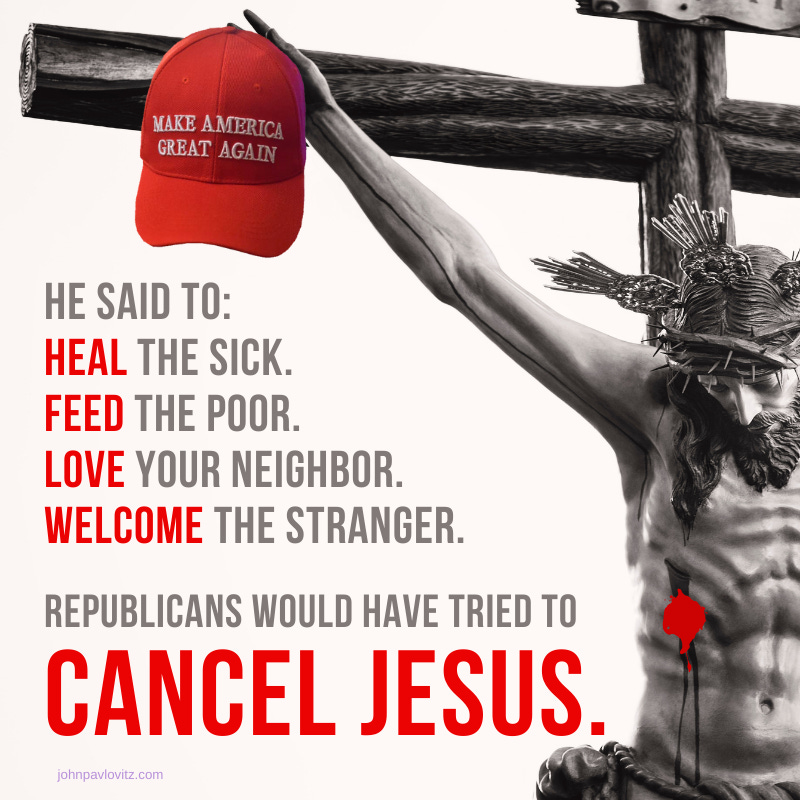
Source: John Pavlovitz

And some religious figures are waxing passionate in condemning Trump. North Carolina minister John Pavlovitz, for instance, offers his critiques on sites such as The Good Men Project. “Donald Trump is not Christian and never has been,” the minister writes. “He is cruel, immoral, vile, racist, misogynistic, narcissistic, vulgar, criminal, hateful.”            

Making it clear what audience he is addressing on that site, Pavlovitz headlines his note: “White Christian, It’s Time to Embrace Jesus’ Love and Reject Donald Trump’s Hatred Once and for All.” And he opens it with “Dear White Christian.”

Of course, Black religious leaders have also rallied around Harris. By the thousands, they have joined in Zoom calls and otherwise gathered to organize their support for her. Black women, in particular, have rushed to back her.

And some leaders have joined hands behind Harris. Pavlovitz has allied with Black singer and activist Malynda Hale to raise money for Harris. Together, they operate a site, “Christians for Kamala: Love, for the Win,” that so far has raised more than $155,000.

“We proudly support Vice President Kamala Harris as she champions true Christian values embodied in the teachings of Jesus,” the site’s authors say. “Now more than ever, we need to bring our personal spiritual convictions to bear and to speak with our voices, our time, our resources, and our votes.”

The Harris backers, however, may have a tall Calvary-like hill to climb in some quarters of America’s religious community. As NPR reported, about 8 in 10 white evangelical Christians supported Trump in the past two presidential elections. And longtime conservative activist Ralph Reed of the Faith and Freedom Coalition says many remain grateful to Trump for efforts such as overturning Roe v. Wade. Democrats, he says, lag far behind Republicans reaching out to faith-based voters.

Certainly, the partisan divide is as wide as the separation between Heaven and Earth. According to the Deseret News/Marist polling, 81% of Republicans believe the U.S. Constitution was inspired by G-d, while only 36% of Democrats agree (though 55% of independents do). As Pew reported, though, most Americans want a president who lives a moral and ethical life:

And, in terms of Trump, Pew found that most Republicans and people in religious groups that tend to favor the GOP think he stands up at least to some extent for people with their religious beliefs. Two-thirds of Republicans and independents who lean toward the GOP (67%) say Trump stands up for people with their religious beliefs “a great deal,” “quite a bit” or “some.” About the same share of white evangelical Protestants (69%) say this about Trump.

Interestingly, though, many Americans in both parties are skeptical of Trump’s attempts to portray himself as a religious person. Some 6% of Republicans and GOP leaners say Trump is very religious, while 44% say he is “somewhat” religious, according to Pew. Nearly half (48%) say he is “not too” or “not at all” religious. Overall, just 4% say Trump is very religious.

Some may see it as pandering on Trump’s part when, after the July 13 assassination attempt on him, he wrote on social media: “It was God alone who prevented the unthinkable from happening. We will fear not, but instead remain resilient in our faith and defiant in the face of wickedness.”

But, as reported by NPR, Republican politician and businessman Vivek Ramaswamy said of the shooting, which killed one person and wounded two others: “I personally believe that God intervened today, not just on behalf of President Trump but on behalf of our country.” And Texas Governor Greg Abbott, also a Republican, said: “Trump is truly blessed by the hand of God — being able to evade being assassinated.”

Whether Trump has truly had a “come to Jesus” moment as a result of his lucky turn of the head then is impossible to know. Will we continue to hear phrases such as that he used about President Joe Biden last September, when he said “let’s indict the motherf_____”? Such language would not serve him well among religious folks, of course.

Just what his religious backers believe is difficult to pin down. Journalist Coppins points to a confounding change in tone that has happened over the last few years among evangelicals backing Trump. Where in 2016 many of them saw Trump as an “unlikely vessel” — a nonreligious person who could be a “blunt, utilitarian tool in God’s hand” – more recently, they have recast him as a “person of faith.” Some 64% of Republicans now see him that way, according to a recent Deseret News poll by HarrisX.

To be sure, seeing a thrice-married philandering felon with a history as a sexual abuser and dishonesty in business as a religious person might take a big jump. Perhaps a great leap of faith. Apparently, that’s a hurdle at least some Americans — maybe an aging and shrinking minority — are willing to make.