Who is the real swine?

Trump’s misogyny may — at last — be catching up with him

Joseph Weber

Nov 19, 2025

Source: Gavin Newsom

Just over a century ago, in 1920, the 19th Amendment gave women the right to vote in the United States, after an effort that took more than 70 years. And just over half a century ago, in 1963, author Betty Friedan bemoaned the lack of progress for women, writing in “The Feminine Mystique”: “In almost every professional field, in business and in the arts and sciences, women are still treated as second-class citizens.”

Now, we have a president telling Bloomberg’s Catherine Lucey, “Quiet, Piggy,” for asking about the Epstein files, the sordid documents that mention Donald J. Trump multiple times. And we have Trump lecturing another woman that she was “a terrible reporter” for asking questions about the savage 2018 murder of Washington Post writer Jamal Khashoggi and the Epstein papers. The president castigated ABC News journalist Mary Bruce for asking a “horrible, insubordinate and just a terrible question.”

Catherine Lucey, source: Bloomberg
Mary Bruce, source: ABC

“Insubordinate?” That’s right up there with other phrases Trump has used in dealing with female journalists, as reported by The Atlantic: “Keep your voice down.” “That’s enough of you.” “Be nice; don’t be threatening.” “There was blood coming out of her eyes, blood coming out of her wherever.”

All are reminiscent, too, of an infamous comment by another Republican, then-Senate Leader Mitch McConnell. He silenced Sen. Elizabeth Warren in an argument over and Attorney General nominee in the first Trump term, in 2017, saying: “Nevertheless, she persisted.” That became a rallying cry for feminists.

So, one has to wonder: just how far we have come? And how much are we being set back?

Yes, four of the nine Supreme Court justices are women. And, yes, voters in New Jersey and Virginia installed women as governors earlier this month, for the first time in Virginia. Thirteen states now have women sitting at the same time in their governor’s chairs, something NPR last year celebrated as a new record.

And yet, since 1872 scores of women have sought and been denied the U.S. presidency. This was even after one, Kamala Harris, won the vice presidency and became the second woman, after Hillary Clinton, to carry a major-party banner into elections.

Of course, Trump’s misogyny is an egregious exaggeration. Like so much about the man, it is so extreme as to be aberrant. His history of mistreating women stretches back at least to the 1970s, through the late 1980s when he started palling around with Jeffrey Epstein, into the 1990s, when he assaulted writer E. Jean Carroll, and into the 2000s, when he bragged about grabbing women by the genitals at beauty pageants. At least 27 women have publicly complained about Trump over the years.

Linda Fagan, source: CNN

But he and his minions are having a corrosive effect on society, certainly in some of our institutions.

Pete Hegseth, the secretary of defense who paid a woman $50,000 to keep quiet after she had accused him of sexual assault, has been driving women out of the military, for instance. After Trump removed Linda Fagan, the admiral who ran the U.S. Coast Guard, Hegseth purged another admiral who was the Navy’s first female chief, reassigned the woman vice admiral who ran the U.S. Naval Academy, fired another female vice admiral who worked with NATO, and pushed out a woman lieutenant general who headed of the Defense Health Agency. Hegseth, who has mandated that every combat soldier meet “the highest male standard” for fitness, also quashed the elevation of a woman slated to head the Navy’s SEAL program. That officer, a captain, had been awarded a Purple Heart for her time in Iraq, during which she was injured in an IED attack, and was the first female troop commander to serve with SEAL Team Six.

Organizations such as the National Organization for Women are documenting the numerous ways that the Trump Administration has been setting women back. These have included mandates that gender not be considered in military academy applications, widespread assaults on diversity and equality efforts, the gutting of the Office of Civil Rights, assaults on the rights of transgender people, and much more.

Even before his election, experts warned about the threats Trump posed to women, setting them the context of the rise of authoritarianism generally. In a November 2024 piece headlined “Why Gender Is Central to the Antidemocratic Playbook: Unpacking the Linkages in the United States and Beyond,” a senior fellow at the Carnegie Endowment for International Peace set Trump’s sexism in a broader context. Saskia Brechenmacher wrote of how “a significant body of evidence shows that right-wing authoritarian views—which are associated with an embrace of traditional values, submission to authority, and a perception that the world is a dangerous place—are linked to both paternalistic attitudes about women (‘benevolent sexism’) and feelings of antipathy toward women who seek equality (‘hostile sexism’).”

Every month since Trump assumed office, it seems, we have seen fresh examples of authoritarian actions – consider the rampages of ICE, the unilateral dismantling of the Department of Education, the firings of government employees, the persecution of political opponents, the harassment of universities, and on and on. And, not coincidentally, we see Trump’s continuing verbal assaults on women.

We have at least three more years during which we’re likely to see more such outrages. Just how much damage will they do?

Congresswomen Mace, Boebert and Greene; source CNN

Still, it seems significant that some women in the GOP appear to be souring on Trump’s vileness. A New York Times opinion writer, Michelle Cottle, wrote of how much of a difference three Republican House members — Lauren Boebert of Colorado, Marjorie Taylor Greene of Georgia and Nancy Mace of South Carolina – have made. They stood up to others in their party and to the president in demanding release of the full Epstein files, forcing Trump to belatedly echo their call.

“Love ’em or hate ’em, these House troublemakers bucked their party leadership, stared down their president and made possible Tuesday’s vote to compel the administration to come clean about the web of degeneracy surrounding Jeffrey Epstein,” Cottle wrote. “This victory speaks to the value of having women’s voices, and strength, inside the Republican echo chamber, a place that can still be tough for women to navigate.”

Might that signal the start of a feminist rebellion or something even broader? Betty Friedan in 1984 struck an optimistic note, writing: “I cry for all the years of women’s struggle and sacrifice to get to this place. I cry for joy and pride at the power that we women have found in ourselves and given to each other to make this moment possible. And I cry with sheer excitement at the amazing grace of it all – the sense of new political hope, of democracy moving again after all the years of cynicism.”

The setbacks that Trump represents – and foments – make such optimism tough now. But, if the three dissident Republican congresswomen signal anything, it’s that the fight isn’t lost yet.

Is “intellectual diversity” really diverse?

An Indiana case tests what intellectual exchange means in the Trump era

Joseph Weber

Nov 14, 2025

Source: The Week

Ah, the hypocrisy.

Indiana last year passed an “intellectual diversity” law. It requires its public universities to develop policies that ensure that faculty foster a “culture of free inquiry, free expression, and intellectual diversity.”

As reported by Insider Higher Ed, schools must consider whether faculty members have “introduced students to scholarly works from a variety of political or ideological frameworks” when deciding whether to give bonuses or renew contracts.

Sounds reasonable, doesn’t it?

But then, enter Jessica Adams, a lecturer at Indiana University’s School of Social Work. Adams was suspended from teaching a graduate-level class titled “Diversity, Human Rights and Social Justice” after a single student objected to a graphic she showed in class.

The graphic described the phrase “Make America Great Again” as socially acceptable covert white supremacy. The term was listed right up there with Confederate flags and denial of white privilege.

A controversial view? No doubt. The sort of thing that might merit a full-blown discussion, one involving pro and con arguments? One might think so.

But after the student complained to U.S. Sen. Jim Banks, the Trump-allied senator contacted IU. He got Adams barred from the course and landed her in the middle of an investigation of whether she broke the new law. Even though she continues to teach three other courses, she now worries that her job is in jeopardy.

No discussion. No truly diverse viewpoints here, it would seem.

Source: Indystar.com

The graphic that Adams used appears to have been updated from one created about 20 years ago by the Safehouse Progressive Alliance for Nonviolence of Boulder, Colorado. Its criticism of the “Make America Great Again” phrase, while something that would certainly offend some folks, is hardly singular.

For years, some critics have seen the term as code for, “Make America White Again.” That’s certainly what former neo-Nazi Christian Picciolini contended in 2017, when he said rightists believe that’s exactly what the phrase means. Indeed, polls have shown that while most Trump supporters see America’s greatest days as in the past, many Blacks disagree.

The “again” part of that phrase seems to evoke far different responses among Blacks and whites, especially at at time when racial resentment seems rampant.

In a 2022 book, “Racial Resentment in the Political Mind,” a dean at the University of California, Berkeley, and a co-author argue that many whites believe Blacks are unfairly advantaged in scholarships and jobs — a view likely not uncommon among Trump supporters. “In that context, any racial progress today is perceived as coming at the expense of whites,” argues the dean, David C. Wilson, a political psychologist.

That’s where the “again” part comes in. Let’s go back to the good old days when any such preferences didn’t exist, it suggests.

Source: VOA

What’s more, at least one would-be politician in Tennessee in 2016 ripped off the Trump phrase to explicitly call on voters to “Make America White Again.” That candidate lost, certainly an encouraging sign.

Wouldn’t all of that be worth discussing in a university classroom? Adams certainly thinks so. “I feel this is an important issue to talk about — censorship, stifling of academic freedom and this real overreach through this legislation,” Adams told The New York Times.

But, for his part, Sen. Banks seemed to think that anything that makes even a single student twitchy has no place in a lecture hall. “At least one student in the classroom was uncomfortable, and I’m sure there are more,” the senator argued. “This type of hateful rhetoric has no place in the classroom.”

So, in other words, “intellectual diversity” means no one should be made to feel anxious. No instructor, regardless of any evidence she could cite, should suggest there might be racism in the term “Make America Great Again” or, perhaps, among those who embrace it.

Presumably, however, it would be acceptable to praise the “Make America Great Again” phrase and the movement and president who use the term. Just don’t criticize it.

To be sure, lots of controversial ideas merit discussion. Students such as the lone objector in Adams’s class should be free to air their views and, perhaps, bat them back and forth with others who may disagree. Such disagreement would seem to be just what should go on in a classroom, especially a graduate level one, wouldn’t it?

As it happens, last night I attended a “Clean Speech” discussion in Denver where disagreement was tolerated, even encouraged — so long as we all were civil and respectful. At my table, we discussed one of the most contentious issues around: whether there should be a two-state solution for Israelis and Palestinians. Not all of us agreed on everything, but all of us learned things.

Isn’t that the sort of thing that should be promoted in university settings, too?

Not to Trumpists, it seems. To them “intellectual diversity” means firing, cancelling, purging those who disagree with them. As summarized well by U.S. News & World Report, their war on higher education has stretched from attacking Ivy League and other schools financially to trying to dismantle tenure and drive out faculty that offend them, often under the guise of combating antisemitism.

Trump has claimed that college campuses have been “infested with radicalism like never before.” He and his allies aim to purge the “woke” agenda wherever they find it.

Adams is just the most recent faculty member to fall prey to the effort,

When the Indiana “intellectual diversity” law was debated, IU law professor Lea Bishop condemned it as “a blank check to fire any faculty member for any reason, at any time, regardless of tenure.” She added it was “radical” and “un-American.”

Many academics slammed the bill. The faculty senates and American Association of University Professors chapters at Ball State, Indiana, Indiana State, and Purdue Universities opposed it. So, too, did the American Civil Liberties Union of Indiana, the Foundation for Individual Rights and Expression, the American Historical Association and the Modern Language Association.

But the critics are fighting an uphill battle with powerful opponents.

When the Trump Administration attacked Harvard in the spring, it cited “viewpoint diversity” as one of its goals. Its letter to the university demanded that it hire a federally approved external party to “audit the student body, faculty, staff, and leadership for viewpoint diversity.”

And it minced no words. “Every department or field found to lack viewpoint diversity must be reformed by hiring a critical mass of new faculty within that department or field who will provide viewpoint diversity.” It called even for admitting “a critical mass” of viewpoint-diverse students, whatever that means.

If the Indiana case is an example, “viewpoint diversity” seems to mean little more than excluding certain views that powerful people don’t like. Is that what universities should be about?

Unfit to serve

Donald J. Trump tarnishes Veterans Day

Joseph Weber

Nov 11, 2025

Draft dodger Donald J. Trump in 1964; source: BusinessInsider

The satirist Andy Borowitz hit just the right note in a post about Veterans Day and Donald J. Trump.

“Reporting” on how the president laid a wreath at the Tomb of the Unknown Podiatrist, Borowitz “recounted” that Trump tearfully thanked “fallen foot specialists” who bravely helped those ducking service in the military. Borowitz “quoted” the president as saying, “They gave everything so people like me could give nothing.”

The piece, of course, was a sendup based on deferments that kept Trump out of Vietnam.

Though he was a healthy and athletic 22-year-old who attended a military-style boarding school from 13 through high school, Trump gave Selective Service officials a podiatrist’s note in 1968, claiming bone spurs disqualified him. He had passed earlier military physicals, but avoided service with four educational deferments before getting a temporary 1-Y medical classification that ultimately was switched to a 4-F.

Recall that this is the same Trump who five decades later, in 2018, called fallen service members “losers” and “suckers” as he refused to enter a military cemetery in France. And it is the same Trump who declined to be seen in the presence of military amputees because he said it didn’t “look good” for him, as recounted by John Kelly, the president’s former chief of staff and a former Marine general.

As we honor the sacrifices of our men and women in uniform – past and present – today, it’s worth noting the deep flaws that mark their current commander-in-chief and his deputies. He has long had those flaws on display.

John McCain after his release from a Vietnamese POW camp

Remember that Trump in 2015 disparaged the late Sen. John McCain, who had spent more than five years in a Hanoi POW camp where he was tortured. “He’s not a war hero,” Trump said in an Iowa gathering. “He was a war hero because he was captured. I like people who weren’t captured.”

And take note that Trump today is misusing active duty and National Guard troops. He has sought to station them in American cities in bizarre displays of force, aimed variously at supporting roundups of migrants or combatting crime.

So far, Trump has deployed National Guard and/or active-duty soldiers to five major cities across the U.S.: Washington, D.C.Los AngelesChicagoPortland, Oregon and Memphis, Tennessee. He has threatened future military interventions in several cities including Baltimore, New York, New Orleans, Oakland, San Francisco and St. Louis.

Encouragingly, U.S. District Judge Karin Immergut – a Trump appointee – on Nov. 7 ordered the military out of Portland, Oregon. In her 106-page ruling, the judge noted the concerns of the nation’s founders that have kept presidents from misusing our military. Citing other court cases, she said the Founders “embodied their profound fear and distrust of military power . . . in the Constitution and its Amendments,” … which has lived on through the decades as “a traditional and strong resistance of Americans to any military intrusion into civilian affairs.”

But there has been no check, so far, on Trump’s misuse of the military to attack boats in the Caribbean and off the coast of Venezuela. His administration has killed at least 76 people in such attacks so far while offering no proof that they are involved in the drug trade, as Trump has claimed. The usual practice had been for the Coast Guard to capture such boats and their crews, rather than killing people without evidence or any legal process.

In other words, Trump is ordering our military to murder people in at best dubious circumstances. “There has been no armed attack. There is no organized armed group [and] there is no armed conflict,” Cardozo Law School Professor Rebecca Ingber, a former legal adviser at the State Department, told The Christian Science Monitor. “Under international law, we’d call the targeted killing of suspected criminals an extrajudicial killing, and under U.S. domestic statutes it’s murder.”

Adm. Alvin Holsey, source: The Guardian

When Adm. Alvin Holsey, the head of U.S. Southern Command, raised questions about the deadly military strikes on the boats, he found himself on the wrong side of the Trump Administration. The admiral abruptly announced last month that he was stepping down, less than one year into what is typically a three-year assignment.

Holsey appears to be a casualty of a broad purge of the military by Trump’s Secretary of Defense, Pete Hegseth. He’s far from the only one.

The New York Times reported that Hegseth has fired or sidelined at least two dozen generals and admirals over the past nine months, ranging from Gen. Charles Q. Brown Jr., the chairman of the Joint Chiefs of Staff, to top intelligence officers. One senior officer, Lt. Gen. Jeffrey A. Kruse, a 35-year Air Force intelligence officer who led the Defense Intelligence Agency, was forced from his position after his agency cast doubt on Trump’s assertion that U.S. airstrikes in June had “obliterated” Iran’s nuclear program.

So much for respect for our military.

Commander Emily Schilling

Recall, too, that Hegseth, following a Trump executive order, is driving transgender soldiers out of the military. More than 4,000 such soldiers are being forced out, including many with long and distinguished service records. For instance, they include Navy Commander Emily Schilling, a 19-year veteran who told CNN that her two tours in Iraq and Afghanistan included 60 combat missions.

The services will suffer without many of those soldiers, Schilling argued. “We see this with all of the troops that are deployed across the world today, already embedded in combat units,” Schilling said. “We have lawyers, doctors, special forces, rangers, and they’re all there today filling critical roles. If we yank them out, it will take decades to fill.”

Schilling was among plaintiffs who sued early this year to overturn the Trump Administration’s anti-trans policy. The plaintiffs won their argument with a federal judge in Washington state, George W. Bush appointee Benjamin Settle, who found that the administration’s contention that gender dysphoria was a disqualifying medical condition was essentially a ruse motivated by hostility towards transgender people, as reported by NPR.

But the Supreme Court paused Settle’s order against the policy in an emergency decision. It allowed the purge of transgender soldiers to proceed, even though it may revisit the case.

Finally, remember, too, that Trump is shrinking the Veterans Administration, threatening the care our veterans will get. As Newsweek reported, the administration has allowed staff to take voluntary early retirement as part of a plan to reduce VA staff by nearly 30,000 employees by the end of fiscal year 2025, which has sparked concerns about the department’s ability to administer healthcare.

No one should be surprised that some veterans are fighting back. “Vets Say No” protests, organized by About Face, a movement of post 9/11 veterans, and May Day Strong, a self-described anti-authoritarian movement, were scheduled on Nov. 11 in several cities.

Between his disdain for our soldiers and veterans and his misuse and abuses of them, Trump has hardly earned the right to lay wreaths anywhere on Veterans Day. Borowitz got it right.

The Big Loser

As Dems sweep the election, a red-faced president proves indecorous

Source: The Week

When George W. Bush’s Republicans took big hits in the 2006 midterms, the president acknowledged that the election was a “thumping” for the GOP. He said he wasn’t about to hold grudges for it but would work with Democrats “to get things done.”

Four years later, Barack Obama felt chastened by Democratic setbacks in that year’s midterms. He called GOP victories a “shellacking,” and added: “The responsibilities of this office are so enormous [that] sometimes we lose track of the ways that we connected with folks that got us here in the first place.”

So, now that Democrats in at least seven states gave Donald J. Trump and his party a bright blue middle finger in this year’s off-year pre-midterm races, how does he react? Humbled? Contrite, as he looks toward the fall Congressional midterms? Accepting responsibility, as prior presidents have?

Fuhgeddaboutit.

“‘TRUMP WASN’T ON THE BALLOT, AND SHUTDOWN, WERE THE TWO REASONS THAT REPUBLICANS LOST ELECTIONS TONIGHT,’ according to Pollsters,” the president wrote on Truth Social. And, even before the California redistricting vote went against him, the president called it a “GIANT SCAM” and “rigged,” promising a “legal and criminal review.” After the results came in – which could help Democrats flip the House next fall – he mysteriously threatened: “…AND SO IT BEGINS!”

Of course, we could have expected no better from Trump, who still insists his 2020 defeat was invalid. Just recently, he has been pressuring the Justice Department to find the fraud he insists cost him the White House that year.

Still, none of his absurd rhetoric could outweigh the anti-Trumpist results in California, New Jersey, New York, Pennsylvania, Virginia, Georgia and Mississippi. And, despite the president’s claim that he wasn’t on the ballot, he and his party surely were on voters’ minds – certainly on the minds of the political victors.

Promising to “usher in a generation of change,” for example, self-proclaimed Democratic socialist Zohran Mamdani in his victory speech as the next mayor of New York City called on supporters to “respond to oligarchy and authoritarianism with the strength it fears, not the appeasement it craves. After all, if anyone can show a nation betrayed by Donald Trump how to defeat him, it is the city that gave rise to him. And if there is any way to terrify a despot, it is by dismantling the very conditions that allowed him to accumulate power.”

Even as Trump has threatened to withhold federal funds from the city, Mamdani looked beyond the 79-year-old president.

“This is not only how we stop Trump; it’s how we stop the next one,” Mamdani said. “So, Donald Trump, since I know you’re watching, I have four words for you: Turn the volume up. We will hold bad landlords to account because the Donald Trumps of our city have grown far too comfortable taking advantage of their tenants. We will put an end to the culture of corruption that has allowed billionaires like Trump to evade taxation and exploit tax breaks.”

Abigail Spanberger, Mikie Sherrill; source: People

Echoing the view that the elections were a mandate on Trumpism, Democratic Virginia Gov.-elect Abigail Spanberger said voters sent a clear message. “We sent a message to the whole world that in 2025, Virginia chose pragmatism over partisanship,” she said. “We chose our commonwealth over chaos.” Then, she laughed when a supporter urged her to run for president.

In New Jersey, Democratic Gov.-elect Mikie Sherrill pointed to the Trump administration’s moves to cut federal food assistance to 42 million Americans, halt federal subsidies for Obamacare, and cancel the Gateway tunnel project. She promised to “fight for a different future in New Jersey.”

Throughout her campaign, the New Jersey Monitor noted, Sherrill worked to nationalize the race, painting it as a choice between democracy and the MAGA movement, reminding voters that Trump endorsed her Republican opponent. She echoed that in her victory speech, saying New Jersey residents “take oaths to the Constitution, not a king.”

The repudiation of Trump spread deep and wide including in a couple Trump bastions, as NPR reported. In Georgia, a couple Democrats were tapped to serve on the state’s five-person public utility regulator after earning roughly 60 percent of the vote. It’s the first time Democrats have won a nonfederal statewide office there since 2006.

Pennsylvania voters chose to retain three state Supreme Court judges who were first elected as Democrats, despite millions of dollars in spending driven by conservative billionaire Jeff Yass‘ efforts to reshape the state court’s politics. Democrats also won special elections for a seat on Pennsylvania’s Superior Court and a seat on its Commonwealth Court.

Also in Pennsylvania, Democrats swept the top “row offices” in Bucks County, electing the county’s first-ever Democratic District Attorney and defeating an incumbent Republican sheriff a year after Trump narrowly won there. As NPR noted, Democrats similarly notched commanding victories in county executive races in Erie, Lehigh and Northampton counties, all bellwether counties in recent presidential elections.

And in Mississippi, Democrats broke a GOP supermajority in the state Senate after flipping two seats there and picked up another state House.

Now, of course, as it prepares for the fall midterms and beyond, the Democratic Party has to figure out what course it will rally around. Does it go mainstream, embracing the center as Bill Clinton, Barack Obama and Joe Biden did?

Source: NY Post

Or does the party embrace the policies of the 34-year-old naif, Mamdani, as GOP pundits and right-wing media enthusiasts hope? The incoming mayor has promised to freeze rents in rent-controlled housing, raise the minimum wage to $30 an hour, eliminate fares on buses, create government-run grocery stores, offer free child care and pay for it all with stiff hikes in corporate taxes. Will the party endorse the Muslim mayor’s denial of Israel’s right to exist as a Jewish state and accept his reluctant repudiation of the term “globalize the intifada?”

The party could, instead, move toward the self-proclaimed moderate stances of Spanberger and Sherrill, women with powerhouse resumes far more substantial than that of the incoming New York mayor. Mamdani, a Bowdoin College graduate, worked as a foreclosure prevention housing counselor for an advocacy group, as a community organizer and then on several political campaigns before being elected to the New York State Assembly in 2020.

For their part, Spanberger and Sherrill lived together as members of the U.S. House, beginning in 2018, and were part of a group of Congresswomen who called themselves the “Mod Squad.” That was a centrist alternative to the leftist “Squad” of Alexandria Ocasio-Cortez of New York, Ilhan Omar of Minnesota, Ayanna Pressley of Massachusetts and Rashida Tlaib of Michigan.

Certainly, their backgrounds scream “Establishment” and “accomplishment.” Spanberger, 46, attended the U.S. Capitol Page School, has a B.A., from the University of Virginia and an M.B.A. from Purdue University, and worked as a teacher and postal inspector, and, for eight years served as a case officer for the Central Intelligence Agency. In her agency work she dealt with foreign nationals, meeting people undercover at times, and she carried five different passports at one point. She then served three terms as a Representative in Congress.

Sherrill, 53, is a Naval Academy graduate and former helicopter pilot who served nearly a decade in the military. She earned a master’s degree in global history from the London School of Economics and Political Science and a law degree from Georgetown University. After serving as a federal prosecutor and Assistant U.S. Attorney in New Jersey, Sherrill served four terms as a Congressional representative.

States breaking Democrat or Republican in redistricting; source: Democracy Docket

As for the GOP efforts to undermine elections and redraw maps to lock Republicans in safe districts, Trump’s press secretary, Karoline Leavitt, insisted to reporters on Election Day that it was “absolutely true that there are [sic] fraud in California’s elections. It’s just a fact,” Leavitt told them. “Fraudulent ballots that are being mailed in, in the names of other people, in the names of illegal aliens who shouldn’t be voting in American elections. There’s countless examples, and we’d be happy to provide them.”

She provided no evidence and, when asked for it, Leavitt again responded, “it’s just a fact.” She also said Trump is mulling over an executive order “to strengthen our elections in this country, and to ensure that there cannot be blatant fraud, as we’ve seen in California, with their universal mail-in voting system.”

Already, the California GOP has filed suit to block the redistricting, despite the nearly 64 percent approval vote state residents delivered. Trump’s party alleges that the maps were redrawn in a racist fashion, an argument apparently designed to meet Fourteenth Amendment concerns regarding racial gerrymandering.

Never mind that Trump got the gerrymandering ball rolling by ordering redistricting in Texas. He got it there and from GOP leaders and in Missouri and North Carolina. He’s likely to get his wish, too, in Indiana, which is planning a redistricting special session.

As Democracy Docket reported, two other GOP-led states have passed gerrymanders, but not solely at Trump’s request. Utah’s redraw was court ordered, and the new map, which is still being fought over in court, doesn’t net any gains for the GOP and could allow Democrats to pick up one seat. In Ohio, lawmakers were required to do a redraw and a new map passed last week could flip two out of five seats currently held by Democrats.

To be sure, the GOP gerrymandering efforts face legal and other challenges. Virginia Democrats plan to put the matter before voters next year and Missouri voters are organizing a citizen-led vote referendum on the matter. Overall, however, pundits say the battles could boost the number of GOP seats to entrench Trump’s party in the House, even as the map mischief disenfranchises minority voters and unfairly advantages one side or the other.

Much will happen between now and next November, of course. The economy could thrive or tank, inflation could rise or fall, international relations could improve or decline. If Trump were more of a rational actor and could take a lesson from this year’s vote, he could scale back on his overreaches — though that would hardly be in character. His inclination would likely be to double down and count on his party’s electoral map manipulations to bail it out.

For now, however, it seems clear that this election reflects disgust with Trump’s nine-month stint so far, which has earned him a 63 percent disapproval rating. As his niece, psychologist Mary L. Trump, put it in a post on X: “Raging narcissist claims that an election that rejected everything he stands for wasn’t about him. Good try, Donald. Loser.”

An era passes

The death of a brilliant colleague highlights our losses in media

Source: Anne Power

In the opening issue of The Pennsylvania Magazine, a monthly published from January 1775 until July 1776 in Philadelphia, editor Thomas Paine wrote: “A magazine, when properly conducted, is the nursery of genius; and by constantly accumulating new matter, becomes a kind of market for wit and utility.”

As a modern nursery of genius, there were few equals to BusinessWeek in its heyday, a couple centuries after Paine’s words were published. BW garnered National Magazine Awards four times between 1973 and 1996. From 1958 to 2004, it picked up nine Gerald Loeb Awards, regarded as the Pulitzer Prizes of business journalism, including five in the glory days between 1987 and 2004. Since being sold to Bloomberg News in 2009 and rechristened as Bloomberg Businessweek, it has picked up another couple NMAs and several Loeb Awards, including two this year.

Alums of BW – graduates of that “nursery” — have gone on to illustrious stints at The New York Times, The Wall Street Journal, The Boston Globe, the Los Angeles Times, Reuters, and The New Yorker, as well as online outfits including Poets and Quants, and elsewhere, including Bloomberg, of course. Some moved into substantial academic careers, including longtime editor Stephen B. Shepard, who founded and led a journalism graduate school at the City University of New York. Others have become novelists or gifted nonfiction authors. All of their work has been filled with wit and utility, indeed.

As someone privileged to work for the magazine for 22 years, until 2009, I was reminded recently of the place’s unique culture, sadly, by the death of a colleague there. Chris Power, a BW stalwart and international editor for most of the best years, died on Oct. 13 at 68. His passing drew more than 120 comments on a BW Friends site, most celebrating his wit, his skills, his easy way with people and his remarkable intellect. Some referred to his short stature – something he joked about – which reminded me of how a colleague once described Chris to me: “5-foot-3-inches of brain.”

Another coworker, a man I succeeded as Chief of Correspondents, described Chris as “an excellent editor who knew when to push fellow journalists to do their best work,” adding “he was always the gentleman.” Saying he was blessed to work with 35-year BW veteran Chris for decades, he added that “a key piece of what BusinessWeek was is now missing.” Yet another workmate called him “smart, fast and unflappable, no matter how tough the story or tight the deadline; all around one of the best.” Still another called him “the kindest, gentlest and cleverest editor I had.”

As Chris guided stories that a copydesk veteran called beautifully edited, he did so with style. “But most of all, I’ll remember Chris dropping by the desk and doing his soft shoe,” she wrote. “Even under the tightest of deadlines, he could lighten a heart.” At a goodbye party for a former top editor bound for Texas, another colleague reminisced about how the folks were all given hats. “When it was Chris’ turn to talk, he came up hatless and said, ‘When you’re 5’3”, you know better than to wear a cowboy hat,’” he wrote. Yet another former workmate wrote of Chris’s recipe for an extra-dry martini: “pour the gin, wave the vermouth bottle over the glass.”

Stephen Shepard, source: The Virtual Memories Show

The extraordinary outpouring of respect, affection and admiration for Chris reflected well on him, of course. But it also said a lot about the collegial and high-powered culture at BW, something that our top editor – Steve Shepard – fostered.

Sure, people brought a lot of brain power to the job. Our chief economist had a Ph.D. from Harvard, our finance editor earned his from The New School, others there had taught at Columbia, and the staff was filled with Ivy Leaguers of all sorts. As a magna cum laude graduate of Harvard who had been trained by Jesuits at Boston College High School, Chris fit in. He “was one of the gifted minds that made BusinessWeek BusinessWeek,” as one commenter put it.

But brains weren’t enough. To work at BW, you also had to be able to get on well, to work in a group, to produce the best damn stuff we could. When candidates interviewed for jobs, they would sit down with as many as a half-dozen people, I recall. The book, as we called it, was a team effort. “Chris was always smart, funny and – most vital to a young reporter trying to find her footing – helpful,” one former colleague wrote. “Farewell to a true gentleman!”

It was no wonder that BW won so many awards. It’s no wonder that it produced such good work.

Sadly, as veterans of the glory days are aging, we are seeing our numbers decline. The man who hired me (Keith Felcyn) died last year, as did a former assistant managing editor (Dave Wallace) and a former Tokyo bureau chief (Robert Neff). Earlier, we lost a former science editor (Emily Thompson Smith), a former managing editor (Jack Dierdorff), a much-respected Washington bureau chief (Lee Walczak) and a finance editor (Chris Welles). Such things are inevitable, of course, as the clock ticks on us all.

But, more than just the passing of such admired and often beloved people, these losses say something about the declines we are seeing all around in journalism. I can’t speak to the culture of Bloomberg Businessweek, but I suspect it’s rather different than the old BW (for one thing, Bloomberg let go or reassigned much of the staff and, for another, the magazine is entirely online now, so we don’t see the powerful blend of imagery and text that helped tell stories so well).

On a more troubling point, even with the exceptional journalism machine of Bloomberg News behind it, BBW and other magazines have lost the extraordinary power and reach they once had. It’s been a long time since they could make big-name CEOs and politicians alike anxious when that was appropriate, and their influence on public attitudes is dubious at best (as is the case with many newspapers).

Thanks to the Net and political changes, so many big-name publications in journalism have seen their influence shrivel. Organizations for which credibility, fairness and thoroughness were core values have lost subscribers and seen their staffs shrink, their economic wellbeing eroded. Today, lies from those at the top levels of politics gain traction because on the Net all voices seem equal and the loudest and least credible don’t even bother going through the responsible media. Instead, they take their distortions and distractions directly to the public.

Consider the appalling list of media outlets that have bent the knee to Donald J. Trump and whose inclination will be to pull punches. Paramount agreed to pay $16 million for a Trump library to settle an absurd CBS case and now the company and network are owned by Trumper David Ellison. He installed rightwing opinion journalist Bari Weiss as editor-in-chief at CBS News and is now pursuing an acquisition of CNN, jeopardizing its independence. ABC similarly agreed to pay $16 million to settle another dubious Trump lawsuit.

The broader media have similarly acquiesced. Facebook parent Meta agreed to pay $25 million and X $10 million, both related to lawsuits over the post-Jan. 6, 2021, suspensions of Trump accounts. Alphabet, the parent of Google and YouTube, agreed to pay $24.5 million to Trump and others over a similar suspension.

Encouragingly, Trump’s legal assaults on some media outlets have gone nowhere. This year, he sued The Wall Street Journal, a Fox property, in July over his 2003 letter to pedophile Jeffrey Epstein, a longtime friend of Trump’s. He’s seeking $10 billion. The president also sued The New York Times, demanding $15 billion for allegedly undermining his reputation with stories raising questions about his business acumen.

While he filed the defamation suits in federal court in Trump-friendly Florida, he’s been set back in both. Lawyers for the WSJ have filed for dismissal of that case, while Trump was forced to refile the Times case after a judge threw out his original 85-page complaint, saying it was laden with “florid and enervating” prose. The judge wrote: “A complaint is not a public forum for vituperation and invective.”

But Trump has a long history of using the courts – or trying to do so – to intimidate the press. In 1992, a colleague at BW, Larry Lightgot hold of financial information about Trump that showed he had a negative net worth. As recounted by another colleague, Light’s inquiries drove Trump to march into Shepard’s office at BusinessWeek. There, the future president (whose companies went through six bankruptcies) launched into a three-hour tirade that included an anti-Semitic gibe about Light (who was, in fact, Episcopalian). Trump also threatened to sue but backed off after our lawyer told him his finances would then be opened to public disclosure in court.

After Trump objected, Time changed a cover photo; source: Deadline

Our editors at BusinessWeek and its owners at McGraw-Hill were not cowed or beholden to Trump. Shamefully, some of today’s media leaders are. Consider, for instance, Time owner and billionaire Trump backer Marc Benioff, under whose leadership the magazine recently replaced a jowly cover photo of the president that offended him with a more complimentary one. Benioff, who acquired Time in 2018, recently flip-flopped on backing Trump’s since-abandoned plans to deploy National Guard troops to San Francisco.

Much has changed in the media since Chris Power and leaders of his caliber set a demanding standard at BusinessWeek. Some magazines – The Atlantic and The New Yorker, for instance – and newspapers such as The New York Times and The Wall Street Journal continue to prize careful and thorough, if critical, journalism. Indeed, I am indebted to The Atlantic for the Paine comment, which appears in its wonderful November issue, which is devoted to the founding of the United States 250 years ago next year.

Source: The Atlantic

But the ability of such outlets to act as a check on unbridled power-seeking and self-dealing by Trump and his minions has been gravely diminished as much of the public and GOP politicians seemingly turns a blind eye on the excesses. In their war on the press, the rightists have sadly succeeded in defunding NPR, a key source of independent news. And the marketplace has savaged the economics of so many other media outlets.

Will some magazines – whether online or in print – remain or ever again become nurseries of genius? Some may. But Chris’s passing is yet another troubling sign of the passing of an era.

In my little town?

Yes, ICE seems to be everywhere nowadays, including in small Colorado towns

Federal agents outside a Frisco, Colorado, restaurant; source: CBS

A half-century ago, Paul Simon wrote a few lines that may forever bounce about in the heads of many of us. The opening: “In my little town/I grew up believing/God keeps his eye on us all/And he used to lean upon me/As I pledged allegiance to the wall.”

Up here in Summit County, Colorado, many of us feel as divinely blessed as Simon might once have. High in the Rockies, ours is a place of mountains, streams, a stunning lake, ski resorts and the prettiest valleys of anywhere. Frisco, a little town in the county, has an Old West feel about it, even as its restaurants, shops and ski-and-bike outlets serve thousands of modern visitors each year.

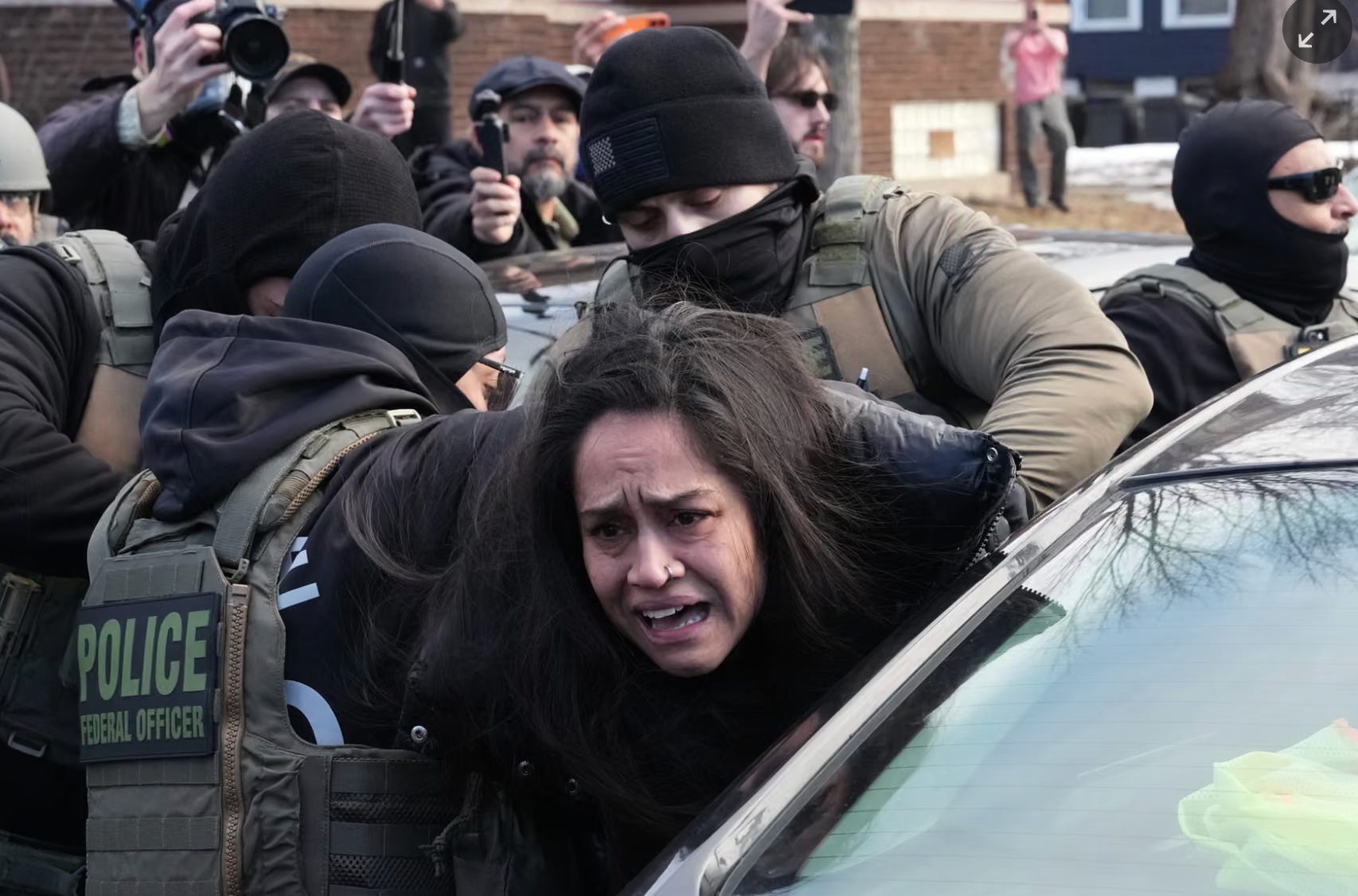
So, are Frisco (pop. 3,100) and Summit County (pop. 31,000) places where one might expect brown-shirted armed government agents to show up at a local favorite eatery for a midday raid? Might we expect them to shut the business down by grabbing up its computers and other vital gear, putting the place out of business for an undetermined time? Is another smaller town nearby, Dillon (pop. under 1000), a place where a raid at a home is worrisome enough for administrators in an elementary school to put students into lockdown?

And are the towns places where we would see an uproar by residents, an outpouring of condemnation? Where even the county sheriff disavows any role in the federal actions? Where the county education superintendent bemoans them?

Sadly, in Donald J. Trump’s America, it’s not God who is keeping an eye on us all these days, it seems. Instead, it’s the FBI and the U.S. Immigration and Customs Enforcement agencies that are doing so, even in little Summit County and even smaller Frisco and Dillon. Those agencies slipped into the area yesterday to pursue a restaurant that has served locals for over two decades, Hacienda Real, after a tipster claimed the place was employing undocumented workers.

Source: Summit Daily

“For several months we have been collaborating with the authorities and delivered all the documentation requested by ICE, fulfilling every requirement,” the restaurant said in a post on its Facebook site. “Unfortunately, this process has led to a broader inspection of the entire restaurant. As part of this investigation, our work team was removed, including the computers we use day to day, so we find ourselves in the need to keep the restaurant temporarily closed while everything is being reviewed.”

The statement added: “Thankfully, we have peace of mind in knowing that for over 22 years we have worked honestly, serving this much-loved community … We’re confident that we’ll soon be able to get back to doing what we do best: working and sharing our food with all of you.”

The raid even took local law enforcement authorities by surprise. As our county newspaper, the Summit Daily News, reported, county Sheriff Jaime FitzSimons said he learned of the operations through a dispatch when the agents arrived. The agents were serving “targeted, federal, criminal” search warrants, FitzSimons told the paper. He added that he knew no details.

Precious little information came from a spokesman for Homeland Security Investigations, an ICE unit involved in the raids. Talking with a reporter at the scene of some of the action, the spokesman said only that the agents were serving a criminal search warrant as part of “authorized law enforcement activity,” adding that the agency would issue a press release with more information at a later time. He declined to answer questions.

But the splashy headline-grabbing raid by the agents, some hiding behind masks, did not surprise some folks. Rumors of impending ICE actions made the front page of the Summit Daily News last week, so when the agents swarmed into Hacienda Real, people showed up with their phones to video the operation. Some blocked the authorities from moving through the parking lot, to no avail.

“Video of the confrontation shared with 9NEWS shows members of the public shouting at agents, telling them to take off their masks and pick up the excess caution tape they had left on the ground,” a Denver TV station reported. “Footage also shows people standing in front of the agents’ cars, blocking their ability to leave, a woman snapping the license plate frame on one of the vehicles, and what appears to be a man spitting in the direction of an agent getting into a vehicle.”

Spitting at law enforcement agents or interfering with them is a sorry reflection on the state of things nowadays. But it’s also not surprising in our very blue Summit County. Democrats swept all federal, state and county races last year, with Kamala Harris besting Trump by 11,762 votes to 5,244. Our sheriff is elected, so it’s not surprising that, as his office reported, he “did not provide any support or assistance” to the federal authorities, nor did those authorities request it.

Local residents who gathered at the restaurant during the ICE action included the county education superintendent, Tony Byrd. “People are going to live in worry, they were living in worry last week, the week before, pretty much forever and now more,” he told a reporter for the Denver CBS News affiliate. Byrd told one of the officials that they were disrupting the community, adding, “We have a lot of crying kids and families right now.”

Raid at the Dillon home; source: Summit Daily

During the raid at the Dillon home — presumably that of restaurant owner Luis Flores — officials at nearby Dillon Valley Elementary School kept children inside and planned “a controlled release” of them at the end of the day. While the reported immigrant population of the county is small – only about 15 percent of the number overall – the Spanish-speaking student population in the schools is much larger, over 41 percent compared with less than 54 percent white non-Hispanic.

This is a county, moreover, where some local churches have pledged to protect immigrants under threat of arrest, even to the point of breaking the law by giving them sanctuary from agents. With an unemployment rate last reported at 2.8 percent, it’s also a place that economically would be devastated without immigrants to work in the restaurants, stores, building industry and various other services.

The initial news reports said no arrests had been made at either the restaurant or the owner’s home. But a Colorado immigrant advocacy group, Voces Unidas, has since reported that a cook and a waiter were arrested, among others, basing its report on information in the ICE system. The group asked people with more details to contact it.

So, this raid leaves us with a lot of questions. First, was the owner of Hacienda Real, Luis Flores, guilty of anything? Did he hire undocumented workers? Did he underpay them, as sometimes happens with under-the-table staff? Did he treat them well or poorly?

We have no answers to those questions now. Indeed, the restaurant has a sterling reputation, repeatedly winning top honors in the Summit Daily News “Best Of Summit” contests. Its burritos and margaritas are top-notch, according to the paper’s readers.

And, among some 50 recent commenters on its website, condemnation of the ICE actions was universal.

“The last time I was at the restaurant they were donating a ton of food for a fundraiser at Silverthorne elementary,” one said. Another said: “You are loved by the community! For the anonymous caller, may karma get them!” And a third said: “The entire team at Hacienda Real is amazing and you are fully supported!!!! I’m so sorry some bigot racist made a false claim against your business and the livelihood of not only your family but the families of all of your employees.” Yet another vowed: “The community will support you and your restaurant!”

But let’s assume that Hacienda Real did hire undocumented Latin American workers. First, the chances are the food will be authentic. Second, and more important, these workers would be supporting their families and contributing to the economy. Are these bad things? If they are arrested – and if Hacienda Real is driven out of business – is this good for our town and county?

And let’s turn to economics for some insight, too. If the restaurant hired under-the-table workers and underpaid or overworked them, just how long would such workers stay at the place? The average wage level in the county tops $56,000 a year and, with the low jobless rate, help-wanted signs are common. Poorly treated workers would have plenty of other options.

The bottom line, of course, is that ICE isn’t welcome in Summit, Frisco or Dillon. By contrast, hardworking migrants are.

But, given these troubled times, we can only hope that other lines from the Paul Simon song are not apt. “Nothing but the dead and dying back in my little town,” he sang. “Nothing but the dead and dying back in my little town.”

If ICE and its masters in the Trump Administration expand their immigrant roundups, as they plan to, and if they continue to do so in facilities that even ICE says violate dozens of federal standards, lyrics like those may only slightly overstate things all across America.

Cleansing the past

Will Charlie Kirk’s death — and life — be remembered in full?

Horst Wessel

Young, good-looking and charismatic enough to impress his party’s elders while rallying lots of other young people to their cause, this passionate true believer was gunned down by people he had long attacked as enemies. As he lay dying, a backer released a statement saying he had been assaulted by “degenerate communist subhumans.”

In death, however, the assassinated man – the son of a Christian minister and a woman whose family included ministers — proved especially useful to his party. His funeral was filmed and turned into a major propaganda event as he was declared a martyr. The party’s top leader called his sacrifice to the “a monument more lasting than stone and bronze.”

The man was Horst Wessel, a Nazi party enthusiast who was killed in Berlin in 1930, as his party was beginning its ascent into infamy. Are we now seeing what happened to Wessel take place with a modern right-wing firebrand, Charlie Kirk?

Wessel was embraced by Nazi propagandist leader Joseph Goebbels and party organs. A wartime article in the Nazi-owned Völkischer Beobachter newspaper called Wessel “the hero of the Brown Revolution” and referred to his “sacrificial death” as one that “passionately inflamed millions who followed.”

Charlie Kirk, source: The Guardian

Today, in Kirk’s honor, flags are being lowered to half-staff around the country by order of President Trump. That’s a distinction usually reserved for deceased presidents and other leaders. Also, the president, without evidence of what drove Kirk’s assassin, was quick to decry the “radical left” for his killing.

So, are we seeing political martyrdom opportunistically bestowed on this polarizing young figure? Are we seeing a nobility bestowed on him in death that many say wasn’t deserved in his life?

Social media, cable TV and other outlets lately have been filled with praise for Kirk, leader of the campus-focused Turning Point USA organization. Vice president JD Vance called him “a true friend. The kind of guy you could say something to and know it would always stay with him.” A tearful CNN commentator, Scott Jennings, called him “one of the most unique and special people in the conservative movement today. What he was able to build, the people he was able to organize, was just so large and powerful.”

In The Wall Street Journal, Peggy Noonan called Kirk “a presence in the life of a whole generation of young conservatives” adding that “he set a kind of template for how to discuss politics—with good cheer and confidence, with sincerity and a marshaling of facts.” Over at The Washington Post, George Will compared Kirk with William F. Buckley, that eloquent lion of the right, saying: “Kirk was killed at the beginning of what was to have been a Buckley-like tour of political evangelism among the unconverted: college students. He also was probably killed because, unlike Buckley when he was 31 in 1956, Kirk was advocating a powerful and ascendant politics.”

Even at The New York Times, Ezra Klein celebrated Kirk. “You can dislike much of what Kirk believed and the following statement is still true: Kirk was practicing politics in exactly the right way,” Klein held. “He was showing up to campuses and talking with anyone who would talk to him. He was one of the era’s most effective practitioners of persuasion.”

When any young person – and Kirk, the father of a 1-year-old son and a 3-year-old girl, was just 31 – is killed, it is monstrous. And when the murdered person is an influential political figure, it is even worse. Such assassinations must be decried anywhere and at any time by everyone on any end of the political spectrum. Such a killing is anathema to the free discourse that is a pillar of American culture or should be.

“There is no place in our country for this kind of violence,” former President Joe Biden said. “It must end now. Jill and I are praying for Charlie Kirk’s family and loved ones.” And his predecessor, Barack Obama, similarly said: “We don’t yet know what motivated the person who shot and killed Charlie Kirk, but this kind of despicable violence has no place in our democracy.”

Also, I concede that it seems churlish to speak ill of the dead person, especially so soon after his passing.

But I also fear that in the lionizing of Kirk, we are seeing a far-too-convenient beatification of sorts that serves Trump and Trumpism too well. Will Kirk’s death be used to further justify outrages that go even beyond anti-immigrant roundups, the placement of troops in cities? Will we now see further rollbacks of reproductive rights and the freedom to marry a person of one’s choosing?

Erin Reed, source: Sociologists 4 Trans Justice

We do ill to ourselves as a society to forget or downplay many of the things that Kirk stood for and built his organization around. As journalist and blogger Erin Reed has written, Kirk in 2023 called transgender people an “abomination” and a “throbbing middle finger to God.” Do such sentiments reflect a compassionate and goodhearted man?

In one interview, Reed wrote, he said the first thing he thinks when he sees a Black pilot is, “Boy, I hope he’s qualified.” In another, Kirk called for the man who assaulted Nancy Pelosi’s husband to be bailed out of jail. He denounced the Civil Rights Act of 1964— and infamously said a few gun deaths were worth his Second Amendment rights in the aftermath of a school shooting. He even derided empathy itself as worthless, a sentiment that Reed wrote has since metastasized into a broader far-right project to strip empathy education from schools.

In another interview, Reed noted, Kirk mocked fellow Christians who followed scripture about loving their neighbor. He scoffed that God also “calls for the stoning of gay people,” which he described as “God’s perfect law.”

As the Anti-Defamation League has written, Kirk promoted conspiracy theories about election fraud and Covid-19. He was an enthusiastic backer of Christian nationalism, “the idea that Christians should dominate government and other areas of life in America,” the ADL reported. His TPUSA organization, the league said, has been a magnet for racists and white supremacists.

“Kirk has created a vast platform for extremists and far-right conspiracy theorists, who speak and attend his annual AmericaFest and other events sponsored by TPUSA,” the ADL reported. “AmericaFest has showcased extreme rhetoric from speakers and attendees and has attracted white supremacists.”

Will his death legitimize even the worst of his views? And was this really the sort of person young Americans should admire and emulate?

Certainly, Trump thinks so: he plans to bestow the Presidential Medal of Freedom posthumously on him. “Charlie was a giant of his generation, a champion of liberty and an inspiration to millions and millions of people,” the president said. “The date of the ceremony will be announced,” he said, adding, “and I can only guarantee you one thing, that we will have a very big crowd.”

Crowds, of course, are important to Trump. And with Kirk’s death offering him a golden chance to draw an audience, this is an opportunity the president will not pass up. We don’t know how and when he’ll commemorate Kirk, but he’s almost certain to make a big show of it.

Melissa Hortman

Recall that Trump has said little about other killings of Democratic leaders. In a Sept. 10 video, USA Today noted, the president did not mention the June shooting of Minnesota House of Representatives speaker emerita Melissa Hortman, though he alluded to his own survived assassination attempts and the shooting of Rep. Steve Scalise, R-Louisiana in 2017. He offered no presidential medal or flag lowering for Hortman.

The president also did not mention other attacks on Democrats, including an arson attack at Pennsylvania Gov. Josh Shapiro’s house, a kidnapping plot against Michigan Gov. Gretchen Whitmer or an assault on former House Speaker Nancy Pelosi’s husband in their home.

Those events apparently don’t serve Trump’s agenda as well as Kirk’s death does.

As former President Obama said, we don’t know what motivated Kirk’s assassin, and it’s possible we never will learn that. Will it prove to be a “leftist” assault, as Trump suggested? In two attempts on Trump’s life, the would-be killers – Thomas Matthew Crooks and Ryan Wesley Routh — seemed to have been driven more by mental illness, anti-government beliefs or antisemitism.

Back in pre-Nazi Germany, Wessel was killed by Communist assassins. His death helped galvanize and further drive the Nazi movement. Kirk’s life certainly helped do the same for Trumpism. Will his death now do even more to advance that cause? And will his life be remembered in its fullest and most honest way, or as something to be sanitized, a martyrdom Trump can market?

The last bulwark

Some courts stand tall against Trump’s depredations

Judge Allison D. Burroughs, source: The Boston Globe

Judge Allison D. Burroughs was unequivocal.

Harvard has been plagued by antisemitism in recent years and should have done more to combat it, she wrote in her 84-page decision in the university suit against the Trump Administration. “Defendants and the President are right to combat antisemitism and to use all lawful means to do so,” she wrote. “Harvard was wrong to tolerate hateful behavior for as long as it did.”

But antisemitism on the campus – which she suggested the university has gone far to defeat since the upheavals of 2023-24 — was not what is really driving Donald J. Trump and his administration in their campaign against the university. It was not the reason for the government to cancel billions in research grants to the university last spring, a full year after pro-Palestinian actions at the school had all but faded away.

“… [T]here is, in reality, little connection between the research affected by the grant terminations and antisemitism,” the judge said. “In fact, a review of the administrative record makes it difficult to conclude anything other than that Defendants used antisemitism as a smokescreen for a targeted, ideologically-motivated assault on this country’s premier universities, and did so in a way that runs afoul of the APA [the federal Administrative Procedure Act], the First Amendment and Title VI [of the Civil Rights Act].”

Judge Burroughs’s blunt ruling came amid a flurry of other recent court setbacks for Trump. A federal appeals court shot down many of his tariffs, another court ruled his use of troops in Los Angeles was illegal, and still another harshly ruled that Trump had no standing to sue federal judges in Maryland over immigration rulings they made.

“Although some tension between the coordinate branches of government is a hallmark of our constitutional system, this concerted effort by the Executive to smear and impugn individual judges who rule against it is both unprecedented and unfortunate,” Judge Thomas Cullen, a Trump appointee, wrote in the Maryland case.

Such losses by Trump suggest that even as his overreaches grow, critics and clear-thinking judges are not sitting still for them. The court actions offer hope amid a seemingly nonstop parade of outrages.

Let’s consider Burroughs’s order closely. Along with being notable for even stronger language than Cullen’s, the clarity and airtight logic of her ruling is exceptional. It is an outstanding example of how the courts remain our last bastion of resistance to a would-be tyrant’s vindictive assaults.

To many critics, it has long been obvious that Trump has used antisemitism as a club with which to batter Harvard and other schools. But the judge’s decision ripped any shred of a veneer off that claim.

“There is no obvious link between the affected projects and antisemitism,” wrote Burroughs, an Obama appointee. “By way of example (although by no means an exhaustive list), Defendants have ordered immunologists overseeing a multi-school tuberculosis consortium to immediately stop research, … a researcher at the Wyss Institute to halt his development of an advanced chip designed to measure NASA astronauts’ radiation exposure during the upcoming Artemis II mission to the moon … and another Wyss Institute scientist, a recipient of the nation’s highest honor for technological achievement, to cease his research into Lou Gehrig’s disease ….”

She continued: “Officials at the Department of Veterans Affairs have begun the process of cutting funding for research into, among other life-saving measures, ‘a predictive model to help V.A. emergency room physicians decide whether suicidal veterans should be hospitalized.’” Yet another project involved a defense program aimed “at increasing awareness of emerging biological threats.”

Going beyond the irrelevance of the defunded research to the antisemitism claim, the judge also laid bare Trump’s true motivations. Using his own language on social media, she left no question that the assault on Harvard was driven by his longstanding and broad attack on “wokeism.”

Source: Politico

Among Trump’s posts: “[p]erhaps Harvard should lose its Tax Exempt Status and be Taxed as a Political Entity if it keeps pushing political, ideological, and terrorist inspired/supporting ‘Sickness?’ Remember, Tax Exempt Status is totally contingent on acting in the PUBLIC INTEREST!” Then there was his slam at Harvard for “hiring almost all woke, Radical Left, idiots,” followed by his denunciation of the university as “a Liberal mess.”

Her order also shone a light on Trump’s vindictiveness, his rage at the university for having the temerity to oppose him, unlike schools such as Columbia and Brown, which rolled over under his attacks. To placate Trump Columbia agreed to pay $221 million, while Brown agreed to pay $50 million to Rhode Island workforce development organizations. Trump has sought $500 million from Harvard.

At one point, Trump said he was considering taking away $3 billion from “a very antisemitic Harvard,” which he would then give to “TRADE SCHOOLS,” the judge noted. Then, during an interview in the Oval Office, Trump said that Harvard is “hurting [itself]” by “fighting,” adding that “Columbia has been, really, and they were very, very bad . . . . But they’re working with us on finding a solution.” He further stated that Harvard “wants to fight. They want to show how smart they are, and they’re getting their ass kicked”; “every time [Harvard] fight[s], they lose another $250 million”; and “[a]ll they’re doing is getting in deeper and deeper and deeper.”

Recall that Trump, far from “smart,” was a middling transfer student at Penn’s Wharton School, where one of Trump’s former professors called him “the dumbest goddamn student I ever had.” Perhaps he still suffers still from an insecure man’s resentment at all those folks who were far brighter than he?

Certainly, there’s little doubt that these were the infuriated reactions of a martinet offended at a school that refused to genuflect to him, as so many other institutions have. Sadly, yet another university president — Northwestern’s Michael Schill — just quit, a few months after Trump’s minions froze $790 million in funding for the school — providing another scalp among many that Trumpists have claimed in recent years.

As for Harvard, Burroughs invalidated the administration’s freeze on billions of dollars in federal research funding for a broad array of projects. But it’s not clear when or whether the school will get any of the money back.

The administration will drag out the matter with appeals as a White House spokeswoman argued that the university “does not have a constitutional right to taxpayer dollars.” As The Wall Street Journal reported, by using agencies across the federal government, Trump has threatened Harvard’s tax-exempt status, tried to block its ability to enroll international students and probed money it receives from foreign sources. Harvard will also owe higher taxes on its $53 billion endowment under the president’s “Big Beautiful Bill.”

Source: Supreme Court Historical Society

Trump’s assault on academia continues, of course. And, in the end, many of his attacks will be adjudicated in the Supreme Court. Good outcomes are far from a sure thing there, given the deference the body has shown to Trump.

But, at least in some quarters, smart people such as Burroughs are seeing the assault for the petty and destructive effort it is. The fight is far from over, but this round has gone to the better side.

Can “going high” work again?

Gutter level politics has a long history, but we seem to hit new lows daily

John Adams, source: Biography.com

For much of early American history, politics at the highest levels was a bloodsport.

Just consider how our founding fathers spoke of one another. To John Adams, Alexander Hamilton was “a bastard brat of a Scotch peddler” and Thomas Jefferson had “a mind, soured… and eaten to a honeycomb with ambition, yet weak, confused, uninformed, and ignorant.” For his part, Jefferson saw Adams as a “hideous hermaphroditical character, which has neither the force and firmness of a man, nor the gentleness and sensibility of a woman.” And, as all fans of the musical know, Hamiton died after Aaron Burr shot him in a duel.

So, is it inconsistent for Gavin Newsom to troll Donald J. Trump by mimicking his tweeting style?

“DONALD IS FINISHED — HE IS NO LONGER ‘HOT,’” the California governor’s press office tweeted. “FIRST THE HANDS (SO TINY) AND NOW ME — GAVIN C. NEWSOM — HAVE TAKEN AWAY HIS ‘STEP.’ MANY ARE SAYING HE CAN’T EVEN DO THE ‘BIG STAIRS’ ON AIR FORCE ONE ANYMORE — USES THE LITTLE BABY STAIRS NOW.”

The governor, a likely 2028 presidential contender, is even hawking merchandise à la Trump. His red caps proclaim “NEWSOM WAS RIGHT ABOUT EVERYTHING!” And he mocks Trump’s bombastic self-promotion in an X post that says “MANY PEOPLE ARE SAYING THIS IS THE GREATEST MERCHANDISE EVER MADE.”

And is it in keeping for Maryland Gov. Wes Moore, another possible presidential candidate, to refer on X to Trump as “President Bone Spurs” who “will do anything to get out of walking” and to offer him a golf cart? As The Wall Street Journal reported, Trump had criticized Moore over “out of control, crime ridden, Baltimore” on Truth Social after Moore had invited the president to walk the streets. “I would much prefer that he clean up this Crime disaster before I go there,” Trump said, and floated the idea of sending the National Guard to the streets of Baltimore, as he has in Los Angeles and Washington, D.C.

Maryland Gov. Wes Moore, source: Johns Hopkins Magazine

The bone spurs reference, of course, was to Trump dodging the draft during the Vietnam War by getting a doctor’s note about foot problems. For his part, Moore served as a captain in the U.S. Army and was deployed to Afghanistan, belatedly getting a Bronze Star.

And then there’s Illinois Gov. J.B. Pritzker’s jibe at the Democratic National Convention last year.

“Donald Trump thinks we should trust him on the economy because he claims to be very rich,” said Pritzker, an heir to the Hyatt Hotels fortune. “Take it from an actual billionaire, Trump is rich in only one thing: stupidity.” More recently, in response to Trump floating the idea of sending troops to Chicago, the governor said: “Donald Trump is attempting to manufacture a crisis, politicize Americans who serve in uniform, and continue abusing his power to distract from the pain he is causing working families.”

Of course, with his combative and bullying style, Trump years ago triggered the insultathon that American politics has become. Slinging the mud, however inartfully, works for him among his underschooled supporters, who often say he “tells it like it is,” unlike the polished politicians of most of the last decades.

It’s not clear when vulgarity and coarseness became synonymous with seeming truthfulness, but neither truth nor simple good manners are things Trump is well-acquainted with, of course. Some of his more juvenile nicknames for people who offend him include Allison Cooper (Anderson Cooper), Maggot Hagerman (Maggie Haberman), Tampon Tim (Tim Walz), Little Marco (Marco Rubio, his own Secretary of State) and, of course, Governor Newscum.

But does it need to be this way? Aside from winning splashy headlines, does it really help a potential president to imitate Trump’s buffoonery? Or would grace and class sell better to those in the electorate who find the schoolyard taunts and WWE-style crudeness tiresome and unworthy of anyone in – or prospectively in – the White House?

Kentucky Gov. Andy Beshear, source: Politico

Consider Andy Beshear, another potential White House occupant. After spring storms clobbered much of Kentucky, Trump belatedly approved emergency aid for the state. Beshear, the state’s popular Democratic governor, was gracious about the president. When asked about a call he got from Trump, Beshear said he and Trump had “good, positive conversation that was only about emergency assistance,” adding that “he was nothing but polite, and positive, and I was nothing but polite and positive.”

Beshear, the son of a former Kentucky governor, was elected to the state’s highest office in 2019 and reelected in 2023. A former attorney general in the state, he is also a deacon in his Christian church, as is his wife. Beshear claims to strive “each day to live out the values of faith and public service,” though right-wing religious figures have attacked what one called Beshear’s “radically progressive political ideology,” mainly blasting the governor’s defense of LGBTQ rights. Beshear riled them with an executive order banning “conversion therapy” on minors.

Beshear in many respects is reminiscent of Bill Clinton, albeit with far better morals. Clinton governed a red state, Arkansas, espoused moderate positions that many in our center-right country could tolerate. Clinton also for the most part avoided gutter-level insults, preferring a gentle jab to a schoolyard slur. Clinton last year poked fun at Trump’s penchant for talking mostly about himself. “So the next time you hear him, don’t count the lies, count the I’s,” he said.

Compared to the way Trump and some Democratic presidential aspirants are talking, that’s mild stuff, little more than blunt observation of the facts. It’s akin to Pennsylvania Gov. Josh Shapiro, another possible presidential contender, calling Trump a “pathological liar” after a debate with President Biden that was, in fact, marked by falsehoods from Trump. Similarly, it was fair game for Shapiro to say that Trump was “obsessed with continuing to spew hate and division in our politics” after Trump called him “the highly overrated Jewish Governor,” a phrase calculated to whip up Trump’s antisemitic followers.

Of course, Trump’s baiting approach drives responses that, even when they are factually on target, seem like descents to his level.

As for Clinton’s stab at Trump’s egocentricity, the president has done little in office but prove how self-aggrandizing he is. A huge image of him now draping the Labor Department not only reflects his megalomania, but evokes the propagandistic self-adulation of the world’s worst despots, men who ruled countries such as North Korean, Romania, Iraq and, of course, Germany.

Self-adulation at the Labor Dept., source: Meidastouch Network

Can someone such as Beshear bring the Democratic Party and the nation back to some sense of civility? Some sense of personal modesty and integrity? Has that boat sailed forever, throwing us back to the days when national leaders vied for who could be more vicious?

“When they go low, we go high,” is how Michelle Obama put it in an address at the 2016 Democratic National Convention. Sadly, she took a sharper tack at last year’s convention, accusing Trump of “going small.” The former first lady said: “Going small is petty, it’s unhealthy, and, quite frankly, it’s unpresidential… It’s his same old con: doubling down on ugly, misogynistic, racist lies as a substitute for real ideas and solutions that will actually make people’s lives better.”

Still, it’s entirely proper to attack misogyny, racism and con artistry, along with the savagery Trump and his minions have brought to bear against immigrants. His conduct and that of his Justice Department and ICE against Kilmar Abrego Garcia, for instance, is despicable. So, too, must we condemn his dictatorial aspirations, as shown by his troop deployments in American cities, along with the sheer vindictiveness of his actions against critics. Consider the FBI raid on the home of John Bolton, a former Trump ally who has his old boss’s number all too well and often lays that out in TV appearances, infuriating the president.

“The real offender here is a President who seems to think he can use the powers of his office to run vendettas,” the often Trump-friendly editorialists at The Wall Street Journal said. “We said this was one of the risks of a second Trump term, and it’s turning out to be worse than we imagined.”

Lambasting loathsome policies in virile and sharp terms is different from calling someone “Crooked Joe” or “Sleepy Joe.” Or, as Trump labeled Bolton, calling someone “a lowlife” and a “sleazebag” — terms he applied to the Yale lawyer who served under Presidents Reagan and George H.W. Bush before becoming a once-trusted adviser in the first Trump White House. We need bold and sharp criticisms of what Trump does, as well as smart insights into his character or lack of it.

But how much longer will all this ugliness last? Will it end in 2029? Or has Trump so polluted the atmosphere that it will take a generation to clear the foul air? Can a Beshear or someone like him win against Trumpist toadies such as JD Vance by going high? In time, we’ll find out.

Entering the reality-distortion zone

Trump’s truth-scrapping efforts reach deep

Big Brother, source: Michael Radford’s film,’1984;’ source: El País

George Orwell’s Ministry of Truth in “1984” had a peculiar mission. Its job was not to spread truth at all, but rather to insure that history and current information aligned with the views and goals of the infallible Big Brother and his ruling party. When reality differed, the descriptions and accounts had to be bent accordingly.

Echoes of that approach abound today, it seems.

Take, for instance, what Washington, D.C. looks like. The district that Donald J. Trump sees is a dystopian spectacle of “crime, bloodshed, bedlam and squalor and worse.” The capital, he tells us, has been “taken over by violent gangs and bloodthirsty criminals” along with “drugged out maniacs and homeless people.”

Presumably, the president is not referring to the Jan. 6, 2021, mob he incited at the Capitol or to the current mostly supine GOP members of Congress and the Senate. Certainly, he’s not referring to the district crime rates as reported by its police.

If one looks at the D.C. police reports, violent crime in the capital is dropping. Homicides fell 32 percent in the district between 2023 and 2024, to 187 last year, the lowest tally since 2019. And the murder rate is down again about 11 percent this year, with 100 recorded so far. Indeed, per capita, D.C. doesn’t even crack the list of the 30 most dangerous cities in the U.S.

To Trump, as with Big Brother and other would-be tyrants, however, reality is not what data tells us. It is, instead, what Trump conjures up in his own mind. Indeed, independently developed data is, to him, an inconvenience that should be suppressed. And incendiary language must reflect the reality of his fevered imagination.

Immigrant detention; source: ACLU

Independent information gets in the way of Trump’s efforts to dispatch federal troops to whatever scene he deems appropriate, for instance. Thus, immigration is an “invasion” a term that justifies the development of detention camps and roundups on the streets by masked authorities. Thus, military forces can be stationed on Los Angeles streets to suppress a “rebellion,” even if a major general involved doesn’t seem to see that.

And independently generated data gets in the way of Trump’s vision of an economy now on the way to a “golden age.” When a Bureau of Labor Statistics report suggested that hiring slowed in July and was weaker than expected in the prior two months, Trump took umbrage at the figures and so fired the bureau director. He moved to install a Heritage Foundation lackey who has suggested deep-sixing monthly jobs reports and presumably will generate shinier numbers.

Jan Hatzius, Goldman Sachs

When people outside of government, moreover, don’t sing his tune, Trump argues for finding new crooners. Thus, he now is pressuring Goldman Sachs to can Jan Hatzius, the firm’s longtime chief economist whose views on the economy-draining effects of tariffs mirror those of many other economists. Trump took to Truth Social to say that firm chief executive David Solomon should “go out and get himself a new Economist.”

Reality bending by Trump and his minions entered a new realm with the president’s deployment of 800 National Guards in D.C. and his seizure of the police department there, as well as his attack on the nation’s preeminent Wall Street firm. These big stretches by Trump could amount in the end to little more than headline-grabbing stunts designed to distract us from the ways his staffers are burying Epstein scandal information.

But Trump’s deflection and misinformation efforts aren’t all that new. Consider the administration’s moves to rewrite American history in national parks and historic sites with a March executive order mandating that such sites not “perpetuate a false reconstruction of American history,” but instead emphasize the “progress of the American people” and the “grandeur of the American landscape.”

No matter whether it’s true or not, unflattering information is not welcome in the America Trump is making great again.

And this reality-twisting, whether economic or cultural, seems likely only to deepen. The White House now plans to review exhibits by the Smithsonian Institution to “ensure alignment with the President’s directive to celebrate American exceptionalism, remove divisive or partisan narratives, and restore confidence in our shared cultural institutions,” as one lickspittle wrote. The effort will “support a broader vision of excellence that highlights historically accurate, uplifting, and inclusive portrayals of America’s heritage.”

Propaganda, in other words.

National Museum of African American History; source: Washington, D.C.

One can only wonder how this will play out in a couple Smithsonian facilities that have been more thorough in efforts to fully describe our history, the National Museum of African American History and Culture and the National Museum of the American Indian. Administrators may be hard-pressed to find a lot uplifting about the nation’s earliest years regarding Blacks and Native Americans, though they will surely be pushed to do so.

Of course, reality distortion is a familiar tack for many Trump toadies. His press secretary, Karoline Leavitt, claims that Trump’s White House is the “most transparent in history.” So why, one wonders, is that White House removing transcripts of Trump’s comments from an official database – which would allow historians and others to easily check his tortured words against reality — and instead is posting limited numbers of videos?

Writing as Orwell, BBC producer Eric Arthur Blair published “1984” in 1949. Blair was appalled by the totalitarian regimes in Nazi Germany and the Soviet Union. But his fictional “Oceania,” the superstate that was home of the Ministry of Truth, included the Americas and the British isles.

Some 76 years on, at least one political leader seems to be doing his best to make Orwell’s vision a reality — of sorts.