Trump and the press

We’re getting a master class in would-be autocracy
Joseph Weber

Source: The Week

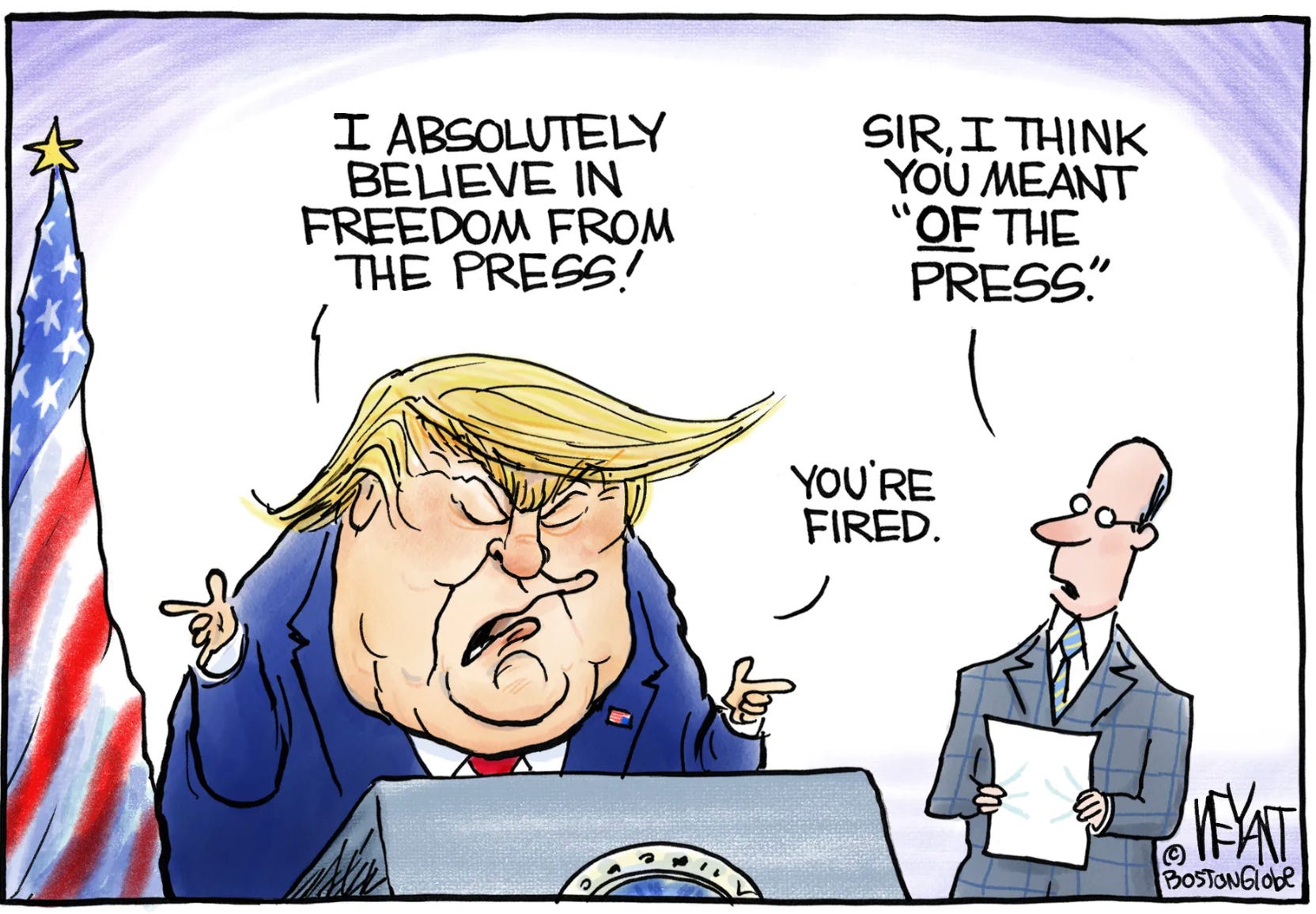
Nearly a decade ago, during his first presidential term, Donald J. Trump infamously tweeted that major media outlets were “the enemy of the American people.” That drew an intriguing response from a fellow Republican, Sen. John McCain.

“I hate the press,” the Arizona war hero sarcastically told NBC News’ Chuck Todd on “Meet the Press.” “I hate you especially. But the fact is we need you. We need a free press. We must have it. It’s vital.”

And McCain – whom Trump had derided as “a loser” — made the risks of losing an unfettered press all too clear.

“If you want to preserve – I’m very serious now – if you want to preserve democracy as we know it, you have to have a free and many times adversarial press,” McCain said. “And without it, I am afraid that we would lose so much of our individual liberties over time. That’s how dictators get started.”

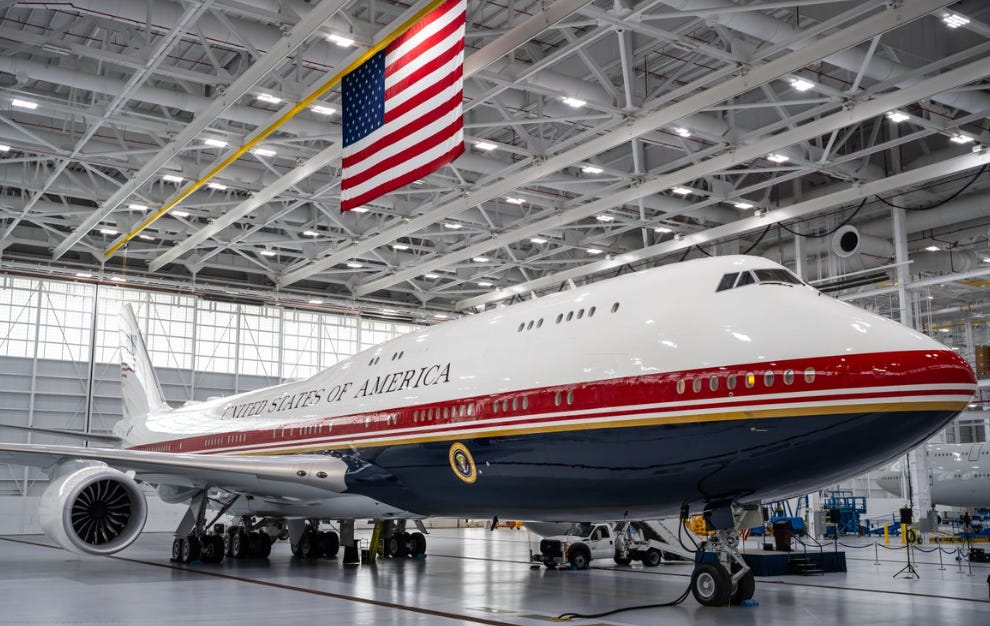
So, now – after he has coopted Congress, the Senate and much of the Judiciary, and weaponized parts of the military against Americans – Trump and his minions are going after the press anew. The administration subpoenaed five New York Times reporters after they reported that the new Air Force One, a Qatari-donated Boeing 747-8, lacked advanced security features, including antimissile capabilities. The journalists cited sources who spoke on the condition of anonymity, a common technique when sensitive matters are involved.

Chillingly, federal agents showed up at the homes of some of the reporters to serve the documents on them. “The appearance of federal law enforcement agents on the doorstep of news reporters should shock the conscience of any American who believes in the Constitution and the press freedom it protects,” David McCraw, a lawyer for the Times, said in a statement.

The administration will likely try to force the reporters to name their sources, who presumably would be prosecuted for divulging information this leak-wary White House seeks to suppress. The DOJ insisted that the reporters are not the targets, but rather those leaking classified information are.
Source: U.S. Air Force

What seems more likely is that l’affaire Air Force One is simply embarrassing to Trump, one of a string of incidents that have been leaving the president red-faced. After all, how could his much-adored “flying palace” be ill-equipped? The reports coincide with his repeated failures to resolve the ill-conceived Iran War, the Reflecting Pool “Algaegate,” and his bizarre misstatements during a NATO meeting (for the record, there’s no “Islamic Republic of Japan.”)

The New York Times is expected in the first instance to fight the subpoenas in court. Taking such a stance paid off earlier this year when the Justice Department sought to compel testimony from journalists at The Wall Street Journal and The Washington Post. The feds withdrew the subpoenas after both news organizations fought back in sealed filings.

As the Times reported, the Justice Department had sought information from three reporters at The Journal about an article detailing how top officials warned Trump of the risks of a military campaign against Iran. It also sought information from a reporter at The Post about reporting related to U.S. military action in Venezuela.

Whether Justice is on firmer legal ground in the Air Force One case could prove to be a crucial matter for journalists. The stakes are every bit as high as McCain suggested they could be so many years ago, as several journalism organizations have contended:

“The National Press Club calls on the Justice Department to immediately withdraw these subpoenas and reaffirm a principle that has long distinguished the United States: a free and independent press serves the people, not the government,” National Press Club President Mark Schoeff Jr. said in a statement.

White House Correspondents’ Association President Weijia Jiang said the organization stands with the Times reporters, saying they were “targeted for doing their jobs to uphold the public’s right to know how its government operates.”

“The WHCA condemns any act of intimidation against journalists, including attempts to pressure them into revealing sources,” Jiang added.

Stephen J. Adler, source: The Baron

And Stephen J. Adler, chair of the Reporters Committee for Freedom of the Press, said, “When the public’s right to know is crushed, as the Trump Administration is trying to do with its subpoenas against The New York Times, all of us suffer irreparable harm, as does the freedom upon which this nation is built.”

Of course, if the journalists do get hauled up to testify before a grand jury, they likely would refuse to disclose their sources. That could set up a painful and costly time for those reporters, as several cases over the last quarter-century have shown.

In 2001, a Houston-based author writing a book about a local murder spent 168 days in jail because she would not identify sources or give her notes to law enforcement. Four years later, New York Times reporter Judith Miller was sentenced to jail because she refused to reveal who told her that Valerie Plame was an undercover CIA agent and Miller served 85 days, testifying ultimately because her source gave his permission. Then, in 2008, a subpoenaed USA Today reporter in an anthrax-by-mail case was held in contempt of court and ordered to pay $500 per day for the first seven days in which she refused to comply, $1,000 per day for the next seven days, and $5,000 a day for the next seven days after that – all from her own pocket, not her employer’s. That contempt charge was later thrown out.

The orders for the Times journalists to testify could put the DOJ official who issued them into interesting political crosshairs. Jay Clayton, the U.S. attorney in the Southern District of New York who issued the subpoenas, was recently nominated by Trump to serve as director of national intelligence, succeeding Tulsi Gabbard. Clayton, who had chaired the federal Securities & Exchange Commission in Trump’s first term, appears to be one of Trump’s most devoted toadies.

For instance, Clayton did not object when the Trump Administration fired Maurene Comey as a prosecutor in the Southern District office in 2025 in a vindictive political move. Comey’s main problem: she is a daughter of James B. Comey, the former FBI director who is one of Trump’s most prominent adversaries. She also handled cases against Trump’s longtime friend, child molester Jeffrey Epstein.

Clayton is to testify on July 15 before the Senate Intelligence Committee and journalism advocates are calling on committee members to press him on the administration’s latest assault on journalists.

“Donald Trump’s war on the press is looking for another victim, this time the storied federal prosecutors office in Manhattan,” Bruce D. Brown, president of the Reporters Committee for Freedom of the Press, said in a statement. “The subpoenas it issued to journalists at The New York Times break from longstanding Justice Department practice to protect the public interest and press independence by requiring prosecutors to only seek information from reporters as a last resort when all other avenues have been exhausted. When Jay Clayton appears before the Senate Intelligence Committee on Wednesday, members of both parties must not let him escape accountability.”

Thankfully for journalists and the public, Trump and his minions have been set back on some of their anti-press efforts.

Hannah Natanson, source: Mint

In January, FBI agents descended on the home of a Washington Post reporter, Hannah Natanson, as part of an investigation into a government contractor’s handling of classified material. The agents seized phones, laptops and a smartwatch after executing a search warrant.

But, in the following month, a federal judge ruled that he – not Justice – would review her materials.

“Given the documented reporting on government leak investigations and the government’s well-chronicled efforts to stop them, allowing the government’s filter team to search a reporter’s work product — most of which consists of unrelated information from confidential sources — is the equivalent of leaving the government’s fox in charge of the Washington Post’s henhouse,” Magistrate Judge William B. Porter wrote in his opinion.

Not surprisingly in this appeals-happy administration, the judge’s order is under appeal.

Of course, Trump and his lapdogs have also scored some victories in high-profile assaults on the press. They’ve sued TV networks that have produced critical coverage of Trump’s actions, including ABC, they’ve made them the target of regulatory pressure from the once-independent Federal Communications Commission; and they’ve cut press access or significantly curtailed it at both the White House and Pentagon.

Under CBS News Editor in Chief Bari Weiss, “60 Minutes” bowed to Trumpian pressure in killing a story involving deportation. The network also heavily edited an interview with Trump on the program, including omitting comments about whether the 2020 election was rigged. Weiss was hired by David Ellison and his father, Larry, the Trump-backing billionaires who own CBS parent Paramount. Trump praised her as “a great new leader.”

Trump’s administration has even used labor law to pressure The New York Times via an Equal Employment Opportunity Commission lawsuit that was decried by the newspaper as “politically motivated.”

As Trump continues to try to cow the press, the work of the Times, the Journal, the Post and other outlets has grown more important than ever. And, given the largely supine Congress, courts have emerged as the last bastions in helping them fight on behalf of the public.

Ultimately, however, the largely Trump-friendly Supreme Court will likely have to weigh in on some of the press cases. And, so far, the prospects look poor for the press.

For instance, the Supreme Court recently declined to intervene to halt an $800-a-day fine imposed on former Fox News reporter Catherine Herridge involving her coverage in 2017 of a Chinese American scientist who was investigated by the FBI but never charged. The issue: Herridge has refused to disclose a confidential source.

If Sen. McCain were around today, he would likely be appalled at how the system lately is ill-serving the press and, by extension, the public. Of course, he was onto Trump long before many others. He once excoriated the president for “naivete, egotism, false equivalence, and sympathy for autocrats.”

Lately, the last charge seems the most resonant.
Are the king’s knickers showing?

Trump’s embarrassments may show his limits

Source: StockCake

In chess, the king is one of the weakest pieces in the game. He can move only one step in each direction, unlike even his pawns at times. And he depends on others for protection even as he lords his crown over them.

Might that become a metaphor for Donald J. Trump, soon to be inaugurated as the nation’s first felon-in-chief? Might his overheated all-powerful image as the man who won all branches of government just a couple months ago now be facing a chillier reality?

In October, editorialists at The Wall Street Journal attacked the “fascist meme” that Democrats were invoking to try to defeat Trump. This was the idea that the then-candidate would subvert democracy much as tyrants around the world have. “We have confidence that American institutions—the Supreme Court, the military, Congress—would resist any attempt to subvert the Constitution,” the editorialists argued.

A month later, in a WSJ piece headlined “Trump Tests the Constitution’s Limits,” opinion writer William Galston of Brookings lambasted Trump for trying to avoid the Senate, short-circuiting the advise-and-consent process in a rush to get his dubious Cabinet nominees approved. “Mr. Trump appears poised to sidestep the Constitution, and we’ll soon find out whether the other branches of government are prepared to go along with him,” Galston wrote.

Nowadays, the once seemingly invincible Trump is getting some answers from some of those branches that he doesn’t much like.

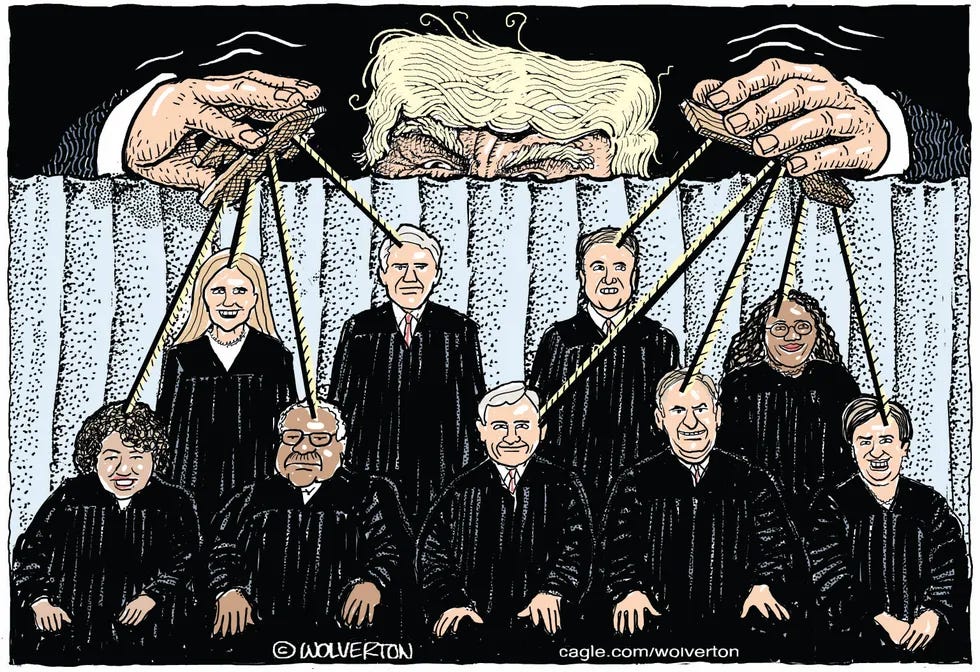
Most notable, of course, is the 5-4 Supreme Court decision forcing him to face sentencing in his seamy hush-money coverup conviction by a jury in New York state court. This involved the 34 felony counts based on a $130,000 payment he made to a porn star to stay mum about their dalliance. The would-be-puppetmaster here got his comeuppance, it seems:

Source: Columbus Dispatch

Instead of toeing the line for Trump, the majority, including Trump appointee Amy Coney Barrett, upheld the rule of law. The group outvoted Trump toadies Brett M. Kavanaugh and Neil M. Gorsuch, along with right-wing ideologues Samuel A. Alito Jr. and Clarence Thomas. While Trump will appeal that 34-count conviction, a jury has already further underlined his lack of personal morality and his disrespect for the law, and for now most of the court sided with those jurors.

The justices’s decision follows a string of rulings they’ve made against Trump, both during and after his first term. In his first administration, The New York Times reported, he or his agencies prevailed only 42 percent of the time in cases before the court, the lowest rate since at least Franklin D. Roosevelt’s administration.

While he was out of office, the court repeatedly rebuffed him. As NBC News reported, when Trump tried to prevent prosecutors from obtaining his financial records, the court rejected his request. Likewise, when Trump tried to stop a congressional committee from accessing White House documents from his administration, the court set him back.

It did so, too, when he asked for a special master to review classified documents seized from his Mar-a-Lago residence. And when Trump sought to stop his tax returns being disclosed to House Democrats, the court refused to intervene.

The self-styled dealmaker-in-chief may have thought he had bought the court with his three appointees, but his purchase clearly wasn’t complete. “I’m not happy with the Supreme Court,” he said on Jan. 6, 2021, during his speech near the White House. “They love to rule against me.” He suggested his appointees were ingrates. “I picked three people,” he said. “I fought like hell for them.”

Source: The Week

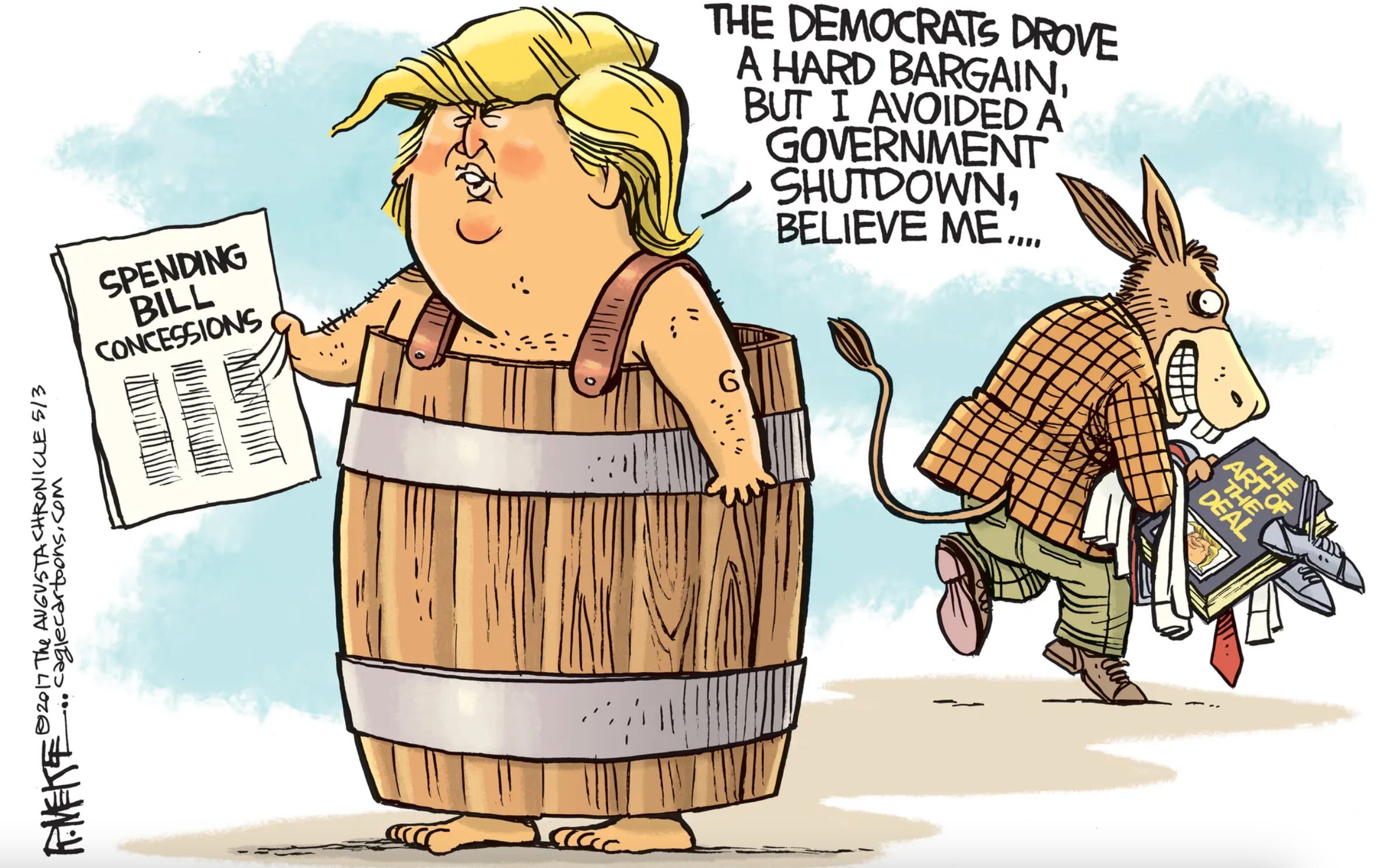
And then there was that recalcitrant Congress. Thirty-eight Republicans last month refused to give Trump his way with a debt-limit increase, forcing the leadership to strip that demand out of a bill that avoided a pre-Christmas government shutdown. It was quite the humiliation for the president-elect, who now faces the need to twist arms anew in a new Congress.

As for his efforts to get his Cabinet members through without the normal hearings – hearings that would further shine a light on their lack of qualifications – Trump appears to have lost that battle too. Those sessions are slated to begin next week with the especially inappropriate Defense Department secretary nominee Pete Hegseth teeing them off. Trump was kicked in the teeth with the loss of the disgraced Matt Gaetz, his absurd and morally vile choice for Attorney General, but it would be surprising if Trump doesn’t prevail on his other picks.

But will he ram his agenda through, nonetheless? Most likely, he will get his tax cuts, border security measures, money to deport immigrants, tariffs and efforts to boost oil and gas energy production. But, will he get backing for his designs on Greenland and the Panama Canal, his suggestions for using the military to carry those out? Will he garner support for using “economic force” in his ludicrous talk of absorbing Canada?

Of course, he is doing his best, with a series of private meetings at Mar-A-Lago, to bring legislators in line. Certainly, the obsequious House Speaker Mike Johnson – whose job Trump managed to save – has said he sees his job as the quarterback who carries out the plays his president calls.

During President Jimmy Carter’s touching funeral, there were many suggestions for our leaders to work for peace and harmony, to bring unity to our polarized country. The example of former foes Carter and President Ford becoming dear friends was compelling. Of course, the reminders by President Biden of the importance of character in a president resounded throughout the National Cathedral, perhaps even ringing in Trump’s ears a bit.

Still, it’s doubtful that such admonitions will have any effect on our most narcissistic once-and-future president. He’s been impervious to embarrassment in the past and seems to prefer conflict to conflict-resolution. The thrive-married philanderer, sexual abuser and business cheat long flaunted his immorality and, at 78, he’s hardly likely to change.

But maybe there is reason for hope that the many other chess pieces in this important game will show their value.

Maybe there is reason to hope that the checks and balances the WSJ thinks so fondly of will work, that some guardrails will keep the incoming president from having the full hand he’d like. With the Supreme Court showing the way, we may see a bit more independence, a bit less fealty than the once and future president would like. The spectacle could be redeeming and surely will be worth watching.

Is justice blind?

The Supreme Court may soon tell us in a Trump case

In 1857, the Supreme Court made one of the worst decisions in its history, the infamous Dred Scott case. It held that African Americans, whether free men or slaves, could not be considered American citizens. This ruling held until it was undone by the 13th (1865) and 14th (1868) amendments to the Constitution, guaranteeing citizenship to those born in the U.S. irrespective of race.

Then there was the “separate but equal” Plessy v. Ferguson decision of 1896, which upheld segregation. It took until 1954 to undo that one.

Soon, we may see whether the current Court makes another bad decision, one that reflects its conservative political bias or one that upholds both a jury decision and an appeals court one. Donald J. Trump wants his sentencing on 34 felony counts, slated for this Friday, quashed. If Trump wins a postponement, he might avoid being formally deemed a felon, The Wall Street Journal reported.

Even though he was convicted by a jury, in New York state courts a defendant becomes a felon when he is sentenced and a judgment is entered, the paper reported. “It puts the conviction officially on the books,” said Cheryl Bader, a Fordham School of Law professor.

As The New York Times reported, his lawyers filed an emergency application late Tuesday. That came after a New York appeals court rejected the same request on Tuesday. Based on last year’s Supreme Court presidential immunity holding, Trump argues that he is entitled to protection from sentencing now that he is the president-elect.

“The stakes of this skirmish … are enormous,” former U.S. Attorney Harry Litman writes in a Substack. “Through a wildly improbably series of legal and political twists that historians will analyze for decades, Trump now stands at the threshold of erasing a long series of crimes from the record books.”

Just a year ago, Trump was facing the prospect of four criminal trials that could have put him behind bars for years, and hundreds of millions of dollars in penalties from civil cases that had been brought against him, as NBC reported. Now the criminal cases are in jeopardy — the two federal prosecutions have already been dismissed, while a state case is stalled — and he could get appeals courts to shrink his hundreds of millions of dollars in civil judgments.

The dismal record shows how Trump is a master at gaming the legal system.

Trump and now-deceased Roy Cohn, source: BBC

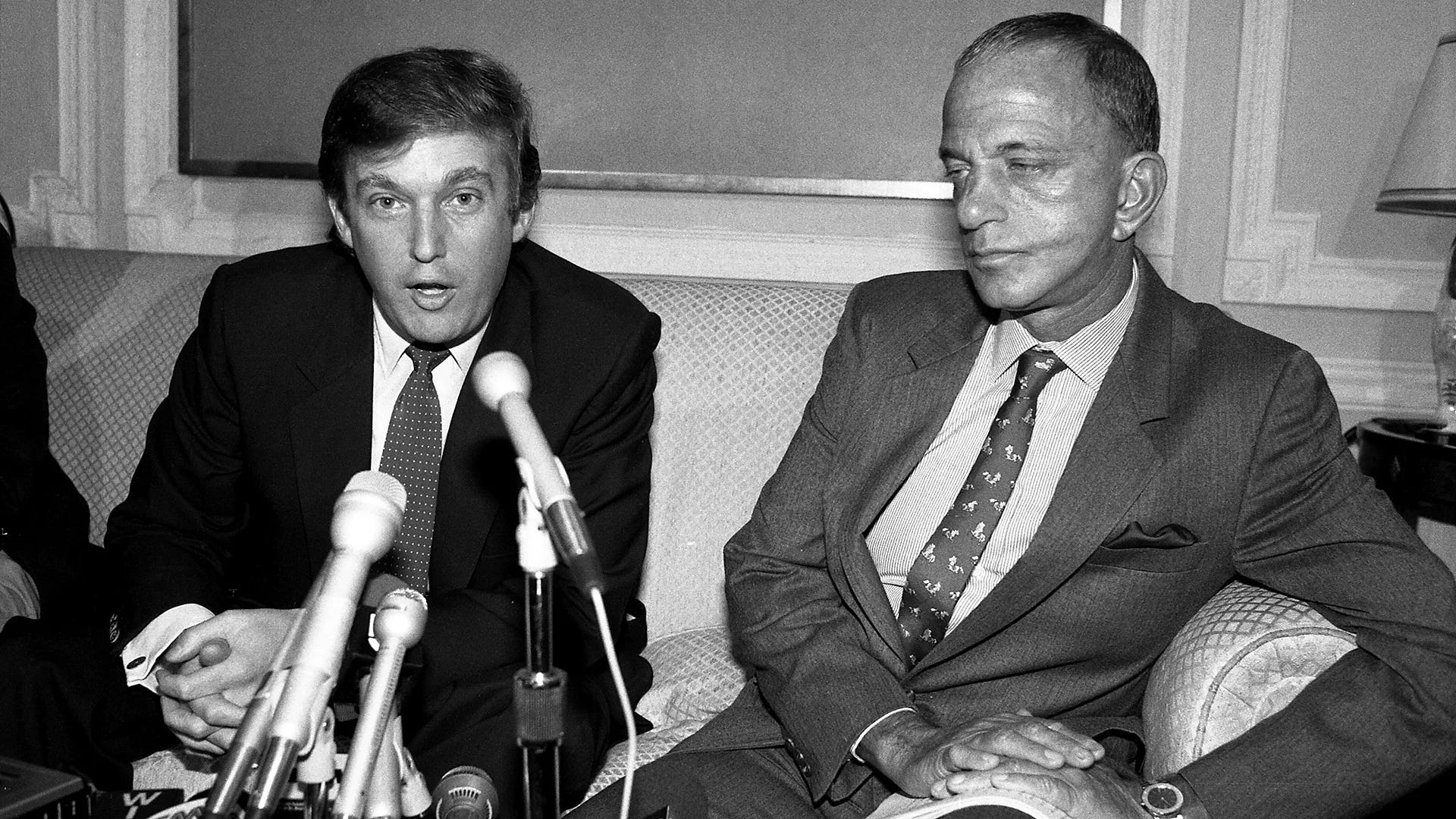
As far back as 1973, Trump and his father engineered a deal that spared them of serious consequences from a Justice Department lawsuit that alleged they violated the Fair Housing Act by steering Blacks away from apartments they owned. As Time reported, their later-disbarred lawyer Roy Cohn sued Justice for $100 million, claiming defamation. Two years later, the Trumps agreed to a consent decree that included giving a weekly list of vacancies to the New York Urban League. Trump later boasted that he ended up “making a minor settlement without admitting guilt.”

He learned in that fight that delaying, distorting, appealing and countersuing can be winning strategies. Later in his career, Trump ran casino businesses into the ground, leading to six bankruptcies in which he managed to keep millions even as he cheated creditors and his own employees who had bought his company stock.

“I didn’t realize he was as stupid as he is,” one former Trump Plaza worker told Mother Jones. “Honestly. I thought, way back when, the guy was way brighter than we were. He was running the company, and we were working for him. We thought he was brilliant. When we invested in it, we thought, how could this stock go so low?”

Of course, stupidity is a troubling description for Trump. He is brilliant as a huckster and political manipulator, despite intellectual limitations that were evident even when he was in college. “Donald Trump was the dumbest goddamn student I ever had!,” one former professor of his at Wharton repeatedly said, according to a close friend quoted by Philadelphia magazine. The friend recalled that the prof “would say that [Trump] came to Wharton thinking he already knew everything, that he was arrogant, and he wasn’t there to learn.”

Trump’s arrogance and disrespect for the law has continued with his repeated pattern of attacking judges he disagrees with or is threatened by. He labeled Judge Juan Merchand, who presided over his conviction in New York in the felony case, a “certified Trump hater,” going so far as to lambast the judge’s adult daughter for working at a digital consulting company whose clients included the 2020 Biden-Harris campaign.

Justice Roberts, source: The New York Times via AP and NPR

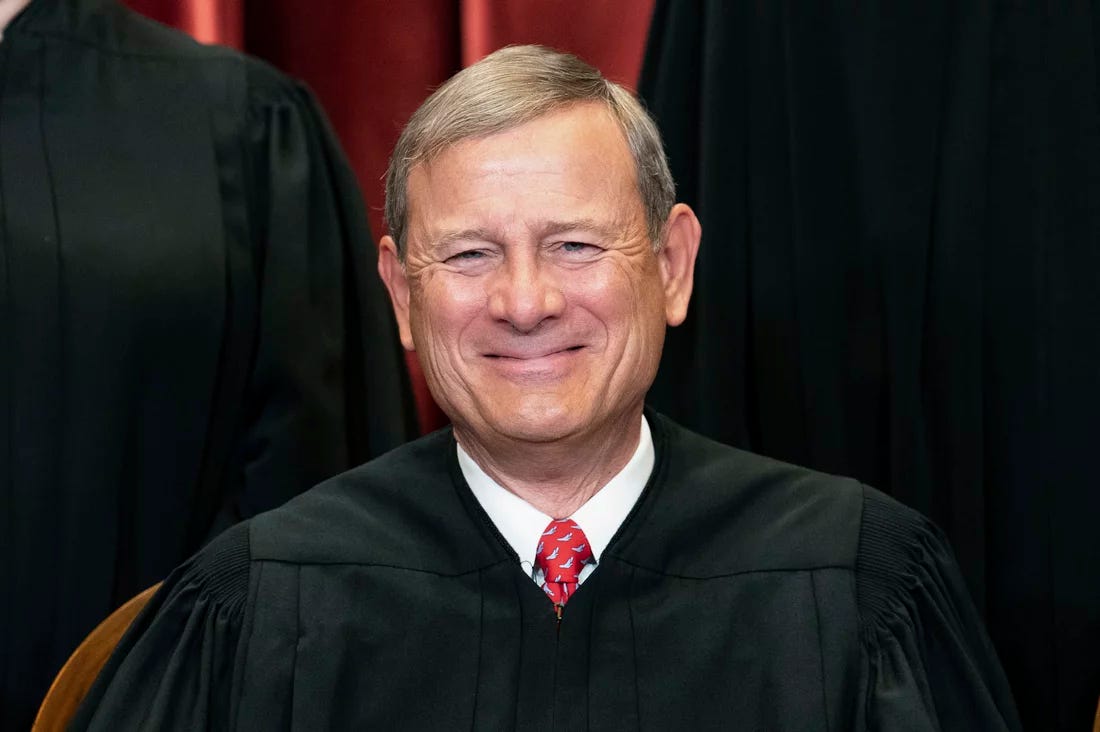
Years before, when Trump criticized a U.S. Appeals Court judge in 2018, he so angered Supreme Court Chief Justice John Roberts that Roberts told the AP that the U.S. doesn’t have “Obama judges or Trump judges, Bush judges or Clinton judges. What we have is an extraordinary group of dedicated judges doing their level best to do equal right to those appearing before them.” Roberts added that “The independent judiciary is something we should all be thankful for.”

Trump responded in a tweet saying that the system did indeed have “Obama judges.”

Whether that’s true or not, it’s clear that the system has Trump judges. One, Aileen M. Cannon in Florida, last July gutted a classified-document case against Trump by ruling that Special Counsel Jack Smith had been unconstitutionally appointed to his job. “The very definition of an activist judge, she has single-handedly upended three decades of established law historically used fairly and in a bipartisan manner,” Joëlle Anne Moreno, a law professor at Florida International University told The New York Times.

The same judge just blocked Smith from releasing a report on the case. Just how much of Smith’s long investigation will ever come to light now is unclear, since the incoming Trump Justice Department will get to decide whether to pursue actions for disclosure. History may or may not someday get to see all that Smith found in the case.

The question now is whether the six conservative justices on the Supreme Court, including Neil Gorsuch, Brett Kavanaugh and Amy Coney Barrett, will side with Trump on the matter of sentencing in the felonies case. The court has ruled against the former president on several cases involving him since he left office, mainly involving efforts by various official bodies to get Trump records.

The justices had “remarkably little interest in intervening in any of the cases about former President Trump’s personal behavior,” Steve Vladeck, a professor at the University of Texas at Austin School of Law, told NBC News.

Indeed, Trump’s conduct in the felony-conviction case was all too personal. He was convicted of falsifying business records while trying to cover up a $130,000 hush money payment to porn actress Stormy Daniels just before the 2016 presidential election.

With their upcoming decision, the Supreme Court justices will say as much about themselves as they do about Trump. They will also say as much about themselves as prior justices did in such cases as the Dred Scott and Plessy cases. Will these justices go down in history as Trump toadies or as judges who uphold the law over politics? Was Judge Roberts right about the judiciary being independent? We’ll soon find out.

Just what do we want in a President?

A look at what drives Trumpism and its potential for the fall election

Bret Stephens, source: New York Times

It’s funny how important things often come in threes. At the base of today’s triptych is Donald J. Trump, the likely victor in tomorrow’s sweep of primaries. All the matters that popped up today deal with the mystery of the man’s appeal and his potential second term. They are worth probing.

First, New York Times columnist Bret Stephens offered some interesting insights on what drives Trumpism – a source of wonder for anyone with half a brain, a sense of history and respect for responsible and responsive government. How can this boorish, immoral, often-unhinged would-be autocrat seem so inspiring to so many people?

Stephens, in a conversation with a colleague, offers the following:

             “He’s a raised middle finger at all the people whom his supporters see as a self-satisfied, self-dealing cultural elite. The more that elite despises him, the more they love him. That’s why any good analysis of the Trump phenomenon has to begin with an analysis of the Us phenomenon, if you will: Where did those of us who were supposed to represent the sensible center of the country go so wrong that people were willing to turn to a charlatan like Trump in the first place? I have endless theories, but here’s another one: We tried to change the way people are instead of meeting them where they are. Neocons (like me) tried to bend distant cultures in places like Afghanistan to accept certain Western values. Didn’t work. Progressives tried to push Americans to accept new values on issues like identity, equity, pronouns and so on. That isn’t working, either. Trump represents a complete rejection of all that. For every American he scandalizes, another one feels seen, heard, reflected and understood by him.”

Source: USA Toda

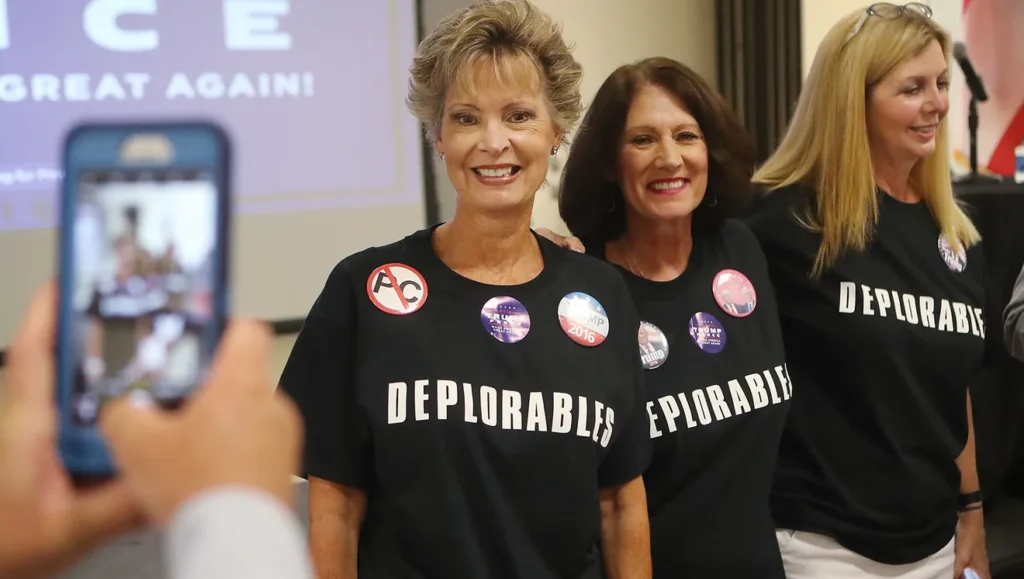
There’s a lot there. To unpack it, consider the “basket of deplorables” phrase that Hillary Clinton deployed to disastrous effect in September 2016. Speaking of half the Trump supporters, she said: “They’re racist, sexist, homophobic, xenophobic, Islamophobic.” The deplorables phrase was quickly snapped up proudly by such supporters, who took to wearing T-shirts emblazoned with it. Clinton even mentioned it in a book as contributing to her loss.

As Stephens suggests, the more the elites loathe Trump (and his supporters), the more his backers love him. The more they are pilloried by those of us who have benefitted from such forces as globalism, economic change and the need for education, the more Trumpists dig in behind the lead critic of such forces. The more they are accused of racism, sexism, xenophobia, etc., the more they will bask in such traits, wearing such qualities all the more brazenly.

Source: KRCR

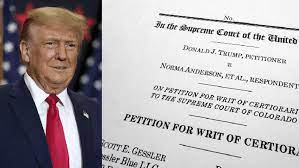
The second development has to do with the national Supreme Court and its ruling that Trump can remain on the ballot in Colorado, despite the state Supreme Court’s ruling striking him from it because of his role in the insurrection of Jan. 6, 2021. The decision was not surprising, of course, given that the Colorado ruling was a 4-3 one to begin with and, as a cynic might suggest, the conservative majority on the national court includes three Trump appointees.

But it was surprising that the national court’s decision was unanimous as the justices agreed that individual states don’t have the right to bar candidates from federal offices, noting “especially the Presidency,” although they may do so for state offices. The majority held that federal legislation would be needed to determine who would be disqualified under section 3 of the 14th Amendment, which bars insurrectionists from holding office. Interestingly, the justices dodged the question of whether Trump had engaged in insurrection.

Unless something extraordinary happens – perhaps turning on any one of several Trump legal woes that all seem, oddly, to entrench Trumpists even more deeply — this decision suggests that we will see a Trump-Biden rematch in November. That prospect looks troublesome for Team Biden, in large part because voters seem to see Biden as much more enfeebled by his age (81) than they do Trump (77). Of course, both men are prone to mixing up facts and faces (Trump recently confusing Nikki Haley with Nancy Pelosi and suggesting Barack Obama was still in office, and President Biden confusing the presidents of Mexico and Egypt). Experts say such verbal stumbles aren’t necessarily signs of a loss of mental acuity, though Joe Q. Voter may disagree, at least in Biden’s cas

Allen Weisselberg, source: Rolling Stone

The third development involves Trump’s dishonesty and the hold he, nonetheless, commands on some associates. Some go to the mat for him, lying or refusing to cooperate with investigators, even when that means jail terms. The latest is former Trump chief financial officer Allen Weisselberg, with his guilty plea for lying under oath in the Trump civil fraud trial that will cost the former president $455 million. Weisselberg faces five more months in jail after the 100 days he served in an earlier case, but he can console himself with a $2 million severance payment Trump provided on the condition that he not cooperate with law enforcement unless forced to.

In that case, Trump seems to have purchased an underling’s loyalty. An exceptional number of Trump associates and supporters have been convicted of or faced various charges, with many going to jail without such payouts, though. Former aide Peter Navarro, who devised a plan to overturn the 2020 election, recently got four months in jail for ignoring a subpoena to testify in Congress about the Jan. 6 insurrection.

Of course, some Trump loyalists turned against him. Former longtime attorney Michael Cohen is perhaps the best known because his testimony was instrumental in Trump’s most costly civil fraud trial. But others have owned up to missteps they made on Trump’s behalf.

Trump’s support among the undereducated is well-documented. He even bragged about this in 2016, saying “I love the poorly educated.” But just why he appeals to people who should know better is a mystery as profound as that of his appeal to a broader base of Republicans. Along with the support his associates provide, his backing among college-educated white GOP members doubled to 60 percent over the last year, according to polling by Fox News.

What do they see in the man? How can they back him in spite of – or perhaps because of – his broad array of legal problems? How do they fall for his victimization narrative?

I’m reminded of a day in 1992, when I spent time with Trump visiting one of his then-bankrupt casinos in Atlantic City for a story for BusinessWeek. He was in financial ruin, his empire controlled by others for the benefit of his many creditors, and his reputation in New York City real estate was in the toilet. And yet, as he strode through the since-sold (and renamed) Trump Taj Mahal, gamblers reached out to touch him for luck, one begging him to autograph her slots-playing hand. No matter the reality that he was a wreck financially, he looked to them like a god, much as he does now to those at his rallies.

Part of this may be narcissistic self-delusion on his part. He casts himself publicly – and perhaps in his mind — as paradoxically godlike (“I alone can fix it”) and as a victim, perhaps much as his followers see themselves as victims of social and economic change. But it also may all be good acting of the sort that he honed on his years on “The Apprentice,” the show that elevated his tough-guy image for a national audience. For all his many verbal flubs, he is an extraordinary performer, one who even managed to disguise ill-health during and after his time in the White House.

Source: Whyvert

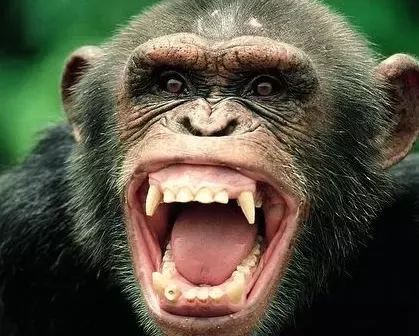
If one believes he is the alpha, perhaps he is the alpha, at least to his devotees. The analysis I find most intriguing – albeit the most unusual and entertaining – is research related to animal behavior.

As Wikipedia notes, psychology researcher Dan P. McAdams pointed to the dominance behavior of alpha male chimpanzees such as Yeroen, the subject of a study of chimp social behavior by primatologist Frans de Waal.  McAdams describes the similarities: “On Twitter, Trump’s incendiary tweets are like Yeroen’s charging displays. In chimp colonies, the alpha male occasionally goes berserk and starts screaming, hooting, and gesticulating wildly as he charges toward other males nearby. Pandemonium ensues as rival males cower in fear … Once the chaos ends, there is a period of peace and order, wherein rival males pay homage to the alpha, visiting him, grooming him, and expressing various forms of submission. In Trump’s case, his tweets are designed to intimidate his foes and rally his submissive base … These verbal outbursts reinforce the president’s dominance by reminding everybody of his wrath and his force.”

Primatologist Dame Jane Goodall compared Trump’s behavior with that of other male primates. “In order to impress rivals, males seeking to rise in the dominance hierarchy perform spectacular displays: Stamping, slapping the ground, dragging branches, throwing rocks,” Goodall said. “The more vigorous and imaginative the display, the faster the individual is likely to rise in the hierarchy, and the longer he is likely to maintain that position.”

The comparison has been echoed by political observers sympathetic to Trump, Wikipedia recorded. Nigel Farage, a Trump backer, said that in the 2016 United States presidential debates where Trump loomed up on Clinton, he “looked like a big silverback gorilla“, and added that “he is that big alpha male. The leader of the pack!”

Sadly, in all his reasonableness and moderation, as well as his frailness, Biden looks like someone the alpha chimp can stomp at will. Just how the two will compare in face-to-face debates (assuming that Trump doesn’t hide from them, as he has in the primaries), will be a telling spectacle, I suspect. Will America go for sober, thoughtful and measured, albeit it physically challenged, or will it go for a more ape-like manner? What will that choice say about our country?