A different sort of war

Trump’s trade battle with Canada will cost us all

Joseph Weber

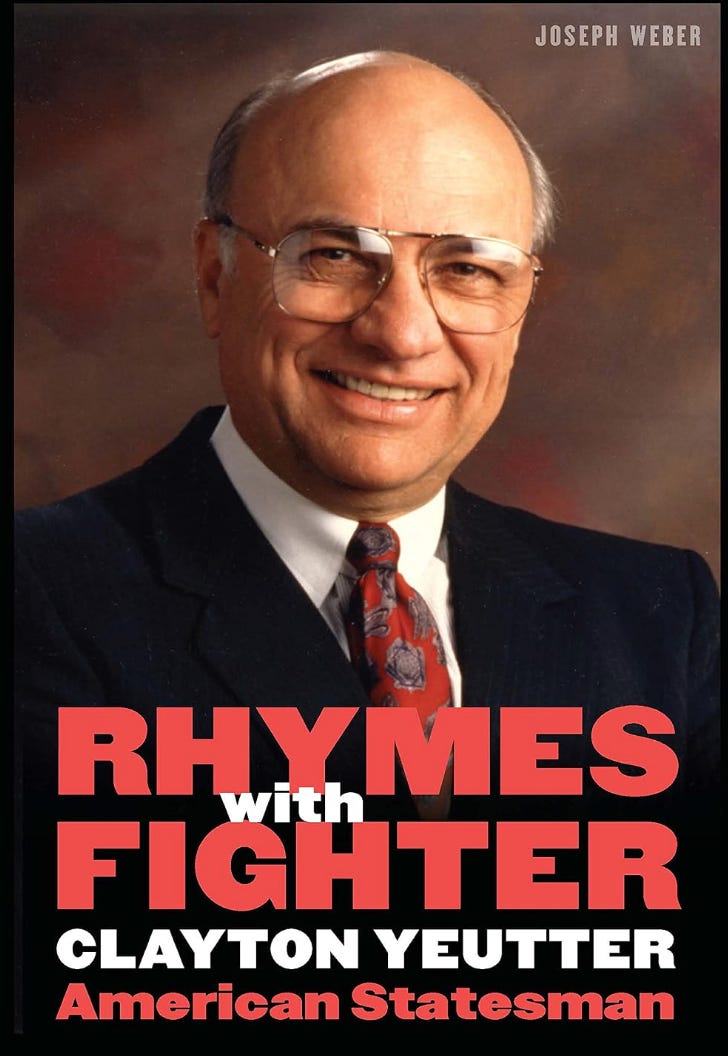
Forty-one years ago, during another sweltering August, Ronald Reagan’s U.S. Trade Representative, Clayton Yeutter, delivered a public address at the Foreign Correspondents Club in Toyko aimed at the overly protective Japanese government. His words could speak loudly today to the trade wars that Donald J. Trump is so fond of having.

“Our trading relationship is not a zero-sum game. For us to win, it is not necessary for you to lose,” the Ph.D. economist and free marketer said. “And for Japan to win, it is not necessary that the U.S. lose. If we handle these issues and disputes properly, we can both win!”

Ah, if only Yeutter (and Reagan) were running things in U.S. trade nowadays.

Instead, we have a president who believes that only one side can win in commerce – or virtually anything else. Worse, he behaves as if he thinks bravado, coercion (and, in tragic instances, bombs), will make him such a victor.

Call it toxic machismo run amuck. It is costing us most visibly in Iran and, less tangibly, in lots of other places.

So, we now have a trade war with Canada, a close long-term ally in commercial and political terms. This battle is, as The Wall Street Journal has repeatedly editorialized, “The Dumbest Trade War.” Not only is Trump damaging American industries, but he is hurting his own party’s fortunes.

“Mr. Trump’s latest round of border taxes will hit an array of consumer goods, construction materials and manufacturing components,” the newspaper warned. “Republicans are already getting pounded on the campaign trail over his tariffs and inflation. One reason for Mr. Trump’s frigid approval rating is that voters believe Mr. Trump is waging blunderbuss wars without a strategy, and on trade they’re right.”

But Trump, who often perversely casts himself and the country as victims, seems to be singing the old South Park song, “Blame Canada.” Recall one key verse: “It seems that everything’s gone wrong/Since Canada came along.” Trump’s less lyrical version, as Time noted, is: “They feel entitled, and yet, we don’t need Canada, they need us!” He repeated his accusation that “Canada has been ripping off the United States of America for years.”

That message came as he announced that U.S. tariffs on all Canadian cars and trucks, automotive parts, and steel will increase to 50 percent starting Jan. 1, 2027. “Build in the U.S. and there are zero tariffs. Canada will be treated like a State no longer! On trade, and in other ways, also, they are among the worst nations in the world to deal with,” he said on social media.

Recall, too, that Trump has long argued that he’d like to annex Canada, making it the U.S.’s 51st state, something that hasn’t played well in a country long bothered by its sometimes vassal-like relationship to the U.S. Canada’s economy in gross domestic product terms is less than one-tenth the size of the U.S.’s and smaller than the economies of Texas and California and about equal to New York’s.

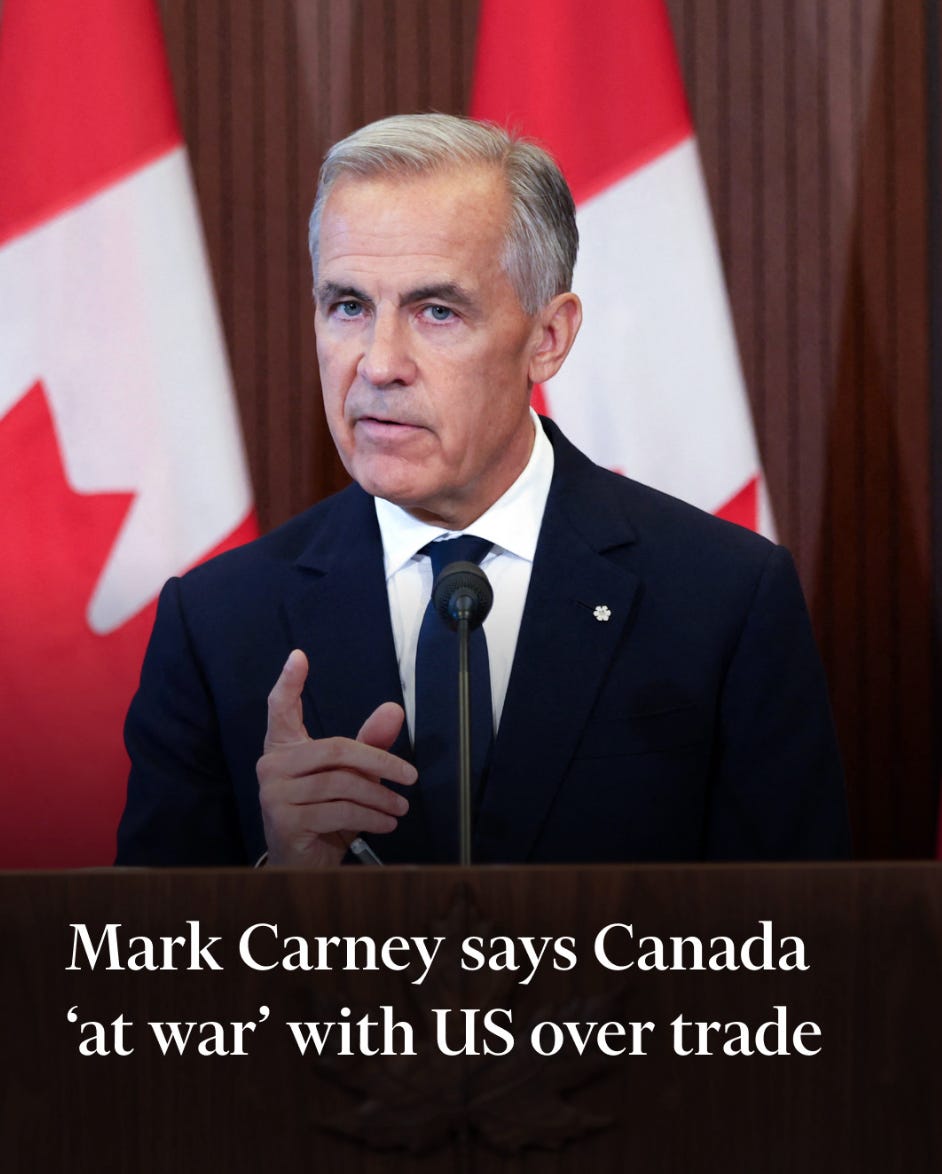
As he has pushed for annexation, Trump has steadily turned up the pressure on Canada in escalating tariffs. Prime Minister Mark Carney, a former Bank of Canada and Bank of England governor, was elected in March 2025 because he stood up to Trump. At the time, he said: “There’s someone who’s trying to weaken our economy,” spurring loud boos at a Liberal party gathering. “He’s attacking Canadian workers, families, and businesses. We can’t let him succeed.”

Trump Administration officials have even fueled a separatist effort in the oil-rich province of Alberta. At secessionist rallies, Politico reported, people have wrapped themselves in Alberta’s flag, waved “we’re done” banners and worn “Trump 2024” and MAGA — Make Alberta Great Again — ball caps.

In January, the news outlet noted, Treasury Secretary Scott Bessent called Alberta a “natural partner for the U.S.,” while referring to the province’s energy resources. “People are talking,” Bessent told conservative podcaster Jack Posobiec, nodding to the separatist movement. “People want sovereignty. They want what the U.S. has got.”

In October, Alberta voters will decide whether to launch the legal process toward a referendum on seceding from Canada.

Canadian Prime Minister Mark Carney, source: Instagram

But, as Trump has long been beating the war drums – in trade and political terms — Carney has been having none of it.

“Last spring, I warned that America is trying to break us so they can own us,” the prime minister said in a national address on Aug. 22, when he suspended the latest trade talks with the U.S. “And I promised that that will never, ever happen. We are keeping that promise. Canada is becoming stronger and less dependent on America. We are already giving ourselves more than they can take away. And we are just getting started.”

Accounts of the negotiations have detailed finger-pointing by both sides, saying each was upping the ante on demands.

“U.S. officials blamed Canada for introducing new asks late in the talks, including seeking lower tariffs on heavy trucks, while Canadian leaders — including Prime Minister Mark Carney — pointed the finger at turf wars within the Trump administration over who controlled key pieces of the deal,” Politico reported.

The Wall Street Journal reported that U.S. Trade Representative Jamieson Greer said Canada walked away from the table and had made unspecified new demands. But Carney said Canadian officials worked in good faith on a deal, claiming the U.S. proposed new, unfair terms.

Whatever the case, as a result, tariffs of 50 percent on $20 billion worth of Canadian goods, or about 5 percent of its U.S.-bound exports, went into force after midnight on Aug. 21. And, in retaliation, Canada planned to slap dollar-for-dollar countertariffs on U.S. goods such as steel, dairy and appliances on Sept. 8, the day after Labor Day.

Trump’s move to double the duties charged on Canadian cars and car parts to 50 percent on Jan. 1 will hurt on both sides of the border. As CNN noted, with the war in Iran already driving up energy and transportation costs, at least some of the financial pain will land on American consumers, even as the levies more directly punish Canadians.

“The new U.S. tariffs are designed to hurt and divide us,” Carney told his countrymen. “They’re a miscalculation. They’re a miscalculation because Canadians will always take care of each other. We know we’re stronger together.”

It’s not clear who will cry uncle first in this trade war.

Roughly 87,000 Canadian jobs could be at risk as the 50 per cent tariffs cut sales of Canadian goods to the U.S., according to an analysis by University of Calgary economics professor Trevor Tombe. As Canada’s CTV News reported, he estimated that about 52,000 jobs are directly vulnerable, while indirect effects on Canadian suppliers and service providers could put another 35,000 in danger.

Carney’s government is setting aside $25 billion (Canadian) to protect Canadian workers and businesses hurt by the tariffs. “We’re helping our small and medium-sized businesses respond by investing in equipment, productivity, and supply chain resilience,” he said. “And we’re financing large companies to keep large employers operating and retain their workers.”

The Canadians, moreover, are reaching out to other markets around the world to boost trade – something that also appears to be irking Trump.

“Over the last year we have signed more than 20 trade and security deals across five continents,” Carney said. “We completed our most recent deal, with the UAE, in a record 47 days. Canadian businesses now enjoy tariff-free access to 1.5 billion consumers. Over the next six months, we will double that number through new trade deals from ASEAN to India. This fall, we will begin discussions with the European Union—the world’s second-largest economy—to deepen and strengthen our security and economic partnership.”

Essentially, Canada is declaring its independence from the U.S. just at a time when Trump is trying to make it more compliant with his whims.

As for the impact of the trade war on the U.S., most analysts point to modest job effects – mainly in areas directly related to cross-border trade. But they say Canadian goods will either become less available or more costly.

“The specificity of the tariffs means that different sectors of the economy — and your everyday purchases — will get hit unevenly,” Business Insider reported. “The tariffs affect alcohol, milk, plywood, and more. For consumers craving Canadian whisky or finally getting around to home renovations, that might mean a bigger bite out of their wallets.”

Canadian lumber near Vancouver, source: Wikipedia

Some areas of the U.S. – such as auto trade-oriented Michigan – and some sectors, such as homebuilding, will especially feel the heat, the outlet noted. “Canada is also a major supplier of lumber, a key material in homebuilding. A tariff impacting lumber prices would increase construction costs for new homes, just as cities like New York, Austin, and Raleigh, North Carolina, double down on policies to boost housing supply.”

Beyond the economic effects, though, Trump’s trade war with our northern neighbor – like his other global trade battles – is having a more pernicious effect. All have cost American credibility dearly.

“We recognized from the start that America has changed,” the Canadian leader told his fellow citizens. “Early last year, in this room, I observed that the decades-long process of steadily increasing integration between our economies was over. Our government understood, before many, that America would transform all of its commercial relationships, that it would put a series of tariffs on its closest allies and use economic integration as a weapon. We recognized that sometimes its signature was written in pencil.”

“Written in pencil.” Indeed.

All of this has been a far cry from when two men whose word meant something were in charge of such things in Washington four decades ago. Philosophically, it’s leagues away from the borderless trade that Yeutter and his president, Reagan, espoused. Both America and the rest of the world are already poorer for it and, sadly, are likely to become more so.

Spit but no polish

Hegseth’s boot has landed heavily on Stars on Stripes

Joseph Weber

Bill Mauldin was a GI favorite

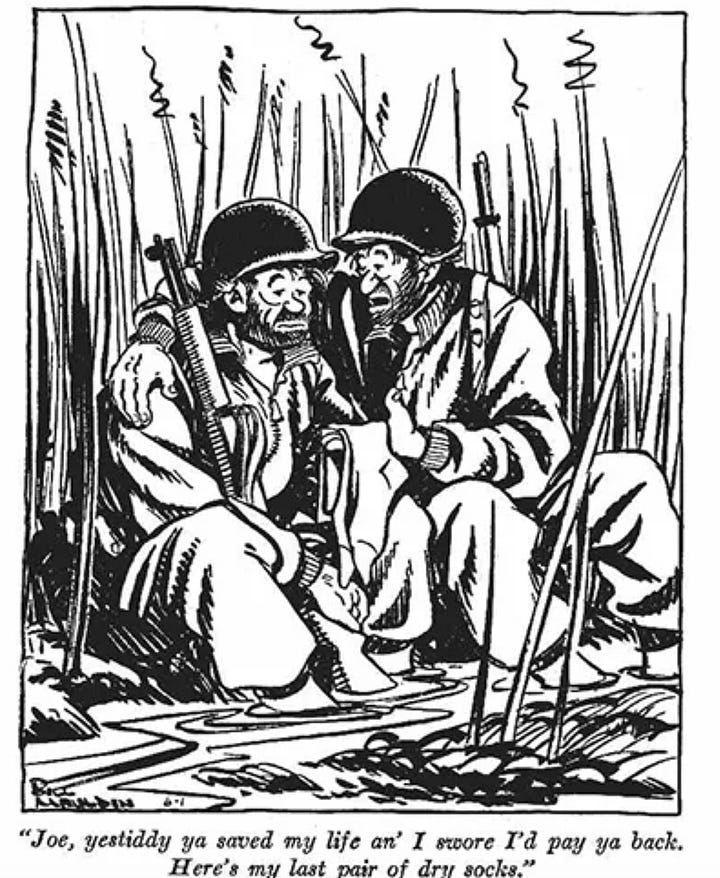
A bit more than 80 years ago, Stars and Stripes cartoonist Bill Mauldin really pissed off General George S. Patton.

The young cartoonist’s signature characters, Willie and Joe, were unshaven, unkempt and thoroughly loved by GIs in World War II. To the spit-and-polish Patton, who ordered front-line fighters to shave daily and even wear ties, the scruffy cartoon GIs looked “like goddamn bums,” were “unsoldierly” and would undermine morale.

Patton threatened to jail Mauldin, a sergeant in the Army, and pushed to get the cartoon banned. But Supreme Commander Dwight D. Eisenhower intervened, seemingly persuaded that if rank-and-file soldiers loved the strip Mauldin was doing something right. Mauldin went on to win a Pulitzer Prize at age 23.

Stars and Stripes, which dates back to the Civil War and has long valued its editorial independence, is again in the middle of a Patton-like fight. Only this time, there’s no Eisenhower to bring some sense to bear. Instead, the self-styled Secretary of War, Pete Hegseth, and his underlings in the Pentagon are determined to squash any degree of autonomy.

As the newspaper itself reported, the Pentagon in March outlined an overhaul effort for Stars and Stripes that barred it from using some news wire services and running comics and other syndicated features. It said content must be consistent with “good order and discipline,” a phrase borrowed from the Uniform Code of Military Justice.

Then, in April, the Pentagon fired its ombudsman, Jacqueline Smith, someone with 40 years of experience in journalism. In her final column, she wrote: “Apparently the Pentagon also doesn’t want you to hear from me anymore about threats to the editorial independence of Stars and Stripes.”

As Smith also wrote, Hegseth killed Sunday comics in the paper, a twist that likely would send Mauldin spinning in his grave at the Arlington National Cemetery. That prompted one reader to write Smith: “As a retired Navy veteran, [I] feel the DOD directive smells like censorship…. We fought for the Constitution and freedom. That includes transparency of our government and freedom of the press. As an American, I have a right to decide what I read.”

Lederer, Slavin and Korte; source: Stars and Stripes

But apparently in Hegseth’s view, only he has the right to decide what soldiers read and see. His Pentagon on Aug. 21 fired Stars and Stripes editor-in-chief Erik Slavin and Middle East reporter Lara Korte after the pair appeared in a CBS interview. In that interview, Slavin said “I stand by the principle that Stars and Stripes must remain editorially independent, as required by law and by the department’s own policies.”

The paper’s longtime publisher, Max Lederer, was also canned, even after he had announced his retirement. As the Associated Press reported, Lederer made his resignation announcement on Aug. 18, shortly after the Pentagon installed a new deputy publisher under him without his prior knowledge. Lederer planned to leave in late September, but felt Hegseth’s boot weeks earlier instead.

To be sure, the brouhaha at the newspaper has been a long time coming. In January, Hegseth’s PR man, Sean Parnell, wrote on X that “Stars and Stripes will be custom tailored to our warfighters… It will focus on warfighting, weapons systems, fitness, lethality, survivability and ALL THINGS MILITARY. No more repurposed DC gossip columns; no more Associated Press reprints.”

But Lederer, who served at the newspaper for 30 years and as the second fulltime civilian publisher since 2007, soon made it obvious that he and Hegseth’s Pentagon were on different pages. He wrote in a staff memo that it had “become clear that my philosophy of leadership, and my understanding of the value and mission of Stars and Stripes, differ in fundamental ways from the direction the leadership of the Department of Defense has for the organization.”

The deputy publisher the Pentagon installed under Lederer, Navy Capt. William Urban, is a PR man, a flack, who bragged that he has been “a spokesman for some of the hardest Public Affairs assignments in the Navy and Department of War for more than 20 years.” As AP noted, he admitted he has “no formal journalism experience.” It’s unclear whether he will rise to publisher.

It is telling, however, that Lederer refers to the Department of Defense by its proper legal name, while Hegseth’s Navy toady calls it the Department of War. Despite an executive order by Donald J. Trump and changes in logos around the Pentagon, the department remains the DoD until Congress replaces the title set in place by statute in 1949.

Urban’s appointment did not sit well with some legislators.

“The placement of an active-duty Public Affairs officer in the senior leadership of an organization whose credibility depends on its independence from the military chain of command raises serious questions,” Democratic Sens. Richard Blumenthal, Elizabeth Warren and Jeanne Shaheen of the Senate Armed Services Committee wrote Hegseth on Aug. 20. “Mr. Lederer’s abrupt departure only heightens those concerns, particularly as the Department determines who will assume leadership of Stars and Stripes. This is particularly troubling in light of the Department’s recent actions affecting Stars and Stripes, including the April firing of independent Ombudsman Jacqueline Smith after she publicly defended the newspaper’s editorial independence and communicated concerns to Congress.”

Thumbing their noses at the senators, Hegseth and his Pentagon minions fired the newspaper’s leaders the day after that.

Perhaps as an Orwellian joke, flack Parnell last April wrote a letter to troubled Congressional lawmakers insisting that “Stripes will remain editorially independent of the U.S. military chain of command, military political affairs activities, or other internal influences, and without censorship and propaganda.” As noted by The Hill, the newspaper has been editorially independent since the 1990s by Congressional mandate.

National Press Club President Mark Schoeff Jr. told AP that Slavin’s firing was “another brazen attempt by the Pentagon to dictate coverage of the military.” He added that “firing a newspaper editor after he publicly defended his newsroom’s editorial independence is deeply troubling, and it should concern every journalist and every member of the U.S. military who depends on independent reporting.”

For some legislators, the recent changes just underscore longstanding fears. “While America is at war, the Trump administration is hellbent on silencing our key military newspaper and attacking service members’ access to the free press. Every American should be concerned about this blatant censorship,” Sen. Warren said in May.

As The New York Times reported with typical understatement, the recent firings “raised questions about the Pentagon’s willingness to ensure the editorial integrity of the publication that has reported extensively on difficulties faced by military communities as the war in Iran has dragged on.”

Really, NYT, it just “raised questions?”

Indeed, the Stars and Stripes trio was fired about 10 days after the paper reported on hardships that Navy sailors were facing on the U.S.S. Abraham Lincoln, the aircraft carrier whose deployment was extended to nine months amid the war.

One can only wonder what will happen to the newspaper’s credibility in the eyes of the military folks who – at least until now – have read it. Somehow, having one DoD flack assure everyone that the paper will be free of propaganda only to have a military flack undermine the place a few months later might strike many as a contradiction.

Gotta wonder what Mauldin would have thought.

“Without fear or favor”

Haley Van Erem has been seeking justice for a long time

Joseph Weber

Haley Van Erem as a student, Source: FSU College of Law

Fourteen years ago, an idealistic Florida State University law student saw something very wrong and, with the help of colleagues, set out to set it right. State authorities blocked her at every turn.

Now that she’s a far more seasoned lawyer, Haley Van Erem is doing the same thing again. But this time, it’s the Trump Administration that she’s tangling with.

Van Erem in 2012 was part of a project at FSU’s Public Interest Law Center that brought suit against Florida to try to get children with complex medical needs out of nursing homes and back into their homes with proper support. The children – who numbered more than 200 back then – were “medically fragile.” Some required 24/7 care that included ventilators.

Still, many of their caregivers wanted them home.

“The saddest part of all is not that these children have nowhere to go. That’s what a lot of people would assume,” Van Erem told the Florida Bar News. “A lot of families are asking for support and want their children at home. Our goal is to get these children back with their families, with adequate support.”

It took more than a decade of litigation, but in 2023 a federal court ruled that the state violated the Americans with Disabilities Act by institutionalizing the children. The court ordered Florida to ensure that the youngsters – then numbering about 140 –get access to needed services while at home and in their communities, as the U.S. Justice Department’s Civil Rights Division reported.

As it happened, Van Erem was working at the time in that division, where she had served as a career DOJ attorney for nearly a decade. While there, she racked up a slew of honors, including Special Commendations in 2019 and 2023, Distinguished Service Awards in 2019, 2022, and 2023, and a Cooperative Achievement Award in 2017 for interagency work.

None of that seems surprising, in light of her work at FSU and her earlier days as a Phi Beta Kappa student at Arizona State University. As a junior studying social work, she won a grant to study in Spain. For years, Van Erem has been a proven achiever, as well as someone with a keen eye for right and wrong.

But her tenure in the once-distinguished Civil Rights Division was upended by Donald J. Trump and his minions at the department. And the demands put on Van Erem and her colleagues have led to an exceptional whistleblower complaint that claims there was no legal or factual basis for probes into antisemitism at Brown, Columbia and Harvard. Recall that those allegations have wreaked havoc at the schools.

Recall, too, that Brown and Columbia settled their disputes with the Trump Administration by agreeing to pay $50 million and $200 million, respectively, mainly because Trump had cut off far larger amounts of federal funding to the schools. Harvard has been fighting, however, and the Trump administration was ordered last year to reverse more than $2.6 billion funding cuts to the school, with a federal judge saying the government “used antisemitism as a smokescreen for a targeted, ideologically-motivated assault on this country’s premier universities.”

More recently, a different judge dismissed a Trump administration lawsuit that accused Harvard of turning a blind eye to harassment of Jewish students. This was a major setback in Trump’s war on academia.

As PBS reported, Van Erem’s complaint alleges that investigations into the schools were designed to strong-arm them into cutting deals for political purposes. Outcomes of the investigations were “predetermined, without regard to the evidence” in a “politically mandated effort” to extract money from schools through settlement demands and funding freezes under the pretext of rooting out antisemitism, the complaint alleges.

In other words, rather than undertake good-faith probes and charge offenses based on the facts, Justice’s lawyers were using the department as a cudgel to achieve Trump’s political end – humbling the schools.

The complaint makes for fascinating reading.

In March 2025, for instance, it says Van Erem and some of her colleagues were reassigned to a task force investigating alleged antisemitism in medical schools at Brown, Columbia, Cornell and Harvard. The lawyers got a memo informing them that the investigations were “based on a New York Post article that alleged anti-Semitic activities at numerous medical school commencement ceremonies.”

Source: New York Post

Some students, according to the newspaper, had shouted “Free Palestine” and worn Palestinian flags or keffiyehs at the graduation ceremonies – repulsive expressions, perhaps, but protected speech, according to the complaint. “It was not unheard of for news reporting coupled with additional evidence to lead the DOJ to initiate further scrutiny of potential statutory violations, but opening an investigation based on a single article was highly unusual,” the complaint notes.

Still, the lawyers expected rigorous investigation, the complaint says. Instead, they were told that the probe at Columbia – a particular bête noire for Trump — had widened to seek out antisemitism at the entire university.

The staff, it seemed, had found no evidence of liability at the medical schools but, together with the funding cuts, the DOJ was determined to pound the schools into settlements. The efforts “reflected a predetermined, outcome‑driven approach to enforcement rather than a fact‑based investigative process,” the complaint says, “… staff were encouraged to invert the standard sequence of investigation, compliance review, and legal analysis and instead work backward from desired settlement terms, including provisions not directly tied to substantiated Title VI anti‑harassment or antisemitism violations, to generate proposed findings that would support those terms.”

Title VI prohibits discrimination based on race, color or national origin in institutions receiving federal funds.

At Brown, in particular, Van Erem and her colleagues were told to interview Middle East Studies professors, particularly Muslims, to try to elicit antisemitic statements, according to the complaint. She and her colleagues felt it was an “attempt to intimidate those professors and was rooted in Islamophobic assumptions that Middle East Studies professors would harbor antisemitic viewpoints rather than any actual evidence of complaints about antisemitism.”

But, to the consternation of their superiors, Van Erem and her colleagues found insufficient evidence to support allegations of Title VI violations.

At Columbia, investigators found evidence of discrimination, but Van Erem and her colleagues argued the investigation was a rush job done before “adequate factual development and legal review were completed” and relied on allegations that “were unsupported, based on news reports or litigation filings, or that implicated protected First Amendment activity.”

DOJ’s representatives on the task force were given only hours to review claims that officials hoped to cite to justify an administration finding that the university had violated Jewish students’ civil rights, as The Washington Post noted. As the newspaper reported, in some cases the claims involved little more than activists’ expressions of support for Palestinians.

“My main concern is that a lot of these [examples] involve protected speech and this document should not imply that those incidents are the basis of a Title VI violations,” Van Erem wrote.

When the pressure from her supervisors persisted, the career DOJ lawyer decided her days in the department were over. Van Erem “was unwilling to be made vulnerable to further participation in politically motivated investigations unsupported by facts and contrary to law.” She quit on May 30, 2025.

As Democratic Congressman Jamie Raskin put it in a letter to Harmeet Dhillon, an assistant attorney general in charge of the Civil Rights Division, “your ‘investigation’ into antisemitism was fake, a pre-baked frame-up operation thoroughly political in nature.”

Raskin added that “the whole project was designed to harass professors and administrators at major universities, to curtail their freedom of speech and academic freedom, and to strip targeted institutions of hundreds of millions of dollars in grants that they had already been awarded on the merits of their applications.”

Like many other career prosecutors who don’t toe the Trumpist line, Van Erem last fall moved into state prosecution. She signed on as a unit chief at the Office of the Attorney General for Maryland. And, on Aug. 17, she brought the complaint against the feds, with the help of lawyers at the Government Accountability Project. In it, she asks the inspector generals of the departments of Justice and Health and Human Services to investigate “without fear or favor” the abuses she has reported.

Will that request go anywhere? That seems difficult to imagine, now that the Justice Department under Todd Blanche appears overtly to be a vehicle for Trump to pursue institutions and individuals he dislikes. Still, the disclosure of Van Erem’s experiences sheds light on just how perverse the department has become.

It took years, but Van Erem prevailed in Florida. That may again happen in D.C., though it may require that someone new occupy the White House and that the Department of Justice be led by someone independent, fair-minded and truthful — in other words, someone as interested in justice as Van Erem is.

“Drest in a little brief authority”

Trump’s disdain for anyone checking him just gets worse and worse

Joseph Weber

Portia, source: Shakespeare Retold

In Shakespeare’s classic play “The Merchant of Venice,” Portia saves the life of her friend Antonio with a clever legal dodge. Even though the lender Shylock has the right to take a pound of flesh from the man because he defaulted on a loan, Portia convinces a court that their contract does not allow Shylock to take any blood:

“This bond doth give thee here no jot of blood;/The words expressly are ‘a pound of flesh:’/Take then thy bond, take thou thy pound of flesh;/But, in the cutting it, if thou dost shed/One drop of Christian blood, thy lands and goods/Are, by the laws of Venice, confiscate/Unto the state of Venice.”

Ah, such a wonderful loophole. No doubt, lawyers have exploited terms such as that for centuries, finding ways to wiggle out of a contract or sidestep a judge’s orders or stated law.

But is it seemly when a president tries this?

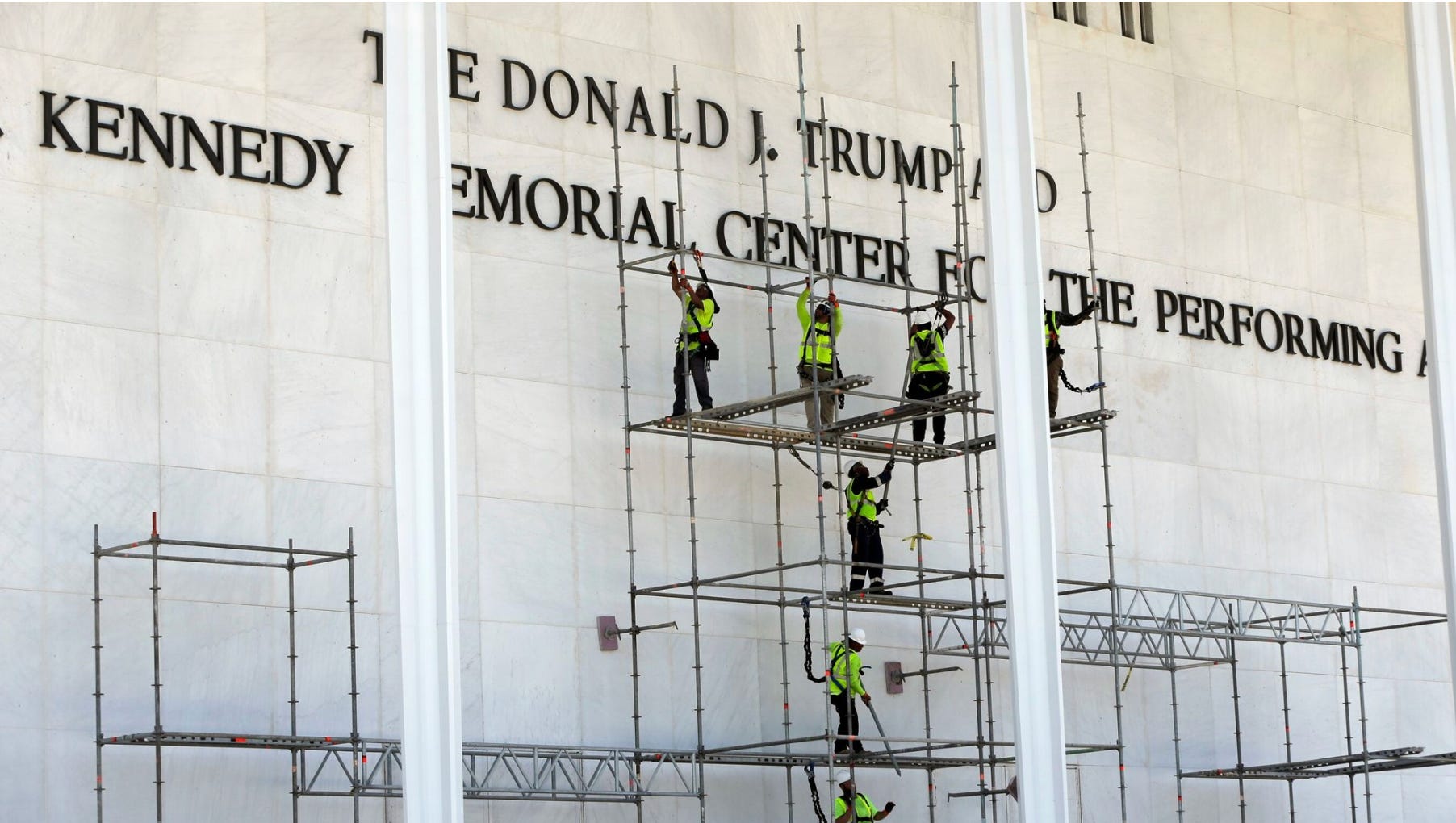
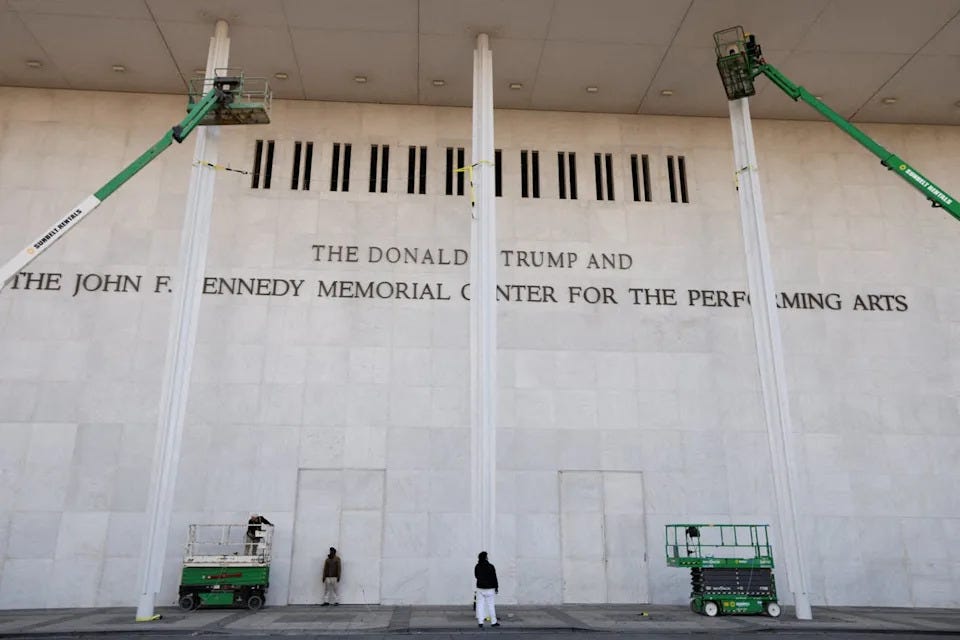
Donald J. Trump and his toadies on the board of the John F. Kennedy Center for the Performing Arts are aiming to do just that with a move to add to that title the phrase “Restored and Renovated by President Donald J. Trump,” as well as by renaming the grounds “President Donald J. Trump Plaza” and by prominently etching the words “Endowed by the Trump Kennedy Center Fund.”

The idea is that Judge Christopher R. Cooper, in his May 29 order requiring Trump’s name to be stripped from the center’s facade, spoke only to the proper name of the building, not to phrases – or names — that might otherwise adorn it, even if they appear as prominently as the place’s name itself.

“The Court has concluded that the Board overstepped its statutory bounds by unilaterally renaming the Kennedy Center after President Trump. In 1964, Congress deliberately rechristened the ‘National Cultural Center’ the ‘John F. Kennedy Center for the Performing Arts,’” the judge ruled. “[So] the Kennedy Center Board’s decision to rename the Center, along with its decision to affix President Trump’s name to the building’s façade, violate Congress’s unequivocal mandate. As stated at the outset, Congress gave the Kennedy Center its name, and only Congress can change it.”

It’s likely that Judge Cooper will be asked to rule on the new proposed changes again. Ohio Democratic Rep. Joyce Beatty, an ex-officio member of the center’s board who was one of three nays on the “Renovated By” resolution, called the group’s action “a transparent effort to circumvent the Court’s ruling,” adding that it “flies in the face of the statutes that Congress passed.” She vowed to fight.

The move by the board, which Trump heads, not merely flies in the face of law, but spits in the eye of the judge, a Barack Obama appointee. Recall that Trump had accused Cooper of ruling against him “because his wife probably told him to do so,” arguing that Cooper’s wife, former federal prosecutor Amy Jeffress, was “a Radical Left Democrat” and that the judge should be brought up on charges because that amounted to a conflict of interest.

Good luck, Donald, with getting a charitable decision now from that judge.

This all amounts to an egomaniac’s childish temper tantrum, of course. One imagines him stamping his feet and saying: “So there.” But it represents something much bigger – Trump’s inability to recognize that no means no, at least when a court declares that.

At times, the consequences of Trump’s refusal to countenance any check on his power can be far more dire than just a few letters etched into marble on a Washington landmark. To cite some recent examples, the Supreme Court has ruled against him on three major fronts – on tariffs, on an appointee to the Federal Reserve Trump dislikes and on birthright citizenship – and on all three Trump and his minions are making efforts to sidestep the rulings.

The administration’s loophole-hunting efforts, detailed in a New York Times newsletter, amount to what an article in The Duke Law Journal called “legalistic noncompliance.” The article’s authors called the sidestepping “deploying the language of the law to shroud what are, in fact, bad faith efforts to evade judicial orders.” Trump’s acolytes insist they are following the letter of the law, as judges interpret that, but they seek to slip around its spirit in whatever ways they can.

Portia would have been proud.

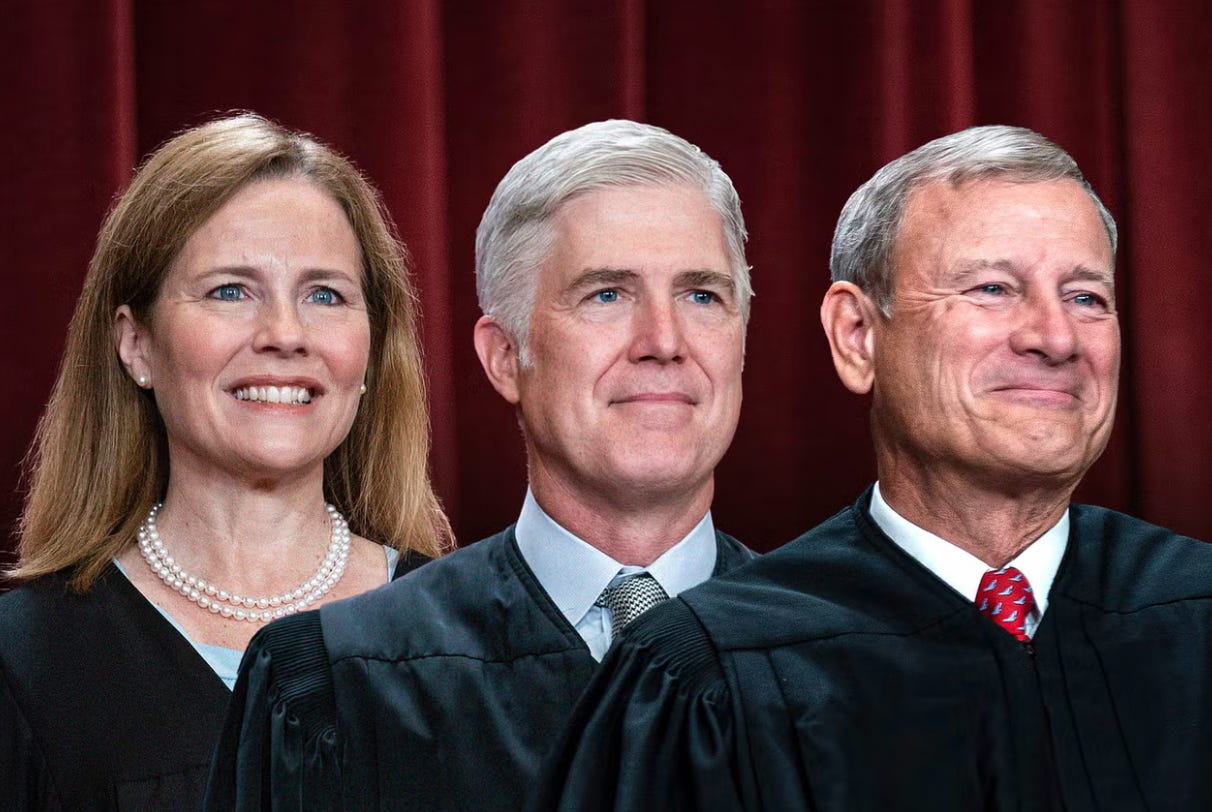
Justices Barrett, Gorsuch and Roberts; source: Slate

But let’s look further. What does Trump say of the judges in some of those cases? He called his appointees Neil Gorsuch and Amy Coney Barrett “weak, stupid, and bad” and an embarrassment to their families.” Worse, the justices were “fools and lapdogs for the RINOs and the radical left Democrats.”

Presidential language, for sure.

So, will Trump and his Justice Department bootlickers now accept another federal judge’s recent dismissal of an antisemitism case against Harvard? “We disagree with the ruling and are assessing next steps,” Assistant Attorney General for the Civil Rights Division Harmeet Dhillon said in a statement.

In other words, no won’t mean no, if the Trumpies can come up with a legal dodge or loophole.

At times, the administration’s arrogance is so deep that it hasn’t bothered to even come up with some workaround. It has just defied the courts. Most infamously, Trump’s lackeys in the spring of 2025 defied an order by Judge James E. Boasberg to not deport 200 migrants without a hearing. Three planes shipped the people out to El Salvador anyway.

Recall that Trump called Boasberg “a Radical Left Lunatic of a Judge, a troublemaker and agitator” who should be impeached, earning a rare rebuke from Supreme Court Chief Justice John Roberts. Boasberg was appointed to separate judicial posts by George W. Bush and Barack Obama and served on the U.S. Foreign Intelligence Surveillance Court.

Perhaps someone who deserves a modicum of presidential respect?

But Trump’s disrespect for judges and defiance of their orders goes far further. Between February of 2025 and last spring, district court judges ruled that the administration violated orders in at least 31 lawsuits over a wide range of issues, including cuts in federal funding, mass layoffs, deportations, and immigration practices, as reported by The Associated Press. These violations followed more than 250 instances of noncompliance that judges highlighted in individual immigration petitions — from failing to return property to keeping immigrants locked up past court-ordered release dates. The AP called it “an extraordinary record of defiance.”

Let’s think about Shakespeare again. He often wrote about arrogance.

In “Measure for Measure,” another of his plays, a character bemoans another character’s hubris, saying: “… man, proud man,/Drest in a little brief authority,/Most ignorant of what he’s most assured,/His glassy essence, like an angry ape,/Plays such fantastic tricks before high heaven/As make the angels weep.”

Donald J. Trump and his minions likely are making many weep now, but someday their “little brief authority” and their deceptions and legal sideslipping will fade away. Perhaps the midterm elections will mark the beginning of their end.

President Donald Trump has called for a federal judge to face charges after a ruling that will temporarily halt his renovations at the center and force his name to be removed from the structure (Reuters)

If ignorance is bliss, why are so many miserable?

But Trump’s funhouse mirrors may be shattering

Joseph Webe

Source: National Catholic Reporter

After Jeanine Pirro, his handpicked U.S. Attorney for Washington, D.C., contradicted Donald J. Trump in a court filing about the Reflecting Pool, the president insisted she was wrong. On social media he blasted “the major damage was caused by VANDALS.”

As a review of the 20-page motion seeking the dismissal of charges against former Olympian David Hearn shows, Pirro offered substantial evidence to the contrary. “[I]nformation show[s] that the damage” to the Reflecting Pool “was the result of a botched installation and not vandalism as initially represented” by the Department of the Interior, the U.S. Attorney and an assistant told the court in their July 31 filing.

Quite the turnabout.

Pirro and a colleague added that “additional documents” provided by the department “indicat[ed] that damage to the Lincoln Memorial Reflecting Pool in June 2026 was the result of flawed installation by the contractor, Atlantic Industrial Coatings (‘AIC’), and the rush to complete the project prior to events associated with the America 250 celebration in the weeks surrounding Independence Day 2026.”

Despite the detailed, photo-laden filing, Trump insisted that his appointee was wrong. “I disagree 100% with Jeanine Pirro,” he said in a post on Truth SociaI. “I don’t know what she was thinking? To me, it was a pure case of VANDALISM ….”

Recall that Trump picked Pirro to serve in the D.C. jurisdiction because of her work as a legal analyst and program host for Fox, as well as her experience as a county judge in Westchester, N.Y., and three-term district attorney. Her credits also include working as a writer and producer for TV’s “Law & Order,” along with some acting experience.

Clearly Trumpworthy.

Certainly, Pirro played her part well on July 2, when she announced the indictment against Hearn, who had dipped his hand in the Reflecting Pool while on a bike ride. She called the vandalism “an affront to the dignity of our shared history.” Insisting it was a day of “accountability,” Pirro said Hearn made “a deliberate act to damage the Reflecting Pool” and alleged that he did so “forcefully and violently,” adding that “we can state and prove beyond a reasonable doubt that he caused damage and that damage is over $1,000.”

My, how her script changed. No more shooting from the lip.

In the dismissal motion, she said new information from the Department of the Interior made it clear that “[t]he rush to complete the project led to hasty and botched work that was not remediated before the project was finished and the fencing removed.” Perhaps the even hastier work, though, was Pirro’s Trump-pleasing indictment of Hearn less than two weeks after the 67-year-old cyclist touched a loose piece of the pool’s liner on his June 19 ride.

But Pirro’s pirouette wasn’t the most disconcerting thing about the episode. Rather, that was Trump’s inability to admit that Hearn was wrongfully charged. Psychologists have a term for that: it’s “willful ignorance.” This is a state in which people realize at some level that their beliefs are probably false OR they refuse to attend to information that would establish their falsity.

No matter how much information contradicts the willfully ignorant, they just can’t see things any other way but their distorted – or simply wrong – way, seeing the world in a funhouse mirror. Or, if they are just liars, they will stick to their guns, even while knowing they’ve misfired.

We see this repeatedly with Trump, whose penchant for lying is well-established. He does so convincingly – at least to his MAGA devotees – perhaps because he believes his own lies. Self-deception is a key part of Trump’s flawed psyche, according to his niece clinical psychologist Mary L. Trump.

And this has had tragic consequences.

Source: flickr

When Israeli Prime Minister Benjamin Netanyahu persuaded Trump that an attack on Iran would be swiftly followed by public uprisings to oust the mullahs, Trump disregarded the views of American intelligence agencies. In February, about a week before the men launched their attacks, the U.S. National Intelligence Council had concluded that neither limited airstrikes nor a larger, prolonged military campaign would be likely to result in a new government taking over in Iran.

The prospect of Iran’s fragmented opposition taking control of the country was described as “unlikely,” according to sources quoted anonymously by several outlets including The Washington Post. As the paper reported, the council is composed of veteran analysts who produce classified assessments meant to represent the collective wisdom of Washington’s 18 intelligence agencies.

American military leaders also waved the yellow caution flag. During a Feb. 18 meeting, General John “Dan” Caine listed options including a) a limited strike as a way to push Iran in the negotiations or b) larger campaign with the goal of toppling the government, as The New York Times reported. The second option, the general warned, carried high risk of American casualties, could destabilize the region and significantly deplete stocks of American munitions.

Since Trump chose option B, at least 14 American soldiers have been killed and 624 wounded. And those figures may understate the tallies because the Pentagon has changed the way it counts and reports such numbers.

And now, of course, the five-month-old war drags on with Iranian leaders playing Trump like a fiddle. Recall that Trump claimed the U.S. and Israel “obliterated” Iran’s nuclear capabilities, but now his administration is still trying to cut a deal to keep nukes out of Iranian hands. And he has repeatedly threatened massive attacks, even while saying Iranians were begging for a deal.

Trump has often asserted that the U.S. and Israel destroyed Iran’s military capabilities. And yet the country still has the power to send missiles and drones into the territory of U.S. allies.

At the moment, Trump says he is holding off on a major assault he threatened, saying allies pleaded for diplomacy. But experts say he backed down because Iran now has the upper hand, mainly because it can use proxies such as the Houthis to threaten ships in the Red Sea and can bombard U.S. allies in the Persian Gulf.

Is willful ignorance driving him again? The most charitable face one can put on it is to blame disastrous miscalculation fueled by arrogance. And yet, with so many smart folks tapping the brakes, should he not have listened?

Then there’s the economy. At his recent very public Cabinet meeting, Trump bragged anew about his economic achievements, saying “… today, there are more people working in the United States than at any time in the history of our country” and that “… without the election, you wouldn’t have what I’ve done economically. So, we have the most successful environment that we’ve ever had.”

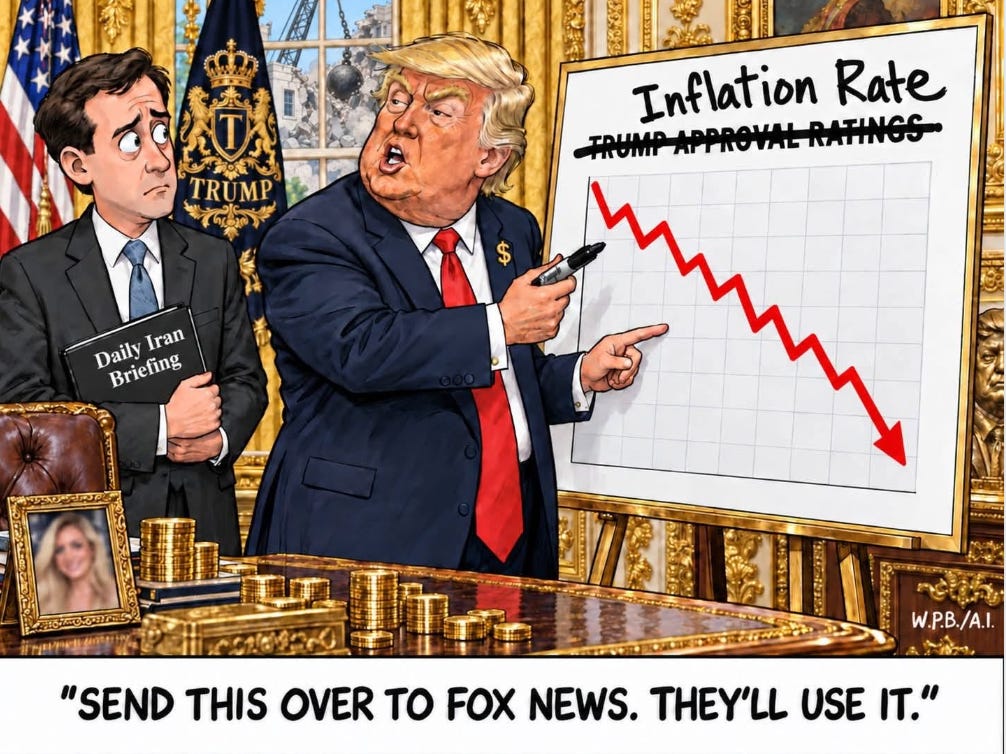
Never mind that in the second quarter of this year, growth in the economy slowed to a 1.5 percent rate, sharply down from the already modest 2.1 percent annual rate clocked in the year’s opening quarter. Or that the consumer price index rose 3.5 percent in June, compared with the same month last year. While that’s down from 4.2 percent in May, it still reflects inflation that is clipping along faster than the 2 percent rate the Federal Reserve wants.

That’s why the Fed is keeping interest rates as they are, not dropping them as Trump wants. And, even as the central bank has taken that stance, three regional bank presidents dissented, pressing for higher lending rates to rein in inflation.

Source: Dragon Quest Wiki

But what do we and Trump hear from his key economic operator, Treasury Secretary Scott Bessent? That sycophant, flattering the president along with the other Cabinet toadies, said “…we’re pulling away from the rest of the world because of your leadership, the policies that you did from day one in terms of digital assets, in terms of technology and bringing back American manufacturing. You’ve done it again.You had the incredible economy during your first term, and we are seeing that carry over here and it is in stark contrast to the Biden economy …”

Nary a word about the slowdown or the Fed concerns, which had made news nationwide. No mention of the decline in consumer spending or rising gas prices. Nothing about how a recent CNN poll found that 65 percent of Americans believe Trump’s policies have worsened economic conditions in the country, or that the president’s approval rating had fallen to 34 percent.

As the Los Angeles Times reported, a recent Pew Research Center survey found most Americans aren’t feeling great about the economy — with 24 percent rating economic conditions as excellent or good, 41 percent rating them as “only fair,” and 35 percent rating them as poor.

Combine willful ignorance with Trump’s astonishingly successful effort to surround himself with opportunistic yes-men, and you get suck-up Cabinet meetings like this past one.

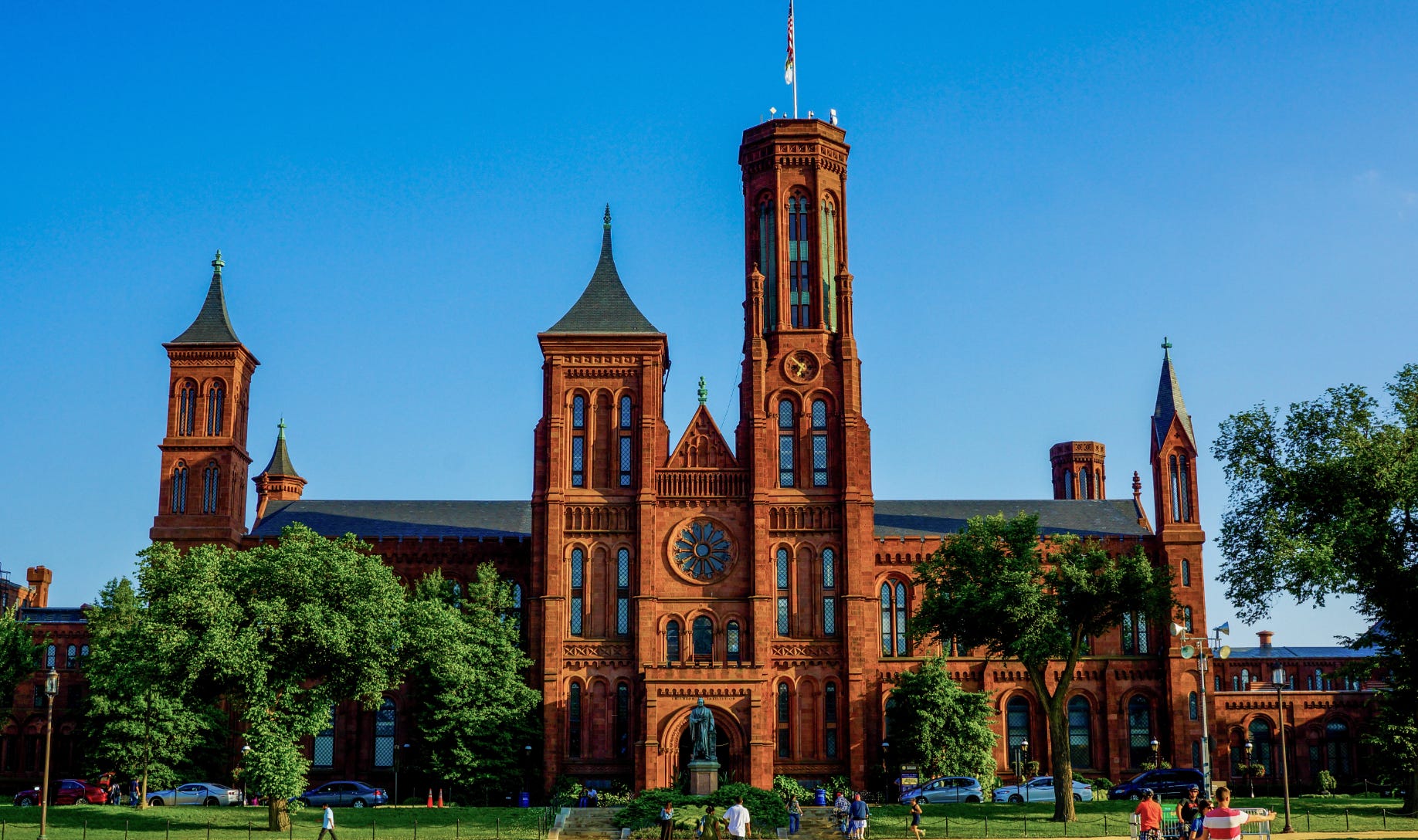
Finally, consider the president’s fight with the Smithsonian Institution and other outfits that tell our national story. The president doesn’t want the best judgments of historians and experts to guide the national self-image, but rather his blinkered and ignorant views.

Smithsonian, source: Wikipedia

As a New York Times writer recalled, two months into his second term, Trump issued an executive order titled Restoring Truth and Sanity to American History, directing officials to “remove improper ideology” from the Smithsonian and its museums, to cut funding to “programs that degrade shared American values” and to reinstate some monuments removed following the 2020 Black Lives Matter protests.

Since then, the National Park Service has been removing signs about slavery; the statue of a Confederate general has been reinstalled in Washington; a scathing report by the White House Domestic Policy Council accused the Smithsonian of using history “as a political instrument to divide, dispirit and discourage our citizens”; and on July 24, Trump issued a new executive order mandating that signs be installed outside the Smithsonian. The signs warn visitors “about the ideological capture at the National Museum of American History.”

The Times writer, Moscow-born M. Gessen, compared the political effort to rewrite history to the constant rewrites of Russian history her countrymen have long endured.

“Trump wants Americans to unlearn what they have come to know about the history and legacy of enslavement,” Gessen wrote. “What his executive orders really promise to restore is a sense of comfort contained in the most reductive and sanitized stories about the United States — the bliss of ignorance.”

The bliss, perhaps, of willful ignorance.

A humorless spectacle

Trump’s correspondents’ dinner schtick was a bomb

Joseph Weber

The Lion King, source: the New York Times

Twenty-two years ago, as the Iraq War raged and George W. Bush came under fire for wrongly claiming Iraqi weapons threatened the U.S. and the world, he appeared at the White House Correspondents’ Dinner. He aired images of himself looking under Oval Office furniture and out the windows, while asking “Those weapons of mass destruction have got to be here somewhere.”

Seven years later, as rightists claimed that Barack Obama was born in Kenya, the president told the assembled reporters he was going to clarify it all. “Tonight, for the first time, I am releasing my official birth video,” Obama deadpanned, before showing the opening scene of Disney’s “The Lion King,” when the royal cub Simba is presented on the savanna.

This year was different.

Donald J. Trump made fat jokes about his former acolyte Chris Christie and about Rep. Jerry Nadler and potential presidential contender J.B. Pritzker (”Don’t call him a fat pig, okay? I’m sticking up for him.”) He repeatedly insulted Joe Biden (“So, just remember, before I came along, if you wanted to see someone lose consciousness on the South Lawn of the White House, all you had to do is ask Joe Biden a question.”) He mocked Minnesota Rep. Ihlan Omar, saying she “and her brother are thinking about moving together. Very much in love.”

Trump also took potshots at the July 24 affair at Calif. Gov. Gavin Newsom, Sen. Minority Leader Chuck Schumer, former Vice President Kamala Harris and Sen. Elizabeth Warren and Rep. Alexandria Ocasio-Cortez. He called CNN’s Jake Tapper “Fake Tapper.” After the cable channel’s Kaitlan Collins got an award for excellence in presidential news coverage, Trump slammed her “fake” stories and faulted her for not smiling.

Kaitlan Collins, source: Sullivan’s “American Crisis”

If Trump’s appearance had been a Broadway show, the night would have been its sole performance – maybe even shuttered halfway through. The notices, as the old term goes, were not good.

“Moments of presidential self-deprecation were few and far between,” The New York Times reported. “There was little laughter in the room as the president’s speech took on a harder edge. Not many people chuckled when he compared the ‘really beat-up faces’ of UFC fighters with those of Bette Midler, Jane Fonda and Bruce Springsteen.”

Jem Bartholomew of the Columbia Journalism Review was far less measured:

Calling it a “farcical spectacle,” he wrote: “In our current moment, the dinner feels especially incoherent and misguided—seven hundred journalists, dressed in their finest clothes, agreeing to break bread and drink wine with administration figures who are aggressively and systematically cracking down on journalism and free speech.”

And, likewise, former White House Correspondent Jim Acosta pulled no punches:

“Trump delivered an unhinged, hateful speech that was written for the sole purpose of celebrating his undemocratic assault on news outlets in America and settling scores with his political enemies,” Acosta wrote. “He called people fat. He told racist and anti-gay jokes. He delighted in his oligarch friends taking over the networks. It was thoroughly disgraceful.”

Margaret Sullivan, source: Reason

Similarly, longtime press critic Margaret Sullivan skewered the president. Trump’s “hate-filled rant,” she wrote, “… was aimed at journalists, at his political enemies and at anybody else who has failed to suck up to him at every moment or to support his lawless regime.”

But, as the jokes fell flat, Trump also managed to be something he often derides. CNN’s Brian Stelter suggested that “more than anything, the speech was just … boring.”

Many have long criticized the annual correspondents’ dinner for the seeming hypocrisy of the press schmoozing with the officials they are supposed to cover, usually adversarially. How can tuxedoed and begowned journalists grin and toast people during one glittery night when for the rest of the year they hold those same people to account for professional or policy slipups? It all just has seemed smarmy, insincere and too insidey, all a sort of Inside the Beltway self-promoting boastfulness.

Defenders of the affair say it’s really a celebration of the First Amendment and some note that rubbing shoulders with officials can help journalists build sources. Sharing a drink can lubricate relationships, leading to better coverage – in theory.

But this year marks a new low. While many White Houses have been hostile to the press (think Nixon), Trump is not only as humorless as his dinner speech demonstrated, but vicious.

Just this month, the administration issued subpoenas seeking phone records and grand jury testimony from New York Times journalists who wrote articles revealing security concerns about Air Force One. After a federal judge in Manhattan scolded the Justice Department for its handling of the matter, the government withdrew the subpoenas. At the dinner, one Times reporter who was a subject of the subpoenas, Tyler Pager, accepted an award.

Tyler Pager, source: The New York Times

At another point, CNN’s Wolf Blitzer welcomed reporters from The Wall Street Journal to the stage to accept an award for “courageous reporting on President Trump’s past relationship with financier Jeffrey Epstein” that “triggered the release of the so-called Epstein files.” Blitzer then noted that “Trump quickly filed a $20 billion lawsuit against The Journal, revealing reporter Khadeeja Safdar’s home address. Her family had to be relocated. The Journal was kicked off of Air Force One.”

The dinner reflected how the Washington press – and the media generally – face a seemingly impossible job in covering this administration. As the media report on its many outrages in a fair and balanced way, they risk alienating both readers and viewers who are Trumpers and those who loathe the man. And, as they work to maintain access to officials, they risk being accused of being too chummy.

Moreover, critics often deride “sane-washing” by media outlets that struggle to find reasonable through-lines and news in Trump’s usually rambling speeches. They “render [Trump’s] most bizarre and incoherent statements into cogent English, shearing off the crazy in a misleading manner,” as a writer for The Atlantic put it in 2024.

Such efforts are all part of a process of normalizing a White House that couldn’t be further from normal, say critics. Many would rather the Washington press corps dump their annual fete, at least while Trump is in office.

“It is the very essence of normalizing an extremely abnormal and dangerous president,” wrote Sullivan, adding that the press should have risen in unison and walked out on Trump’s speech. “It’s so far past the time when this normalization should have ended that it seems almost absurd to make the argument once again.”

While such arguments carry a lot of weight, reporters need to keep in mind a few realities. First, 77.3 million Americans voted for Trump in 2024 and, while they shouldn’t get cheerleading coverage for that, the media can’t afford to simply turn them all off by showing disrespect, at least for the office. Second, if journalists behave like the enemies Trump has repeatedly called them, they will just make his case for him.

Report critically, report thoroughly and report fairly. Some will buy it. Others won’t. But the facts on everything from Trump’s grifting to his mismanagement of the war in Iran and mishandling of the economy will be out there.

To be clear, the president’s performance at the dinner was despicable and typical. But, in a way, we should be glad it happened. It’ll go down in the history books in all its ugliness, humorlessness and egomania, representative of so much of this presidency. And, more immediately, it helps sets the stage for the midterm election less than 100 days hence, when – perhaps – some of those 77 million will have second thoughts.

Trump and the press

We’re getting a master class in would-be autocracy

Joseph Weber

Source: The Week

Nearly a decade ago, during his first presidential term, Donald J. Trump infamously tweeted that major media outlets were “the enemy of the American people.” That drew an intriguing response from a fellow Republican, Sen. John McCain.

“I hate the press,” the Arizona war hero sarcastically told NBC News’ Chuck Todd on “Meet the Press.” “I hate you especially. But the fact is we need you. We need a free press. We must have it. It’s vital.”

And McCain – whom Trump had derided as “a loser” — made the risks of losing an unfettered press all too clear.

“If you want to preserve – I’m very serious now – if you want to preserve democracy as we know it, you have to have a free and many times adversarial press,” McCain said. “And without it, I am afraid that we would lose so much of our individual liberties over time. That’s how dictators get started.”

So, now – after he has coopted Congress, the Senate and much of the Judiciary, and weaponized parts of the military against Americans – Trump and his minions are going after the press anew. The administration subpoenaed five New York Times reporters after they reported that the new Air Force One, a Qatari-donated Boeing 747-8, lacked advanced security features, including antimissile capabilities. The journalists cited sources who spoke on the condition of anonymity, a common technique when sensitive matters are involved.

Chillingly, federal agents showed up at the homes of some of the reporters to serve the documents on them. “The appearance of federal law enforcement agents on the doorstep of news reporters should shock the conscience of any American who believes in the Constitution and the press freedom it protects,” David McCraw, a lawyer for the Times, said in a statement.

The administration will likely try to force the reporters to name their sources, who presumably would be prosecuted for divulging information this leak-wary White House seeks to suppress. The DOJ insisted that the reporters are not the targets, but rather those leaking classified information are.

Source: U.S. Air Force

What seems more likely is that l’affaire Air Force One is simply embarrassing to Trump, one of a string of incidents that have been leaving the president red-faced. After all, how could his much-adored “flying palace” be ill-equipped? The reports coincide with his repeated failures to resolve the ill-conceived Iran War, the Reflecting Pool “Algaegate,” and his bizarre misstatements during a NATO meeting (for the record, there’s no “Islamic Republic of Japan.”)

The New York Times is expected in the first instance to fight the subpoenas in court. Taking such a stance paid off earlier this year when the Justice Department sought to compel testimony from journalists at The Wall Street Journal and The Washington Post. The feds withdrew the subpoenas after both news organizations fought back in sealed filings.

As the Times reported, the Justice Department had sought information from three reporters at The Journal about an article detailing how top officials warned Trump of the risks of a military campaign against Iran. It also sought information from a reporter at The Post about reporting related to U.S. military action in Venezuela.

Whether Justice is on firmer legal ground in the Air Force One case could prove to be a crucial matter for journalists. The stakes are every bit as high as McCain suggested they could be so many years ago, as several journalism organizations have contended:

“The National Press Club calls on the Justice Department to immediately withdraw these subpoenas and reaffirm a principle that has long distinguished the United States: a free and independent press serves the people, not the government,” National Press Club President Mark Schoeff Jr. said in a statement.

White House Correspondents’ Association President Weijia Jiang said the organization stands with the Times reporters, saying they were “targeted for doing their jobs to uphold the public’s right to know how its government operates.”

“The WHCA condemns any act of intimidation against journalists, including attempts to pressure them into revealing sources,” Jiang added.

Stephen J. Adler, source: The Baron

And Stephen J. Adler, chair of the Reporters Committee for Freedom of the Press, said, “When the public’s right to know is crushed, as the Trump Administration is trying to do with its subpoenas against The New York Times, all of us suffer irreparable harm, as does the freedom upon which this nation is built.”

Of course, if the journalists do get hauled up to testify before a grand jury, they likely would refuse to disclose their sources. That could set up a painful and costly time for those reporters, as several cases over the last quarter-century have shown.

In 2001, a Houston-based author writing a book about a local murder spent 168 days in jail because she would not identify sources or give her notes to law enforcement. Four years later, New York Times reporter Judith Miller was sentenced to jail because she refused to reveal who told her that Valerie Plame was an undercover CIA agent and Miller served 85 days, testifying ultimately because her source gave his permission. Then, in 2008, a subpoenaed USA Today reporter in an anthrax-by-mail case was held in contempt of court and ordered to pay $500 per day for the first seven days in which she refused to comply, $1,000 per day for the next seven days, and $5,000 a day for the next seven days after that – all from her own pocket, not her employer’s. That contempt charge was later thrown out.

The orders for the Times journalists to testify could put the DOJ official who issued them into interesting political crosshairs. Jay Clayton, the U.S. attorney in the Southern District of New York who issued the subpoenas, was recently nominated by Trump to serve as director of national intelligence, succeeding Tulsi Gabbard. Clayton, who had chaired the federal Securities & Exchange Commission in Trump’s first term, appears to be one of Trump’s most devoted toadies.

For instance, Clayton did not object when the Trump Administration fired Maurene Comey as a prosecutor in the Southern District office in 2025 in a vindictive political move. Comey’s main problem: she is a daughter of James B. Comey, the former FBI director who is one of Trump’s most prominent adversaries. She also handled cases against Trump’s longtime friend, child molester Jeffrey Epstein.

Clayton is to testify on July 15 before the Senate Intelligence Committee and journalism advocates are calling on committee members to press him on the administration’s latest assault on journalists.

“Donald Trump’s war on the press is looking for another victim, this time the storied federal prosecutors office in Manhattan,” Bruce D. Brown, president of the Reporters Committee for Freedom of the Press, said in a statement. “The subpoenas it issued to journalists at The New York Times break from longstanding Justice Department practice to protect the public interest and press independence by requiring prosecutors to only seek information from reporters as a last resort when all other avenues have been exhausted. When Jay Clayton appears before the Senate Intelligence Committee on Wednesday, members of both parties must not let him escape accountability.”

Thankfully for journalists and the public, Trump and his minions have been set back on some of their anti-press efforts.

Hannah Natanson, source: Mint

In January, FBI agents descended on the home of a Washington Post reporter, Hannah Natanson, as part of an investigation into a government contractor’s handling of classified material. The agents seized phones, laptops and a smartwatch after executing a search warrant.

But, in the following month, a federal judge ruled that he – not Justice – would review her materials.

“Given the documented reporting on government leak investigations and the government’s well-chronicled efforts to stop them, allowing the government’s filter team to search a reporter’s work product — most of which consists of unrelated information from confidential sources — is the equivalent of leaving the government’s fox in charge of the Washington Post’s henhouse,” Magistrate Judge William B. Porter wrote in his opinion.

Not surprisingly in this appeals-happy administration, the judge’s order is under appeal.

Of course, Trump and his lapdogs have also scored some victories in high-profile assaults on the press. They’ve sued TV networks that have produced critical coverage of Trump’s actions, including ABC, they’ve made them the target of regulatory pressure from the once-independent Federal Communications Commission; and they’ve cut press access or significantly curtailed it at both the White House and Pentagon.

Under CBS News Editor in Chief Bari Weiss, “60 Minutes” bowed to Trumpian pressure in killing a story involving deportation. The network also heavily edited an interview with Trump on the program, including omitting comments about whether the 2020 election was rigged. Weiss was hired by David Ellison and his father, Larry, the Trump-backing billionaires who own CBS parent Paramount. Trump praised her as “a great new leader.”

Trump’s administration has even used labor law to pressure The New York Times via an Equal Employment Opportunity Commission lawsuit that was decried by the newspaper as “politically motivated.”

As Trump continues to try to cow the press, the work of the Times, the Journal, the Post and other outlets has grown more important than ever. And, given the largely supine Congress, courts have emerged as the last bastions in helping them fight on behalf of the public.

Ultimately, however, the largely Trump-friendly Supreme Court will likely have to weigh in on some of the press cases. And, so far, the prospects look poor for the press.

For instance, the Supreme Court recently declined to intervene to halt an $800-a-day fine imposed on former Fox News reporter Catherine Herridge involving her coverage in 2017 of a Chinese American scientist who was investigated by the FBI but never charged. The issue: Herridge has refused to disclose a confidential source.

If Sen. McCain were around today, he would likely be appalled at how the system lately is ill-serving the press and, by extension, the public. Of course, he was onto Trump long before many others. He once excoriated the president for “naivete, egotism, false equivalence, and sympathy for autocrats.”

Lately, the last charge seems the most resonant.

Gordon Gekko is having a moment

Where has generosity gone among the megawealthy?

Joseph Weber

Michael Douglas as Gordon Gekko, source: New York Times

In the 1987 movie “Wall Street,” corporate raider Gordon Gekko infamously praises what some religious thinkers peg as near to the top of the list of the seven deadly sins, one behind only pride.

“The point is, ladies and gentlemen, that greed – for lack of a better word – is good,” says the character, portrayed by Michael Douglas. “Greed is right. Greed works. Greed clarifies, cuts through, and captures the essence of the evolutionary spirit. Greed … has marked the upward surge of mankind.”

Perhaps Elon Musk is proof that Gekko was speaking truth — or, maybe, he proves something else entirely.

This week Musk graduated from being the world’s richest man to becoming our first trillionaire, logging in with a net worth of about $1.1 trillion thanks to the initial public offering of SpaceX. He owns the lion’s share of the company’s stock – variously calculated at 42 percent or 46 percent – and its shares altogether are now worth $2.1 trillion.

So, given all that wealth, we might expect that Musk might also be the world’s most generous man, right? After all, he has only 14 children and doesn’t currently have a wife. He has plenty of money to give away, of course, and he’s no Gordon Gekko, right?

Curiously, however, it seems Musk routinely makes the stingy lists.

Even before SpaceX’s offering padded his pockets still more, he was reported by Forbes early this year to have given away just 0.06 percent of his net worth over his lifetime so far. Granted, that’s a half-billion dollars out of a net worth then totaling $780 billion, but everything’s relative, right? To Musk, that’s a few coins in one of his no-doubt many sofas.

Source: Forbes, February 2026

By contrast, Warren Buffett has donated nearly 32 percent of his $146 billion, or $68.3 billion. And Buffett, who is 95, has pledged to give away 99 percent of his wealth during his life or upon his death. Together with Bill and Melinda Gates, in 2010 he set up the Giving Pledge, an outfit that encourage the megarich to give away most of their money to charity.

“The reaction of my family and me to our extraordinary good fortune is not guilt, but rather gratitude,” Buffett has said. “[T]hat … 99% can have a huge effect on the health and welfare of others. That reality sets an obvious course for me and my family: Keep all we can conceivably need and distribute the rest to society, for its needs.”

Musk, it seems, has far bigger needs.

As it happens, Musk is also a signatory of The Giving Pledge – but he seems to have a long way to go to fulfill that. And some friends, such as billionaire Peter Thiel, have been urging the trillionaire to opt out of the nonbinding pledge. In recent transcripts and audio lectures given by Thiel to Reuters, Thiel warned Musk that his donations would go “to left-wing nonprofits that will be chosen by Bill Gates.”

Indeed, Thiel, who has preferred giving his money to Donald J. Trump and JD Vance, has been pressing the 250-plus megamonied on The Giving Pledge list to back away from it. “I’ve strongly discouraged people from signing it, and then I have gently encouraged them to unsign it,” said Thiel, who derides the GP outfit as an “Epstein-adjacent, fake boomer club” – whatever that means.

Musk may be heeding his rich buddy’s advice, as he finds it tough to find needy – and deserving – folks to share the largesse of his namesake foundation with. “The biggest challenge I find with my foundation is trying to give money away in a way that is truly beneficial to people,” he told interviewer Nikhil Kamath. “It’s very easy to give money away to get the appearance of goodness. It is very difficult to give money away for the reality of goodness.”

The Musk Foundation is enormous. Its resources were pegged at $14 billion in a 2025 New York Times report. “But unlike some other billionaires who have dedicated their nonprofits to broader social or political causes, Mr. Musk in recent years used his nonprofit in ways that narrowly track the interests of his for-profit businesses,” the Times noted.

For instance, more than three-fourths of the $474 million the foundation gave away in 2024 – some $370 million — went to a nonprofit in Texas led by Musk’s top aide, the newspaper reported. That nonprofit appears to provide a benefit to Musk’s business empire: It operates an elementary school in a rural area where many of his employees live, near many of Musk’s companies.

Self-interested philanthropy? Perhaps there are other words for it, and they arguably don’t meet his test of “the reality of goodness.” That is, unless goodness is defined as benefitting both some of his workers and himself. It appears it’s not in Musk’s nature to give money selflessly to needy people. Selflessness seems not to be part of his vocabulary.

Source: Dan Perry

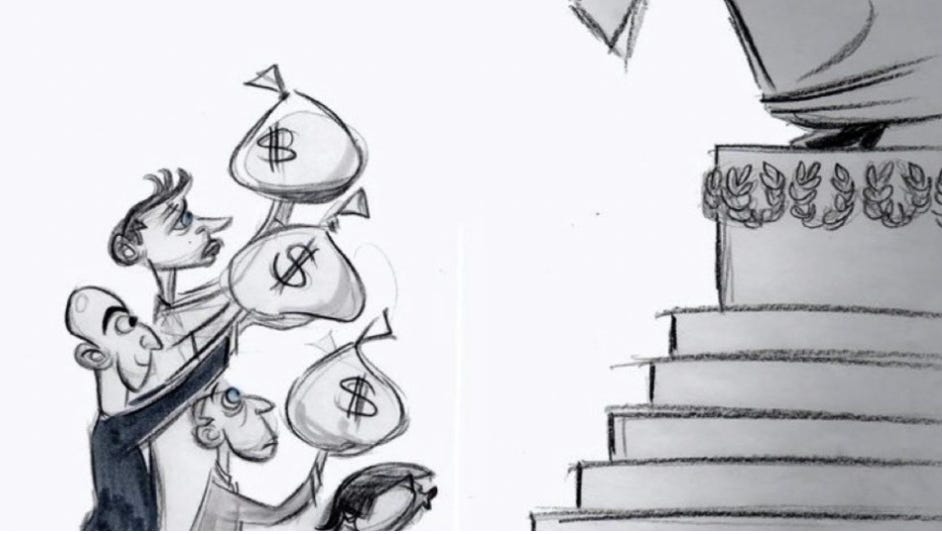
In some respects, Musk mirrors the times, reflecting a new Gilded Age that – literally – emanates from the Trump White House. It’s as if the megawealthy don’t need to bother with the little people or those in need anymore.

“This is an era of a more voracious capitalism, of billionaires trending right and getting ahead by embracing an administration that is happy to dole out favors,” The New York Times recently reported in a piece headlined The Billionaire Backlash Against a Philanthropic Dream. “Many of today’s ascendant billionaires are dismissive of philanthropy as nothing more than public relations.”

The piece quoted sociologist Aaron Horvath as calling the Giving Pledge a “time capsule” of a bygone era, albeit just 16 years ago. “It feels old school,” he said. Billionaires, he said, now think: “I can keep my head down and keep making money. I don’t have to put up with this charity charade anymore.”

Perhaps they are following Trump’s lead. Recall that the Donald J. Trump Foundation was forced to close down in 2018 after New York’s Attorney General at the time said it functioned “as little more than a checkbook to serve Mr. Trump’s business and political interests,” and engaged in “a shocking pattern of illegality” that included unlawfully coordinating with Trump’s 2016 presidential campaign.

The Trump foundation had been charged with “improper and extensive political activity, repeated and willful self-dealing transactions, and failure to follow basic fiduciary obligations or to implement even elementary corporate formalities required by law.” A couple of notable examples cited by the Times: the foundation bought a $10,000 portrait of Trump that was displayed at one of his golf clubs. And one transaction was revealed by a note in Trump’s handwriting that said $100,000 of foundation money should be directed to another charity to settle a legal dispute between the Town of Palm Beach and Trump’s Mar-a-Lago resort.

To be sure, there is a reasonable argument that one of the best ways for wealthy people to give back to society is by running successful, growing businesses that create jobs. Some 150,000 or more people work for Musk companies, for instance. With such a job base, it’s not surprising that he has said that his businesses “are philanthropy,” according to the Times.

But where does this leave people who can’t work? People with disabilities, inadequate skills or education, people who aren’t going to be software engineers or, literally, rocket scientists? Where does this leave children in disadvantaged families? Are the rich just blind to them?

Studies have shown that as people get wealthier, they not only lose touch with those on society’s margins, but they lose empathy for them. “Wealthy people are less likely than poor ones, in lab settings at least, to relate to the suffering of others,” The Atlantic reported in 2021, in a piece headlined “Research Proves It: There’s No Such Thing as Noblesse Oblige.”

Researchers hooked volunteers up to ECG machines and showed them two short videos: a “neutral” video of a woman explaining how to construct a patio wall and a “compassion” video of children receiving chemotherapy treatments for cancer, the magazine reported. Compared with wealthier subjects, poorer subjects not only reported feeling greater compassion for the kids but also exhibited a significantly larger slowdown in heart rate from one video to the next. It seems our hearts slow down when people experience compassion.

Yes, wealthy families donate significantly more money to charity on average than poor families do, but they tend to give away a smaller share of their income. “As wealth goes up, the stinginess seems to increase,” one researcher said.

And people such as Musk are unembarrassed by their lack of fellow feeling.

Notoriously, he told podcaster Joe Rogan in 2025 that “the fundamental weakness of Western civilization is empathy.” Citing a Canadian marketing professor who has written on the topic, Musk warned against “civilizational suicidal empathy,” explaining “I think you should care about other people, but you need to have empathy for, for civilization as a whole, and not commit to a civilizational suicide.”

Civilizational suicide, it seems, means having too much compassion for the less fortunate. That’s not a problem for Musk and his buddies, especially his on-again, off-again friend in the White House. Even though he’d be committing the worst of the sins, Gekko would be proud.

Watch the parkin’ meters

Why do so many politicians disappoint us?

Joseph Weber

Source: Goodreads

In 1965, Bob Dylan released “Subterranean Homesick Blues,” a nod to the Beats of the 1950s, particularly Jack Kerouac’s novel, The Subterraneans. The stream-of-consciousness autobiographical book explores a deeply flawed writer struggling in an ill-fated romance.

In Dylan’s hallucinatory, fast and wonderful song, many of the lyrics are memorable, but perhaps none more than these:

Look out kid
You’re gonna get hit
But users, cheaters
Six-time losers
Hang around the
theaters
Girl by the
whirlpool
Lookin’ for a new
fool
Don’t follow leaders
Watch the parkin’
meters

Let’s pounce on the “leaders” lines for a moment. When we look at the number of politicians – i.e., leaders – with serious personal flaws, Dylan’s libertarian final lines in that verse seem prescient and, sadly, all too enduring.

From awful presidents, such as Donald J. Trump, to accomplished ones, such as William J. Clinton, to many in lesser offices, we see people who use their power and various professional positions for sexual manipulation and dishonesty of all sorts. In some cases, we see financial misdealings and political malfeasance.

One key question is: why do such deeply flawed people – often individuals with tortured personal psyches — seek public office? What is it that they seek in politics? And, perhaps more important, why do voters elect them (though not always, as we’ll see below)?

Certainly, many of us are not paying mind to Dylan’s caution.

Everyone knows that the dirt in the lives of the people with feet of clay has a way of coming out. Surely, folks in media know that all too well.

Just as Trump and Clinton’s sometimes sordid misadventures with many women were front-page news, so, too, were those of John F. Kennedy (at least, after his presidency and assassination) and Ted Kennedy. Same with former Colorado Sen. Gary Hart, whose presidential hopes were shattered by the “Monkey Business” scandal.

More recently, we had former Rep. George Santos, who was expelled from Congress in 2023 after repeated scandals came to light, including colorfully falsifying his background. A prodigious liar, the Republican congressman made up stories about his college education, his employment, his real estate, his religious background, his athletic achievements, his wealth and even his mother’s death (he claimed it was on 9/11). What nailed his career were convictions on wire fraud and aggravated identity theft.

Santos was sentenced to 87 months for his criminal convictions but served just three months because Trump commuted his sentence. Trump said the fraudster had been “horribly mistreated.” Birds of a feather, perhaps?

Recall that Trump is a felon, convicted on 34 counts of falsifying business records. He was also civilly found to be liable for sexual abuse and defamation of the writer E. Jean Carroll, on whom he has sicced his Justice Department for alleged perjury. Trump is on the hook for more than $80 million in the Carroll affair.

Trump also just pardoned the unfortuitously named Stephen Buyer, a former Republican congressman from Indiana who served nearly two years in prison for making illegal stock trades based on inside information after he left office, as The Guardian reported. Buyer was sentenced in 2023 for trades he made while working as a consultant and lobbyist. He was released in 2025, and the Supreme Court in May rejected Buyer’s appeal without comment or noted dissent.

Even though three of the six conservative justices on the court are Trump appointees, the president in effect overruled them in granting a full, complete and unconditional pardon to this convicted felon.

Again, birds of a feather, it seems.

Graham Platner, source: Maine Public

Of course, plenty of Democrats have much to answer for, too. Now, we have a Senatorial aspirant, Maine’s Graham Platner, a 41-year-old political naif who is expected to win the Democratic primary and to run in the fall against the 73-year-old Republican stalwart Susan Collins.

Platner brings a steamer trunk full of personal baggage. Among his offenses are making demeaning social media posts about women, sporting a since-covered up Nazi tattoo and alleged (but denied) reports of physical intimidation of at least one woman he dated. His wife has said he sexted with several women early in their marriage, as she suggested that “no marriage is perfect.”

For his part, Platner has said that recent reporting about him “struggling, not being a good boyfriend, certainly self-medicating with alcohol,” is something he’s been “very up front since the beginning of this campaign that that was a pretty dark period of my life after I came back from my combat service,” as Forbes noted. He added there are things in media reports that he “absolutely will take responsibility for…But those serious allegations are just not true.”

Nonetheless, his chances of beating Collins have “plummeted,” as the news outlet reported. “Bettors on Kalshi predict the race is now a toss up with the Democratic candidate’s odds falling from 72 percent last month to 54 percent early on Saturday [June 6]. On the crypto betting platform Polymarket, Platner’s odds have a similar drop, falling from 78 percent on May 23 to 60 percent …”

The stakes in the Maine fight are enormous, though. A win by Platner could tilt the balance in the Senate toward Democrats, putting party officials in a precarious position. Do they hold their noses and support a tainted candidate? Or do they shun him, offended by the stench of a senator sitting with them for the next six years (at least) with much to apologize for?

David Frum, source: Facebook

David Frum, writing in The Atlantic, posed the matter as a choice between “character and power.” He compared the Platner quandary to the choice Republicans faced in 2017 with Roy Moore, a Senatorial candidate from Alabama who, as a 32-year-old assistant district attorney had “initiated sexual contact” with a 14-year-old girl, as well as three other women, whom he pursued when they were underage.

GOP leaders including Sen. John McCain and two dozen other Republican senators as well as then-Senate Leader Mitch McConnell urged Moore to quit the race, even though the Republicans had hung onto the Senate by a thread. Moore refused to quit but ultimately lost the race to a Democrat.

“Not as paragons of moral virtue but as pragmatic politicians, the Senate Republicans of 2017 made and executed a calculation: We are better off sacrificing the Alabama Senate seat for three years than enduring Roy Moore as a Senate colleague for who knows how long,” Frum wrote. “To defend Platner, Democrats will have to choose between two strategies: denouncing as liars a possibly growing number of women—or else accepting the stories, but then arguing that twisting a woman’s arm and locking her in a room is not quite the same as beating her.”

Certainly, the l’affaire Platner knocks the Dems on the back foot.

“Do they want to haggle over just how inappropriate these romantic relationships were, even as they argue that wearing an SS tattoo throughout most of one’s adult life does not prove that one is a literal Nazi?,” Frum asked. “These are not conversations that Democrats should wish to prolong in a year that might otherwise deal with Trump’s abuses of power, corruption, and economic mismanagement.”

Whether Platner could serve as a perfectly fine legislator, despite his dubious past, is an open question. Some argue that personal foibles, especially sexual ones, are irrelevant to an elected official’s ability to do a decent job in office. After all, the argument goes, we’re not choosing someone for sainthood, but just to do a decent job for constituents.

But the problem is that character outs, it seems. It seems likely that the citizens of New Jersey would have been better off if Robert Menendez, now a felon residing in a prison in Pennsylvania, had not been elected. He was convicted in 2024 of multiple corruption and bribery charges involved gold bars, cash and luxury cars and is now serving an 11-year sentence.

And, certainly, the nation would have been better served if Vice President Spiro Agnew hadn’t accepted hundreds of thousands of dollars in bribes and kickbacks while serving in various offices before the White House. He resigned in disgrace but avoided jail time even as he paid back hundreds of thousands of dollars.

For Menendez and Agnew, their mendacity didn’t go public before they attained their electoral heights. It took a while for their dirty laundry to get aired. With others, such as Clinton and, certainly, Trump, the flaws were well known and apparently forgiven by the electorate. Now, with Platner, the smudges on his escutcheon are slowly becoming apparent.

But the question remains: why do such flawed people seek the limelight, even when it can sear them? Is there something in their tortured psyches about seeking redemption or justification? Do they turn to public adoration as a way to fill holes in their character and mental makeup?

Perhaps more important, though, why do voters look past their sometimes obvious faults? Have our standards plunged so much that character is irrelevant now?

For Dylan and for plenty of journalists long accustomed to covering political scandal, the lesson is clear. Keep a skeptical eye on all politicians and would-be politicians. Don’t fall in love with them, especially those whose views align with yours. Vote for those who seem to speak for you but recognize that they’ll usually disappoint you in the end.

And, even as you watch their often troubling antics, be sure to watch your parkin’ meters. Perhaps happily, there’s no doubt that the stuff of our ordinary workaday lives deserves more attention than many of the people we choose to represent us.

Moi, moi, moi

Trump apes a 17th century king – without his grace or taste

Joseph Weber

King Louis XIV, source: Biography

In 1655, King Louis XIV of France may or may not have uttered the aphorism widely credited to him: “L’État, c’est moi.” The phrase — meaning “I am the state” — has come to symbolize a national leader’s extraordinary egotism.

Whether he said that or not, there’s little dispute that Louis’s self-regard was exceptional. He saw himself as the direct representative of G-d, the personification of the divine right of kings, and even chose the sun as his emblem. At least in his own mind, he was the omniscient and infallible “Roi-Soleil” (“Sun King”) around whom the entire realm orbited, according to “History.

But there’s also no doubt that Louis created remarkable monuments during his 72-year reign, the longest in monarchical history (he was anointed at age 4). Among his projects in Paris were the Les Invalides hospital and retirement complex, the Place Vendôme and the Place des Victoires, as well as the tree-lined avenues that later became the Champs-Élysées. He reigned over the creation of the 150-mile Canal du Midi, linking the Atlantic and the Mediterranean Sea. And he built the stunning Palace at Versailles.

Are we hearing echoes today in Washington, D.C., however pallid, thin and embattled they are? Are we seeing a leader’s massive ego (without the substance of a Louis XIV) in a display of cloddishness that looks like a parody of Louis’s grace? Are we seeing a cartoon caricature of a monarch trying to immortalize himself as he dodders toward an 80th birthday?

Ballroom construction, source: NPR

It’s not only the gilding of the White House, the construction of a huge ballroom abutting the place or the planned 250-foot-tall Triumphal Arch near the Arlington National Cemetery that seems to be part of a pathetic parade of self-adulation by Donald J. Trump. It’s also festooning his image on passports, on banners that decorate federal buildings, on a proposed $250 bill, on commemorative coins and a national park pass, his name on the Kennedy Center (though that soon seems about to end, thanks to a judge). And, of course, we have the bluing of the Lincoln Memorial Reflecting Pool, as contractors – whom he may or may not have picked — repaint it to look like a swimming pool at Mar-a-Lago.

Source: The Washington Post
Source: The Guardian
Source: Snopes

Now, with a breathtakingly self-indulgent effort, we have Trump’s latest plan to cast his self-admiration across as big a canvas as possible. He plans to turn what was to have been a 250th celebration of the history of the United States, on the National Mall in D.C., into rallies for himself — opening the fair with a MAGA rally and giving a July 4 keynote speech.

At least seven of nine musical artists have dropped out of the multiday celebration, slated to begin in late June, because of the partisan cast it was taking. So Trump posted this on his Truth Social:

“It’s difficult to read this without laughing, but it’s no joke,” wrote former U.S. Secretary of Labor Robert Reich, who served under Presidents Ford, Carter and Clinton. “His malignant narcissism is ramping up even higher than its usual galactic level.”

But the enduring mystery is why Trump’s devotees apparently see no flaws in their leader’s perverse psychology. To the extent that they are aware of history, why do they not see a man casting himself here as a tacky version of a 17th century French king? Or, more sinisterly, as a Stalin, Mussolini, or Kim Jong-Un, someone desperate to feel and seem all-powerful — but even that in a distorted fun-house mirror way — “a man who gets much larger audiences than Elvis in his prime.”

Pathetic? Perhaps the very definition of it. But do his followers really see his image-spreading as signs of strength that they applaud?

Certainly, Trump sucks up attention and flattery like a pampered puppy. Watching a Cabinet meeting, for instance, can be painful because of the way otherwise bright people prostrate themselves before him, as if they are supplicants before Pharoah.

The New York Times reviewed over a dozen hours of Cabinet meeting footage and found that, on average, at least one of every six sentences out of the mouths of his acolytes either flattered Trump, gave him credit or criticized his political opponents.

“You have saved this country,” Treasury Secretary Scott Bessent said. “You have changed America and created the golden age,” crowed Commerce Secretary Howard Lutnick. And the arch-flatterer, Secretary of State Marco Rubio, speaking bizarrely of the lingering Ukraine-Russia War, effused “… the country owes you a great debt of gratitude and the world, really, because I mean you’re the only leader in the planet that can bring the two sides together …”

Cynically, one might say that these Cabinet lapdogs are simply doing what foreign leaders have learned to do to try to stay in Trump’s good graces: speaking glowingly of him to his face, and in front of the cameras, in hopes of a friendly pat on the head. Japan’s prime minister, Sanae Takaichi, told him in February: “I firmly believe it is only you, Donald, who can achieve peace across the world.” Israel’s Benjamin Netanyahu has spoken of Trump’s “unmatched leadership.”

Indeed, one can imagine that such people — with their spouses or trusted advisers behind closed doors — dismiss Trump as, instead, a horse’s ass. Perhaps one day, when Trump is gone, and the memoirs come out, we’ll hear what they really think.

Certainly, the words some former associates have used are far different than those of today’s toadies.

As The Guardian reported, their terms have been “fascist,” “conman,” “predator” and “cheat.” Former White House Chief of Staff and former Gen. John Kelly called Trump an “idiot” and the head of a “Crazytown” administration. Another former General, Mark Milley, who chaired the Joint Chiefs of Staff called Trump a “fascist to the core” who was doing “great and irreparable harm.” And former National Security Adviser John Bolton has said Trump is “unfit to be president” and “hasn’t got the brains” for a dictatorship.

Prepping for the UFC, source: ABC

Still, when Trump assembles his crowds at the bizarrely low-end June 14 Ultimate Fighting Championship matches at the White House and later at the Great American State Fair, plenty of MAGA fans will show up. Recall that many showed up on Jan. 6, 2021, when Trump beckoned them to the Capitol, where they rioted.

Trump, like monarchs and despots, is drawn to spectacle, especially when he is at the center of it. But, despite the crowds that will show up, there’s plenty of reason to believe that Trump’s act is wearing thin with many Americans.

About 58 percent of Americans now disapprove of Trump’s job performance, according to the latest polls. Just 21.7 percent strongly approve of the job he’s doing, while another 17.2 percent only somewhat approve and 48 percent “strongly disapprove.” As pollwatcher Nate Silver has reported, that’s less popular than Joe Biden was at this point in his term (-13.6) and less popular than Trump himself was during his first term (-10.6).

Whether such distaste for Trump shows up in the November midterm elections remains to be seen, of course. But, for now, with all his desperate self-promotion, this Sun King-wannabe is looking more like someone on whom the sun is going down and pretty fast.