Do we want “watchful protectors?”

Flock cameras ignite a bipartisan backlash
Joseph Weber

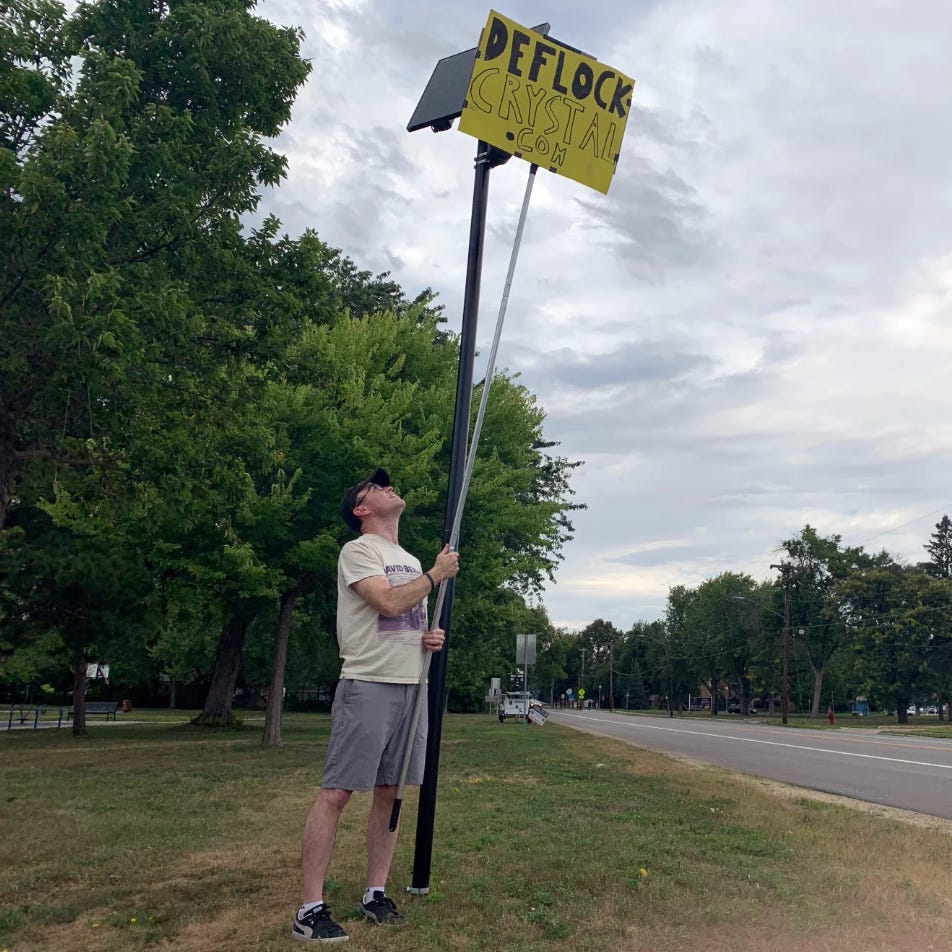
A Flock camera opponent makes his view known, source: NPR

In late August, a 23-year-old driver weaving on a west Denver road late at night ticked off an 18-year-old and his passengers in another car. The younger man flashed his lights and his friends made obscene gestures, enraging the older fellow enough that he gave chase and repeatedly fired a gun, according to police.

He hit one of the passengers, who died four days later.

The shooter sped off with a Denver police car in hot pursuit. But, in the end, investigators used surveillance video, including from Denver’s Axon and Aurora’s Flock cameras, to track the car and capture the killer.

Score another win for the more than 100,000 such cameras that have popped up all across the U.S. The Denver case comes atop more than one million criminal investigations and incidents last year that were aided by Flock cameras, according to Flock Group Inc. The Atlanta-based company claims that its ubiquitous cameras were involved in one of every five resolved cases and that they helped authorities find more than 10,000 missing persons.

So, what’s not to love about the cameras, which don’t collect images of people but rather of vehicle information, principally car license plates? Well, according to a strange-bedfellows mix of right-wingers and lefties, there’s plenty to hate about the so-called ALPRs (automatic license plate readers) from Flock and its increasingly popular rival, Axon Enterprise Inc.

On the left, the “creepy cameras” drew the ire of the ACLU. “Just think about how much someone could learn about your life if cameras constantly tracked where you drove,” the group says. “They could find out which doctors you visit, what house of faith you worship at, who you visit or drive around with — even which political meetings and protests you attend.”

The ACLU points to repeated use of Flock by ICE and CBP to go after immigrants without warrants. “Kansas police used them to pursue a man who wrote a critical op-ed about the department, while a Colorado police officer wrongfully accused a woman of theft based on a Flock hit and then refused to look at evidence proving her innocence,” the group adds. “A mother and her children were held at gunpoint because ALPR cameras wrongly flagged their car as stolen.”

Meanwhile, on the right, Texas Gov. Greg Abbott, recently told police departments to stop spending state money on Flock Safety cameras. As The Texas Tribune reported, Abbott pointed to a Lufkin, Texas, police officer now facing 100 counts of misusing public information for allegedly using the area’s Flock cameras to surveil eleven people for more than a year. At least six police departments and sheriff’s offices across Texas in the past month have announced that officers were being placed on leave, investigated or criminally charged in misuse cases.

Florida Gov. Ron DeSantis quickly followed Abbott’s move with orders to have the systems pulled off roads in his state. DeSantis, who also opposes using automated systems to clock speeders, describes the surveillance technology as “out of control.”

As Newsweek reported, more than 150 U.S. communities have now rejected, canceled or deactivated automated license plate reader systems, according to the anti-surveillance project DeFlock, marking a sharp increase in just a few weeks. They range from Lynchburg, Virginia, and Asheville, North Carolina, to Gloucester, Rhode Island. Summit County in Colorado, where I live, suspended its deal with Flock for 30 days to seek public comment.

At least nine of the 30 cameras in my county have been taken down or vandalized in recent weeks.

Across the country, the cameras have even become a midterm campaign issue. The Associated Press reported that candidates for governor in Wisconsin have sought limits, while others in Pennsylvania have supported a ban. A Michigan congressional candidate called the cameras “un-American,” and an enterprising Florida Senate candidate began offering campaign merchandise opposing them.

Donald J. Trump seems to be trying to suss out the politics involved, perhaps calculating how many votes his party could lose by taking a stance. “Well, it’s being studied right now,” Trump said, according to the Washington Examiner and PBS News. “You know, you have pros and cons, right? It’s being studied right now. We’ll have an answer soon, as to our views on it, in the coming weeks.”

For its part, Denver canceled its contract with Flock, but replaced it with cameras from Axon, known to police for its Tasers and body cameras. Denver halved the number of cameras to 50 under Axon, which backers say offers better privacy protections. Unlike Flock, which keeps its data in a national database accessible to law enforcers across the country, Scottsdale-based Axon limits its information to individual subscribing agencies. Denver, for instance, owns and controls its data. And that data disappears after 21 days.

Still, in the recent Denver murder, cameras from both companies played a role, it appears. Notwithstanding the abuses – which surely merit prosecution – there’s little question that the heightened surveillance with such cameras has been enormously helpful in nailing bad actors.

It all reminds me of a visit I made a while ago to Singapore, where cameras track not only vehicles, but people. On a bicycle tour of the city-state, our guide asked us why we had not seen any police officers or cars. His answer: there are few of them because everyone knows they are on camera in any public place. The result is an extraordinarily low crime rate, with just 341 physical crimes for every 100,000 residents reported last year.

Singapore “watchful protector,” source Singapore Police Force

Americans and Singaporeans, the guide noted, have different ideas about the tradeoff between safety and privacy. The “watchful protectors,” as Singapore police call them, don’t sit well with lots of Americans.

For me, the issue is something of a no-brainer, though, a case of flailing after a barn door when the thoroughbreds are miles down the road already.

As a matter of principle, I see little difference between my license plate being eyed by a roving police car or a cop on the corner and a fixed camera. Moreover, there are few public places anymore, it seems, where cameras don’t track our movements. Go to any shopping mall, walk into many shops, and trip down most city streets and it’s a good bet you are on candid camera.

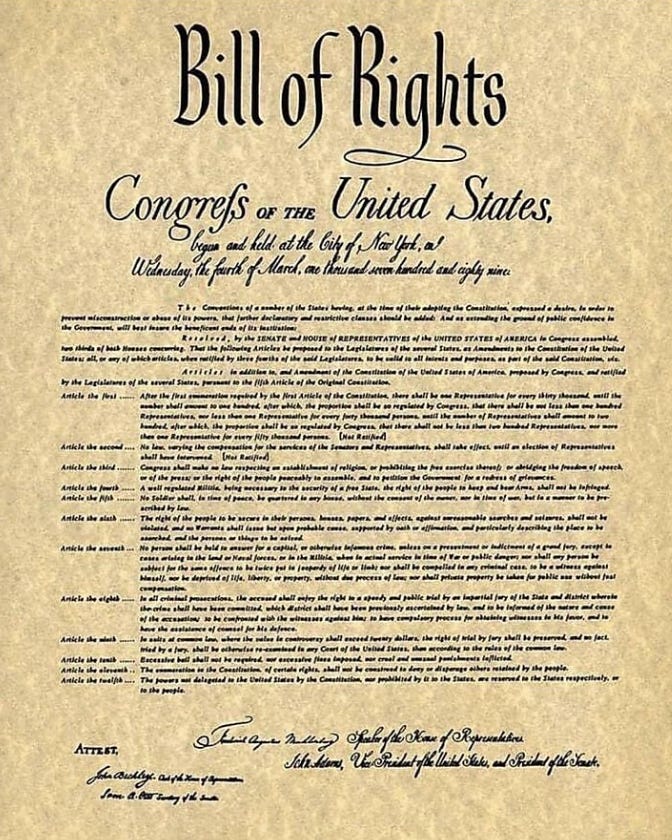
Is this a good thing? Not sure about that. Is it creepy, as the ACLU says? No question. Still, that seems to be life in America and much of the rest of the world in 2026. Privacy seems to have become as quaint as the parchment the Bill of Rights was written on.
Source: Cato Institute

There’s no doubt for me, however, that abuses of the system by ICE or cops pursuing lovers who jilt them demand prosecution. Such things are far creepier than having my plate clocked while driving down Main Street in Frisco or anywhere else. Perhaps suitable regulation with good oversight would come in handy.

But depriving cops of a tool that can nab murderers or find missing folks? I suspect few of us would be down with that.

Livin’ the Disney Dream

A cruise offers a few lessons

The Disney Dream, source: Disney

Some 52 years ago, I made a silly mistake. Seeing myself as very much a counterculture creature at that time, I looked on high school proms as just so unhip. The formal clothes, corsages, etc., were just not my jam, as we might say now. They seemed so, well, Establishment and the cool kids were anything but that. So, I skipped my prom.

Now, I have a different view. Such anti-Establishment notions, it seems to me today, were essentially snobbish, ways of looking down one’s nose at others who were just not “aware” enough (today we might say “woke”). I didn’t disdain friends who rushed off to rent formal clothes, and get dates, photographs and limos arranged, but I thought the scene just wasn’t for me. Somehow, I was above or at least apart from all that.

Of course, I would have liked the motel rooms that groups of the guys booked at the Jersey Shore for them and their well-coiffed newly adult (i.e., about 18 years old) girlfriends. But that would have been for other reasons.

I’m put in mind of all this because I just got back from what surely has to be one of the most Establishment things one can do — a cruise on the Disney Dream. For a week, my wife and I, our son and daughter-in-law and three grandkids steamed about the Mediterranean. We stopped off at a few Greek islands and we spent a good bit of time on board a very large ship, one that holds 4,000 souls and a host of cartoon characters.

Disney Royalty

This was, in some ways, very prom-like. Girls and women on such trips dress up as princesses, men and boys as pirates or princes – and those are not just the employees, but the cruisers. Meanwhile, Disney employees parade about, decked out as Mickey Mouse, Minnie Mouse, Donald Duck and a host of others in the Mouse House universe, strutting and posing for photos to the delight of kids and their parents, alike.

All the while, music from uplifting Disney movies plays in the background on nearly all 13 decks on that ship. Some tunes are reprised during evening shows when cast members in Broadway-style productions caper about on a stage suited to any New York legitimate theater. Think “Beauty and the Beast” in a venue that rocks and sways slightly. The production values are impressive.

One of several elegant family dining spots

And then there’s the food. It’s unlimited at breakfast and lunch and is exceptionally varied. In the evenings, dinner rotates among several lavishly appointed restaurants. We skipped the adults only restaurants, though they were there for those wanting to get away from the kids for a while. For such times — or anytime — there were, nursery and kid’s club programs (that kids, like the 3-year-old with us, really, really want to go to).

A couple wading pools and an adults only pool (complete with wade-up bar) round out the offerings. And above it all, folks can fly through a tube on fast-rushing water, the AquaDuck water coaster. Remarkable fun. There’s also a track for burning off the many calories one consumes, along with a workout room and spa.

I’m no Disney cultist of the sort found at times in the parks and on the ships – people who count their visits on many more than two Mickey hands. But our weeklong adventure, to and from a port near Rome with stops in Naples/Pompeii, Mykonos, Santorini, and Chania on Crete, was extraordinary. Yes, it was the ultimate conventional tourist thing to do, but it was wonderful.

Reality, of course, is all too ugly at times in ways that make Cruella De Vil and evil stepmothers seem far too tame. But with Disney one can be immersed in a fantasy world that can be surprisingly engaging when seen through the eyes of the 6-and-under set, like our grandkids. Piracy in the real world is monstrous, but on the boat it’s all makeup and “aarghing.”

Moreover, the real-life elements that make Disney ride high among entertainment and hospitality companies are exceptional. From a business point of view, the company knows its markets, knows what its public wants, and it serves that up to a fare-thee-well.

On board the Disney Dream, the details knock your socks off (or those yellow Mickey shoes, perhaps). Portraits of characters around the ship move and talk when one stands before them. Waiters know what the kids eat each night. The level of cleanliness in the halls and staterooms (post-cleaning) is the definition of shipshape.

And the staff — the “cast members” — bring their A-game each day.  From stateroom “hosts” who make the beds to ship mechanics, people greet guests warmly on sight. Each night, the ship’s officer group –- clad in Navy-like dress whites – gather for events to chat amiably with guests.

Source: Disney

As I dealt with the multilingual and ethnically varied crew and staff, as well as with fellow guests, I was reminded of a bright, bold contrast, one involving the blinkered view of the world that Florida Gov. Ron DeSantis brought to his silly fight with Disney. Recall that DeSantis in 2022 signed the Parental Rights in Education Act. As NPR reported, the “Don’t Say Gay” law restricts how sexual orientation and gender identity are discussed in the schools. Disney’s former CEO Bob Chapek spoke out against the law and said he’d work to overturn it. “That angered DeSantis, who then worked with Republican lawmakers to pass a measure revoking Disney’s self-governing status,” NPR said.

DeSantis, of course, also derided the “wokeism” that he argued plagued Disney. The company famously reaches out to customers and staff of varied backgrounds and orientations, and the governor lambasted that approach as he tried to appeal to a very different constituency – the straight, white anti-LGBTQ and anti-immigrant crew that dominates the MAGA GOP.

On the ship, the variety of people that Disney serves and employs is apparent. The cruises draw passengers of all sorts, including straight white folks. Its crew includes people from all across the world, some of whom (such as our dinner servers) are supporting families back in India and elsewhere with their earnings from several-month stints on board ship.

Disney both employs and serves the broadest of markets. Its “wokeism” and its aggressive embrace of diversity may have offended DeSantis (or perhaps he was just being opportunistic about that). But the company’s decisions to appeal to a rainbow-like array of constituencies in films, music and other vehicles (including ships) are simply smart business moves. Disney CEO Bob Iger, who succeeded Chapek, may or may not share a welcoming ideology, but he knows what his customers and staffers want. He knows those whom he serves.

DeSantis’s political moves, by contrast, seemed aimed at a very narrow slice of the electorate, one that surely will diminish in time. MAGA bigotry and narrow-mindedness won’t disappear, of course, but demographics suggest it will appeal to fewer and fewer Americans over time.

So Disney is remarkably conservative – consider those carefully coiffed princesses and happy tales of good prevailing over evil – but also progressive. It is prom-like but with a modern spin, perhaps something akin to the group dates that many high schoolers now indulge in, rather than conventional couples nights out.

Curiously, today’s wokeism is really just an updated version of the counterculturalism of my high school years in the late 1960s and early 1970s. In that sense, a Disney cruise or visits to the parks can be pretty hip things to do.

I later regretted missing my prom, but I’ve made up for it with visits to Disney parks in Florida and outside Paris with grandkids, along with that cruise. Smitten with the Dream, my wife and I are making arrangements for another such big boat ride next year, this one with more grandkids.

I still can’t quite bring myself to wear those Disney ears, as some adults on the cruise did. But, if one of the grandkids insists, I won’t fight too hard.

The dominance of dumbness

Anti-intellectualism has a long history in American culture

Source: HubPages

A friend set me to thinking about the long and unsavory history of anti-intellectualism in American life. This strand of our culture didn’t begin with Trumpism, of course, though the anti-science and anti-elites chords the former president strikes so powerfully are exceptional examples of it. Indeed, it’s not by accident that Donald Trump in 2016 singled out the group he had most affection for, saying: “We won with young. We won with old. We won with highly educated. We won with the poorly educated. I love the poorly educated.”

Nor has this phenomenon been exclusively a province of the right, which boasts of many ignorant folks but also the likes of the brilliant (if often distasteful) William F. Buckley. In fact, a most intriguing commentary on the phenomenon came in 2001 from conservative economist Thomas Sowell in “The Quest for Cosmic Justice,” where he wrote:

“From its colonial beginnings, American society was a ‘decapitated’ society—largely lacking the top-most social layers of European society. The highest elites and the titled aristocracies had little reason to risk their lives crossing the Atlantic, and then face the perils of pioneering. Most of the white population of colonial America arrived as indentured servants and the black population as slaves. Later waves of immigrants were disproportionately peasants and proletarians, even when they came from Western Europe … The rise of American society to pre-eminence, as an economic, political, and military power, was thus the triumph of the common man, and a slap across the face to the presumptions of the arrogant, whether an elite of blood or books.”

As a trip through Wikipedia reveals, there is much support for Sowell’s view. A minister in 1843 wrote about frontier Indiana (one of our most undereducated states): “We always preferred an ignorant, bad man to a talented one, and, hence, attempts were usually made to ruin the moral character of a smart candidate; since, unhappily, smartness and wickedness were supposed to be generally coupled, and [like-wise] incompetence and goodness.”

Such views have long infused our politics, sometimes with well-schooled leaders who either demagogued on this stream of thought or just warmed to it. Consider the 1912 thoughts of Woodrow Wilson, who, despite his doctorate from Johns Hopkins, said: “What I fear is a government of experts. God forbid that, in a democratic country, we should resign the task and give the government over to experts. What are we for if we are to be scientifically taken care of by a small number of gentlemen who are the only men who understand the job?”

American historian, author, and Columbia University professor Richard Hofstadter (1916 – 1970) poses for a portrait, New York, 1970. Two of his most important works are ‘Anti-Intellectualism in American Life’ (1963) and ‘The Paranoid Style in American Politics’ (1964). (Photo by Bernard Gotfryd/Getty Images)

A thorough discussion of this trend came in 1963 from Columbia historian Richard Hofstadter. In “Anti-intellectualism in American Life” he argued that anti-intellectualism was how the middle-class showed its feelings for political elites. As that group developed political power, he contended, it held up the ideal candidate for office as the self-made man, not a well-educated man born to wealth.

More recently, in 1980, author Isaac Asimov observed: “There is a cult of ignorance in the United States, and there has always been. The strain of anti-intellectualism has been a constant thread winding its way through our political and cultural life, nurtured by the false notion that democracy means that ‘my ignorance is just as good as your knowledge’.”

Susan Jacoby, Source: WBEZ

Since then, many folks have dusted off this theme. Journalist and author Susan Jacoby in her 2008 book, “The Age of American Unreason,” bemoaned what she called the resurgence of anti-intellectualism in the modern era. According to The New York Times, she blamed it on television, video games and the Internet, saying they created a “culture of distraction” that has shortened attention spans and left people with “less time and desire” for “two human activities critical to a fruitful and demanding intellectual life: reading and conversation.”

Certainly, the forces Jacoby pointed to exacerbate the cult of ignorance we are awash in. Still, history shows that it’s nothing new. The new media that preoccupy us now may just be building on that well-rooted base. One has only to look at the success of Fox News to see how deep that base is.

We might take heart, however, that there’s an ebb and flow at work. At various times in our history, we have swung from respecting (and electing) smart people to choosing ignoramuses. How else to explain descents such as that from Thomas Jefferson to Andrew Jackson (in just 20 years) and from Barack Obama to Donald Trump (in no time at all)?

It’s troubling, nonetheless, that politicians such as Ron DeSantis feel a need to play down or deride their elite-education credentials to try to harness votes from the masses that are less-schooled than they. After using Yale as a steppingstone to Harvard Law School and then entering politics, he soon realized that such credentials were “a political scarlet letter as far as a G.O.P. primary went,” as The New York Times reported. As he has sought to remake higher education in Florida, DeSantis has also said he would eliminate the federal Department of Education, among other agencies.

For his part, Trump has bragged — when it suited his purposes — about attending an Ivy League school, the University of Pennsylvania, even as he failed to mention that he had transferred there after two years at the less tony Fordham University, as The Daily Pennsylvanian reported. In fact, he claimed to have graduated first in his class in 1968 at the university’s Wharton School, though the school newspaper’s investigation of this did not bear that claim out. Indeed, he did not even make dean’s list that year.

He also has often derided intellectuals and pursuits such as reading. He told a reporter for The Washington Post in 2016 that he has never had to read very much because he can reach right decisions “with very little knowledge other than the knowledge I [already] had, plus the words ‘common sense.’ ” Moreover, Trump told the Post that he is skeptical of experts because “they can’t see the forest for the trees.”

Despite the choice of Joseph Biden in 2020, we seem now still to be perilously in a period when the pendulum remains far from valuing education in our leaders or elsewhere. Indeed, it’s troubling how few Americans today put a premium on schooling, a trend concomitant with the rise of book-banning nationwide. Our next election will be revealing about many things (not least of which are understandable concerns about the current president’s age), but it may also mark either a departure from the pendulum’s swing or its confirmation.

An Assault by the Right

George Wallace, source: The Washington Post

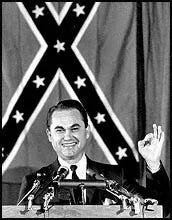
Conservative assaults on higher education are nothing new. Recall George Wallace’s vitriol about “pointy-headed intellectuals” in the late 1960s. Years before then, in 1952, William F. Buckley Jr. earned his spurs with the book “God and Man at Yale,” lambasting universities for straying from his dearly held Christian principles. That same year, the House Un-American Activities Committee investigated Communist methods of infiltration in education, as political analyst Pam Chamberlain explained in “The Right v. Higher Education: Change and Continuity.”

Indeed, it has become an article of faith in conservative circles that universities are dominated by lefties who don’t educate, but who indoctrinate. Ronald Reagan in his first gubernatorial campaign in 1966 stoked conservative hostility toward the University of California schools, particularly UC Berkeley, which was a center of demands for free speech on campus and a locus protest against the Vietnam war. After his attacks succeeded, and he forced the schools into a position of needing to charge tuition for the first time in their history.

Unlike these scattered efforts, however, today’s conservative movement is mounting well practiced and orchestrated assaults on what its supporters see as rampant liberalism in education. These drives are led by governors and lesser politicians who in calculated campaigns have won elections or appointments to boards of regents and higher education panels, particularly in red states.

Florida Gov.Ron DeSantis epitomized the drive in 2021 when he signed legislation designed to crack down on a perceived bias in the classrooms by requiring schools to survey themselves annually to measure “intellectual freedom and viewpoint diversity” on their campuses. He followed up early this year by packing the board at the New College of Florida with rightists determined to remake the campus and squash liberal viewpoints there.

He’s hardly alone, however. Other officials have driven out educators they believe would espouse values they can’t stomach, especially on matters of diversity, equity and inclusion (which evidently are values they can’t abide. Consider the actions of the U.S. Supreme Court against affirmative action in university recruitment).

Nikole Hannah Jones, source: NBC News

Most notable here are the cases of two distinguished New York Times journalists who, perhaps not coincidentally, were Black women:

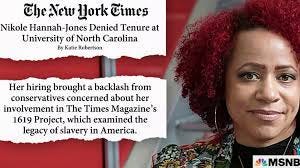
— Nikole Hannah-Jones, whose leadership of the 1619 Project earned a Pulitzer Prize, was appointed in 2021 as the Knight Chair in Race and Investigative Journalism at the University of North Carolina’s Hussman School of Journalism and Media. But, after she was denied tenure by conservative trustees, she decamped to Howard University.

— And this year Texas A&M University drove out former New York Times editor and tenured University of Texas professor Dr. Kathleen McElroy as the new head of the journalism department. After announcing her appointment to a tenured spot, the school’s leaders steadily chipped away at the terms, eventually offering her a nontenured one-year position as a professor of practice with three years as the program director, serving at will. She refused and the university wound up settling with her for $1 million.

An alumni group had agitated against McEloy’s hire, balking at her reported advocacy of DEI. Regents echoed the worries. As The Chronicle of Higher Education reported, one regent texted the chancellor: “I thought the purpose of us starting a journalism department was to get high-quality Aggie journalist [sic] with conservative values into the market.” He wrote: “This won’t happen with someone like this leading the department.”

Take note: the regent didn’t argue for distinguished journalism chops and a commitment to such verities in the field as fairness, thoroughness and accuracy. No. Instead, he applied an ideological test, demanding “conservative values.” Indeed, for conservatives in Texas, McElroy’s affiliation with The New York Times was hardly a plus. It was as if she had worked for Pravda, McElroy said an official at the school told her.  

While often underhanded – as when schools chip away at offers that right-wingers object to – some of the assaults are simply dishonest. A flap this year at Arizona State University, for instance, included an official blaming the university for eliminating her position at the school, when in fact her job went away after a funder — a conservative — pulled his support for her center. The donor was offended when faculty members objected vocally to a couple right-wing speakers coming on campus.

Ronnie D. Green, source: University of Nebraska Foundation

And, sometimes, well-regarded academics who personally may be conservative themselves are victims of the assaults — presumably because they aren’t conservative enough. At the University of Nebraska-Lincoln, where I taught for 14 years, rightists led by then-Gov. Pete Ricketts attacked Chancellor Ronnie D. Green after he led an effort to promote diversity and inclusion at the school. Green, who grew up on a farm in Virginia, made his academic bones in agriculture and was known for his Christian religious commitments, wound up retiring this year as chancellor after just seven years, at age 61.

Aside from such examples, the efforts by conservatives to remake higher education have drawn heat from such groups as the American Association of University Professors. In a recent statement, the AAUP and the American Federation of Teachers condemned the efforts. Their statement said: “Right-wing lawmakers continue to wage a coordinated attack against public colleges and universities with legislation that would undermine academic freedom, chill classroom speech and impose partisan agendas on public higher education.”

The groups cited legislation introduced in at least 23 states that would limit teaching about race gender and sexual orientation, require intellectual and viewpoint diversity statements and surveys, cut funding for diversity, equity and inclusion efforts, and end tenure for faculty. As the groups said, “This legislation is the latest in a multiyear effort by right-wing activists and donors to reshape academia to its liking.”

These efforts come against a backdrop in which many Americans, particularly Republicans, feel hostile to university educations. According to Gallup, only 36% of Americans have “a great deal” or “quite a lot” of confidence in such schooling Among Republicans, only 19% of Americans expressed such sentiments. Given such feelings, academics who hope the public will back them in fights to preserve tenure, for instance, may be sorely disappointed.

Finally, let me share a personal anecdote. I once gave a college tour to a young man who was quite hesitant about entering the University of Nebraska-Lincoln. He told me he feared that his Christian faith would be challenged at the school, despite an abundance of churches on campus. He was trying to figure out if a small Christian college, where he would find reinforcement, would be a better fit for him. I recall thinking a few things: university should be a place where many of one’s ideas as a teenager should be tested (although I doubted his Christian commitments would be), and two, his faith must be a fragile thing, indeed, if it can’t hold up to exposure to people who may believe differently.

And yet, that young man may may be representative of much of the sentiment that has coursed through the right since at least the days of William F. Buckley Jr., before conservatives hit upon the approaches they are taking now.

Today’s assaults may owe their genesis to the isolated attacks of prior decades. But, nowadays, they are well-organized and well-developed. And in a troubling number of cases they are working.