When is understatement misleading?

The New York Times stands accused of calling a “five-alarm fire” a matter of a few sparks
Joseph Weber

Source: Physician’s Weekly

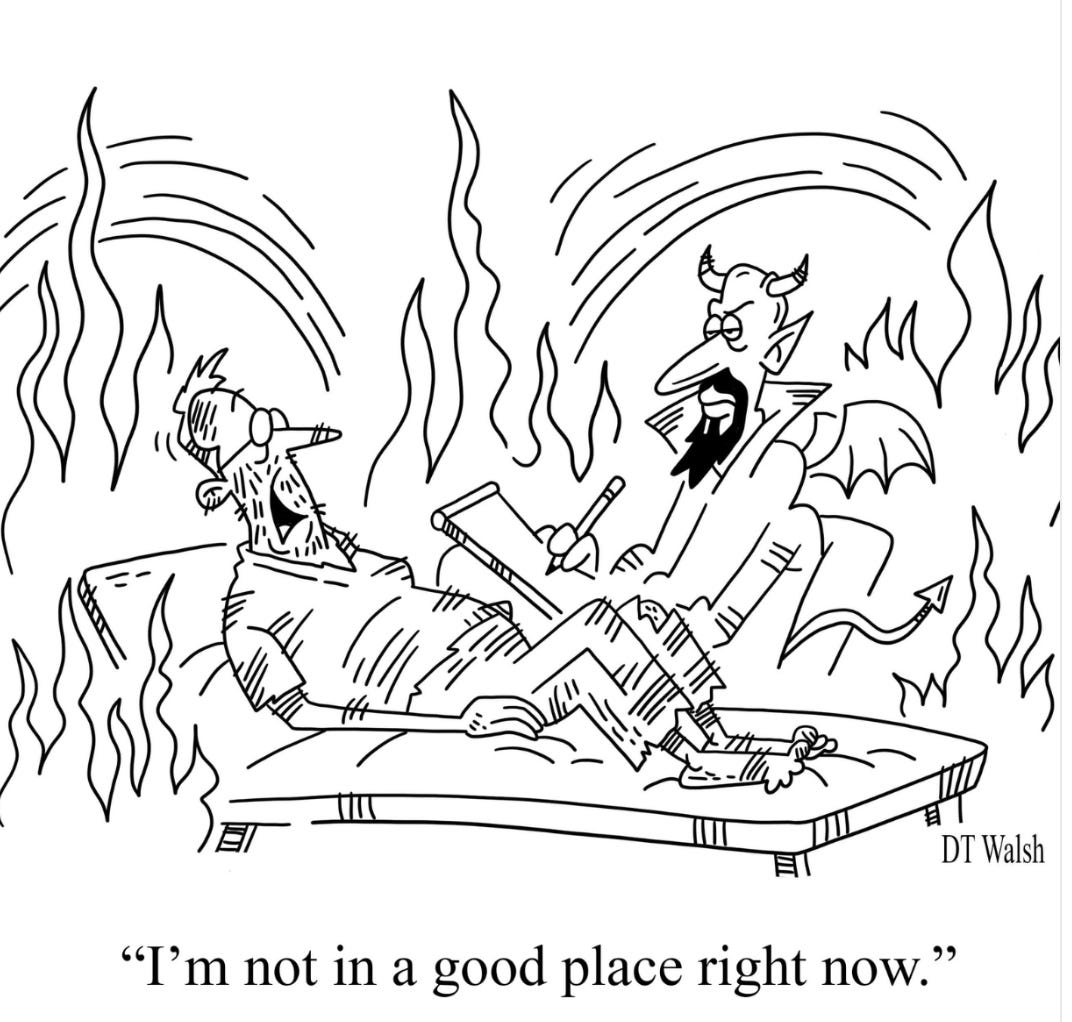
In a text journalism students have used for years, University of Nebraska Professor Emeritus John Bender and his colleagues warn against using loaded words. In order to preserve a sense of neutrality, they counsel against terms such as “extremist,” “radical,” “fanatic” and “zealot,” suggesting they convey value judgments by the writers. Use language that helps keep a reporter’s opinion out of the pieces, they advise.

In an era when overstatements or falsehoods by politicians and their critics alike abound on cable news and elsewhere, however, the advice in the text, Writing and
Reporting for the Media
, seems almost quaint. Stridency and alarm about the state of the Republic seems the order of the day and journalists, some critics say, should reflect that, not mute it with euphemism and weak language.

The New York Times, “The Old Gray Lady,” has waded into the understatement fray in a new weekly newsletter, The Backstory. Patrick Healy, an assistant managing editor for Standards and Trust (an intriguing title given the widespread lack of trust in media nowadays), answers reader queries in the publication about the paper’s coverage of any number of issues.

The newsletter is home to “Sound Off,” where Healy parries, thrusts and explains things in exchanges with readers. In the debut edition, Healy went back and forth with Mark Jacob, a former metro editor for The Chicago Tribune, about whether the muted language the Times often uses in pieces about Donald J. Trump ill serves readers and the country. Jacob bristles at headlines such as “Trump Has Moved the Ethical Line” and terms suggesting that the president is “sidestepping norms” or is “untethered to the truth,” when the man and his aides are just lying.
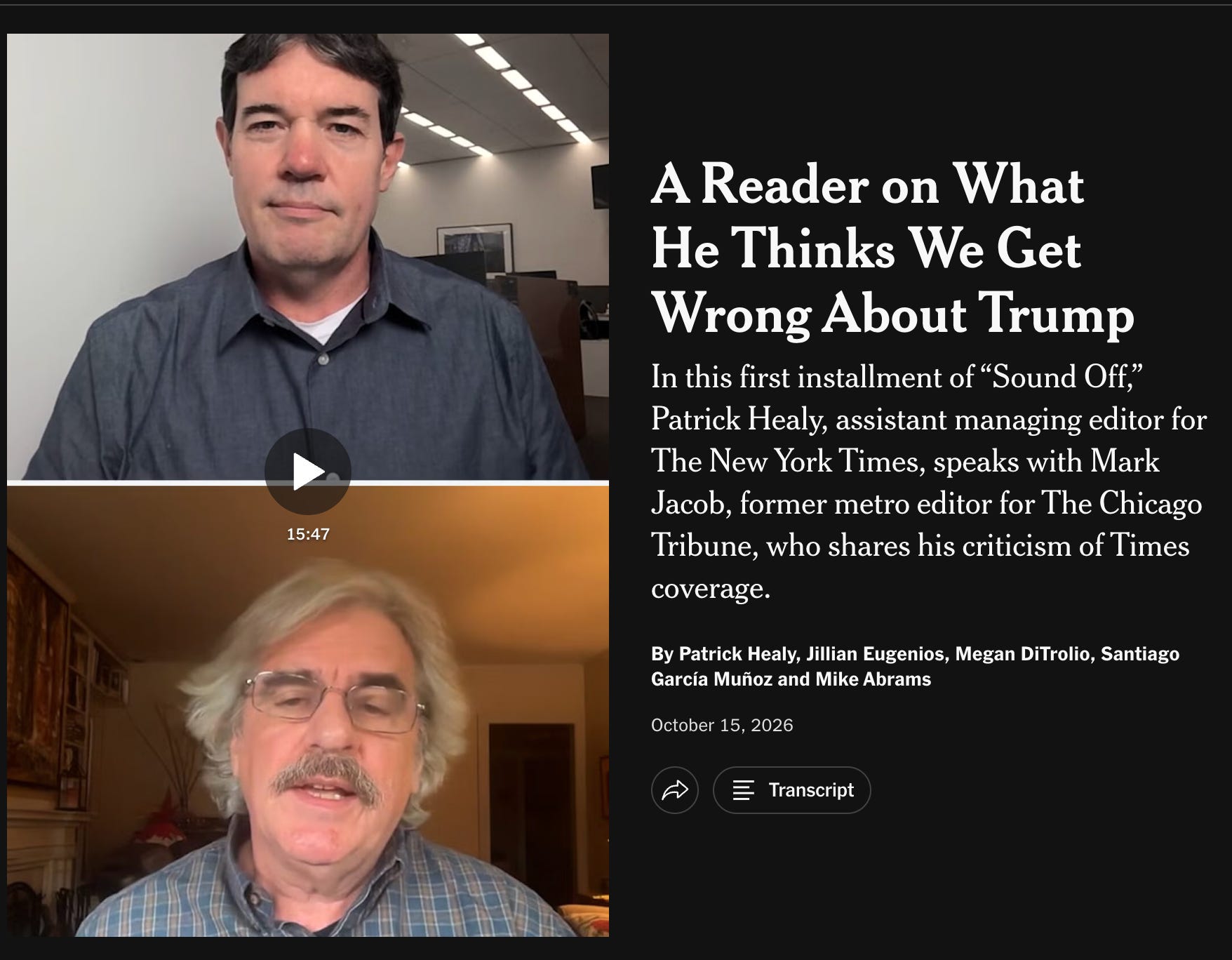
Source: The New York Times

Jacob pointed to a piece about former press secretary Karoline Leavitt that described her as fierce, steely, nimble and a homegrown star of the Trump White House. He said the piece “never once mentioned that she had constantly lied to the press during her entire time as press secretary. I mean, this woman, for example, after Renee Good was killed by ICE in Minneapolis, Karoline Leavitt called her a lunatic said that she was deranged and called her a domestic terrorist.”

He said the story “seemed to be awarding her style points, and a fascist liar like Karoline Leavitt is — does not deserve to be like praised for how good she is at lying.”

Instead of couching terms in euphemism and understatement, Jacob contended, The Times should be writing headlines such as “Donald Trump is assaulting democracy.” He added that “The New York Times not taking Trump seriously enough as far as normalizing his behavior and minimizing what I think is just a five-alarm fire in the country. And, I mean, I feel like The New York Times might think it’s being tough on him, but it’s just not being tough enough.”

Healy countered that the paper tends to be “precise but also measured” in its language. It doesn’t lean into terms “like fascist and liar” in its wording, though it does quote others saying such things, he said. He contended that “we do tend to be really careful about the most potent and inflammatory words. And yes, sometimes do use those in our own voice, but we’re very careful about it.”

The AME said: “What we’re trying to do, again, is bring facts to people, accurate information that whether you’re a Democrat or a Republican, you would look at it and say, that’s corrupt or that’s authoritarian. We don’t need to tell you that in some blunt terms, we’ll give you those details.”

Healy argued that The Times focuses “on bringing those facts and that revelatory information to light, not just about hurling words at someone and calling them names, ultimately.” And for that effort, he maintained, “a lot of people across the spectrum, including a lot of people on the left and the Democratic Party, trust us because they believe that we’re presenting the facts in a straight way.” He held that “sources trust us as kind of a nonpartisan news organization.”

For his part, Jacob insisted that the paper’s approach soft-pedals the corruption and threats that Trump represents. He faulted The Times and others in the news business for living “on what I call Neutrality Island,” arguing that this approach constituted a lack of bravery.

The argument, a fascinating one, reminds me of hoary battles about “objectivity,” a term many journalism veterans have abandoned. No one can be objective, they say, suggesting that everything from the stories publications pursue — or don’t — to the sources they choose to quote — or don’t — are, in fact, very much subjective. That doesn’t mean good journalists aren’t obliged to be both fair and thorough and, yes, neutral in their choices of adjectives and descriptions.

Anyone who reads The Times consistently would have to agree that in its news columns – and even more so on its editorial page – the paper is almost never in Trump’s corner. In today’s edition alone, we read about how much Trump policies could cost Republicans dearly in Iowa, how young voters are tilting Democratic, how Trump is “openly embracing Mr. Putin and easing the economic pressure on the Kremlin,” and how Trump’s Washington D.C. golf course plan will harm area residents.

These are not Trump-friendly pieces of the sort one might find, say, on Fox News or other right-wing outlets.

Source: Boston Political Review

So, is it necessary to say outright that Trump is a “fascist,” a “menace” to democracy, a “corrupt self-enriching demagogue?” Would it be helpful to describe his MAGA adherents as underschooled ignoramuses? Or should The Times and others quote folks saying such things, but in its own words stick to restrained language of the sort an old gray lady might favor?

If The Times used the hard-hitting terms Jacob and other critics might prefer – insisting they are more accurate – would it make any difference to readers, moreover? Surely, The Times doesn’t hope to win over Trumpists with its linguistic neutrality. That would seem to be a pipe dream; Trumpists, I suspect, aren’t reading critical news outlets, but instead they opt for Fox News and its ilk to hear their prejudices affirmed by the likes of Leavitt.

And readers of The Times stick with it, I’m sure, similarly to have their biases echoed and reinforced — no matter how much Healy insists it’s only delivering “straight” news.

In the end, The Times does seem to twist itself in knots to avoid accusing the notoriously dishonest Trump of lying, for instance. Still, terms such as “untethered to reality” do bring a certain elegance to reporting that accurately recounts the man’s venality.

Face it, we all know that Donald J. Trump is a corrupt and incompetent buffoon whose mental stability is at least questionable. But in the news columns do we need such rhetoric to make the point? Don’t the facts alone make that case? And doesn’t every new critical story just drive home the point anew, no matter how understated its headline may be?

The dispassionate, even cool-headed, journalistic approach Bender and his old-school colleagues press for may seem out of step in our overheated times. But perhaps they are still onto something.


Can minds be changed?

Social media may make the task difficult, perhaps impossible

Joseph Weber

Source: jobboom

Vanderbilt social scientist Arthur C. Brooks, who styles himself The Happiness Professor, wrote an intriguing piece for The Atlantic four years ago called “A Gentler, Better Way to Change Minds.”

In it, he noted that research “shows that changing minds, especially changing beliefs that are tied strongly to people’s identity, is extremely difficult. As one scholar put it, this personal attachment to beliefs encourages ‘competitive personal contests rather than collaborative searches for the truth.’”

He suggested, moreover, that online arguments make things worse. “Disagreements can feel like a war in which the fighters dig trenches on either side of any issue and launch their beliefs back and forth like grenades. You wouldn’t blame anyone involved for feeling as if they’re under fire, and no one is likely to change their mind when they’re being attacked.”

I’m reminded of this by a couple interchanges I had on Facebook with a couple former BusinessWeek colleagues. One set was based on a piece someone else shared that enumerated historical problems between Palestinians and Israelis. The other was based on a Wall Street Journal editorial that took the Nobel Committee to task for awarding the peace prize to Navi Pillay whose career, it said, “has been marked above all by hatred for Israel and the Jews that support it.”

Provocative as they were, these pieces gave my friends platforms for attacking Israel, the writers and, oddly, AI. Their criticisms, in fairness, did make some valid points, though there were no point-for-point refutations or even any of the real back-and-forth that marks in-person conversation. Mostly, they vented — briefly and sometimes tartly — making their cases or mounting attacks.

Source: The New York Times

One of 55 posts in response to my posting of the WSJ editorial called it “[a]nother tone-deaf misread of history, geopolitics, and the real dangers facing Jews around the world today,” for instance. Another asserted that Israel’s actions in Gaza amount to a “genocide,” though it dismissed the matter as “almost a semantic distraction,” contending that the term “massacre” would make right-wingers “just as hysterical.” The writer also defended the use of “apartheid” and “racist” as descriptive terms for Israel and, puzzlingly, referred to the U.S. as still having a “slave-based economy” today. She called Israeli democracy “an outright falsehood.”

Another friend derided opinion pieces that slammed Hamas and held that scholars of genocide broadly concurred that the term for the destruction of a people was suited to Gaza — though evidence suggested that there was far from a consensus on the point. She faulted what she called “poor sourcing and unfounded assertions.” She didn’t single out any examples, when pressed, but instead added, “I’ve said all i can usefully say.” On the matter of Israel limiting access to Gaza for journalists, she faulted an account of how various militaries, including those of the U.S., have limited journalistic access to war zones over time, calling it mere “whataboutism.”

All fair enough, I suppose. We all have deep-set views about such unsettling topics.

But I got the discomfiting sense that pieces I posted in response to their contentions went unread or, at least, unconsidered. It’s as if I cast them into a void, that they couldn’t be bothered reading something contrary to their biases or views. Or, if they did read them, they simply dismissed them as “opinion pieces.” One sympathetic friend, responding separately, noted that opinion pieces do often contain facts, suggesting that I remind my friends of that point.

Disturbing as some of these things may be alone, though, the more troublesome thing is a core problem related to the Net broadly and to social media in particular. Thanks to such vehicles, we are exposed to an astonishing explosion of diverse views. We are awash in more facts and viewpoints than ever before in history – not limited as we once were to, say, three major TV networks or a handful of newspapers. And yet, it seems many of us just see what we want to see, reading or viewing only what reinforces our prejudices.

Do we, in these interchanges, really consider the views of others or facts that contradict our biases? And are we really exposed to such dissenting views? If not, it’s perhaps because we are abetted in this narrowness by social-media algorithms that don’t share contravening information.

Maybe it’s inevitable that, as we sit separately in our homes and sift through information tailored for us, we remain blinkered. It’s far different from, say, meeting in a book club, where we converse with others who open our eyes and minds to different views of a piece of literature. It’s different from a classroom where, as young people, we were exposed to a range of novel views. And it’s far different from BusinessWeek editorial discussions, back in the day, where we were challenged — and challenged back — in live-and-in-person thrusts-and-parries of conflicting ideas about topics.

Source: Clean Speech Colorado

Along this line, I was privileged a while ago to attend a few dinners in Denver, where a rabbi of my acquaintance invited people in for “Clean Speech” dialogues. His concept, which he has rolled out nationally over the last few years, is to invite people in to talk at tables of eight so about hot topics on which there is likely to be disagreement. Facilitators – and sometimes speakers – provide some context and expert information. But the idea is to debate and disagree civilly — the “clean” part.

These dinners are set in a Jewish context. So, at one session, we discussed whether a two-state solution is still possible in the Middle East. At another, we discussed whether Jews have a home in the major political parties anymore. There was, of course, a lot of disagreement – though the discussions were all done respectfully and, I believe, people learned things they might not have considered. Certainly, I did.

In at least one of the dinners, I believe, one person’s mind seemed to have been changed. I don’t know about others. But, whether that happened or not, we did listen to one another, consider opposing views, and offer our feelings considerately and politely, if at times strongly.

“Showing others that you can be generous with them regardless of their values can help weaken their belief attachment, and thus make them more likely to consider your point of view,” is one of the phrases with with Brooks concludes his Atlantic piece. It’s easier to do that when sitting opposite someone over a meal.

That idea, moreover, echoes something I teach students in an editorial-writing course – that it’s helpful to concede points to your opponents when appropriate. Such an approach can buttress your view by showing that you recognize and consider the other side.

“But for your values to truly be a gift, you must weaken your own belief attachment first,” Brooks holds. “This is the argument of the late Buddhist master Thich Nhat Hanh. As he taught, we should all promise to ourselves, ‘I will cultivate openness, non-discrimination, and non-attachment to views in order to transform violence, fanaticism, and dogmatism in myself and in the world.’”

That’s a tall order when so many of us are so divided on so many things. But, for a host of reasons – not least of which is one’s own emotional well-being – it seems like smart advice. Whether people active on social media can heed it, of course, is a knotty thing.

October 7th

Maybe fiction can help us grasp it

Joseph Weber

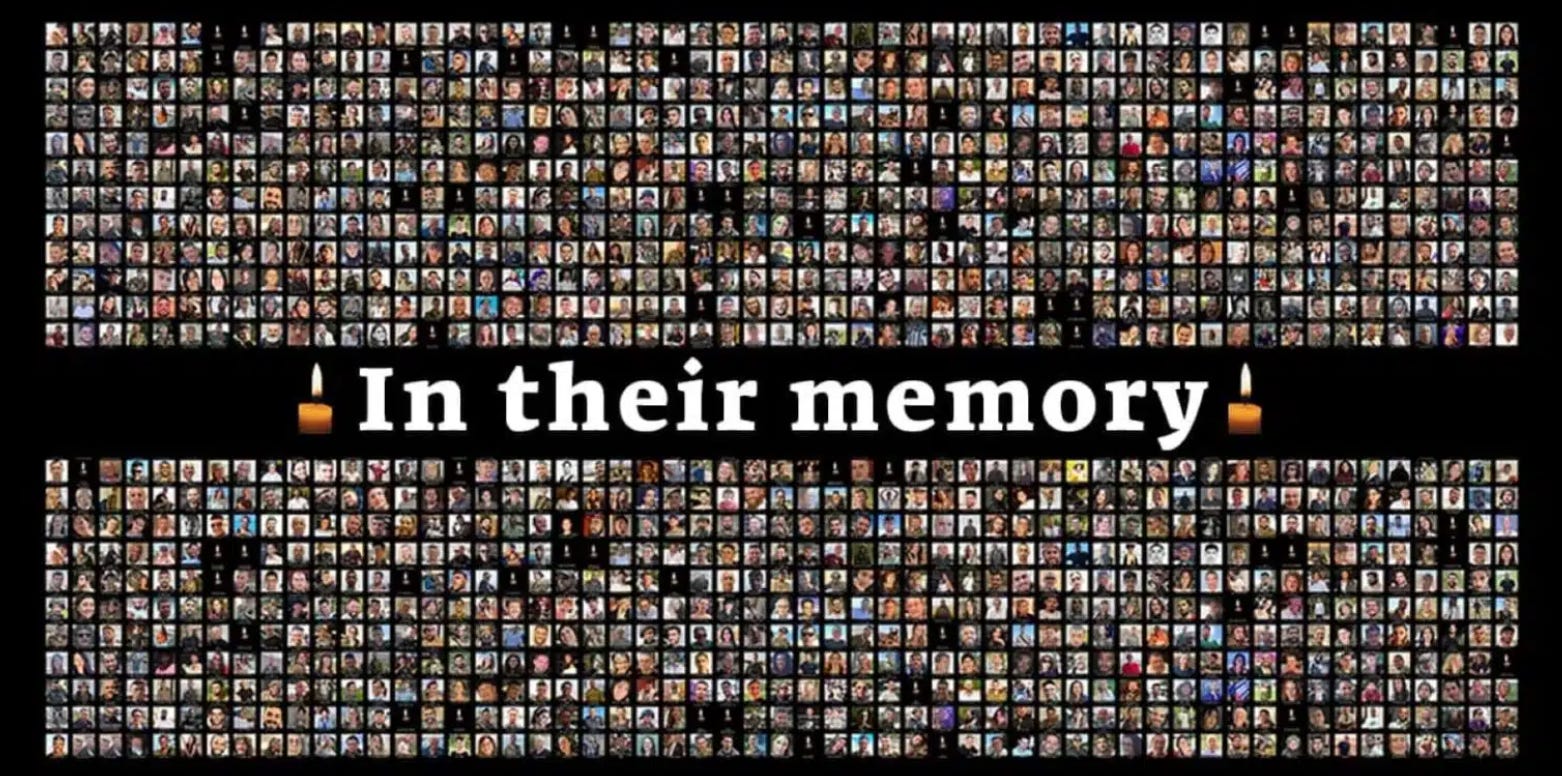
The October 7 Memorial Wall; source: National Library of Israel

Six years ago, a retired Drake University professor wrote a piece in Psychology Today headlined “Why is Fiction More Believable Than Fact?” Fiction, Patricia Prijatel wrote, “can force us to face our realities far better than any news story.”

Skeptical about that? Well, here are some facts that are scarcely believable:

Three years ago, on Oct. 7th, Israel was subjected to the most horrific assault in the nation’s then 75-year history. Some 6,000 terrorists broke through fences in Gaza to massacre 1,200 people in some 20 Israeli communities. They slaughtered more than 350 people at a music festival. They raped and mutilated women. The terrorists wantonly murdered children and took at least 38 kids hostage, among the more than 250 people they carried off into Gaza, triggering an ongoing war that has taken some 70,000 lives so far.

The terrorists did this despite a Muslim tenet, a hadith that orders the faithful to not kill women or children. They even killed fellow Muslims and kidnapped some of them. Their savagery knew no bounds, as they moved from house to house in Israeli kibbutzim, torturing people as they filmed them and setting fire to entire neighborhoods.

So how can we process such horror, such inhumanity by people who invoke Allah as they commit unspeakable acts?

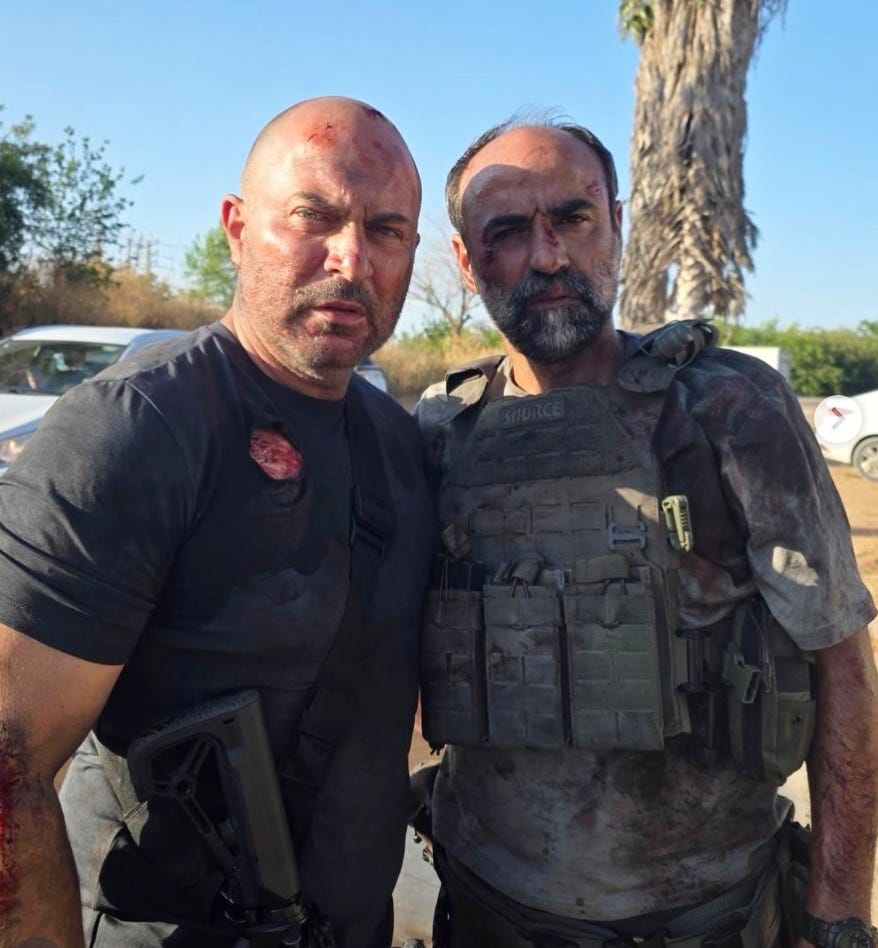
Lior Raz and Yaakov Zada-Daniel, in Fauda

One way, I believe, is through fiction, as Prijatel contended. Recently, I finished watching the fifth season of Fauda, a Netflix show featuring Lior Raz, a former elite Israeli commando who co-created the series. This latest season is all about coming to terms with Oct. 7th.

Two of the 11 episodes recreate some of the atrocities of the Hamas assault. We see the terror through the eyes of a single Israel family trapped and ultimately killed in their home. Perhaps, I should say, we almost experience that fear, as it has haunted me for days.

It is painful to watch. Indeed, Fauda’s producers issued a warning before the release of episodes seven and eight, saying they “include content, sights, and sounds that may be difficult to watch. It’s important for us to say: These episodes return to that terrible day and stand on their own. If watching is too difficult, it’s OK to give up and connect with the season’s plot, which will continue in” subsequent episodes. A disclaimer to that effect precedes each of those powerfully troubling episodes.

To be sure, Fauda gives us some of the big picture, showing bloodied, wounded and murdered people. But it’s a personal and intimate family story that is most haunting, that takes us beyond the bare statistics to make it seem all too real. It is gut-wrenching to see both those who were killed and those who survived them.

“After all, we have all seen dozens of real videos from the attack, many of them filmed by the terrorists themselves, and they were horrifying enough. But this time, the fictional work takes us directly into the horror,” one Brazilian viewer said, as quoted by The Jerusalem Post. The scenes “do not feel like an attempt to imagine the horror. They take us directly into it.”

After October 7th, Raz and his fellow writer, Avi Issacharoff, scrapped the original script idea and recast it to “show to the world this is what happened,” Raz told a Call Me Back podcaster.

For them, it was all very personal. Raz was in Romania, where he was slated to speak, at the time of the assault. He got a phone call from his sister saying she was hiding in a safe room, armed with a knife, and she needed him to save her. He couldn’t then do anything, of course, but he took the first available flight, got his gun and drove to an embattled town, Sderot, where he helped people flee the murderers. His sister, happily, escaped with her sons.

“Each and every one of us is carrying some kind of memory from October 7th,” Issacharoff said.

Nova Music Festival site

In Fauda’s Oct. 7th episodes, we do see beyond just the single family, such as when Raz’s character tries to help young people fleeing the Nova music festival. The writers used real events, recreating them for the screen. For instance, they show how 20-30 concert-goers fled into a big container to hide and were all killed. In another scene, a character walks by young people’s bodies piled atop one another in a shelter.

The series, and the Oct. 7 episodes in particular, hit many viewers around the world hard. One man, quoted by The Jerusalem Post, wrote: “I could barely keep my eyes open.” A woman wrote: “Yesterday, a friend called me and told me the same thing. She added, ‘Who knows, perhaps this series will help people understand the atrocities committed by Hamas on October 7.’”

A viewer in India wrote: “Sleepless nights. Can someone please erase my memory of this episode?? I can’t stop thinking and worrying. Episode eight of ‘Fauda’ really disturbed me. I don’t understand how there are still Hamas supporters among us. God, please help me get over this series.” Another responded: “I am a huge fan of ‘Fauda’ and of Israel, but I don’t have the courage to watch the fifth season.”

To be sure, the writers struggled with how much to show, how graphic to be. They hint at a rape, for instance, but thankfully don’t depict it.

So, some commenters have said the show didn’t go far enough.

“It spared viewers descriptions of women who were gang raped and burned alive, families who were tied together and whose bodies were dismembered, the killing of pregnant women and children, the sexual desecration of bodies, the mutilation of genitalia, and horrific injuries suffered by children,” one viewer wrote. “Many children were also abducted, including infants as young as nine months old. Kfir Bibas was only nine months old when he was kidnapped; he was later murdered in captivity alongside his four-year-old brother, Ariel. The series did not show fathers who had kerosene poured over them and begged for their lives moments before being set on fire as their attackers laughed.”

Still, the Oct. 7th episodes – and the whole series for that matter – should be mandatory viewing for Hamas sympathizers. The savagery of the terrorists becomes all too real, even without the worst of their monstrosity on display.

Beyond the terrible events of that day, we also get a sense of how Israelis try to come to terms both with them and with what many of them had to do afterward as soldiers. The Raz character, Doron Kabilio, is especially riveting as someone revolted by the violence he sees and – like most Israelis involved in defending their country, one expects – someone who loathes the violence he commits. Both rip him apart.

It’s reminiscent of a famous comment by former Israeli Prime Minister Golda Meir: “When peace comes, we will perhaps in time be able to forgive the Arabs for killing our sons, but it will be harder for us to forgive them for having forced us to kill their sons.”

But when one contemplates the horrors the Hamas terrorists inflicted – with exultation – on innocent Israelis, one can only wonder whether the same sensibility that Raz portrays in Kabilio can possibly exist in those heavily propagandized Palestinians. They are taught to hate Jews from their earliest days. Indeed, the terrorists have used children as suicide bombers.

And there can be little doubt that Hamas knew that Israel would respond with overwhelming force to the events it triggered. The group’s leaders accepted the deaths of their fellow Palestinians as “necessary sacrifices,” in the words of the Hamas military leader Yahya Sinwar, who welcomed high civilian casualties as a tool to generate pressure from the world on Israel. He cynically said, “Israel’s journal in Rafah won’t be a walk in the park.”

Israel’s soldiers killed Sinwar in October 2024 in Rafah.

Meir also famously said that peace will come “when the Arabs will love their children more than they hate us.” Perhaps, however, it will come only when the last Hamas fighter is killed or surrenders. But, thanks to the all-too-real fiction displayed by shows such as Fauda, maybe some in the world who are tempted to excuse the group’s horrors will think twice.

Will you be persuaded? Will anyone?

Political ads besiege us, but they can backfire

Joseph Weber

Source: The Atlantic

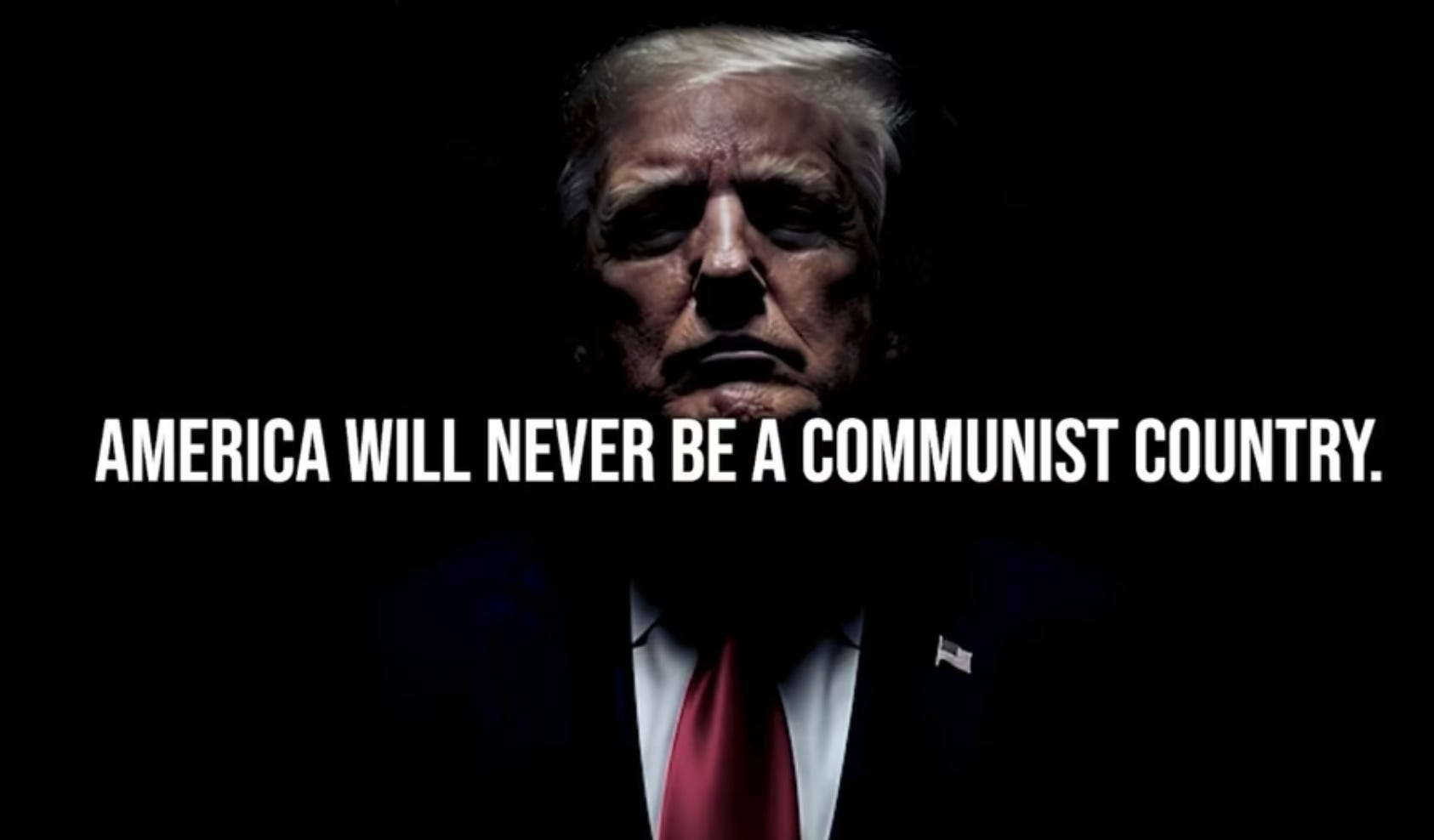
Maybe you’ve seen some of the Trump ads that you, as a taxpayer, are paying for. If not, Donald J. Trump on one of them says “together we will defeat communism, socialism and Marxism in America” and “America will never be a communist country.”

If that ad strikes you as a campaign commercial designed to encourage voters to turn out for the GOP between now and November, the White House says you are just plain dumb. Such ads, which ran on a recent Fox News Sunday show and several college and NFL football games, are “very clearly not campaign ads,” the White House says. No, they just are “a reminder for Americans to love their country and know what it’s worth defending.”

Driving home the point for those numbskulls who might question the pre-midterms timing, Trump’s White House adds, “That’s not partisanship — that’s a government that still believes in the country it serves.”

And Brendan Carr, the Trump toady who runs the Federal Communications Commission, has rebuffed objections from some in the GOP, as well as from Democrats, about the legality of the $20 million TV effort. Asked about complaints from Public Citizen and others, the Trumper said the ad struck him as “normal course public service announcements that you see all the time.”

Never mind the offense taken by some Republicans. For instance, Senate Majority Leader John Thune said: “It’s a great message, I like the message, but it shouldn’t be paid for by taxpayer dollars.” Then there’s Sen. Mike Rounds, who said: “It would not have been something that I would have done…I just don’t think it’s right to be using taxpayer money in that way, particularly if it’s tied to political campaigns.”

And Sen. John Cornyn said the ad, which is nearly identical to one Trump used in his presidential race, crosses a red line. “We all know you’re not supposed to use taxpayer money for that purpose,” he said.

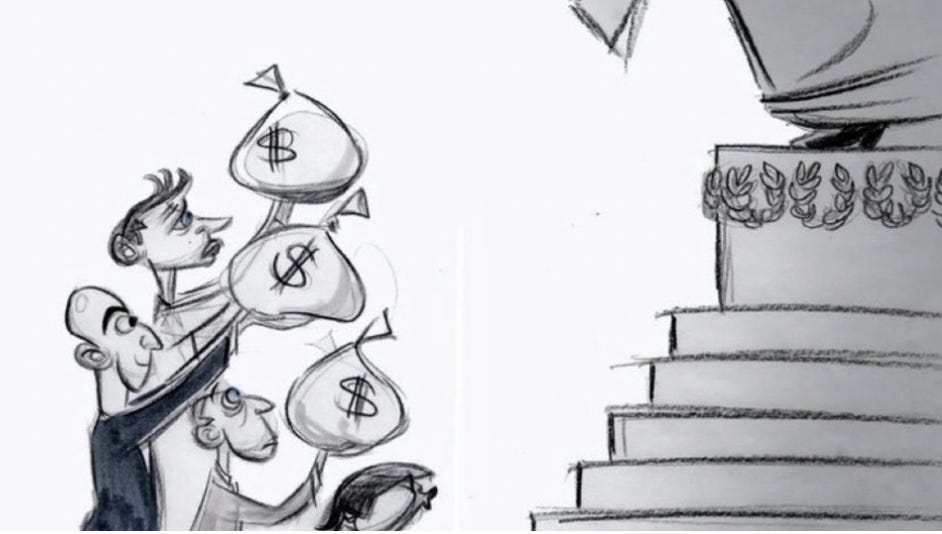
But the larger question is whether such advertising, from Trump or from individual campaigns, makes any difference. If not, the ads are just gifts – whether from taxpayers or unnamed billionaires — to national and local TV operators.

Certainly, plenty of donors and critics believe advertising blitzes can determine elections. “This critical 2026 midterm election may be decided by dark money, big money, tech money,” warns Brennan Center President Michael Waldman. “Above all, secret money. The money storm is now gathering. It could tip the outcome of many races.”

So far, at least $1 billion from anonymous donors has flooded into various campaigns, according to The New York Times. The newspaper tracked TV and digital ad buys, as well as donations to super PACs from nonprofits, saying the dark money surge has “reached industrial scale.” It quoted one critic, Nick Penniman of Issue One, as saying the cash is more than “enough money to manipulate a lot of politicians and to put a lot of poison in the blood of the American political system.”

Ann Telnaes cartoon

There’s no doubt that the part about manipulating politicians is spot on. Legislators and others from presidents on down surely will do the bidding of those who fund their efforts to win and keep office — at least if they want their support the next time.

But there’s plenty of reason to think that a public weary of having their football games, news shows and soap operas interrupted by overly loud attacks on some politicians and encomiums for others may just shut down on the messages. For instance, will Trump’s attacks on communism play at all to voters who have plenty of non-ideological reasons to fault him and his party?

For a partial list of recent presidential blunders just read what Karl Rove, a former adviser to President George W. Bush, noted in The Wall Street Journal about Trump’s antics in September alone.

“The big news out of Republicans’ first-ever midterm convention: If the GOP won, Mr. Trump would give every adult $5,000. There was no prior consultation with congressional Republicans, and there were conflicting explanations of how it would be paid for … It was crickets. Then on Sept. 14, Donald Trump Jr. confirmed to the media that a Russian oligarch paid for his lavish post-wedding celebrations. That’s never a good look.

“Two days later, the president asserted Iranian leaders ‘want to make a deal.’ Six days after that, he said he might have to ‘annihilate the Islamic Republic and do it quickly.’ This left voters whipsawed.

“On Sept. 16, the president said the Kennedy Center would ‘end up being ripped down’ unless the administration received ‘recognition’—i.e., his name on the building. Later that week, the president banned CNN, MS NOW and Politico from the White House press room. A judge soon restored access with a temporary restraining order as the outlets’ lawsuit against the administration proceeds.

“Even as GOP candidates are trying to make radical New York City Mayor Zohran Mamdani the Democratic Party’s face, the president met with the mayor in what a reporter called a ‘lovefest.’ It’s hard to make Mr. Mamdani a pariah—and tarnish Democrats by extension—when Mr. Trump says the self-described socialist has ‘great potential.’

“Then there was last Thursday’s lavish White House dinner honoring Xi Jinping. Mr. Trump’s praise of the dictator as ‘truly outstanding, amazing’ couldn’t hide the summit’s lack of substantive achievement … Then there’s Mr. Trump’s Truth Social post early Sept. 20 that he has ‘agreed to convert’ his planned Triumphal Arch at Arlington National Cemetery into ‘a top grade Military Complex, complete with ‘drones, plus Snipers’ with ‘large quantities of sniper ammunition in storage.’ Who will snipers be targeting? Commuters on the parkway the arch will overlook?”

Matt K. Lewis, source: The Guardian

And consider the view of The Washington Sun’s conservative writer Matt K. Lewis, who calls Trump “a greater threat to my conservative values and policy preferences than any Democrat.”

The tide will shift in a few weeks, he argues.

“Besides, what bad, un-conservative things could Democrats do?” Lewis writes. “I mean, are they going to start another forever war in the Middle East? Start socializing industries? Raise the national debt to $40 trillion? Cause abortion rates to rise? Increase the cost of groceries and gas? Pal around with socialists (like Zohran Mamdani)? Suck up to communists (like Chinese President Xi Jinping)? Nominate a bunch of weirdos, drunks and inexperienced hacks to the Cabinet? Pursue self-enrichment? Start building monuments to themselves? Threaten to use the power of government on their opponents?”

Beyond all the GOP failures that voters can see with their own eyes and experience in their lives (say, shopping for groceries or buying gas or perhaps houses), some academic research suggests that ads have at best a marginal effect. Work by a Yale political scientist and two California colleagues on the 2016 election found “small average effects on candidate favorability and vote… During the primary and general election, in battleground states, for Democrats, Republicans, and Independents, effects are similarly small.”

A CATO Institute review of the effects of digital ads on Facebook and Instagram in the 2020 election similarly concluded that the messages “had, at most, a minimal impact on political outcomes.” This is so even as digital ads are becoming popular tools for politicians.

To be sure, name recognition for little-known candidates and a reminder effect – encouraging people to not forget to vote – would seem important. Moreover, if one candidate stays on the ad sidelines while his or her opponent blasts the airwaves, voters might feel that absence. And there’s evidence that tone — negative or positive — can have an effect.

Researchers at Northwestern’s Kellogg School of Management, in reviewing the 2000 and 2004 elections, found that positive ads encouraged more people to show up on Election Day, while negative ads slightly suppressed turnout. Still, the marketing professor who ran the study, Brett Gordon, noted “No ad ever convinced me to do something.”

And there’s also the possibility that heavy ad spending can backfire, as it did spectacularly in Illinois earlier this year where tens of millions spent by the American Israel Public Affairs Committee may have helped the group’s opponents win primary contests. One, Daniel Biss, the mayor of Evanston, turned AIPAC’s efforts against him to his advantage, as he blasted the group for “trying to buy” the Congressional seat he is running for.

Will Americans cut through the noise and vote based on their interests and their life experiences rather than some Mad Ave whiz’s Hollywoodesque imagination? If they do, a lot of billionaires could soon find that they blew a lot of money trying to con people into doing the opposite.