Raw antisemitism in the academy

An attack on a business-school dean lays it bare
Joseph Weber

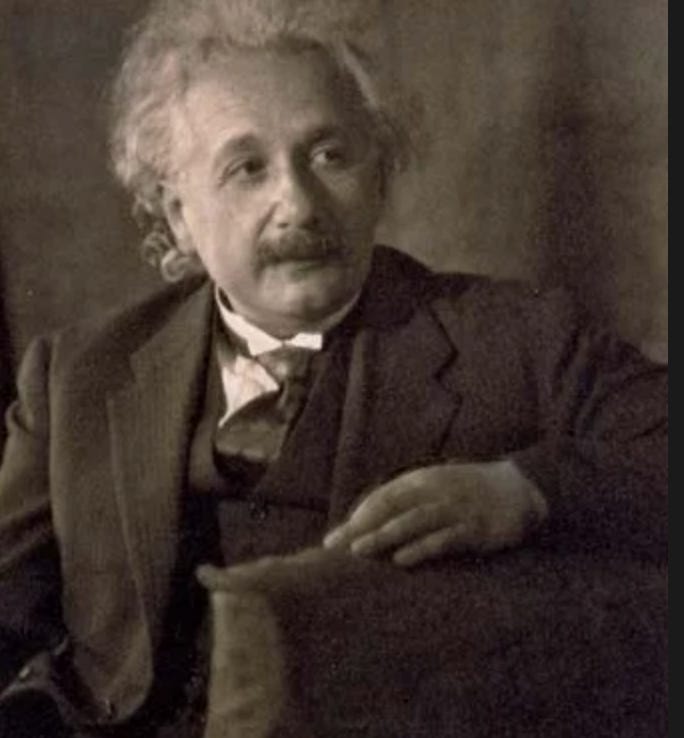
Albert Einstein, source: Library of Congress

In April 1933, less than four months after taking power in Germany, the Nazi Party passed a bland sounding law that ended the careers of some 1,200 Jewish academics. The “Law for the Restoration of the Professional Civil Service” – the Berufsbeamtengesetz — provided that non-Aryans – Jews – could be fired or forced into retirement from their university posts.

Many fled the country, including 14 Nobel laureates and 26 of Germany’s 60 professors of theoretical physics. One theoretical physicist – vocal anti-Nazi Albert Einstein – turned in his German passport and renounced his citizenship shortly before the law was enacted. Einstein, who had been a professor at the University of Berlin and directed the Kaiser Wilhelm Institute for Physics, at the time was teaching at the California Institute of Technology.

“When the Nazis came to power, I looked to the universities that prided themselves upon their intellectual freedom, and they failed me,” Einstein said.

Today, it’s not the government that is assailing Jewish academics in the United States. Rather, the assaults come from within the universities. They are led by students, faculty, staff, and organized faculty-led or endorsed campus groups, including unions.
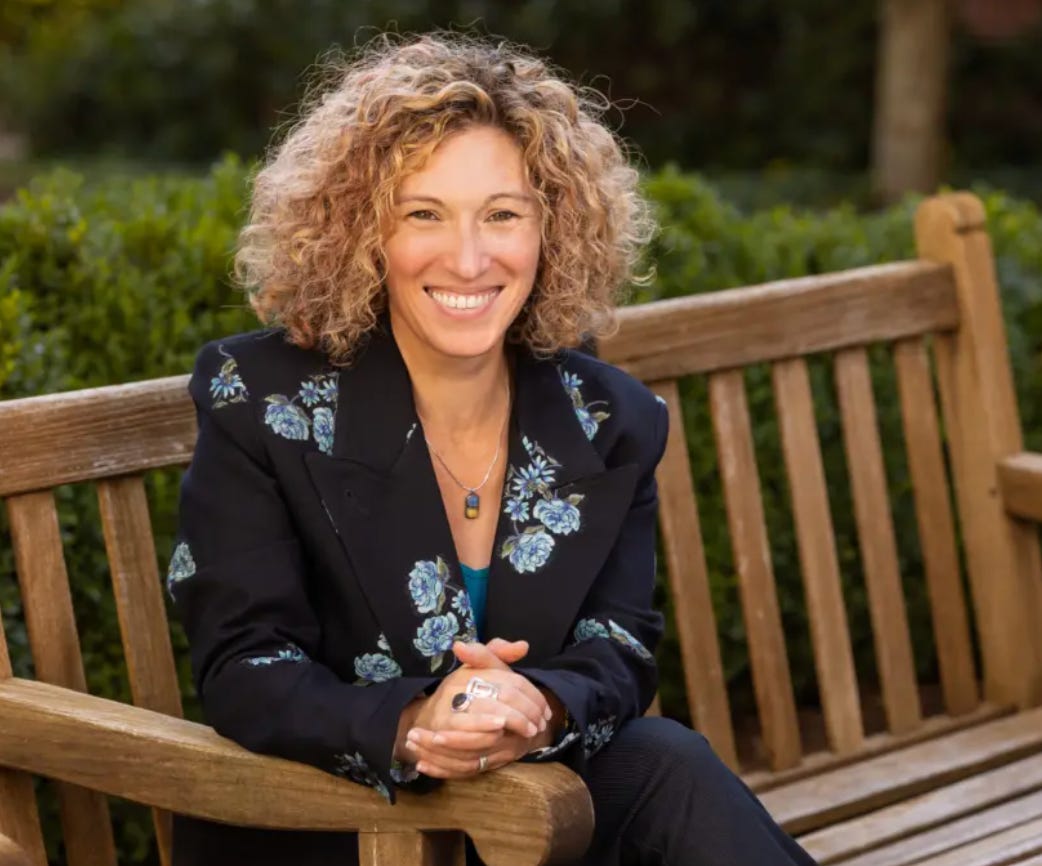
Dean Yael Grushka-Cockayne, source: Poets&Quants

The most glaring case in point now is an effort to oust a much-decorated scholar from the deanship at the University of Virginia’s prestigious Darden School of Business. Yael Grushka-Cockayne’s offense, according to the shadowy campus group Students for Justice in Palestine, is that she is an Israeli who in the 1990s served in the Israel Defense Forces. Then, a few years later, she worked in San Francisco for an Israeli software company. And in 2018, she took students and current UVA President Scott Beardsley, a business administration professor, to Israel.

In other words, Grushka-Cockayne is a Jew who, like many other Jews in America and elsewhere, has supported her ancestral homeland.

That’s enough to void a doctorate from the London Business School and master’s degrees from that school and the London School of Economics. It’s enough to make meaningless 17 years of service at Darden marked by a string of awards that include the Darden Morton Leadership Faculty Award in 2011, the University of Virginia’s Mead-Colley Award in 2012 and the Darden Outstanding Faculty Award in 2013 and 2022, the Faculty Diversity Award in 2013 and 2018, and the University of Virginia All University Teaching Award in 2015. More recently, she was named among the Executive MBA Transformational Faculty in 2024 and the Part-Time MBA Transformational Faculty in 2025.

Despite such distinctions, the SJP chapter at UVA has set out to fire Grushka-Cockayne, who was named dean on Aug. 1, by way of a petition drive on Instagram. The group, which doesn’t name any of its leaders and which may amount to little more than a thinly populated Instagram site, calls the new dean “UVA’s newest feat in legitimizing genocide.”

Never mind that Grushka-Cockayne has not publicly discussed her feelings about Israel’s policies. And never mind that most Israeli young people serve in the IDF or that when she left the forces, in 1996, she was in her early 20s. And never mind that she has zero influence on the government of Benjamin Netanyahu.

As John Byrne, the founder of the Poets&Quants business-school website, writes, it’s one thing to criticize the Israeli government. But “holding an Israeli-born professor personally responsible for the actions of that government is something else entirely.”

Indeed, the petition the pro-Palestinian group is pushing defies the sort of basic logic that even the rawest business-school student would know.

“Would we hold an American professor personally responsible for Abu Ghraib because he once served in the U.S. military?” Byrne asks. “Would we demand that a Russian professor resign because Vladimir Putin invaded Ukraine? Would we question whether a Chinese-born academic should lead a university program because of Beijing’s treatment of the Uyghurs?”

Of course not. Unless, that is, we apply the same sort of logic the Nazis did in destroying the careers of so many brilliant academics nearly a century ago. If they were Jews, they had to go. In Grushka-Cockayne’s case, that means if she’s an Israeli, she has to go.

But the call to end the Darden dean’s role is not occurring in a vacuum. It is of a piece with the Boycott, Divestment and Sanctions campaign, which the Anti-Defamation League reports forbids people-to-people exchanges, dialogue opportunities for Israelis and Palestinians or even interactions between “pro-Israel” and “pro-Palestine” groups and advocates unless the parties involved first recognize Israelis as “oppressors” and “colonizers.”

It also comes amid growing antisemitism – often dressed up as anti-Israeli sentiment – on many campuses. Nearly three-quarters (73.2 percent) of 209 Jewish academics surveyed last year by the Anti-Defamation League and the Academic Engagement Network reported anti-Jewish activities or statements from faculty, administrators, or staff on their campuses.
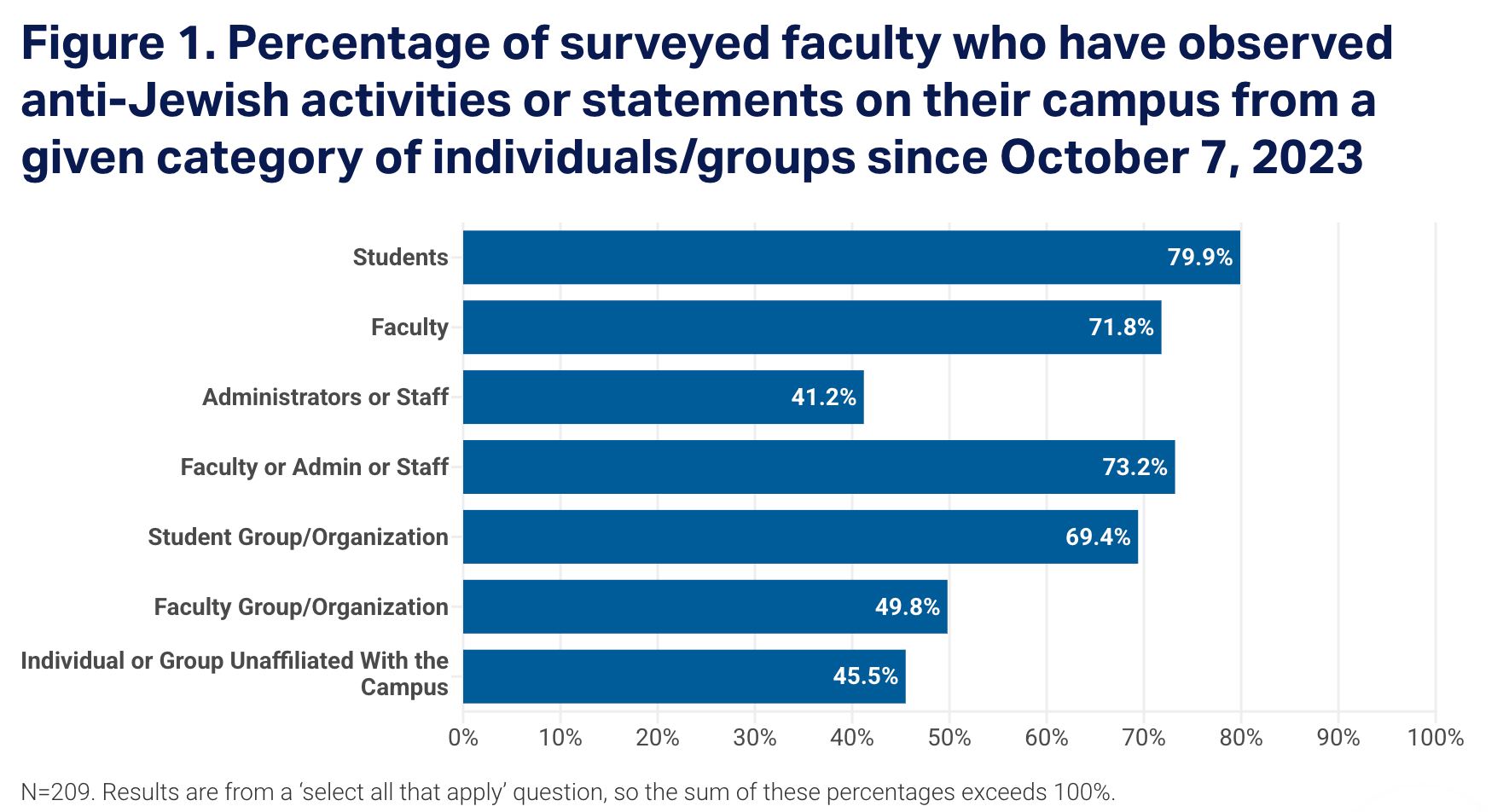
Source: ADL-AEN

While much of such activity is focused on Israel, some respondents told of events organized by another group, the Faculty for Justice in Palestine, that “were billed as being anti-Zionist but … posted tropes about Jews and Israel that were clearly antisemitic.”

Half (50.2 percent) of the respondents believed that their campuses have been affected by “soft” or “shadow” boycotts. Of them, 55.2 percent noted that departments avoided co-sponsoring events with Jewish or pro-Israel groups and 29.5 percent reported that partnerships with Israeli institutions and/or academics were discouraged or blocked, the ADL-AEN study reported.

“In their open-ended responses, faculty described being publicly maligned, professionally isolated, and in severe cases, doxxed or harassed, with repercussions including canceled academic talks, denied professional opportunities, reputational damage, and even withdrawal from the academy,” the report added.

More recently, according to another ADL-AEN report, academic organizations have been hijacked by anti-Israel members.

“Jewish members report hostility from leaders and fellow members for raising concerns about antisemitism, expressing views related to Israel or Zionism, or challenging anti-Israel advocacy within their unions,” the report noted. It quoted one academic as saying, “the term ‘Zionist’ is applied as a slur if you express an opinion other than full condemnation of Israel.”

The American Association of University Professors (AAUP), a national union of faculty and other academic professionals, in 2024 reversed its longstanding opposition to academic boycotts, particularly of Israel. It now claims efforts such as the BDS movement are “legitimate” tactics. It even hosted a webinar on “scholasticide in Palestine,” and, according to ADL-AEN, did not respond to requests from Jewish organizations to include different perspectives.

And other groups, coopted by anti-Israeli members, have mirrored such efforts.

In 2025, the California Faculty Association, which represents faculty across 23 California State University (CSU) campuses, urged CSU to cut academic ties with Israeli universities. It invoked claims of “scholasticide,” “apartheid,” and “genocide,” according to the ADL-AEN report. The Santa Cruz Faculty Association took similar action by co-authoring resolutions that raised allegations of “scholasticide” in Palestine and supported anti-Zionist departmental statements on the grounds of “academic freedom.”

So, the SJP demand for the Darden dean’s head is consistent. It’s just more of the same, though it puts a face, an individual target, on the antisemitic and anti-Israeli campaign. Tellingly, its proponents are too cowardly to let their own faces be seen or their names known.

“Unfortunately, SJP seems eager to raise a five-alarm fire over anything remotely affiliated with Israel,” a student writing in the UVA newspaper, The Cavalier Daily, noted. “This July, the organization went as far as to call for the cancellation of an event in Tel Aviv, Israel designed to connect with prospective Israeli students — an event having nothing to do with Israeli military action in Iran, Gaza or elsewhere. Rather than advancing any substantive concerns, SJP appears to harbor a personal vendetta against all things Israeli.”

But can there be a “substantive concern” here? Just as was the case in Germany in 1933, the only one here is raw and undiluted antisemitism.
The sins of the past

Trump’s assault on higher education threatens to repeat them — or worse

Share

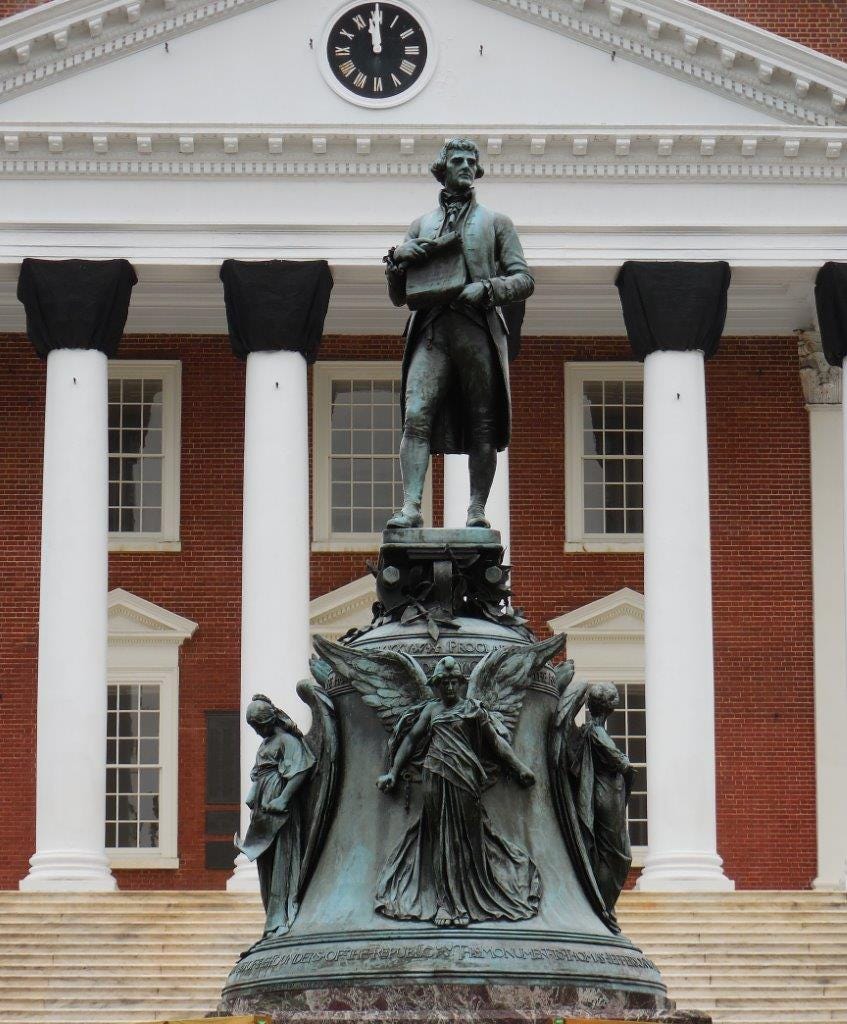
Jefferson looks over his university; source: PresidentsUSA.net

Founded by slaveholder Thomas Jefferson in a state where 20 percent of the population is now Black, the University of Virginia might reasonably be a place that owes the state’s minority population something. And yet, only a fraction of the undergraduate UVA student body is Black (variously reported as 6.2 percent or 8 percent). And, after other minorities are counted, nearly 57 percent of undergrads are white, College Factual reports.

Diversity has been even more of a nonstarter among the faculty at Mr. Jefferson’s university. More than 82 percent of the faculty are white, according to College Factual, with the share of Black faculty variously reported as 5 percent or 9.8 percent.

So, it’s not terribly surprising that James E. Ryan, a UVA Law graduate, saw a need to boost diversity, equity and inclusion efforts when he took over as the school’s president in 2018. In his inauguration speech, Ryan committed to redressing UVA’s longstanding racial imbalances.

As The Chronicle of Higher Education reported, he said the campus community should “acknowledge the sins of our past,” including slavery, eugenics, and the exclusion of Blacks and women well into the 20th century. The university needed to recognize both Jefferson’s “brilliance and his brutality,” he argued.

Ryan also praised that fact that most UVA students at the time were women (a demographic reality at many campuses) and spoke highly about hundreds being among the first in their families to attend college. He warmed to the idea that the freshman class then was the most diverse in the university’s history.

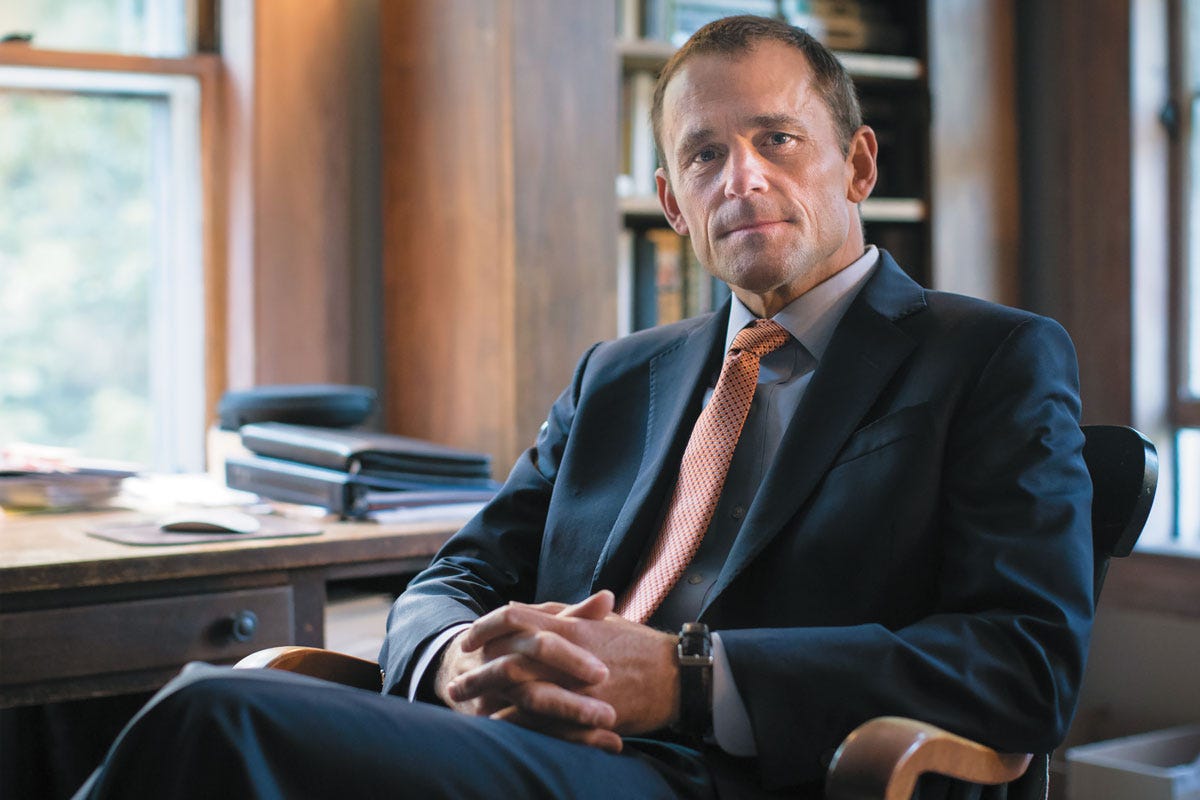
James E. Ryan, source: Virginia

As might be expected, this all didn’t sit well with some alums. A couple of the good ol’ boys in 2020 co-founded the Jefferson Council, an advocacy group that the Chronicle described as “committed to reducing the influence of progressive students, faculty, and staff, and restoring a more traditional UVa.”

The alums involved saw the university’s investment in DEI as wasteful, the news outlet reported, and they argued that it forced leftist dogma down the throats of Wahoos, as UVA students are known. They lambasted efforts to rename buildingsdiversify admissions, and spend millions on DEI-focused administrators. Through blogs and social-media posts, they documented what they saw as the university’s mistaken priorities, and they put New Jersey-born Ryan into their gunsights.

With Donald J. Trump leaning on the school, the good ol’ boys have now won. Ryan quit after Trump’s Justice Department bridled at his refusal to dismantle the DEI programs and demanded his scalp, according to The New York Times. He stepped down rather than having the school risk losing hundreds of millions of dollars in federal funds, as other universities have.

“I cannot make a unilateral decision to fight the federal government in order to save my own job,” Ryan said in an email to the school community, The Wall Street Journal reported. “To do so would not only be quixotic but appear selfish and self-centered to the hundreds of employees who would lose their jobs, the researchers who would lose their funding, and the hundreds of students who could lose financial aid or have their visas withheld.”

Of course, this is just the latest university administrator’s head Trump or his supporters can claim. Their trophies now include Katrina Armstrong, driven out at Columbia in March after Minouche Shafik was forced out last August; and M. Elizabeth Magill, ousted at the University of Pennsylvania in December 2023, just a short time before Claudine Gay was driven out at Harvard. A fifth university chief, Martha E. Pollack surprised the Cornell University community in May by stepping down amid a threatened $1 billion in funding cuts.

Trump has put some $9 billion at risk at Harvard, with another $3 billion or so at risk at those above and other prominent schools. Those under the gun also include Princeton, Brown and Northwestern, as well as Johns Hopkins, a research gem where $800 million in cuts have led to hefty layoffs and where up to $4.2 billion in federal support is in danger.

Columbia University

The attacks are personal to a degree – Trump has a particular animus to Columbia, which once refused a $400 million land purchase he tried to foist on it (it’s not accidental that he cut $400 million from the university, or that the money hasn’t been restored even as Columbia largely capitulated to his demands). Also, recall that Trump himself was a middling transfer student into the University of Pennsylvania, where a professor of his said “Donald Trump was the dumbest goddamn student I ever had!’”

But the assaults also reflect the longstanding hostility rightists have had against the academic world, dating back at least to the days of Richard Nixon. Recall that Nixon famously said, “the professors are the enemy,” a phrase JD Vance reprised in late 2020 at a National Conservatism Conference.

Recall racist Gov. George Wallace’s assault on “pointy headed intellectuals,” which was mirrored decades later by Trump’s attack on “those stupid people they call themselves the elite.” The attack played well with Wallace’s undereducated followers back then and still resounds with Trump’s underschooled loyalists now.

It’s all something of a replay, though those earlier assaults had none of the teeth Trump’s latest ones have. The broad-gauge attack the president and his acolytes have mounted has been enormously costly. Consider what The Atlantic reported at the end of March:

“But college life as we know it may soon come to an end,” the magazine reported. “Since January, the Trump administration has frozen, canceled, or substantially cut billions of dollars in federal grants to universities. Johns Hopkins has had to fire more than 2,000 workers. The University of California has frozen staff hiring across all 10 of its campuses. Many other schools have cut back on graduate admissions. And international students and faculty have been placed at such high risk of detainmentdeportation, or imprisonment that Brown University advised its own to avoid any travel outside the country for the foreseeable future.

“Higher education is in chaos, and professors and administrators are sounding the alarm. The targeting of Columbia University, where $400 million in federal grants and contracts have been canceled in retribution for its failure to address campus anti-Semitism and unruly protests against the war in Gaza, has inspired particular distress. Such blunt coercion, Princeton University President Christopher Eisgruber wrote in The Atlantic earlier this month, amounts to ‘the greatest threat to American universities since the Red Scare.’ In The New York Times, the Yale English professor Meghan O’Rourke called it and related policies ‘an attack on the conditions that allow free thought to exist.’”

The administration’s twin rallying cries are fighting anti-Semitism and killing DEI. The former, of course, is just a fig leaf, a handy excuse for bludgeoning administrators because some students angry about the Gaza War misbehaved in the school year before last. Those protests were usually handled, if not always well, and mostly didn’t recur in the year just ended. Still, they are bogeymen the rightists can invoke as example of dissent they just can’t tolerate.

Source: The Federalist Society

The DEI assault is more substantial. White Trumpians angry about minorities becoming more prominent feel disadvantaged, as they have ever since affirmative action began in 1965. Back then, President Johnson issued an executive order requiring federal contractors to take affirmative action to ensure equality of employment opportunity without regard to race, religion and national origin. Ever since then, any steps to give disadvantaged groups a leg up – and to adapt to our increasing national diversity – have been castigated by angry whites as unfair.

So, it’s no surprise that at UVA some white alums have resented the modest advances Blacks and other minorities have made and DEI efforts to help them. To them, 57 percent is apparently not a high enough share of whites among students; nor is 82 percent of faculty.

A third rallying cry among the Trumpians is intellectual diversity in the college communities. What that means is that professors are just too damn liberal — another longstanding canard — and they should be driven out in favor of rightists. That is taking root in some places. Just look at what Florida Gov. Ron DeSantis has done with the New College of Florida in Sarasota, where ideologues have marched in, particularly as scholars in residence. The right sees this is as a model for remaking universities nationwide.

Judging from my days as a student and more recently as a professor, there are indeed plenty of liberals on faculties. That’s likely because liberals generally tend to be more adaptive to social change than conservatives, almost by definition, and being attuned to such change is natural in the academy. Still, there also are plenty of conservatives, and not only in economics departments and business schools. And is the liberal-conservative split even an issue in the sciences, tech and ag areas, for instance?

There are lots of scary elements about the changes Trump and his minions are enacting. One is a very conservative idea — that the drive amounts to social engineering by an elite in Washington — a Trumpian elite — not change coming from the grassroots. It is one thing if spontaneous change is demanded by the public around the country, in various states where legislatures fund education; another if it is directed by federal authorities.

Another troublesome factor is that many of the changes now being forced on private institutions are moving into the public ones. UVA is an example, but not the only one. We’ll likely see more such state universities in the dock going forward. More university presidents are likely to be driven out or quit under the pressure.

And where will this all leave students? Well, federal funding cuts will leave them with fewer intellectual opportunities as programs disappear. What’s more, in some states dominated by Trumpian rightists such cuts are being amplified by stinginess in state funding. As a result, many students are paying more for less.

In Nebraska, where I taught for 14 years, the state government’s contribution to the university system will rise roughly 0.6 percent in the coming year, far below the 3.5 percent increase that the Board of Regents had sought to account for inflation. The Trumpian Gov. Jim Pillen, who wanted the state to have “the courage to say no, and to focus on needs, not wants,” had originally pushed for a 2 percent cut, The New York Times reported.

“We will need to continue to reduce spending and make increasingly difficult choices to ensure fiscal discipline,” Jeffrey P. Gold, the University of Nebraska’s president, said before the regents voted to impose cuts and increase tuition. Students at the flagship campus in Lincoln will pay about 5 percent more.

It took many decades for higher education at both private schools and top-tier public ones, such as UVA, to develop into an international bragging point for the United States, a magnet for the world. That system, moreover, has long been the engine of American economic growth. Tragically, all that is under siege and it’s not clear how or when the damage we’ll see in the coming three and a half years can be undone.