When down is up

As Trump terrorizes international students, he endangers us all

Comic book fans of a certain age will remember The Bizarro World. Courtesy of DC Comics, this planet featured just about everything that was its opposite on Earth. Superman was a villain. Batman was an inept detective. Aquaman couldn’t swim, etc.

Lately, it feels as if Washington has fallen into that world and is dragging the rest of the country with it.

Consider the approach of Donald J. Trump to foreign students in our colleges and universities. Almost as long as there has been a United States, our schools have drawn foreigners here. International students attended Yale, for instance, starting in the 1800s, if not even earlier. And World War II marked a huge uptick, with the numbers of non-Americans coming to study rising to top 25,000 in 1948-49 and climbing to over 1.1 million in 2023-24, an all-time high.

Education has long been one of our biggest services “exports” — one helpfully “consumed” at home — that pours more than $50 billion annually into our economy. It’s also a big draw for the best and brightest to stay and enrich America economically and culturally. Some 41 percent of graduates at all levels – especially at the master’s and doctoral level – stay to settle in the U.S., according to the Economic Innovation Group.
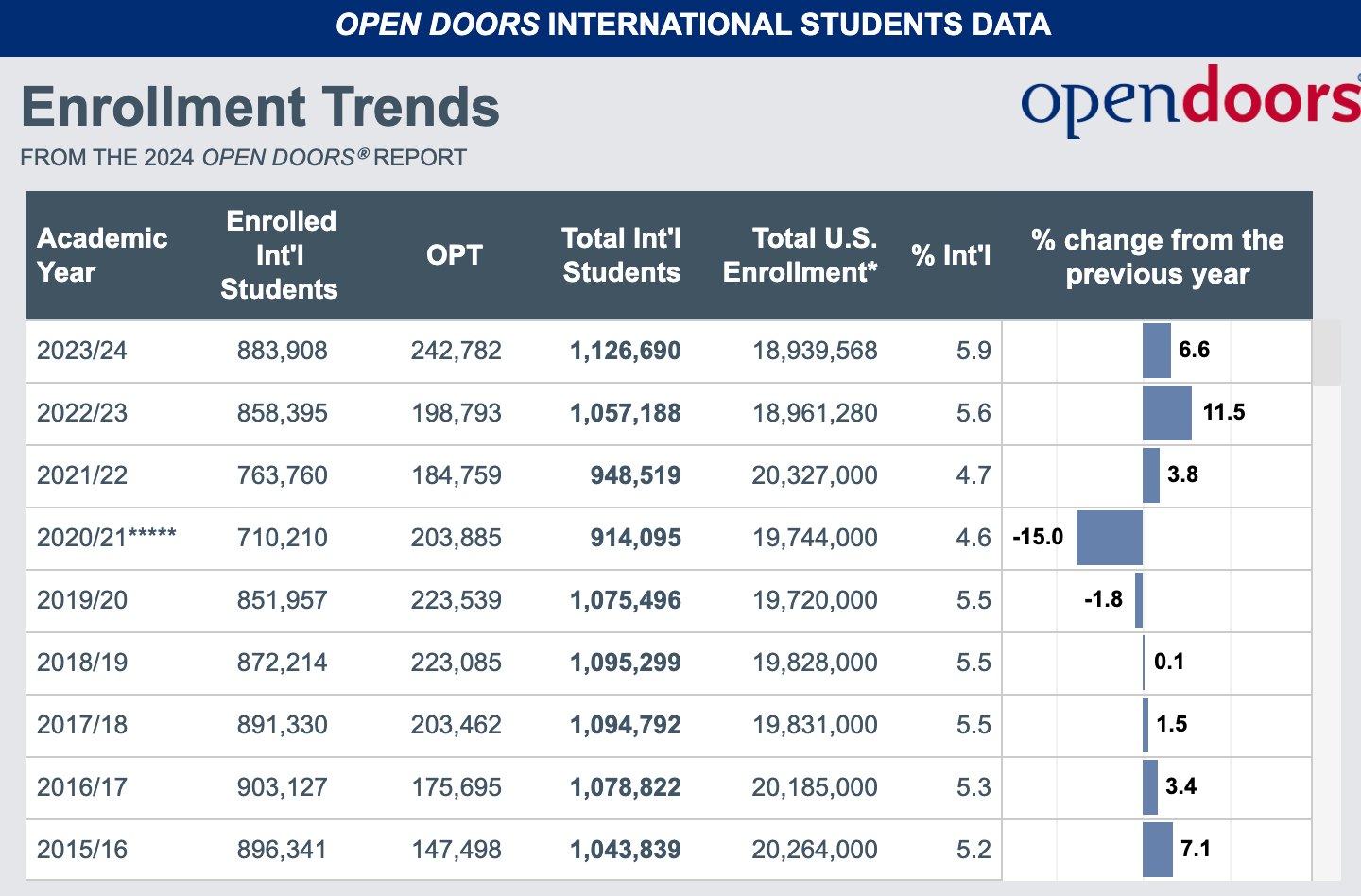
Source: Institute of International Education

So why is the Trump Administration – which claims to want well-schooled and talented immigrants and aims to boost exports – making life miserable to international students? Only on the Bizarro World would this make sense.

How else can we understand why the administration has revoked the visas of more than 1,000 international students, and counting, so far? With only days to go for graduations for some of these students, it has cancelled their abilities to stay and study in more than 240 colleges and universities nationwide, according to Inside Higher Ed.

This count of students tops the 300 that Secretary of State Marco Rubio initially estimated. He claimed that such students came to the U.S. “not just to study but to participate in movements that vandalize universities, harass students, take over buildings and cause chaos.”

Rubio made the comment after masked plainclothes officers on March 25 snatched a Fulbright Scholar in a doctoral program in child development off the street in Massachusetts. The student, 30-year-old Rumeysa Ozturk, coauthored an opinion piece in the Tufts University student paper criticizing Israel over the Gaza War.

Ozturk’s apprehension in Somerville, Mass., source: AP

Even though the Turkish woman has not been charged in any crime, she is being held in an Immigration and Customs Enforcement detention center in Louisiana pending a decision in her revocation case. An immigration judge recently denied Ozturk bail.

In some cases, the students are being driven out of the country for taking part in demonstrations against the bloodshed in Gaza. In others – perhaps most – however, their revocations appear to have been triggered by traffic tickets or old minor violations that linger in their student records.

Based on such problems, the numbers of revocations are likely to grow. More than 4,700 students may have already had their records terminated in ICE’s Student and Exchange Visitors Information Systems database (SEVIS), according to Bloomberg Law. This move, which targets them for visa revocation and removal from the United States, is the opposite of the usual process in which a visa revocation triggers termination in the SEVIS system.

Another case of a Bizarro World approach, it seems.

The backwards, database-based approach also smacks of involvement by Elon Musk’s numbers crunchers at the so-called Department of Government Efficiency. A claim on that point has been made in at least one lawsuit, that of 10 students who have sued over their SEVIS record terminations in Michigan.

At least 16 lawsuits have been filed over the government actions, IHE reported. Among the students who have sued is a Georgia Tech Ph.D. student who is supposed to graduate on May 5, with a job offer to join the faculty. His attorney told the Associated Press that the student was likely targeted because of an unpaid traffic fine from when the student lent his car to a friend. Ultimately, the violation was dismissed.

As with the Georgia doctoral student, the U.S. stands to lose some of the best and brightest in this Trumpian effort. Science, for instance, reported the case of a biochemist caught up in the SEVIS terminations who had just been selected for a H-1B visa, but who had a misdemeanor charge dismissed more than 10 years ago. “A mistake made in high school came haunting me all over again,” the researcher told the outlet.

Trump and his toadies are going even broader. In the administration’s battle against Harvard University, it now is threatening to block the enrollment of foreign students. “It is a privilege to have foreign students attend Harvard University, not a guarantee,” Homeland Security Secretary Kristi Noem wrote in a letter to the school obtained by The New York Times. “The United States government understands that Harvard University relies heavily on foreign student funding from over 10,000 foreign students to build and maintain their substantial endowment.”

Harvard relies on such students, who often pay full tuition, to support it financially. Noem demanded detailed records on such students and she said that failure to comply would be treated as a “voluntary withdrawal” of the certification system that allows international students to enroll. “The withdrawal will not be subject to appeal,” Noem wrote.

Wrongheaded as this assault on international students is, it also contradicts what Trump, the candidate, said last June when he promised a green card to any international student bright enough to graduate from a U.S. school, as Washington Post opinion writer Catherine Rampell recently wrote. “He also promised to help his country better compete on the global stage,” Rampell added. “Today, he’s destroying one of our most powerful economic engines — and ensuring international students don’t come here (let alone graduate) at all.”

That 1.1 million tally for foreign students here in the last academic year may well turn out to be a high-water mark, a count that could easily decline in coming years. In China — one of the biggest sources of foreign students in the U.S. — New York Times columnist Thomas Friedman heard repeatedly a few weeks ago that maybe studying in the U.S. isn’t such a great idea. “The reason: They don’t know when their kids might be arbitrarily arrested, when their family members might get deported to Salvadoran prisons,” Friedman wrote.

Somdeep Sen, an associate professor at Denmark’s Roskilde University, echoed that theme in a piece in Aljazeera headlined “United States is no longer a safe destination for international students.” In it, Sen contended: “One cannot underestimate the precarity that orders the lives of international students in the United States.”
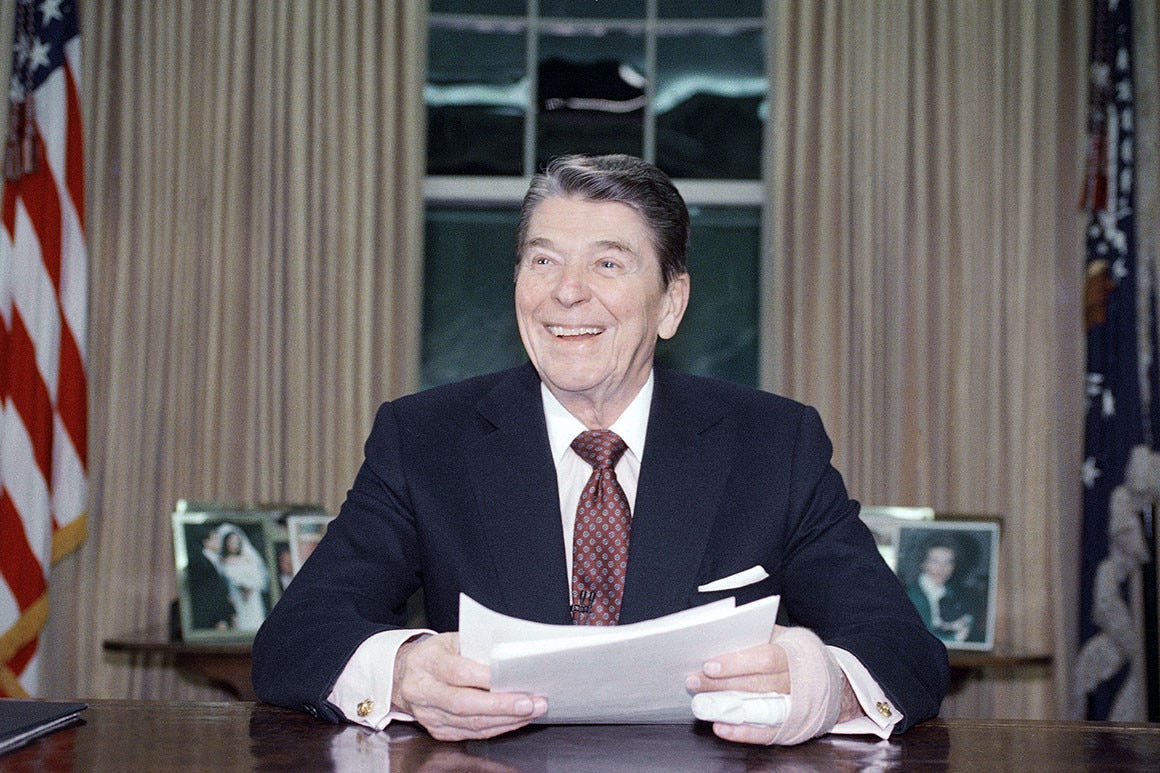
Reagan’s Farewell Address, source: Politico

Former President Ronald Reagan, in his farewell address to the nation in 1989, referred to the famous vision of Pilgrim John Winthrop of America as a “shining city upon a hill,” a theme Reagan had often invoked. The former president said the country was “still a beacon, still a magnet for all who must have freedom, for all the pilgrims from all the lost places who are hurtling through the darkness, toward home.”

As Trump appears today to be doing his best to douse that light, one can only wonder how inverted his world is. For many international students, and for the U.S. generally, his comic-book version of reality is tragic. The harm it will do could prove irreparable and likely to long outlast him.

Friedman invoked Steve Jobs’s Syrian birth father, Abdulfattah “John” Jandali, who came to the U.S. in the 1950s to get a Ph.D. at the University of Wisconsin. The legacy he left us, through Jobs, has proved immeasurable. How many Jandalis will now opt for graduate study in Canada, Europe or the U.K., or anywhere but Trump’s Bizarro America?
When taking aim at the king …

Trump has a fight on his hands, at lasT

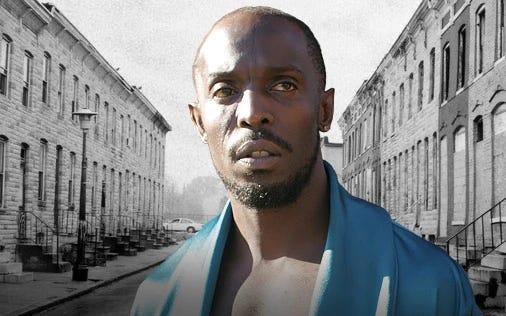
Omar Little, portrayed by the late Michael K. Williams, source: Fandom

The wonderful character Omar Little, appearing in the eighth episode of “The Wire,” offers a memorable line: “Ayo, lesson here, Bey. You come at the king, you best not miss.”

That line, now 23 years old, resonates anew as Harvard has decided to fight back against the would-be monarch now soiling the White House. It applies, too, to a group of other schools – including Brown University, Princeton University, Massachusetts Institute of Technology, California Institute of Technology and the University of Illinois — that have brought suit against Trump’s Department of Energy.

All are attacking the vindictive federal overreach Trump is using to withhold funds in his effort to reshape higher education policies. Together, the moves could embolden more institutions, such as law firms and Columbia University, perhaps including some that the president has already bullied into acquiescence of various sorts.

“This is of momentous, momentous significance,” J. Michael Luttig, a prominent former federal appeals court judge revered by many conservatives, told The New York Times. “This should be the turning point in the president’s rampage against American institutions.”

But they also had better win. Their opponent is a wily master of the judicial system who has shown that 34 felony convictions, among other legal humiliations, are not enough to defeat him. Just look at how – so far, at least – Trump has spit on an order by nothing less than a unanimous Supreme Court to return wrongly deported Kilmar Abrego Garcia from an El Salvador prison.

Along with showing an astonishingly callous indifference to a jailed man’s plight, Trump seems to believe that all and sundry should bow to his will, no matter how wrongheaded it is. The president is similarly indifferent to the damaging effects his battle with universities are having on medical and scientific research.

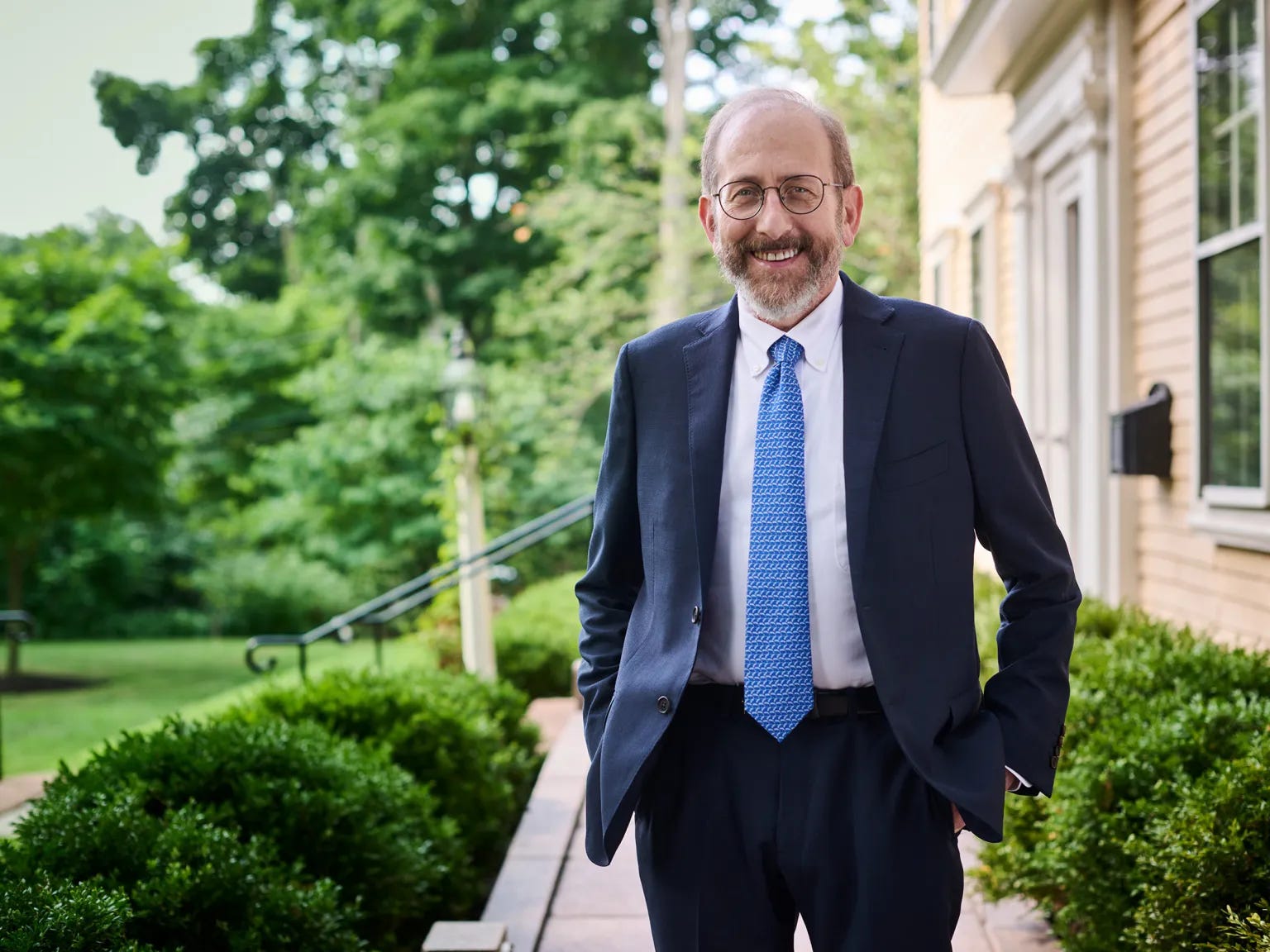
Alan Garber, source: Harvard

Already, Trump is upping the ante in his battle with Harvard. In the wake of Harvard President Alan Garber’s defiance, federal officials froze $2.2 billion in multiyear grants and canceled a $60 million contract, along with the president threatening to remove the university’s tax-exempt status. The administration had put nearly $9 billion in funding at risk when Garber refused to bow to its demands for extensive policy changes and oversight.

“The University will not surrender its independence or relinquish its constitutional rights,” Garber wrote in a message to the Harvard community. He added: “No government — regardless of which party is in power — should dictate what private universities can teach, whom they can admit and hire, and which areas of study and inquiry they can pursue.”

As The Harvard Gazette reported, Garber’s message was a response to a letter sent late Friday by the Trump administration outlining demands that Harvard would have to satisfy to maintain its funding relationship with the federal government. These demands included “audits” of academic programs and departments, along with the viewpoints of students, faculty, and staff, and changes to the University’s governance structure and hiring practices.

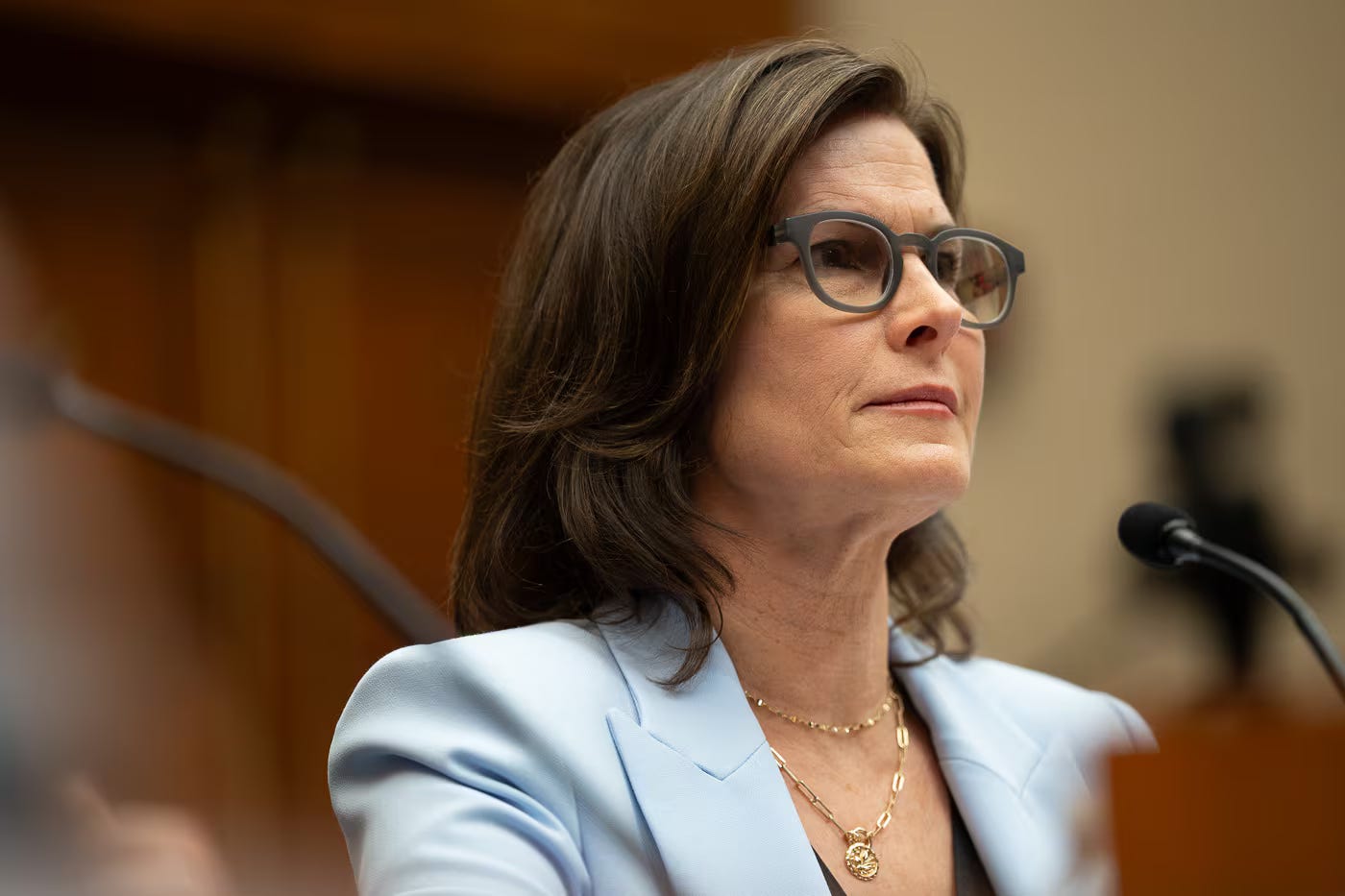
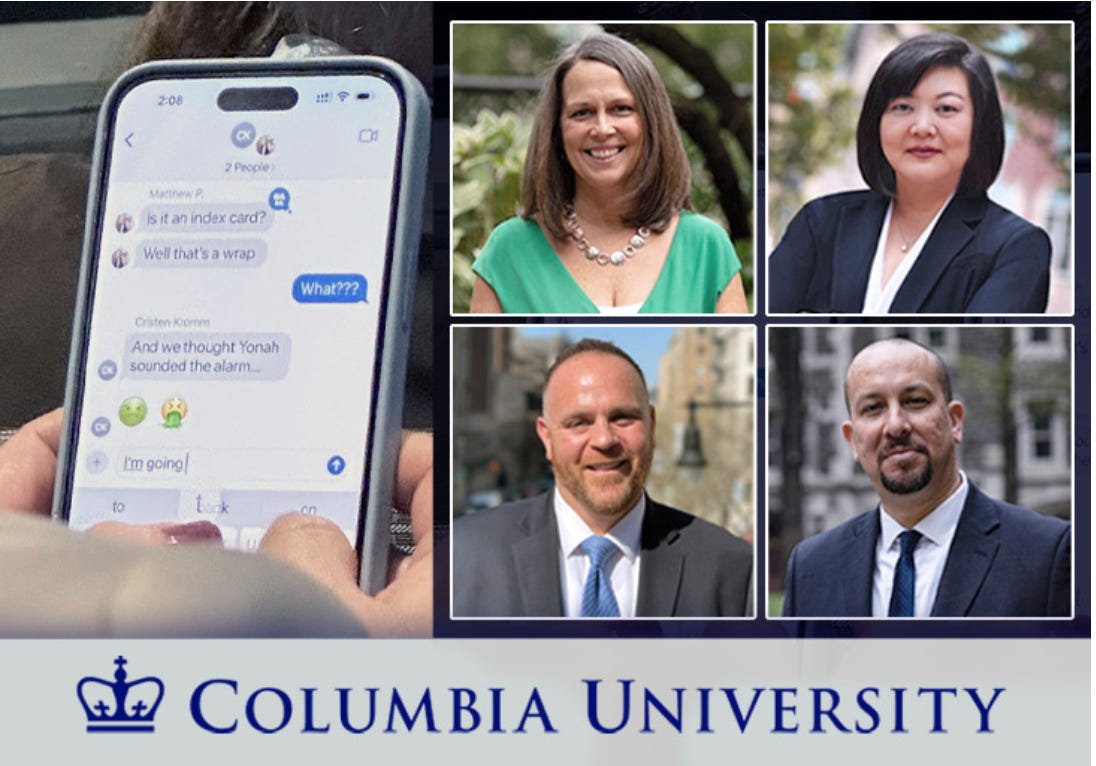
Garber’s defiance stood in stark contrast to Columbia’s genuflection to Trump. So far, Columbia’s obeisance has not led to a restoration of the $400 million Trump cut. That, together with Harvard’s stance, may have prompted Columbia’s new acting president, Claire Shipman, to push back in a new message to the university community after her predecessor, Dr. Katrina Armstrong, had bowed to Trump’s demand and then quit.

Claire Shipman, source: Columbia Spectator

“To be clear, our institution may decide at any point, on its own, to make difficult decisions that are in Columbia’s best interests,” journalist and writer Shipman wrote. “Where the government – or any stakeholder – has legitimate interest in critical issues for our healthy functioning, we will listen and respond. But we would reject heavy-handed orchestration from the government that could potentially damage our institution and undermine useful reforms that serve the best interests of our students and community. We would reject any agreement in which the government dictates what we teach, research, or who we hire. And yes, to put minds at ease, though we seek to continue constructive dialogue with the government, we would reject any agreement that would require us to relinquish our independence and autonomy as an educational institution.”

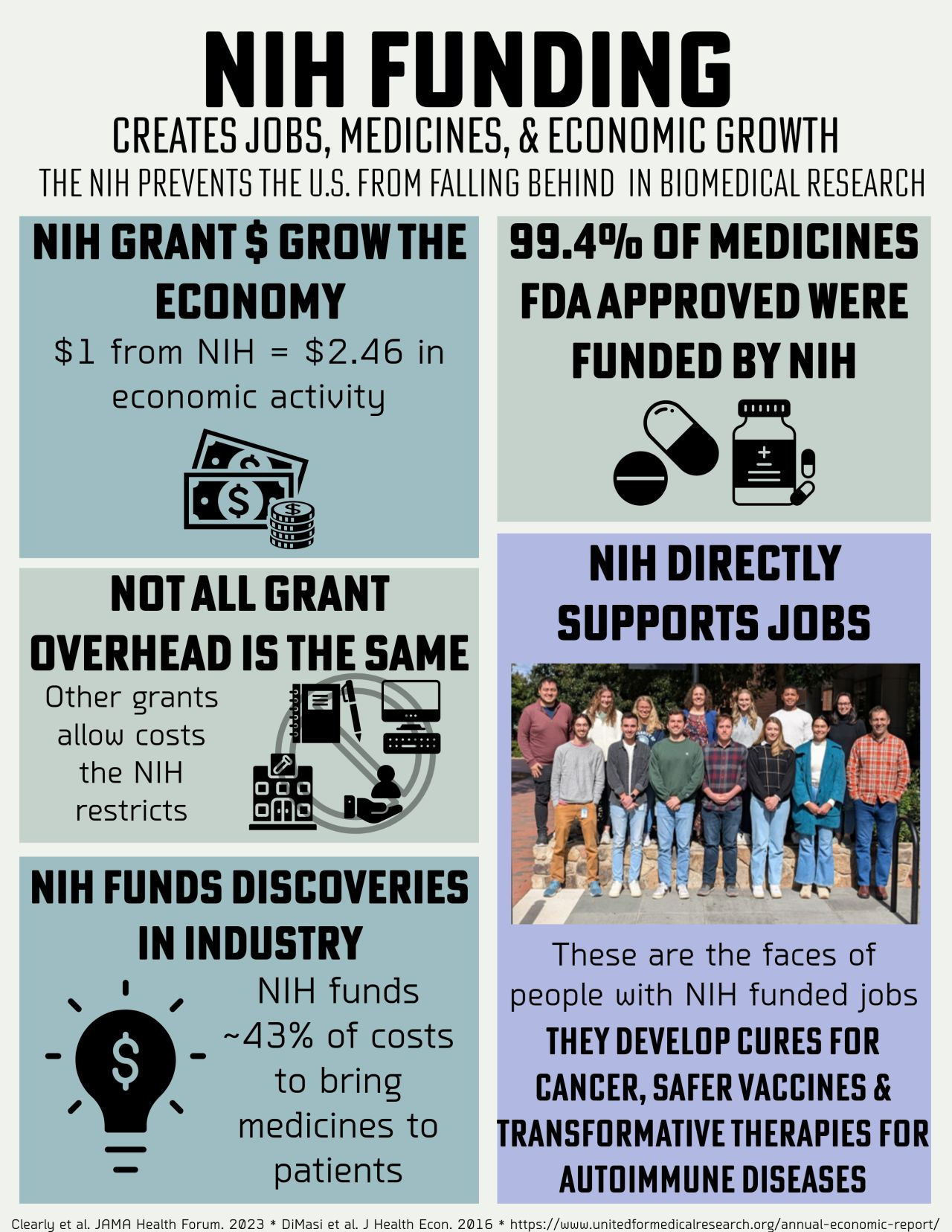
Separately, the handful of top schools that brought suit against Trump’s Department of Energy are fighting a policy change that would reduce the amount of indirect support that federal grants provide. As Reuters reported, the DOE announced that it would cut more than $400 million in annual spending by setting an across-the-board 15 percent reimbursement rate for indirect costs of research.

Many of the universities involved in the lawsuit have negotiated far higher “indirect” rates than the 15 percent proposed by DOE policy. The National Institutes of Health announced a similar cut and was also sued. A federal judge has issued an order blocking the Trump administration from proceeding with those cuts, while the lawsuit against NIH proceeds.

In the case of the indirect research support, the administration offers the specious argument that the cut would bring “greater transparency and efficiency” to federal government spending. In the case of the broader university reforms Trump is seeking, he and his minions have veiled their moves behind the claim of fighting antisemitism on the campuses.

The president’s broad list of demands to Harvard, however, gives the lie to the latter claim. He has demanded an end to diversity, equity and inclusion programs, for instance, along with eliminating any hiring preferences based on race, color, religion, sex or national origin, along with gutting any such preferences in student admissions. He has demanded audits to assure “viewpoint diversity” at the school without defining that.

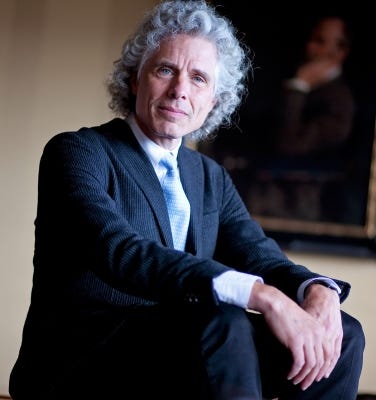
Steven Pinker, source: his website

Steven Pinker, a Harvard psychologist who is also a president of the Council on Academic Freedom at Harvard, told The New York Times that it was “truly Orwellian” and self-contradictory for the government to force viewpoint diversity on the university. He said it would also lead to absurdities.

“Will this government force the economics department to hire Marxists or the psychology department to hire Jungians or, for that matter, for the medical school to hire homeopaths or Native American healers?” he said.

In going up against Trump, the universities, no doubt, will be equipped with the best and brightest. Happily, they will fight a Trump Justice Department and other agencies that have lost their top talents in the president’s government-wide gutting efforts. Just consider that Harvard’s legal team includes William A. Burck and Robert K. Hur.

As the Times reported, Burck is also an outside ethics adviser to the Trump Organization and represented the law firm Paul, Weiss, Rifkind, Wharton & Garrison LLP in the deal it recently reached with Trump. And Hur, who worked in the Justice Department in Trump’s first term, was the special counsel who memorably called President Biden “an elderly man with a poor memory.”

They are insiders who understand the man and the system they now are battling.

For his part, Trump is someone whose two years at The University of Pennsylvania’s Wharton School were undistinguished at best. “Donald Trump was the dumbest goddamn student I ever had!,” one former prof of his said.

Still, he can work a lot of governmental levers, has a bottomless well of vindictiveness and can’t stand losing. The universities are in a fight for their lives and all of us have much riding on the outcome. They’d best not miss.

Social engineering

Trump’s efforts to remake higher education bring us all to grief

Source: History Today

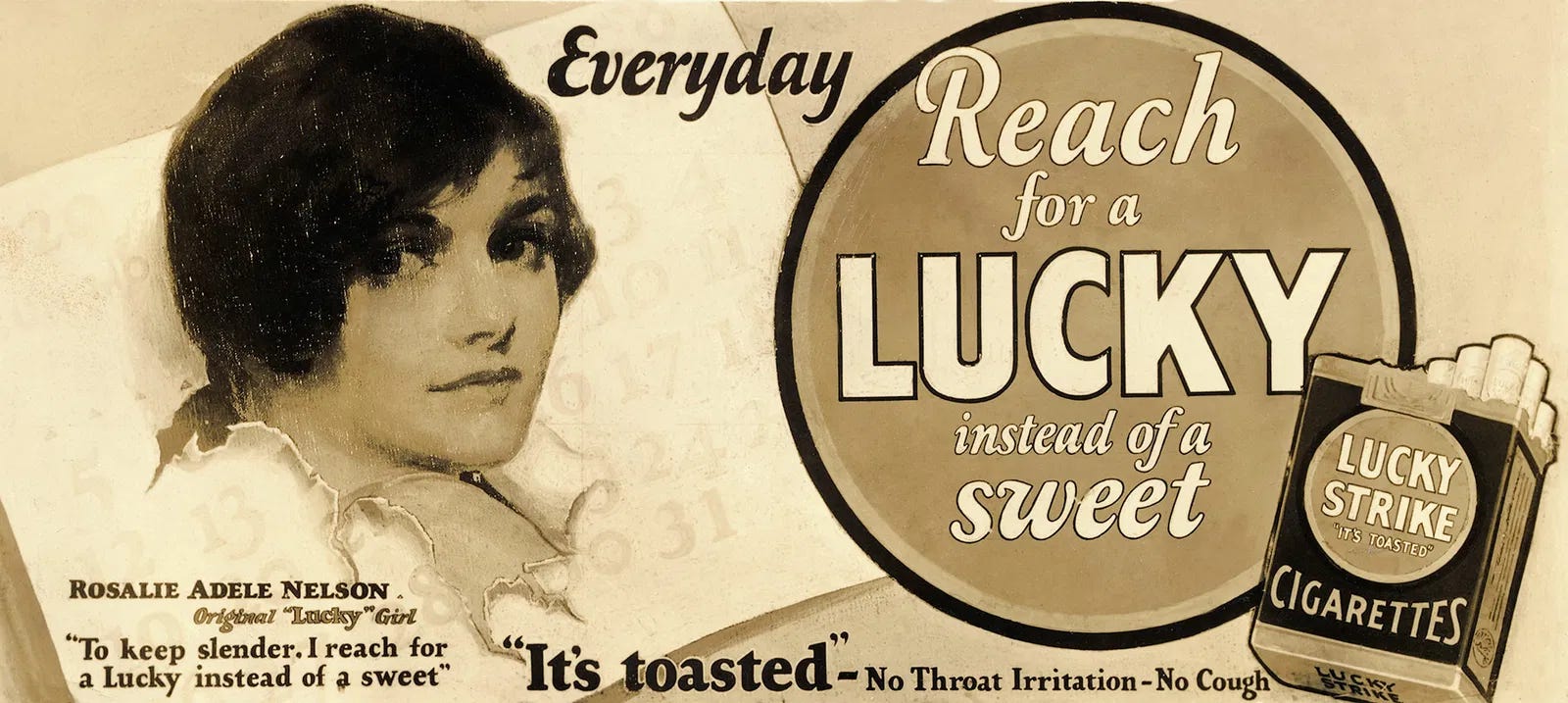
During the Easter Parade in New York in 1929, PR wizard Edward Bernays pulled off quite the stunt, one that influenced generations. He hired appealing women to light cigarettes and march, scandalously smoking in public. Their “torches of freedom,” as Bernays called them, garnered headlines nationwide as symbols of equality and emancipation.

Women, who earlier accounted for only about 5 percent of cigarette sales, soon bought about 12 percent of smokes and, in time, grew to consume about a third of cigarettes sold. It was a PR coup and a health disaster.

For Bernays, a Viennese-born nephew of Sigmund Freud who was then working for the American Tobacco Co., this was proof that “social engineering” could work. It showed how “people in power . . . shape the attitudes of the general population,” and that those who mastered communication could become an “invisible government . . . the true ruling power of our country.”

Such social engineering – once anathema to people on the right who long bristled at government efforts to shape public and institutional behavior – comes naturally to another huckster, Donald J. Trump. But, tragically, his efforts are more than just headline-grabbing stunts. His extortions of federal funds are biting deeply at universities including Princeton ($210 million), Columbia ($400 million), Northwestern ($790 million), Johns Hopkins ($800 million) and Cornell ($1 billion).

Source: Health Policy Watch

And health, along with public welfare, is at stake in his cuts. The grants he and his anonymous minions are withholding go for things such as medical research (in topics including pediatric long-COVID, environmental science, cancer) at Columbia, global health initiatives at Hopkins, pacemaker and Alzheimer’s investigations at Northwestern, defense and health at Cornell, and defense and energy at Princeton, and much more.

Now, with his reported plans to put Columbia under the control of a federal judge, Trump is poised to cement his engineering. Independent governance at the private university would, for all practical purposes, be eliminated. Such a judge would oversee the university’s compliance with any formal agreement to change a host of policies in Trump’s efforts to suppress dissent and academic freedom, setting up years of oversight and putting the school at risk for contempt proceedings if it fell short.

If Trump succeeds, a consent order providing for such oversight at the New York school would be a model for other schools he is attacking.

It is social engineering at its worst. Trump seems determined to humble such schools, to prove he can bring them to heel and gratify is base’s hostility to elite education. It seems to be all about control, reining in institutions that could defy him – whether they are law firms, Congress or educational outfits.

And, pathetically, Trump’s effort has little to do with his claimed battle against antisemitism at Columbia and the other schools. As Ben Olinsky of the Center for American Progress put it, is Trump’s effort is just weaponizing antisemitism for political gain.

“It does nothing to keep Jewish students or any other Americans safe from hate or prevent terrorism, which pose legitimate threats to America’s Jewish communities,” Olinsky said. “Instead, it forsakes education and dialogue while attacking protected political speech. It’s clear that Trump’s real goal is to silence opposing voices, whether they be from pro-Palestinian protesters on college campuses, Black Lives Matter marchers, clergy who pray for mercy, or journalists who report news that is critical of him. The right to free speech, protest, and exercise of any religion or none are bedrocks of America and must be protected in our schools and universities.”

To be sure, real dangers arose last year for Jewish students at many of the schools. They do need to do more to root out antisemitism among students and faculty alike. And there’s no doubt much ugliness persists, as became clear in protests at an April 7 visit to Princeton by former Israeli Prime Minister Naftali Bennett.

Jewish students at the event were taunted by pro-Palestinian demonstrators. “You’re committing a holocaust!” and “You’re killing babies!” some said. Some were told to “go back to Europe.” As student Danielle Shapiro reported in The Free Press, “We also heard many shouts of ‘They’re all fucking inbred!’ and ‘inbred swine!’ At least two or three protesters used their hands to create the shape of the Hamas triangle.”

Ugly and ignorant as such language is, it is not against the law. Vile, uncivil and disrespectful as it is, it is legal.

Where such protests cross the line is in preventing others from speaking.

Saying he was “appalled at reports of antisemitic language directed by demonstrators at members of our community” after the event, Princeton President Christopher L. Eisgruber promised an investigation and disciplinary moves, if appropriate. Since some students disrupted the talk and others set off a fire alarm, the university may have reason to take action.

But, to Trump’s critics, the president’s use of such protests to move against universities is just a fig leaf covering up his assault on any dissent he dislikes. It also gives him an excuse to attack such rightist hobbyhorses as efforts to build diversity and erode inequality, so-called “woke” culture, and moves to preserve academic freedom.

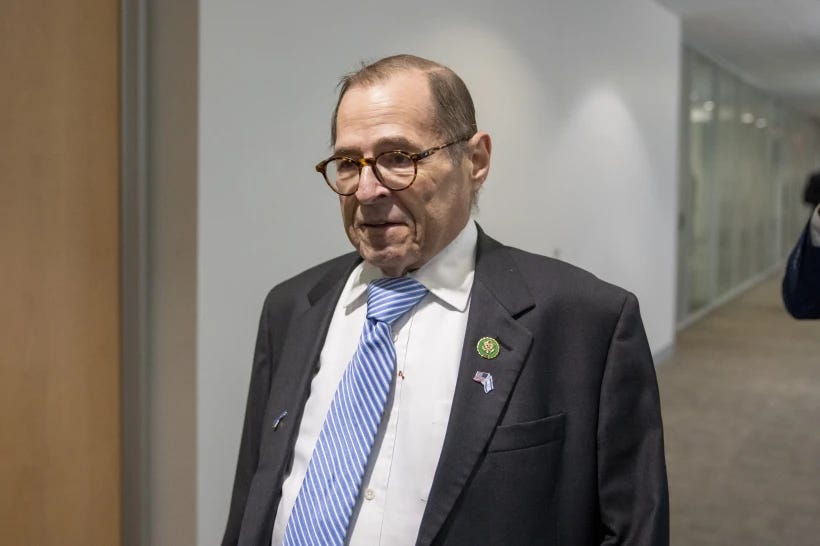
Rep. Jerry Nadler, source: AP

“Trump obviously doesn’t give a damn about antisemitism, this is just an expression of his authoritarianism,” Jerry Nadler, the most senior Jewish member of the House of Representatives, told The Guardian.

“Once again, the President is weaponizing the real pain American Jews face to advance his desire to wield control over the truth-seeking academic institutions that stand as a bulwark against authoritarianism,” Nadler added in a statement. “Withholding funding … will not make Jewish students safer. Cutting funding to programs that work to cure cancer and make other groundbreaking discoveries will not make Jewish students safer. Impounding congressionally appropriated funding will not make Jewish students safer. Trump’s ‘review’ is part of a larger effort to silence universities and intimidate those who challenge the MAGA agenda. It is a dangerous and politically motivated move that risks stifling free thought and academic inquiry.”

So far, Columbia has rolled over in the face of Trump’s bullying, much as several law firms, some media magnates and some corporations have. Princeton’s Eisgruber has called on fellow academics to fight, writing in The Atlantic: “The attack on Columbia is a radical threat to scholarly excellence and to America’s leadership in research. Universities and their leaders should speak up and litigate forcefully to protect their rights.”

Schools are not without weapons of their own. Columbia, for instance, has a nearly $15 billion endowment and a wealthy alumni base. Princeton could tap a $34 billion endowment.

As lawyers for many of the universities argue, moreover, there are grounds for legal action. The government cannot cut off funds until and unless it has done program-by-program evaluations of alleged Title VI violations, given schools notice and “an opportunity for hearing,” limited any funding cutoff” to a particular program, or part thereof, in which… noncompliance has been…found,” and submitted a report explaining its actions to relevant committees in Congress at least thirty days before any funds can be stopped.

The problem, of course, is that for all his stupidity and power-hunger, Trump is a master of using the courts to delay and obfuscate. While prospective lawsuits would wend their way through the judiciary, researchers would be sidelined and their work and, often, their livelihoods put on hold. And there can be no assurance that a sometimes servile Supreme Court, where the fights could wind up, would rein in the president.

Still, as the discrediting of the “torches of freedom” demonstrates, good sense can in time prevail. As with tobacco, though, one must wonder how long it will take to do so? Will it take a regime change? And, in the meantime, how much will universities, students, faculty and the public suffer?
There are no sidelines here

The academic battle against Trump calls for unity

Source: Appalshop

In 1931, the wife of a United Mine Workers organizer was terrorized in Harlan County, Kentucky, by Sheriff John H. Blair and his henchmen, who worked for the local mining company. The woman, Florence Reece, in response wrote the memorable song “Which Side Are You On?”

Reece included the lyric: “They say in Harlan County/There are no neutrals there/You’ll either be a union man/Or a thug for J. H. Blair.”

Academics today face a similar fight. There can be no neutrals among them in the battle against today’s thug, Donald J. Trump. And yet, we are seeing splits, with some laboring to stay away from the fray, unable to overcome differences they have with other academics to unite against a common enemy.

Today’s major cleaving isn’t a matter of labor vs. management, of miners versus the company. Instead, the battle is joined over Zionism and antisemitism, and it pits supporters of the First Amendment and academic freedom against Trump Administration overreach and the pretext of antisemitism the anti-“woke” president is using.

Troublingly, some of the least popular people on American campuses — especially at elite schools — are carrying the water for the rest at the moment. And that could cede the fight to Trump.

Source: Wikipedia

Consider a new lawsuit brought by the American Association of University Professors and local AAUP chapters at HarvardRutgers and NYU, as well as the Middle East Studies Association. The case, in which Columbia University’s Knight First Amendment Institute is providing legal counsel, is aimed at stopping Trump’s “large-scale arrests, detentions, and deportations of noncitizen students and faculty who participate in pro-Palestinian protests and other related expression and association (the ‘ideological-deportation policy’).”

The complaint points to administration actions such as the arrests of Columbia graduate Mahmoud Khalil, the revocation of permanent legal status for Columbia student Yunseo Chung, the arrest of Georgetown University postdoctoral fellow Badar Khan Suri, the persecution of Cornell University doctoral candidate Momodou Taal, which led to his self-deportation, and other student visa revocations. The common denominator: the targeted students all protested the Gaza War, backing Palestinians.

As Secretary of State Marco Rubio warned in early March on X: “We will be revoking the visas and/or green cards of Hamas supporters in America so they can be deported.” But is Rubio, a lapdog for Trump, really attacking Hamas supporters?

The AAUP-MESA lawsuit assails that Hamas contention. It argues that administration officials “have stretched that label beyond the breaking point to encompass any speech supportive of Palestinian human rights or critical of Israel’s military actions in Gaza.”

By contrast, the suit notes that demonstrators, including some Jews, had varying motivations. While some backed Hamas or damned Zionism, others just called for peace.

“Many of the pro-Palestinian protests included calls for a ceasefire and for humanitarian aid to displaced or wounded Palestinians,” the complaint says. “Others centered on calls for institutional divestment from Israel. Many included criticism or condemnation of Israel’s campaign in Gaza; and some included denunciations of Zionism.”

To be sure, many thoughtful people hold that the protestors were way off base. Certainly, they would have been better served to call on Hamas to lay down its arms and seek peaceful coexistence; clearly the simplest, fairest and least bloody solution. For various reasons — mostly bad ones discussed in other Substack pieces — the demonstrators didn’t see it that way, though.

Whether they were wrongheaded or misguided, however, those protestors were within their rights to speak their minds lawfully on campuses. And whether they were citizens or not, they remain protected by our First Amendment while they are here.

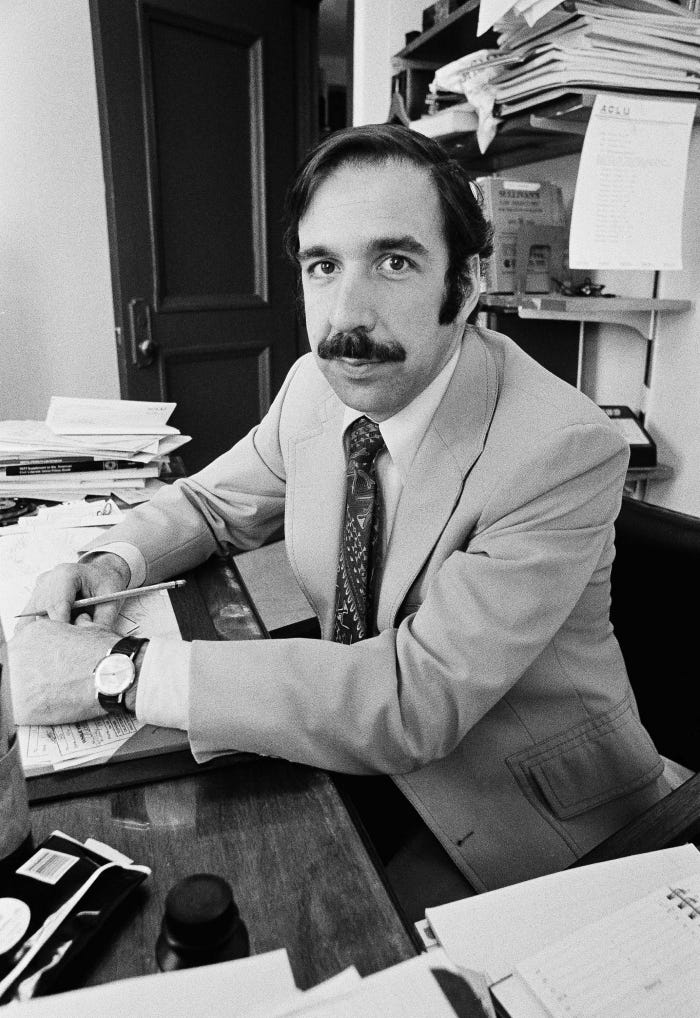
David Goldberg, 1979, source: ACLU

And, surely, there should be agreement among academic organizations in supporting academic freedom and those First Amendment rights.

Much as Jewish members of the American Civil Liberties Union such as David Goldberger decades ago supported the right of Nazis to march in Skokie, Illinois, so should campus groups such as Hillel and Columbia’s Institute for Israel and Jewish Studies join in lawsuits such as the AAUP-MESA case. If they don’t sign on as plaintiffs or file amicus briefs, the could at least offer intellectual support for the principles involved.

Instead, the Middle East Studies Association — an organization many rightly find repugnant because of its calls for boycotting Israeli academics — is standing alone among non-AAUP professional associations in this lawsuit. Where is the Association for the Study of the Middle East and Africa, a group founded by a Princeton scholar in 2007 as a reaction to the anti-Israel bent of MESA? Yes, these rival groups are riven by deep differences, but do they not share a commitment to academic freedom and open discussion?

And none should miss the bigger picture here. The lack of a united front can only weaken all academic institutions in this fight.

Surely, all academics should decry the atmosphere of fear and intimidation that the Trump Administration is spawning in its intellectually bankrupt attack on “wokeness” at universities. Even as schools such as Columbia must root out antisemitism that darkens too many departments there, they should not bow to Trumpian financial extortion.

Columbia may or may not get back the $400 million in cut federal funds because of its genuflection to Trump, but the bully surely won’t relent, finding other ways to hound the school (note that he drove out the latest interim president, Dr. Katrina Armstrong). Emboldened by Columbia’s submission, he’s now threatening to withdraw billions in funding at Harvard and Princeton. In reaction, all such institutions should unite to fight him in the courts, not succumb to being picked off one by one.

As the president of Princeton, Christopher Eisgruber, wrote in The Atlantic, the government’s assault on Columbia presents “the greatest threat to American universities since the Red Scare of the 1950s.” He urged universities to speak up in defense of their rights.

“Every citizen and officeholder who cares about the strength of our country must also care about free speech, self-governing thought, and the untrammeled quest for knowledge,” Eisgruber wrote.

Just how bad are things on some campuses now? Take note of the claims in the AAUP-MESA suit. Academics avoid open discussion of Middle East matters for fear of retaliation, the suit maintains. The Trump policy, it says, “is accomplishing its purpose: it is terrorizing students and faculty for their exercise of First Amendment rights in the past, intimidating them from exercising those rights now, and silencing political viewpoints that the government disfavors.”

The suit provides several examples, including:

Noncitizen students of City University of New York history professor Beth Baron fear leaving the U.S. for research because they may be unable to return. Some who teach avoid discussion of Israel, Palestine and U.S. foreign policy for fear of deportation. At Columbia, a noncitizen organizer of a longstanding online community shut down the channel for fear of jeopardizing the status of noncitizen members. English and comparative literature associate professor Patricia Dailey says this denies her of access to information about the region and the university.

David Kurnick, Rutgers

Another associate professor at Columbia, classics scholar Joseph Howley, last spring criticized the university for arresting student demonstrators and he now finds noncitizen graduate student instructors shunning his regular teaching sessions in fear. And a Rutgers English professor, David Kurnick, avoids publicly discussing the Middle East with noncitizen students and he limits his communications with noncitizens to in-person chats, all because he doesn’t want to endanger them.

With these and other detailed cases, the suit paints a picture akin to the darkest days of McCarthyism, an atmosphere that differs little from the repression once common in the old Eastern bloc. Back then, academics and others were forced into samizdatsecretly recording and distributing government-forbidden literature. Will that sort of system arise anew in the United States as Trump assaults more and more freedoms?

There’s no question that many Jewish students at Columbia and other universities lived in unacceptable fear of anti-semitism. And there’s no question that the pathology must be rooted out in every academic department polluted by it. Moreover, the best tack for the schools to take is to require protesting students to take coursework that would inform them fully about Middle East history, so they can understand how Israel has long been victimized.

But trading one fear for another is not the answer. And neither is allowing Trump to win by dividing those who should unite behind larger common aims.

By picking off his targets one by one, Trump prevails against some and weakens all — just look at how he has divided big law firms. Even as they differ on other important things, academic groups should stand shoulder to shoulder in supporting principles they can agree on.

Indeed, there can be no neutrals in this fight. That’s the way the bully in the White House wins.

Echoes of the ugly past

Trump’s jackboots are making a mark on universities

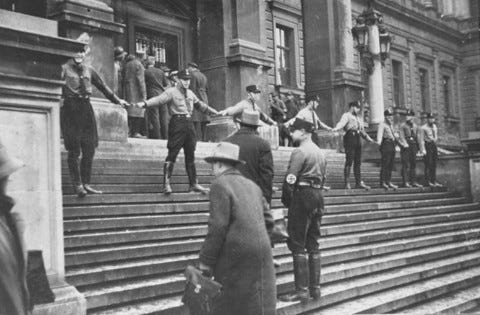
Nazis barring Jews from the University of Vienna, 1938. Source: Holocaust Encyclopedia

In 1933, the Nazis imposed a Civil Service law that excluded Jews and political opponents from positions in universities, among other places. At the liberal Frankfurt University, a Nazi commissar told a faculty meeting that Jews were forbidden on campus and launched into an abusive tirade, pointing his finger at one department chairman after another and saying, “You either do what I tell you or we’ll put you into a concentration camp.”

The war on education was on. Hitler’s minions were determined “to root out any dissent to their policies and ideology that remained in German higher education,” as Facing History & Ourselves described it.

Are we hearing echoes today in Donald J. Trump’s siege on universities? Is it overwrought to make such a comparison? Maybe not.

Certainly, it’s clear that Trump’s Republican Party is determined to bring higher education to heel ideologically. In the process, it is instilling fear among students, faculty and administrators as it attacks everything from diversity programs to medical and scientific research and global outreach efforts.

At Columbia University, for instance, Trump’s administration is cutting $400 million in federal support, the details of which are just now emerging. To point to one example, hundreds of researchers at the school’s Irving Medical Center have lost 232 grants for scientific research. These amount to about a quarter of the center’s research portfolio, according to Dr. Joshua Gordon, the chair of psychiatry at Columbia’s Vagelos College of Physicians and Surgeons.

And Trump’s reason for this – a bizarre inversion of the Nazi tack — is that the school has failed to protect its Jewish students. Never mind that Columbia’s administration last spring squelched the pro-Palestinian demonstrations that had riled the campus and inarguably spawned a hostile environment for Jews. That was last year’s news, but apparently Trump hasn’t paid attention to extensive changes on the campus.

“Unlike some universities that have ignored or downplayed campus antisemitism, Columbia has been strengthening its policies and taking action, even earning praise from watchdog groups like the ADL,” blogger Ethan Brown wrote in the Times of Israel. “If the government truly wanted to support Jewish students, they would be encouraging these efforts, not singling out an institution making progress while leaving worse antisemitism offenders untouched.”

Brown added: “Addressing campus antisemitism required a scalpel. Instead, Trump used a sledgehammer. Jews celebrating this tactic miss the bigger picture — it targets the wrong institution, disrupts critical research in climate science, technology, and medicine, and does nothing to protect Jewish students. We deserve real protection from harassment on campus, not a political stunt that exploits our community to attack our values.”

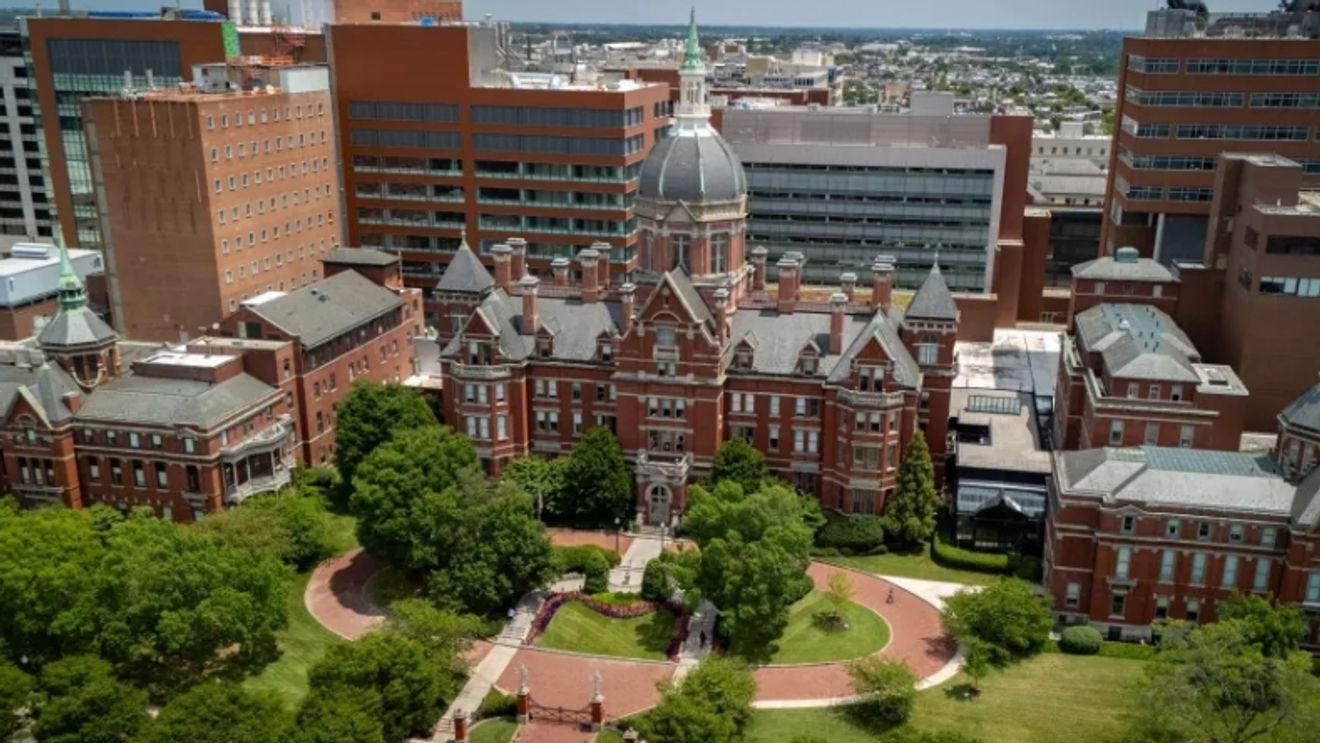
Johns Hopkins, source: The Baltimore Sun

And then there’s the even bigger financial blow Trump is delivering to Johns Hopkins University, with cuts starting at $800 million. That effort, led largely by Elon Musk, has led to staff eliminations of at least 2,000 people so far, most of whom have worked in USAID-related Hopkins programs overseas.

These cuts will end projects ranging from breast-feeding support efforts in Baltimore to a range of global efforts, according to The Wall Street Journal. Among them are a nearly complete eight-year effort aimed at convincing people in more than 50 countries to adopt behaviors such as sleeping under mosquito nets in Mozambique and using contraception in Nigeria. One dead project involved providing chlorine tablets and soapy water and messages about hygiene to prevent diarrhea deaths in Bangladesh.

“We are, more than any other American university, deeply tethered to the compact between our sector and the federal government,” Hopkins President Ronald Daniels wrote last week, as The Washington Post reported. “The breadth and depth of this historic relationship means that cuts to federal research will affect research faculty, students, and staff and will ripple through our university.”

Nearly half the university’s total incoming money, he wrote, came from federal funds last year.

But the administration efforts are even worse at the Baltimore school. Hopkins, which spends more than any other U.S. university on research — some $3 billion — stands to lose at least another $200 million under a Trump plan to cut National Institutes of Health grants for so-called indirect costs. Last month, Hopkins and a dozen other schools who would lose money sued, and those NIH cuts are on pause while the legal challenges move forward.

Remember that scientists at Johns Hopkins University have done extraordinary things. Some invented cardiopulmonary resuscitation. Others confirmed the authenticity of the Dead Sea Scrolls. And still others introduced the rubber glove to surgery and, much later, others landed the first spacecraft on an asteroid. Twenty-nine people associated with Hopkins have won Nobel Prizes.

With Trump, that legacy is under assault. Similarly, schools nationwide are under the gun.

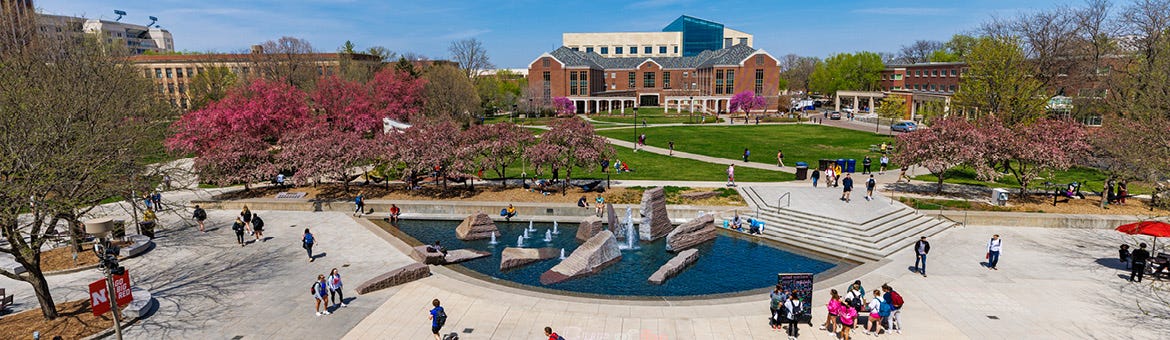
University of Nebraska-Lincoln, source: Princeton Review

As reported by Inside Higher Ed, those that have paused hiring or trimmed budgets because of funding cuts include Brown, Duke, Harvard, the University of Pennsylvania, the University of Washington, Emory University, the University of Notre Dame, the University of Nebraska–Lincoln, the University of Pittsburgh and the University of Vermont.

Trump’s plans to eliminate the federal Department of Education, moreover, are threatening student loan programs. By fiat, he and his education chief, Linda McMahon, have already cut the department’s staff in half. And Trump has said that the main task for McMahon – whose main claim to fame is cofounding and running the WWE wrestling outfit – is to put herself out of a job.

As the Associated Press reported, Trump has vowed to cut off federal money for schools that push “critical race theory, transgender insanity, and other inappropriate racial, sexual or political content” and to reward states and schools that end teacher tenure and support universal school choice programs.

Academic freedom? Intellectual independence? Fuhggedaboutit.

Diversity programs have been a particular target of the administration and of Republican-dominated state legislatures across the country. As reported by Inside Higher Ed, presidential “[e]xecutive orders denounced ‘dangerous, demeaning, and immoral race- and sex-based preferences,’ and the Department of Justice promised to investigate ‘illegal DEI’ activities.” Claiming that universities have “toxically indoctrinated students” with ideas about “systemic and structural racism,” McMahon’s Education Department launched an “End DEI Portal.” And more than 30 states have considered or enacted laws curtailing DEI.

The attacks have cast universities into disarray. Some have canceled and then reinstated cultural events, as Inside Higher and others have reported. Some have scrubbed DEI websites and canceled race-focused events. Others have vowed to “resist.” More than 60 higher education organizations called on the department to rescind its DEI Dear Colleague letter, and one lawsuit seeks to block the DCL and another has won a preliminary injunction regarding the executive orders.

So far, however, Trump and his allies have been succeeding in cowing many schools, sometimes with efforts that go far beyond financial pressure. Even as it has triggered new protests, for instance, ICE’s arrest of Mahmoud Khalil, a Palestinian who was active in Columbia demonstrations, has cast a chill on longstanding academic commitments to free speech.

Wesleyan President Michael S. Roth; source: The Chronicle of Higher Education

“I was really shocked that someone in the United States would be arrested for having participated in a lawful demonstration,” Wesleyan president Michael S. Roth told Politico. “… I thought there would be some crime that had been committed for which the individual was being held accountable. But as I learned more about it, I saw that this was part of this broader attempt to intimidate people from protesting in ways that the White House doesn’t like.”

Many students and faculty members, Roth added, “are reeling … this is the greatest fear in civil society, including in the higher education system, since the McCarthy era. People are really afraid to be targeted by the government, whose powers are extraordinary, and when they’re willing to arrest or detain someone without charge and threaten to deport him without charges, that’s very frightening.”

Along with Khalil, Secretary of State Marco Rubio is seeking to arrest a second so-far-unnamed person — who, like Khalil, is a legal permanent resident — in connection with campus protests, according to The Atlantic. Trump has said on social media that Khalil’s is “the first arrest of many to come.”

Amid the fearful atmosphere, many university administrators are holding back on commenting on national matters, apparently trying to avoid drawing Trump’s ire. In Roth’s terms, “the infatuation with institutional neutrality is making cowardice into a policy.”

Roth, one must note, is an ardent defender of Israel, but also advocates free speech and academic freedom. “You have to respect the rights of people with whom you disagree, and I think presidents, deans and professors, we should model that as best we can,” he said.

Largely an academic disappointment in his two years at Wharton himself, Trump runs into most of his opposition from well-schooled folks. And his supporters are dominated by the undereducated. So, his attacks on education are not all that surprising. They resonate among people who are either envious of those with more schooling or feel left behind by them.

Still, the assaults are troublingly effective. Schools may have some success in fighting the president’s efforts in the courts, but with Congress and the Senate mostly behind him, their battle will be uphill. At least until the midterm elections, they are in for far too much grief. The Nazis would have been proud.

Antisemitism poses a challenge for Trump

How will the administration deal witH IT?

Source: IAC

When Arab-Israeli journalist Yoseph Haddad spoke at a downtown Chicago synagogue a day after the presidential election, dozens of pro-Hamas demonstrators showed up. Masked or wearing kaffiyehs, most screamed outside the Loop shul, but a couple got inside under false names, disrupting the event and vandalizing property. Shouted down by the audience, they were hauled out by police.

This followed an attack by a pair of masked men earlier that day on two Jewish students at DePaul University, about five miles away. And it came after an attempted murder of a Jewish man, shot on Oct. 26 on his way to synagogue West Rogers Park, about 11 miles away.

Meanwhile, on Election Day, a neo-Nazi endorsed Donald J. Trump for president. As Rolling Stone reported, Chris Hood, the founder of the neo-Nazi group NSC-131 called on fellow fascists in the swing states to vote for Trump.

So, might we expect to see stepped up antisemitic incidents over the coming four years? Recall that Trump flirted with white extremism two years ago by dining with the rapper Ye and prominent white supremacist and Holocaust denier Nick Fuentes at his Florida club, Mar-a-Lago, as Vox noted.

Source: NBC News

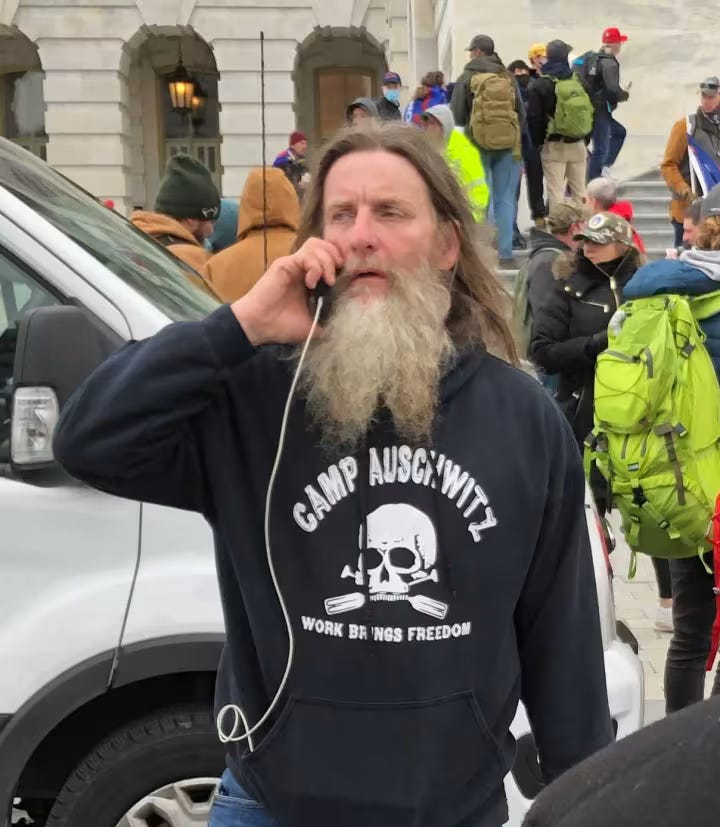
And remember that during the Jan. 6, 2021 insurrection, protesters carried a Confederate flag into the US Capitol, erected a gallows and noose on the lawn, and that at least one rioter sported a “Camp Auschwitz” hoodieProud Boys brandished “6 Million Wasn’t Enough” T-shirts and an Israeli reporter was singled out and harassed by protestors, according to AP News. White nationalists recorded a live stream and offered a “Shoutout to Germany” for their 10,000 viewers. 

Of course, Trump has long done a weird dance with such supremacists. He repeatedly denounced antisemitism and he has a Jewish daughter and grandchildren. But he also has praised Hitler and criticized American Jews for not showing enough gratitude for his support of Israel. 

It’s likely that Trump’s stances on immigrants and others hated by supremacists emboldened them. Antisemitic incidents and hate crimes rose 12% from 1,879 in 2018 to 2,107 in 2019, where the highest previous number was in 1994, according to Reuters. These included fatal shootings at a California Synagogue and a New Jersey kosher grocery store, as well as the stabbing of a rabbi in his New York home.

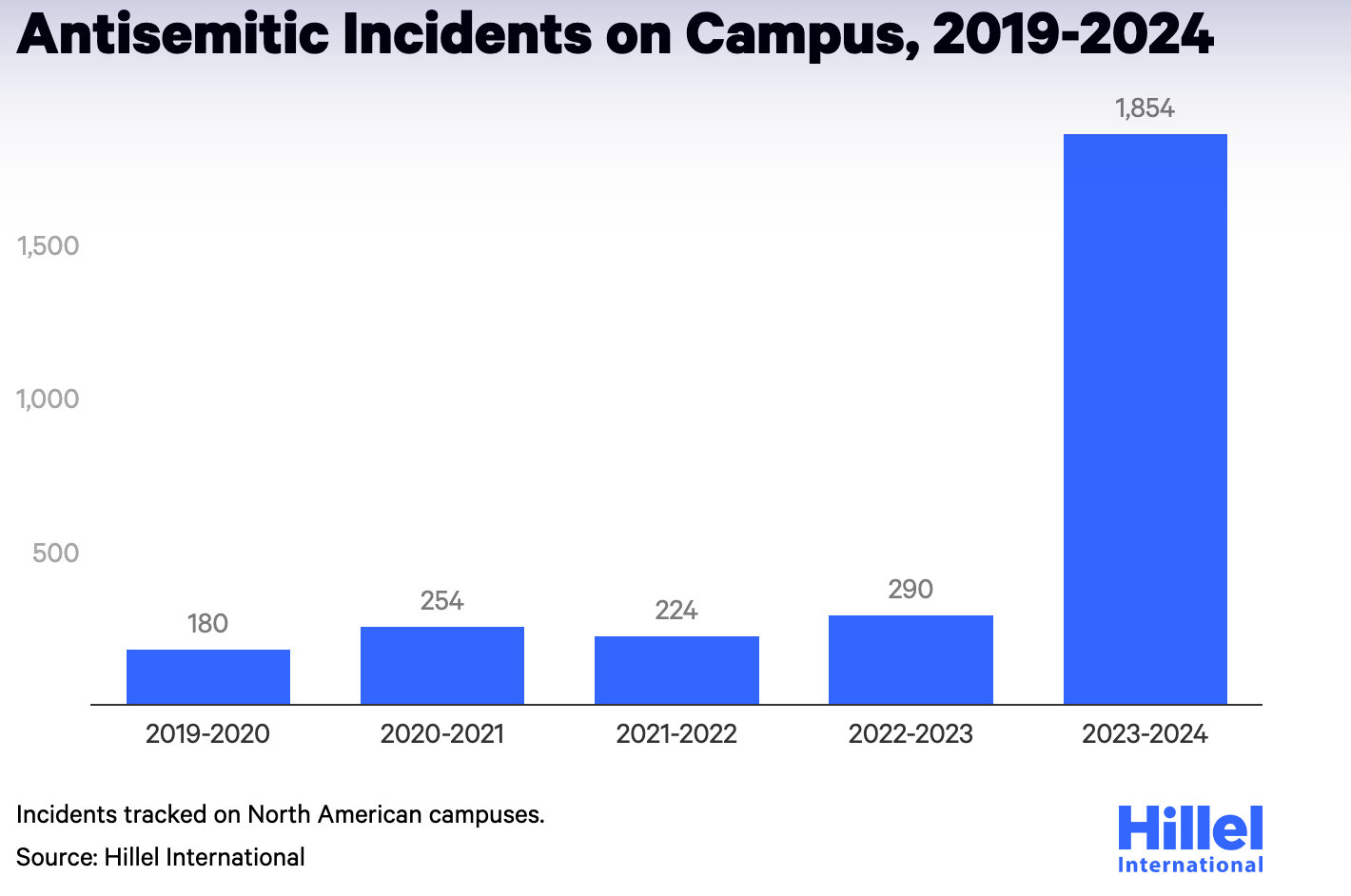
To be sure, antisemitism exploded during the Joe Biden term, mainly as a reaction to the aftermath of the Oct. 7, 2023, Hamas attack and Israel. Hillel recorded 1,834 antisemitic incidents on campuses in the 2023-24 school year, up from 180 in 2019-20 and 254 the following year. A study by Brandeis academics found that antisemitism was “far more prevalent” on campuses last year than in 2016, when they first examined the phenomenon. “The ongoing Israel-Hamas war is clearly a major driver of the sharp increase in antisemitic hostility on campus,” they reported.

And the Anti-Defamation League counted 8,873 incidents nationwide last year. This was sharply up from the roughly 2,000 recorded each year during Trump’s first term. Such incidents have continued.

Tarek Bazzi, source: ADL

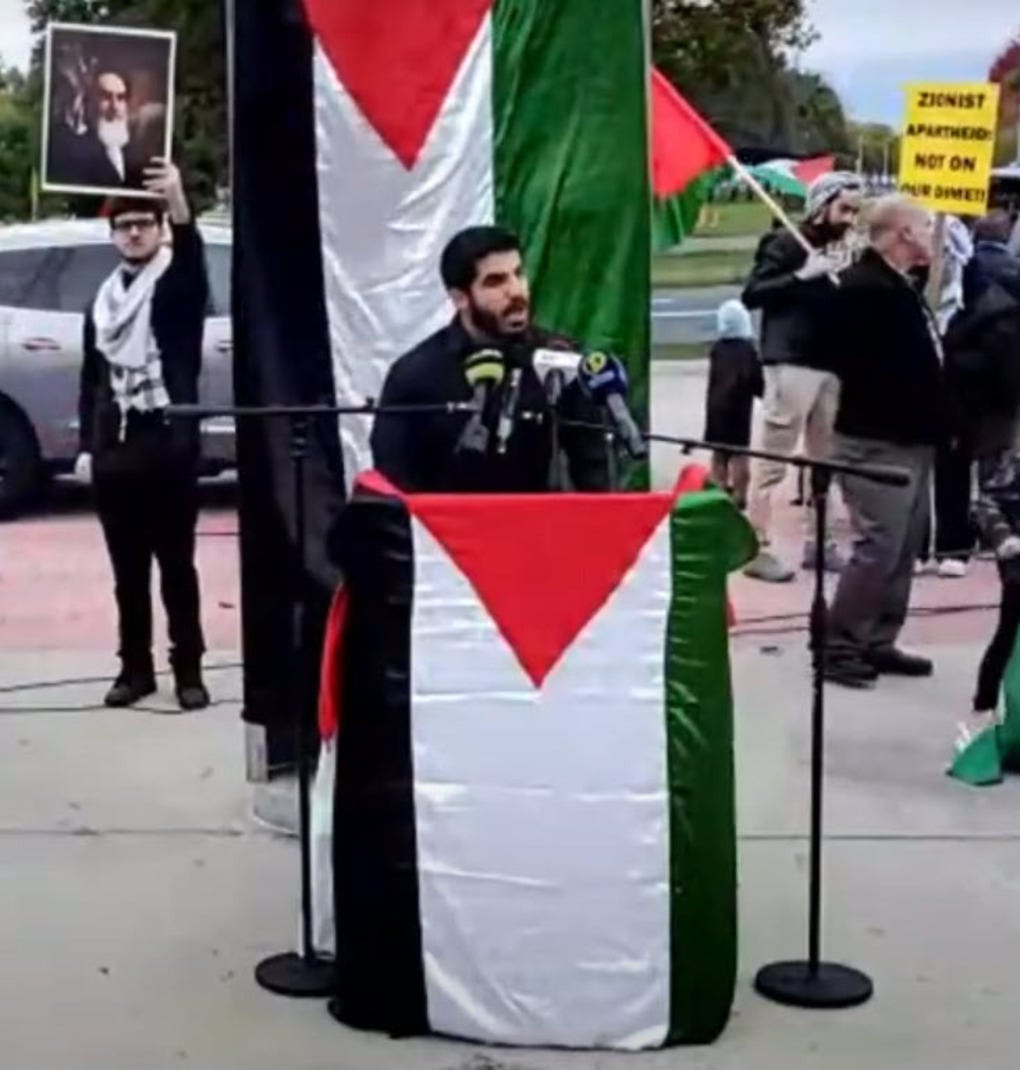
As the ADL reported, on Oct. 13, a speaker named Tarek Bazzi at an anti-Israel rally in Dearborn, Michigan, said: “We’re not here to condemn the killing of innocent civilians on both sides. We’re not here to chant empty slogans, because when we say ‘Free Palestine,’ and when we say ‘From the river to the sea,’ we understand what that means….The only hope that Palestine has is its armed resistance…If you’re pro-Palestine, then you’re pro-armed resistance.”

Four days before, at a rally in New York City, the crowd cheered after a speaker mentioned that 5,000 rockets had been fired at Israel. An attendee displayed his phone to onlookers with an image of a swastika on it, and another held a sign celebrating the attack as a “Zionist nightmare.”

But can we expect things to get worse in coming years? As long as the Gaza War continues, this may be the case. But much will turn on how the White House and campus administrators respond.

“Trump and extremists’ unabated use of xenophobic antisemitic tropes without an immediate and unequivocal condemnation from a bipartisan group of leaders across the U.S. will likely lead to more violence and hatred toward the American Jewish community,” former ambassador Norman Eisen and former USAID administrator Jonathan Katz warned in a September piece in Newsweek in which they said Trump was fueling antisemitism in his campaign. “A 2024 American Jewish Committee survey found that 93 percent of Jews think that antisemitism is a problem, with 56 percent calling it a ‘serious’ problem.”

They pointed to efforts in Washington to combat the problem. They praised the Biden-Harris National Strategy to Counter Antisemitism, and pressed for the bipartisan Countering Antisemitism Act. But they said such national efforts must be coupled with state and local action, including by governors and mayors, across the U.S., who should adopt policies in line with the White House led strategy to counter antisemitism.

While collegiate bans on encampments protesting the Gaza War have limited the more vocal antisemitic events on campuses, incidents have continued, as recorded by the AMCHA Initiative:

Source: Harvard Crimson

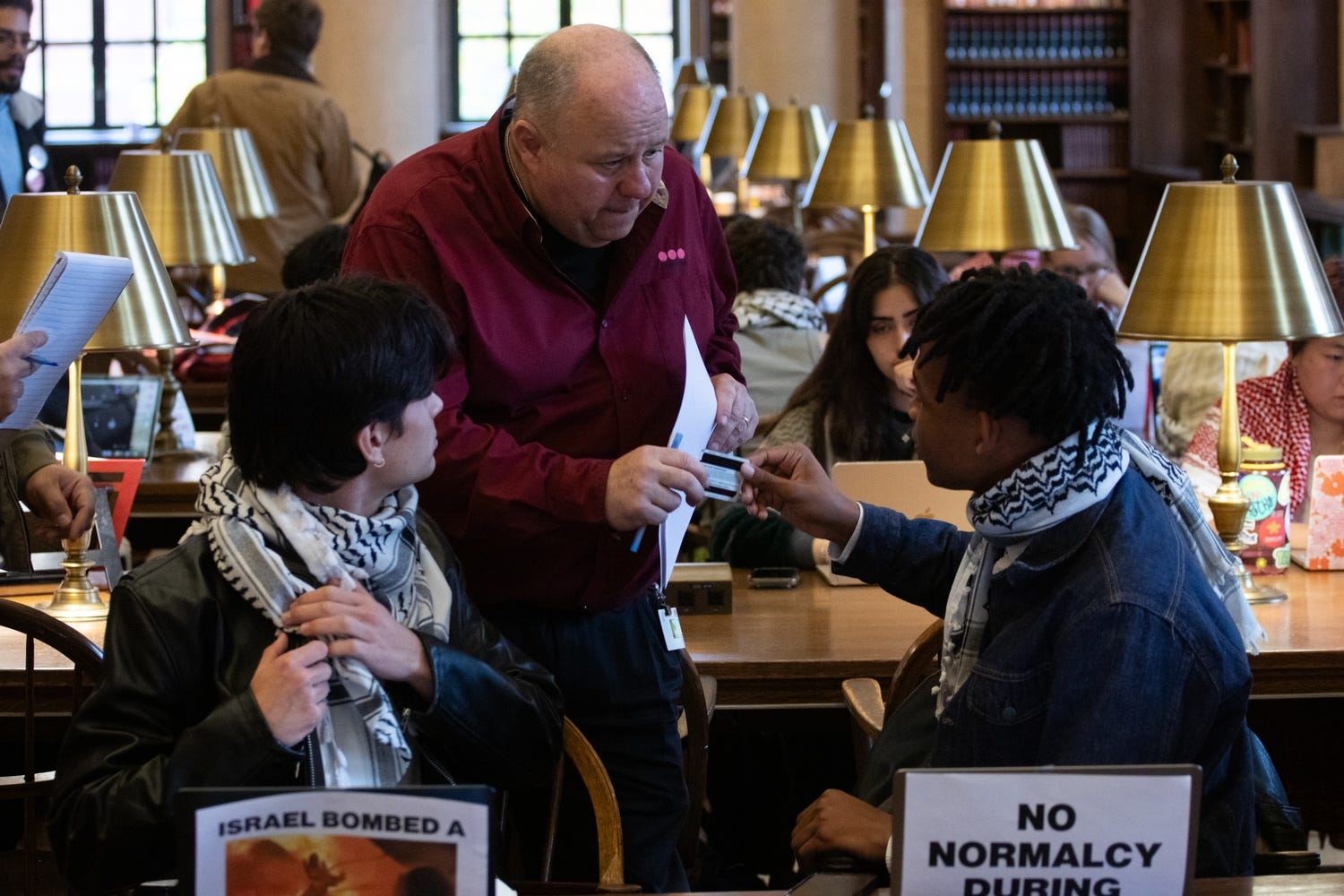
At Harvard the Palestine Solidarity Committee and Harvard Out of Occupied Palestine held a silent protest inside a library in October, during which students sat with signs that demonized Israel with such phrases as, “No normalcy during genocide,” “Harvard divest from death,” and “Israel bombed a hospital, again.” Meanwhile, the university restored the PSC as an official student group after a five-month suspension.

At Drexel in Philadelphia, a helicopter dropped leaflets that demonized Israel, stating, “This is how Israel gives evacuation orders. Imagine this paper telling you to pack up your family and leave your life behind. This is what terrorist Israel does when you stay at the hospital where you are being treated.” At Columbia, a faculty and staff group called for a boycott of local businesses with ties to Israel on Instagram, including a map of businesses to boycott indicated with red inverted triangles, a symbol of Hamas’s targets. 

For Halloween, a student at Binghamton University dressed up as Yahya Sinwar, the dead leader of Hamas. The student and posted a picture on Instagram alongside the caption, “this was my costume last night.”

Some academics have stood out for their viciousness against Israel. At an Oct. 15 rally in New York, CUNY professor Danny Shaw shouted, “Zionism is a trap. Go back to your true history. Go back to Yiddish land …. This is not Israel versus Hamas. This is a Zionist extermination campaign that began in 1948.” 

Republicans in recent months criticized campuses that they said didn’t act against antisemitism, often angering free-speech advocates. Whether legislative efforts will continue or grow remains to be seen.

If incidents multiply, it’s likely that the Trump Administration will face demands to act anew against antisemitism. Given Trump’s dalliances with supremacists, can or will it do so?

When is cancellation warranted?

A Connecticut teacher faces heat over refusing to share a stage with a Jewish autho

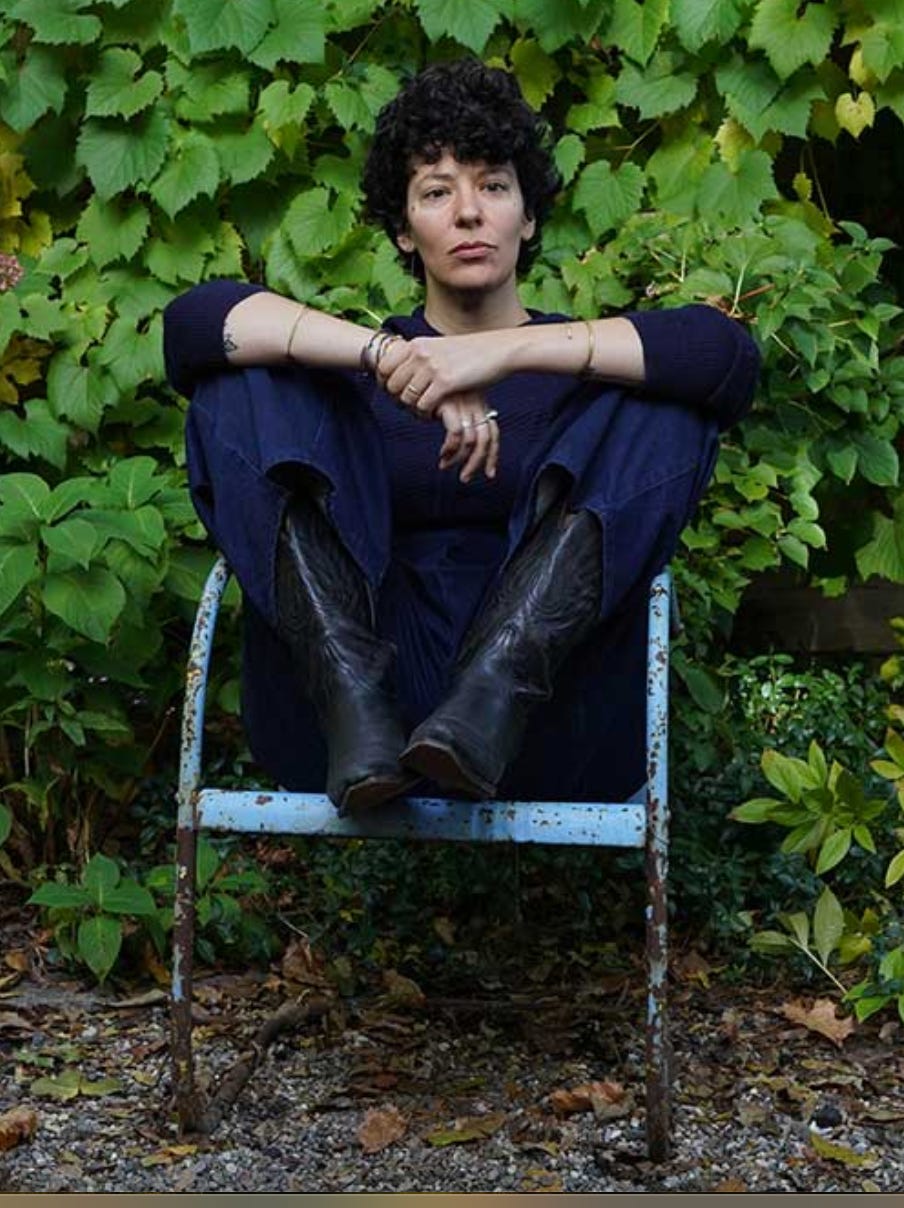
Aisha Abdel Gawad, source: her website

When I attended an all-boys prep school in New Jersey many decades ago, one of my history teachers was a chapter leader in the John Birch Society. He routinely spouted bizarre Communist-infiltration theories, had us read conspiracy-oriented books and tried to recruit students to sell for Amway.

He lost his job at the school.

Should that happen now to Aisha Abdel Gawad at the prestigious all-girls Greenwich Academy in Connecticut? Should parents at the K-12 school think twice about sending their daughters there, as an alum of the school suggests in The Wall Street Journal?

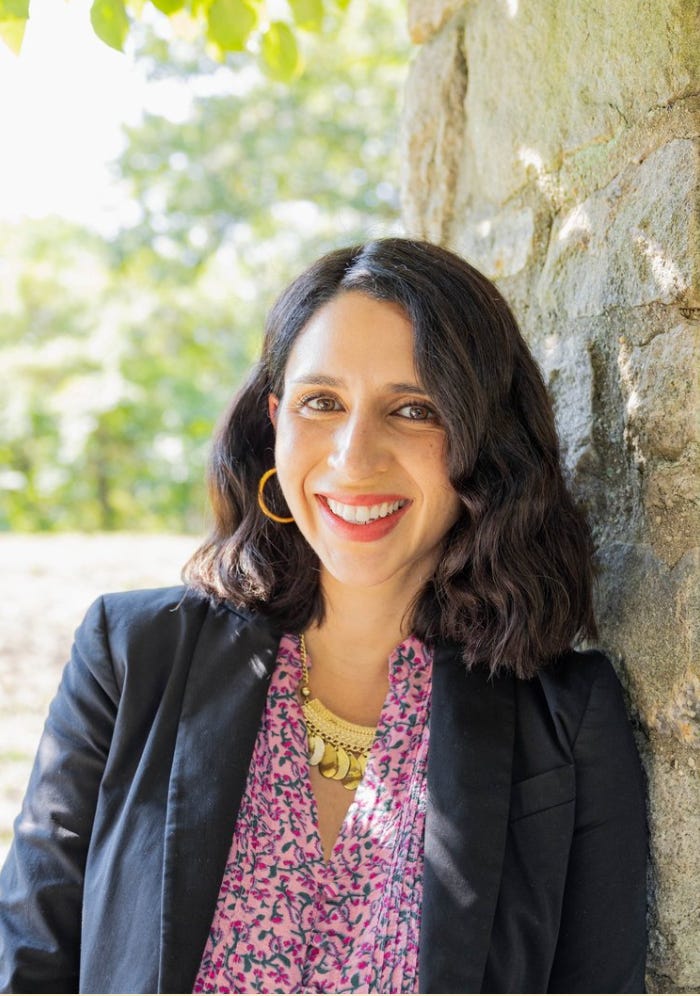
Gawad is the writer who refused last weekend to appear on a literary panel discussion at an Albany book festival with a Jewish writer, Elisa Albert, who supports Israel. The festival director cancelled the session, saying Gawad and another writer didn’t want to share the stage with a Zionist.

Never mind that the panel had nothing to do with Zionism or Judaism. It was about “Girls, Coming of Age.”

Elisa Albert, source: her website

And never mind that, to Gawad, Albert’s unpardonable sin was to write a piece lambasting those who defended Hamas after it murdered some 1,200 people and carried off a couple hundred hostages nearly a year ago.

Never mind that Albert’s piece, “An Open Letter to Hamas’ Defenders” in Tablet magazine expressed sympathy for Palestinians, even as it condemned their terrorist oppressors. “We weep for the plight of the Palestinian people and for the ignorance and naïveté of so many who believe that anyone but Hamas is responsible for their current suffering,” Albert wrote.

To Gawad, Albert’s criticism of Hamas and its supporters “mocked anyone who expressed grief over Palestinian life.” To be sure, Albert used sarcasm to make her point, as she began with “Hi terror apologist!” That was enough for Gawad to say that sharing the dais with such an outspoken Jew “did not feel like a safe forum.”

What would Albert have done, one wonders? Would she have pulled out an Uzi? Would she have strapped on a suicide vest? Would she have kidnapped Gawad and taken her off to a tunnel for 11 months?

More likely, Albert would have discussed her latest book of essays, “The Snarling Girl.” Her collection of 16 essays deal with feminism, childbirth, medicine, life in Los Angeles and Albany and, yes, her Judaism. The last includes things such as the stress of being a ​“per­fect host­ess, per­fect Jew­ess” at a Passover seder, the lega­cy of Philip Roth, a vis­it to a mik­vah, and anti­se­mit­ic com­ments she’d received.

Still more likely, Albert would have sought to bridge the gulf between her and Gawad.

In fact, in a new Tablet post, Albert invites Gawad to her Shabbos table, offering to break bread and talk to one another. Albert writes “… the last thing on earth anyone needs is more anger, more resentment, more fighting, more hatred, more blood, more violence, heads to roll. Haven’t we had enough, yet, of anger, fear, suspicion, hatred, fighting, bloodshed?”

In that same piece, Albert defends Zionism. To her, it “is the belief that the State of Israel has the right to exist. Zionism is the belief that the Jewish people (literally aka ‘Israel’) has the right to self-determination, peace, and safety in our ancestral homeland.”

And, as a proponent of a two-state solution, she adds: “Zionism precludes no other peaceful nationalist ambitions or aspirations.”

Would that sort of conciliation be enough for Gawad? Would she join Albert in sharing challah so they could civilly air their disagreements?

Probably not.

Source: AZ Mirror

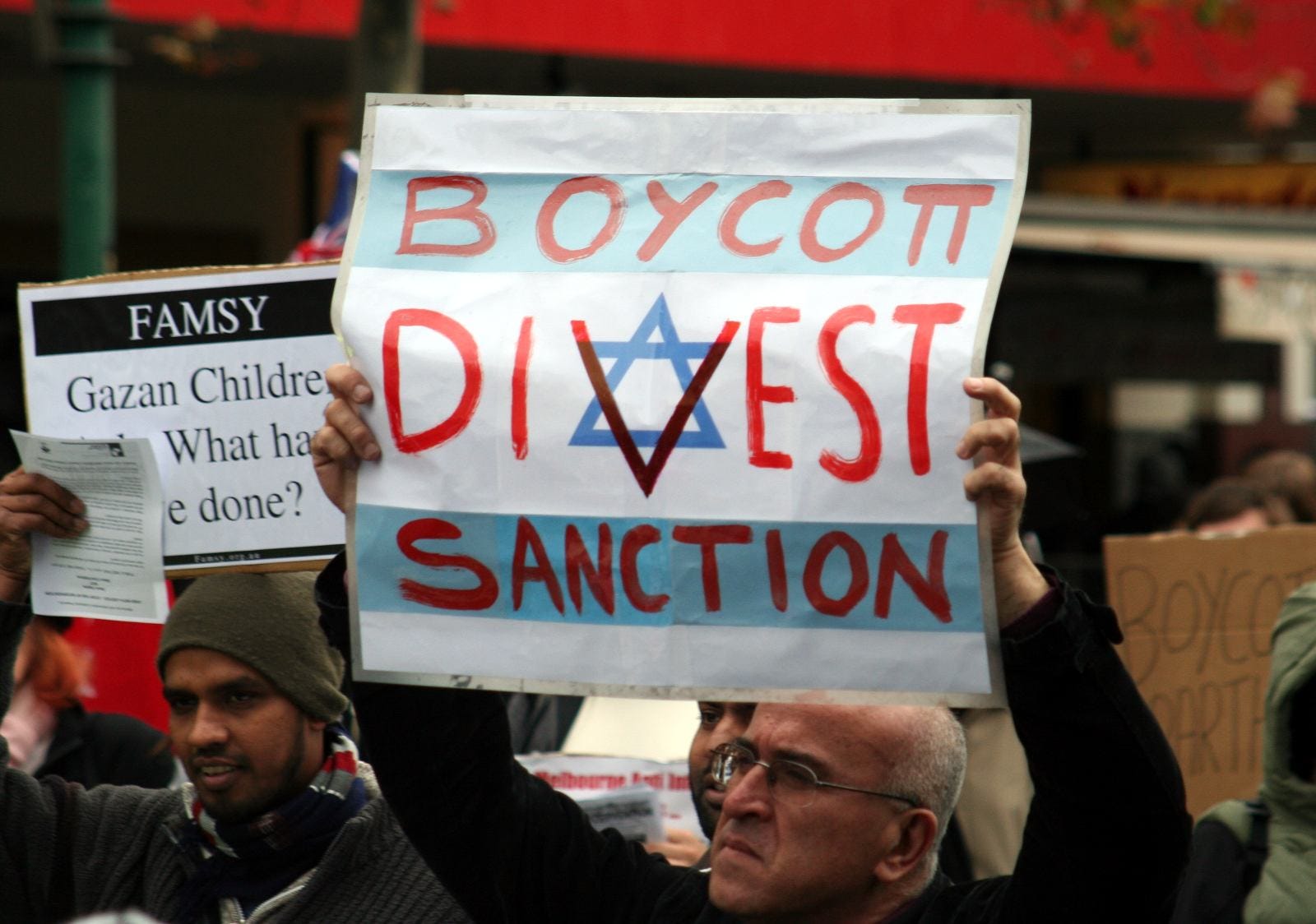
Gawad’s refusal to share a platform with Albert is a new wrinkle on the longstanding Boycott, Divestment, Sanctions effort. That’s the 18-year-old drive that blacklists Jews, especially Israelis in academic institutions and others. The aim is to pressure Israel to accept, among other things, a right for Palestinians who fled in 1948 to return to their homes. That, of course, would destroy Israel. It would make it impossible demographically for the Jewish state to exist.

Indeed, BDS co-founder Omar Barghouti has said “we oppose a Jewish state in any part of Palestine. No Palestinian, rational Palestinian, not a sell-out Palestinian, will ever accept a Jewish state in Palestine.”

Gawad’s decision to boycott a panel that would include Albert is of a piece with some of the more bizarre BDS efforts. Backers sought to boycott McDonald’s because a franchise in Israel offered free meals to Israeli soldiers. And BDS called for a boycott of an upcoming Disney movie that that features an Israeli superhero, Sabra, a fictional member of spy-agency Mossad. And some have called on supporters to shun Disney altogether.

Over the last few years, BDS backers have risen to the fore in several academic organizations. They won a vote for a resolution last May in the American Sociological Association, by a 58.8 percent margin, condemning Israel’s actions in Gaza and criticizing “Zionist occupation.” For all of its fury over the deaths in Gaza, however, there was no condemnation of Hamas in the resolution — its murderousness, apparently, wasn’t worth noting.

More recently, in August, BDS backers succeeded in getting the American Association of University Professors to support academic boycotts, rescinding its longstanding opposition to them. In a case of Orwellian logic, the AAUP argued that “when faculty members choose to support academic boycotts, they can legitimately seek to protect and advance academic freedom.”

So, should Gawad continue to teach at the Greenwich Academy? Should she be shunned for her refusal to sit next to a Zionist? Should her boycott of Albert lead to the school, in effect, boycotting her?

Well, Emma Osman, an editor at The Wall Street Journal and a graduate of the academy, puts the matter in terms of how some of Gawad’s students may be affected. She wonders what things might be like for some of them now.

“I imagine myself back in school, seated around Ms. Gawad’s table,” she writes. “Would I feel my voice was ‘heard and valued’? Would I feel comfortable raising a view that I knew Ms. Gawad disagreed with? Could she grade my essay objectively knowing it was written by someone she might label a ‘Zionist’?”

The head of the school, Margaret Hazlett, defended Gawad initially. But, as pressures have grown, she more recently said that the teacher’s actions “showed a lack of judgment” and “reflected poorly on GA.”

Indeed, Gawad has already lost another prestigious gig as a result of her action. The Wilton Library terminated her as its first writer in residence, a $30,000 position. In explaining the move, officials there write: “We continue to be passionate about the free exchange of ideas. We remain dedicated to our mission to ‘inform, enrich, connect, and inspire our community,’ and to maintain an environment where everyone is made to feel safe and welcome.”

So, should she be fired from Greenwich Academy, as well, because it’s entirely possible some students will now feel unsafe and unwelcome in her classroom? Under intense fire now, Gawad claims that she, in fact, opposes all forms of discrimination and hatred.

“I oppose anti-Semitism and have dedicated my professional and personal life to not only fighting anti-Semitism, but also racism, Islamophobia, and hatred of all kinds,” Gawad wrote in a response to press inquiries. “I find it deeply hurtful and saddening that the festival chose to make public my private choice.”

But does she oppose the venomous hatred that led a terrorist group to murder hundreds of innocents? To rape and kill wantonly? There’s been no word from her on that, at least not publicly. Not a hint of criticism from her of Hamas and its ilk.

My former history teacher’s wrong-headed, at-times vicious and certainly ill-informed views made many of us in the classroom pretty uncomfortable. His attacks on some of us over our opposition to the Vietnam War at times got quite personal. And, in the end, his intellectual and emotional shortcomings and attitudes did him in.

Ultimately, that teacher’s position was untenable, his views were just too noxious. Gawad’s antisemitic act — whether she sees it as that or not — may in the end have the same effect.

Holden Caulfield’s flawed creator

A new book offers insights into J.D. Salinger

Source: Google Books

On D-Day in June 1944, J.D. Salinger landed at Utah Beach with 23,000 other Allied soldiers. They were the lucky ones, as the Germans only lightly defended that stretch of seafront. Some 197 of them were killed or wounded, far less than the 2,400 gunned down at Omaha Beach, five miles away. Still, the trauma of that battle – and gorier ones to come – left deep scars on the budding writer, then 25.

Salinger explored his wounds a bit in “The Magic Foxhole,” an unpublished short story in the archives at the Princeton University Library. In the piece, a chaplain wanders among the dead and wounded on that bloody beach, frantically searching for his eyeglasses. He is shot to death.

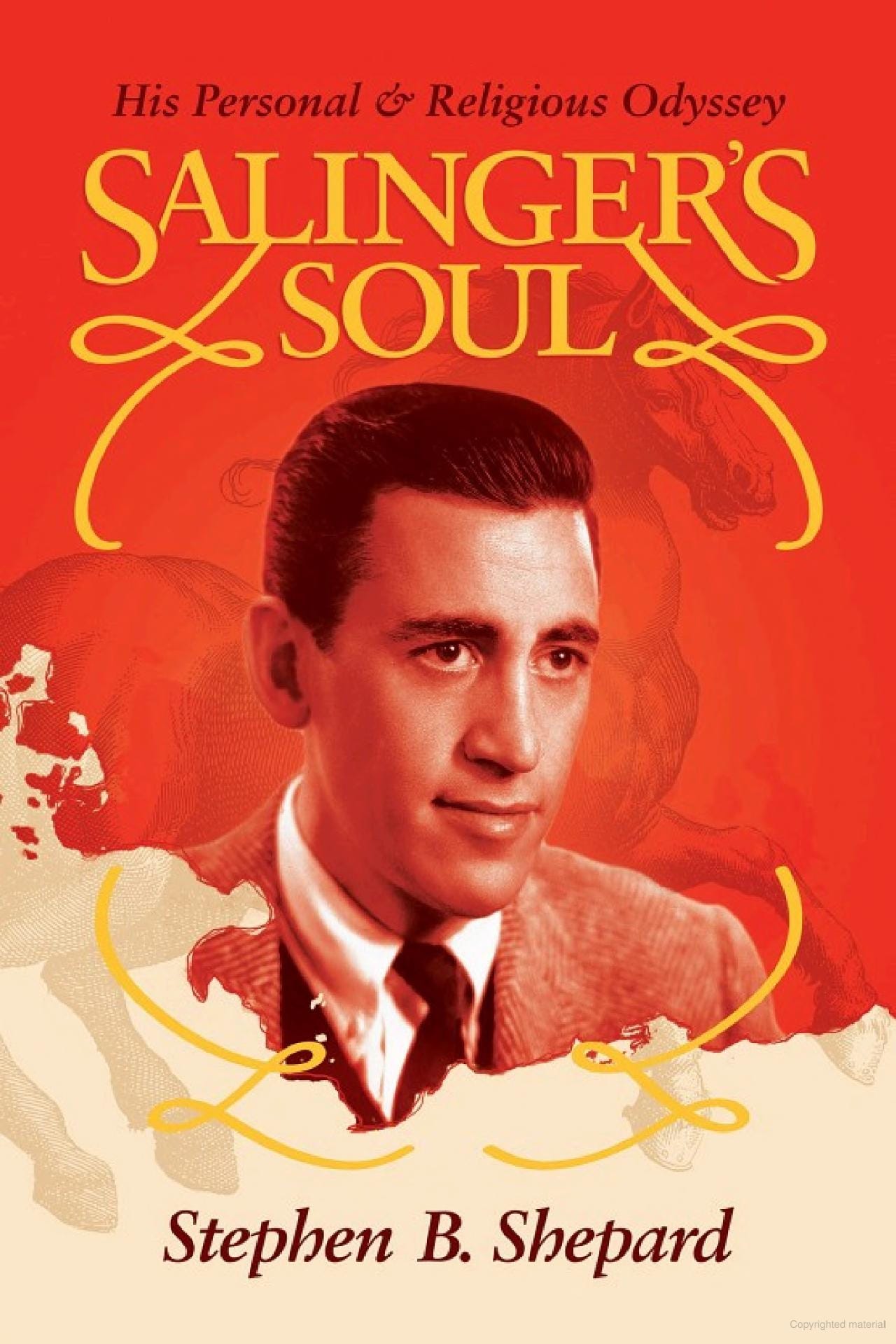
“Critics have pointed out the symbolism of God’s messenger finally being killed—the death of God—after searching for the clarity of battle that his eyeglasses might have provided,” Stephen B. Shepard writes in Salinger’s Soul: His Personal and Religious Odyssey.

In Shepard’s superb analysis of this enigmatic and much-read writer, Salinger comes across as something like that fictional chaplain. Spiritually lost and seeking relief amid the ugliness of the world, he wanders about, damaged and confused.

Salinger, for his part, abandoned the religion of his youth, trying to soothe his chronic depression in various Eastern creeds. He ran through a string of wives and lovers. He alienated or cut off friends and family.

It’s no wonder that he lived most of his life in hermitic seclusion on a mountaintop in New Hampshire.

“Passionate yet detached. Raised Jewish, but a practitioner of mystical Hinduism,” Shepard writes about Salinger’s many contradictions. “No sex in his books, but plenty in his life. A great believer in the power of love, but not so ready to give it. An adult with sophisticated views, but a man of arrested development in his romantic interests. A person with ‘a cast-iron ego’ who spent a lifetime seeking solace in God.”

Under Shepard’s unsparing eye in this short but absorbing work of literary analysis and journalism, Salinger emerges as self-centered and selfish, often disloyal, more than a bit creepy, and sometimes quite cruel.

Of course, he gave us memorable characters, most notably Holden Caulfield of The Catcher in the Rye and Franny and Zooey Glass and their family. Indeed, Catcher still sells 200,000 copies a year, totaling 65 million, making it one of the best-selling books of all time. Salinger made the cover of Time in 1961, when Franny and Zooey was published.

Joyce Maynard, now 70. Source: The New Yorker

But the writer’s life was a mess. To take just one example, Salinger famously seduced an 18-year-old college freshman Joyce Maynard, when he was 53. Then, after living with her for 10 months, he callously dismissed her.

While vacationing with him in Florida, Maynard broached the idea of having children. “I can never have any more children,” the father of two told her. “You better go home now. You need to clear your things out of my house.” He gave her $100 the next morning and put her in a cab to the airport.

Maynard was one of many young women the thrice-married Salinger wooed and won. Each was “in the last minute of her girlhood,” a phrase he memorably wrote in one of his stories

Claire Douglas, source: Digital Commonwealth

Salinger couldn’t abide pregnancy, it seems, perhaps because it shattered his idealized vision of (or one might say his lechery for) girls on the cusp of adulthood. His marriage to Claire Douglas, whom he had met when she was a high school student and he was in his thirties, ended in 1967, a few years after she gave birth to their second child. Salinger’s sister told his daughter Peggy that Douglas had “a suicidal depression when she realized that her pregnancy only repulsed him.”

Claire couldn’t handle the isolation he imposed on them in their home in rural Cornish, New Hampshire. When their daughter was born, Claire was 22 and he was 37, and he seemed to leave her largely alone, abandoning her to spend his days in a cinderblock writing studio he had built.

“Up by 6:00 AM, he ate breakfast, packed his lunch, then went to his writing bunker, where he worked nonstop—draft after draft—until dinnertime, often returning to his bunker after dinner,” Shepard writes. “He had a phone installed in his bunker, along with an army cot, but made it clear to Claire that he didn’t want to be disturbed for anything less than a dire emergency.”

Salinger racked up a lot of broken relationships, often with people who had helped his career.

As a 20-year-old taking night courses at Columbia University’s School of General Studies, he was mentored by an adjunct professor, Whit Burnett, who cofounded Story magazine and published a few Salinger stories. But, when Burnett ‘s partner in a book imprint, the Lippincott Company, vetoed the idea of publishing a collection of Salinger’s pieces in a book, Salinger blamed the late Burnett and didn’t speak to him for years.

A.E. Hotchner

Salinger in 1948 told A.E. Hotchner, an editor at Cosmopolitan, that he planned to submit a story he called “Scratchy Needle on a Phonograph Record” about the death of blues singer Bessie Smith. Sounding much like a prima donna, Salinger said not one word could be changed.

Unbeknownst to Hotchner, however, the title was changed to “Blue Melody.” When Hotchner shared the magazine with him, Salinger blew up, accused the editor of deceit. The late Hotchner never saw him again.

Margaret “Peggy” Salinger, source: Simon & Schuster

Salinger even became estranged from his only daughter, who described him in a memoir as cold, manipulative and abusive, as Shepard tells us. The father Peggy describes is weird, drinking his own urine and sitting in an “orgone box,” a closet-sized cabinet for storing psychic energy.

Perhaps his driven self-absorption was necessary for Salinger to give us such fascinating and enduring characters. Despite his many successes, he endured a lot of rejections in the competitive post-war publishing world, one dominated by such figures as Ernest Hemingway, whom Salinger befriended in wartime Paris, and Norman Mailer (who dismissed him as “no more than the greatest mind ever to stay in prep school”).

The wartime experiences of both the latter writers – and many others — did much to shape their work. With Salinger, only a modest bit of his combat experiences appears in his fiction. Indeed, as he focused on young fictional characters, he seems to have tried to suppress the ugliness he saw in Europe. Instead, he seemed to immerse himself in imagined youthful innocence, perhaps taking refuge in it.

But the psychic ravages of the war may well be the key to understanding this peculiar man.

After landing on D-Day, Salinger’s regiment fought its way toward a French port city, Cherbourg, Shepard tells us. As the men moved street by street, under German fire the whole way, many were slaughtered. Of some 3,000 of Salinger’s fellow soldiers, only 1,100 remained by the end of June 1944; the rest were killed, wounded or missing. The regiment suffered the highest rate of casualties of any in the war.

Soon after, in January 1945, Salinger fought in the especially ghastly Battle of the Bulge. Then, in April, came what Shepard calls the author’s most devastating wartime experience. He saw the horrors that fleeing Nazis left at a slave labor camp that was a satellite of Dachau. Bodies of Jews, starved or shot, lay about the camp. Others, too sick to leave, were burned to death in their barracks.

“You never really get the smell of burning flesh out of your nose entirely, no matter how long you live,” Salinger told his daughter. He was hospitalized for a time in Germany for combat stress,

Salinger did draw on such wartime experiences in crafting a few of his stories, including one of his most famous, “A Perfect Day for Bananafish.” In it, the fictional Seymour Glass, an ex-sergeant like Salinger, suffers a nervous breakdown and commits suicide.

Of course, Salinger didn’t kill himself. He died in 2010 at 91. At the time, he was married to Colleen O’Neill, whom he had met when she was 22 and he was in his early 60s. They married in 1988, and that marriage endured.

Whether Salinger ever found the personal peace that he thought his Eastern religion, Vedanta, promised is unclear. His son Matt, in a family statement upon his death, said: “Salinger had remarked he was in this world but not of it,” evoking that philosophy.

Matt, a successful actor, has been combing through his father’s unpublished work with an eye toward releasing it in the next couple years. Though he wrote constantly, Salinger didn’t publish anything after 1965, so we may soon see a wealth of material emerge.

Stephen B. Shepard; source: CUNY

Shepard’s work is well-timed to anticipate the flood.

The former longtime editor of BusinessWeek (full disclosure: I worked for him for about 20 years) and the founding dean emeritus of the graduate journalism school at City University, Shepard draws on biographies of Salinger. He also alludes to most of the author’s work, using it to flesh out his personality.

Much about the man still puzzles Shepard. But this reclusive figure who made an enduring mark on American literature has given us all much to puzzle over.

A tempest looms

The coming school year will test leaders and try many

Trinculo, as portrayed by Russell Brand; Source: Fandom

In Shakespeare’s ingenious play, “The Tempest,” a man takes shelter next to a sleeping sea monster. “Misery acquaints a man with strange bedfellows,” the jester Trinculo tells the audience.

Such is the case with the Philadelphia-based Foundation for Individual Rights and Expression (FIRE), antisemites and Republican politicians. Peculiarly, all seem allied now in celebrating the departure of Nemat “Minouche” Shafik as president of Columbia University.

“Marked by chaos and cowardice, Minouche Shafik’s tenure was a disaster for freedom of expression,” a FIRE official tweeted on X. “Columbia University now has an opportunity to select a leader who will recommit the institution to protecting free speech and academic freedom. Students, faculty, trustees, and alumni should demand no less.”

Troublingly, the bold-faced message echoed that of Columbia’s suspended chapter of the Students for Justice in Palestine. “The student intifada outlasted Minouche Shafik and will outlast every corrupt administrator until divestment, liberation, and return,” the antisemitic group posted.

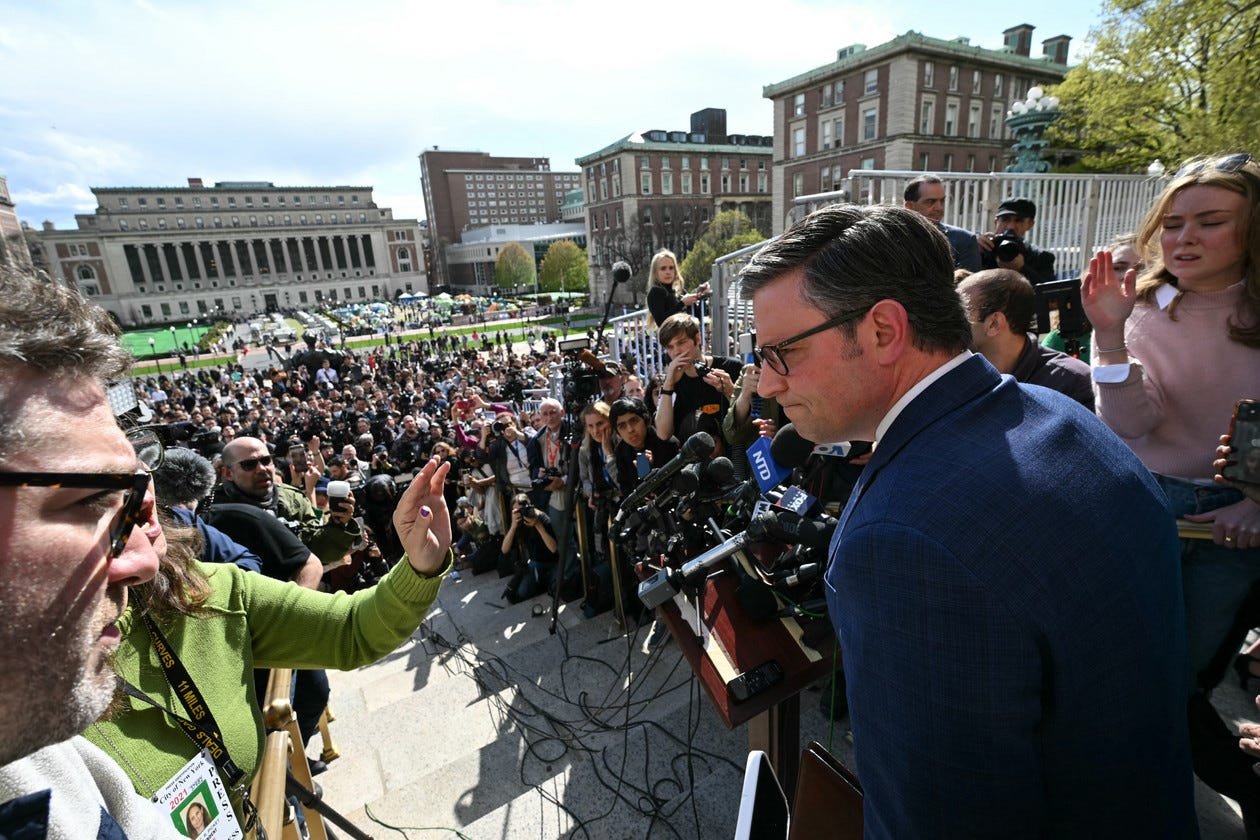
Speaker Mike Johnson at Columbia, source: AFP/Getty Images via Politico

And, for different reasons, FIRE’s reaction also reflected that of GOP politicians, including House Speaker Mike Johnson and Reps. Elise Stefanik and Virginia Foxx. The congress members’ hearings led to resignations by the leaders of the University of Pennsylvania and Harvard. And Johnson last April grandstanded on the campus, where he was booed.

“Jewish students at Columbia beginning this school year should breathe a sigh of relief,” Johnson (R-La.) wrote on X. “We hope that President Shafik’s resignation serves as an example to university administrators across the country that tolerating or protecting antisemites is unacceptable and will have consequences.”

Just why Jewish students should feel relieved is hardly clear, though.

NYPD at Columbia; source: AFP/Getty Images

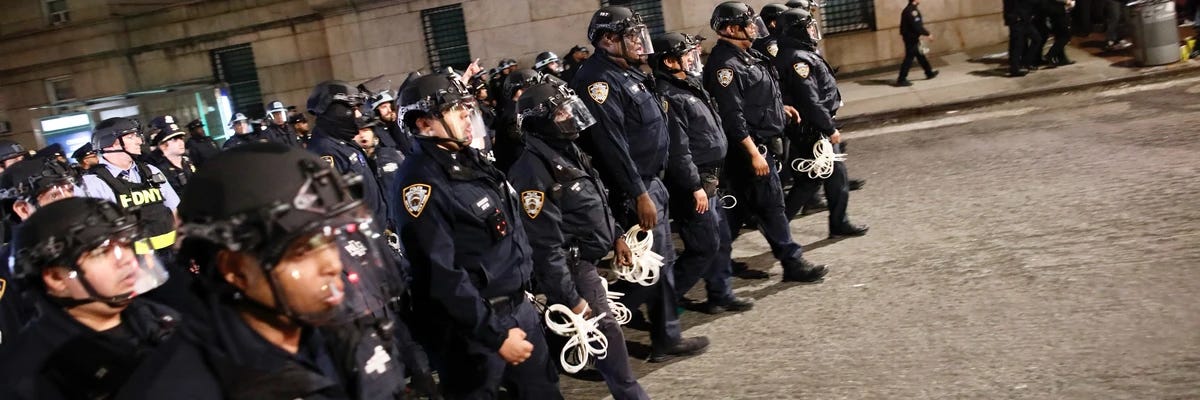
By asking police on the campus twice last April, Shafik was responding in part to the complaints of such students, even as that angered FIRE and the antisemites. The first time it was to clear an encampment that, in part, was blocking Jewish students from going to class. The second was to clear a campus building that students and outsiders had occupied.

But she infuriated the GOP officials by not moving more quickly against the camping protestors.

FIRE’s motives differ, of course, from those of its strange bedfellows. The group is committed to free speech and academic freedom, which few would argue with (aside perhaps from some GOP politicians, particularly in Indiana and Florida). FIRE would even tolerate much “hate speech,” though it draws the line at illegal threats, harassment, incitement and hate crimes.

So, why didn’t it defend Shafik, instead of being jubilant at her departure? Was she not acting against threats and harassment, against hate? FIRE’s intellectual inconsistency is certainly troubling.

Despite its condemnation of the former Columbia president, FIRE appears to adhere to the maxim that one’s right to swing his fist ends where another’s nose begins. It doesn’t support students being threatened or blocked from class, for instance.

“Hopefully policies are in place and discussions are happening with students and faculty surrounding how to respond in case encampments go up or students are being threatened or denied access to different portions of campus,” Nico Perrino, FIRE’s executive vice president, said, as quoted by VOX.

FIRE’s problem, of course, that it can’t tolerate any moves that would inhibit free expression — even if it is ignorant expression.

But, for educators, the real question isn’t a matter of free speech – it’s a matter of schooling versus ignorance. To most academics, student protestors have every right to speak their minds; the larger problem is that the demonstrations showed that there’s little real information in those young minds.

For starters, there’s the ignorance many showed by chanting “From the river to the sea, Palestine will be free” without even knowing that the Jordan and the Mediterranean were being referred to. In a survey cited by The Wall Street Journal, only 47% of the chanters could name the bodies of water. Less than a quarter of the students could even identify Yasser Arafat. And they were blind to the fact that the slogan they shouted meant removal of Jews from Israel, by murder if needed (Hamas’s preferred tactic).

Would they protest if they knew more about the history of Israel, a history in which Jews long lived in the land that they reclaimed in the early 20th Century? If they knew more about the state’s right to exist and its repeated targeting by Arabs, would they be in their encampments? Would their sympathies differ if they knew of the repeated instances of efforts to achieve peace that were rebuffed by Arabs?

Understandably, students are infuriated by the deaths of thousands of innocents in Gaza, as Israelis try to destroy terrorists who hide among them. Who could not be aggrieved by that? Such deaths, as those lost in all wars, are monstrous.

Site of Hamas attack on Oct. 7, 2023; Source: AFP/Getty Images via CNN

But do the protestors know that Hamas deliberately incited those deaths with its Oct. 7 assault on innocents in Israel? Are they aware that this murderous and suicidal group — lionized by some Palestinians — eagerly welcomes more such deaths for the propaganda it gets for its cause? That Hamas leader Yahya Sinwar calls such losses “necessary sacrifices”? That some Gazans deride Hamas for bringing on their misery and loathe the group that has ruled, tyranically, for decades?

As campuses ready themselves for what could be stepped up protests in the coming academic year, educating students on these issues could be a useful approach. Most schools have mandatory curricula. So why couldn’t that include education on issues in the Mideast (so long as the profs are committed to peaceful coexistence between Jews and Arabs there)?

Columbia’s vaunted core curriculum could include such teaching (though perhaps not by its propagandistic Middle East Institute, which is heavy on Arab studies and not so much on Israel-related ones). Perhaps students who got in hot water over their actions last spring could be required to take and pass balanced, fair and accurate coursework as a condition of being reinstated on campus.

The outlook, however, isn’t bright for knowledge to prevail in the coming year. Instead, escalation seems to be on the agenda.

“Shafik’s resignation is not the end,” Columbia’s chapter of the SJP posted, for instance. “It is not yet time to celebrate.”

That group and a related one, Columbia University Apartheid Divest, are sticking by their demand that the university divest itself of all securities that “profit from Israeli apartheid, genocide and occupation in Palestine.” Encouraging its own sort of apartheid, CUAD also demands that Columbia “sever academic ties with Israeli universities, including the Global Center in Tel Aviv, the Dual Degree Program with Tel Aviv University, and all study-abroad programs, fellowships, and research collaborations with Israeli academic institutions.”

Such demands are hardly a formula for coexistence, hardly a prescription for peace.

But what is worrisome is whether such demands – which such organizations are free to express, of course – will be accompanied by stepped up harassment or even violence. The outlook is troubling.

Already, some groups, such as the Young Democratic Socialists of America, are calling for a national student strike. What happens when some students, particularly Jews, try to get through the picket lines?

Source: Washington Square News, NYU

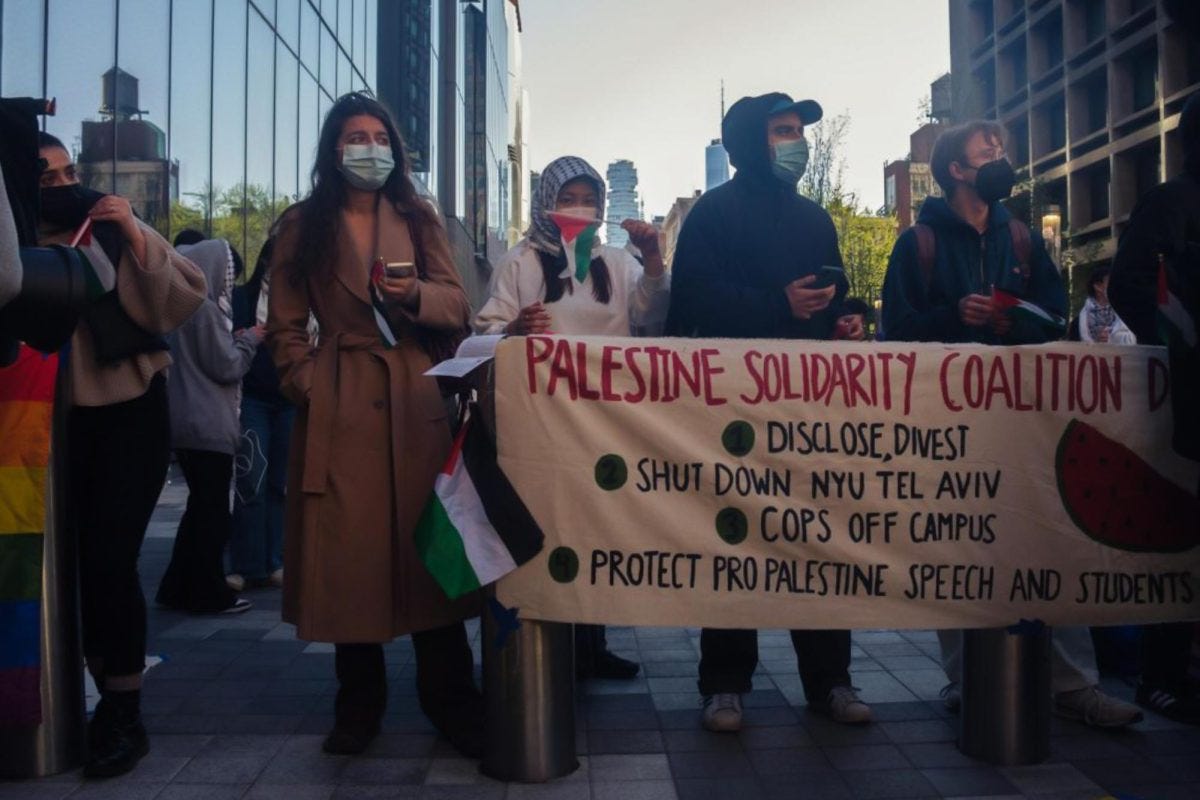
And at New York University a group, the Palestine Solidarity Coalition, endorsed “armed struggle” and resistance “by any means necessary,” though it sought to softpedal that when called on it. A group at the University of Wisconsin at Milwaukee, meanwhile, is threatening Hillel, the Jewish Federation and any organization supporting Israel, saying they are unwelcome on campus and will be treated “as extremist criminals.”

Certainly, many Jewish students last year were made to feel unwelcome on many campuses. “When the encampment started, I thought it was great that people were standing up for what they believe in, speaking their minds and all that,” Ellie Rapoport, a 20-year-old senior at Metropolitan State University of Denver, told The New York Times. “But once people started carrying around antisemitic signs and saying antisemitic things, it got a little out of hand, and it got a little scary to be on campus.”

Now those demonstrators plan to exercise their discontent, as one put it, at the Democratic National Convention. Surely, they won’t stop there.

For many campuses, the coming semester will be challenging. Will the misery that Shakespeare wrote of in “The Tempest” pale beside the experiences some students will endure?

Some administrators, such as Shafik and her colleagues at Harvard and Penn, were set back on their heels by the experiences of last spring — knocked hard enough that they left the jobs to successors. Will the new leaders protect students, as well as free speech? Will they push their institutions to remove the cant and strip away the blinders that shroud the eyes of so many students?

“We are all Hamas, pig!”

Columbia faces a new year and the outlook isn’t good

Alma Mater; Source: Columbia SJP Facebook page

As the Vietnam War raged in 1968 and students occupying buildings at Columbia University set the tone for antiwar demonstrations across the country, some in the movement went a step further. “Bring the war home,” they demanded.

The idea: the Vietcong were in the right and the warmongering capitalist West needed to be brought down. These were not pacifists demanding an end to the bloodshed. These were would-be combatants, fifth columnists, taking a side.

Today, as some students and faculty celebrate the departure of Nemat “Minouche” Shafik as Columbia’s president and, presumably, plan new anti-Israel actions for the fall term, it seems they are determined to bring the Israel-Palestine war home. Consider the responses of a couple university groups suspended by the school in November 2023:

“After months of chanting ‘Minouche Shafik you can’t hide’ she finally got the memo,” the Columbia Students for Justice in Palestine group posted. “To be clear, any future president who does not pay heed to the Columbia student body’s overwhelming demand for divestment will end up exactly as President Shafik did.”

Nemat “Minouche” Shafik; source: Jewish Journal

And, lest anyone doubt the “Students for Justice” group’s intent, its motto is “Long live Hind’s Hall, long live the student intifada, glory to our martyrs. Fighting until divestment, liberation & return.” Hind’s Hall is what occupiers of a campus building renamed Hamilton Hall in honor of a six-year-old Palestinian girl killed in the Gaza War.

The BC/CU Jewish Voice for Peace chimed in: “The students of Columbia will never forget the sheer violence unleashed upon us by Minouche Shafik, and we will not be placated by her removal as the university’s repression of the pro-Palestinian student movement continues.”

But make no mistake, as the naïve or deluded folks in the latter group do: the pro-Hamas forces on campuses will target Jews. As they did last spring, these ‘68 wannabes will vilify Jews who support Israel’s right to exist and defend herself — something embattled students on Columbia’s campus know all too well.

“For us, attending Columbia was a deliberate choice to engage in complex and even uncomfortable discourse with a diverse group of curious and passionate thinkers like ourselves,” three Jewish student leaders at the university wrote in a letter to the Columbia Spectator in July. “Unfortunately, we have found that many of our peers and professors in the ‘Free Palestine’ movement do not believe we have a right to be here. We know this because protesters on campus chanted at us, ‘We don’t want no Zionists here,’ told us ‘You have no culture,’ and threatened us to ‘Go back to Europe.’”

And, to be clear, for these protestors there is no difference between antisemitism and anti-Zionism, no matter how much some claim that. Last spring, they tipped their hands with shouts such as “We are all Hamas, pig!” Hamas exists to displace and murder Jews, as it did on Oct. 7. Chants such as “Yahoodim, yahoodi, f*ck you” gave the groups and their supporters away, too.

Cas Holloway’s home; Source: Times of Israel, via ABC News

Just last week, the antisemites revealed themselves further by painting Nazi and Hamas symbols in red on a building in Brooklyn Heights where Columbia chief operating office Cas Holloway lives. As CBS News reported, the vandals also left a fake wanted poster with Holloway’s picture, accusing him of “crimes against Palestine, students and lack of morals.” Another poster said, “You signed off on police brutality. Now you want to expel us?”

Shafik isn’t the first casualty in pro-Palestinian efforts to bring the war home. At Harvard, Claudine Gay was felled in the wake of demonstrations there, and the University of Pennsylvania lost M. Elizabeth Magill as its chief after protests on its campus.

All three presidents were caught in a vise between politicians such as Rep. Elise Stefanik of New York, who thought them too soft on antisemitism, and faculty and others on their campuses who thought them too tough on protestors.

Stefanik, who had subjected several university heads to tough questioning in hearings about antisemitism on their campuses, crowed about Shafik’s departure and that of the others. “Three down, so many to go,” the GOP politician said.

Last April, Shafik twice asked New York City police to clear demonstrators from Columbia’s campus, drawing the ire of some faculty members. The Faculty of Arts and Sciences passed a vote of no confidence in her on May 16, after the Columbia chapter of the American Association of University Professors expressed concern about shared governance and academic freedom at the university, the Columbia Spectator reported. Less specifically, the University Senate in late April passed resolutions expressing concerns with administrative decision-making and disciplinary processes.

Recent events at Columbia’s Center for Palestine Studies

The roots of Columbia’s problems stretch deep into the university, which has been declining as a magnet for Jewish students. After peaking at about 40% of the student body in 1967, Columbia’s undergraduate Jewish population has shrunk to about 22.3%, according to Inside Higher Ed. The decline parallels the rise of Arabist studies at the university, which in 1954 established the Middle East Institute, a now-sprawling interdisciplinary group that has become a bastion of Arab scholars, including those at the Center for Palestine Studies. Funders to the MEI include the United Arab Emirates and Saudi sources. Students and faculty interested in Israel have no home at MEI, but instead have the far smaller Institute for Israel and Jewish Studies.

The antisemitic rot in some quarters of the university reached as high as four deans who, in puerile fashion, swapped disparaging text messages during a May forum about Jewish issues. The deans, responsible for undergraduate student affairs, sent biting messages as they reacted to speakers expressing concern about antisemitism during the two-hour event.

Text messengers, source: The Washington Free Beacon

As the New York Times reported, one dean suggested that a Jewish speaker was playing up concerns for fund-raising purposes. Another sent vomit emojis in reaction to the mention of a college newspaper opinion piece written by one of the school’s rabbis. Shafik in June suspended three of them — Susan Chang-Kim, Cristen Kromm and Matthew Patashnick — and they recently quit, though a fourth dean, Josef Sorett, apologized and remains dean of Columbia College. Sorett formerly headed the Department of Religion and has the protections of tenure.

Shafik, an Egyptian-born Muslim, British baroness, member of the House of Lords and trained economist who took the Columbia post in July 2023, found it impossible to thread the needle between the university’s competing interest groups. “I have tried to navigate a path that upholds academic principles and treats everyone with fairness and compassion,” she wrote in a resignation letter. “It has been distressing—for the community, for me as president and on a personal level—to find myself, colleagues, and students the subject of threats and abuse.”

In an environment that couldn’t be more polarized, she sought to forge a common approach — with the result that the campus is facing a year of uncertainty and likely tumult. The get-tough interests at Columbia may have been cheered by her recent proposals to empower university law enforcement by adding “peace officers” who could arrest students.

But, with just three weeks to go before the beginning of school, little has come of suggestions she offered in July that action was on the way to forestall problems in the coming year. The university senate is “reviewing the rules” that govern conduct in protests, Shafik said in a July 24 “Update for Our Community.” She added that Columbia officials were “working hard to put in place more mechanisms for community consultation, more clarity about our rules going forward, more training on discrimination issues for everyone (staff, faculty, and students), better capacity to handle incidents and complaints, and stronger internal engagement and communications.”

Other schools, such as Penn, have taken stronger measures such as banning camping on campus. That temporary move is due to be reviewed by faculty in the coming school year.

Dr. Katrina A. Armstrong, source: Columbia

To heal its woes as interim president, Columbia has turned to Dr. Katrina A. Armstrong, a primary care physician who is the chief executive officer of the Columbia University Irving Medical Center and dean of the faculties of health sciences. In a message of acceptance, she hit a few high notes, writing: “The habit of critical thinking and humility that gives birth to tolerance of contrary points of view is the most essential lesson taught in Columbia’s classrooms and the intellectual common ground that unifies the many scholarly pursuits found across our campuses.”

Enforcing that tolerance and fostering critical thinking among students and faculty members duped by the pro-Hamas forces will be a tall order. Indeed, it will likely take years — and probably the removal of more than just a few antisemitic deans — to bring some sense to Columbia. This year, surely, will be a pivotal one.