
Where has generosity gone among the megawealthy?
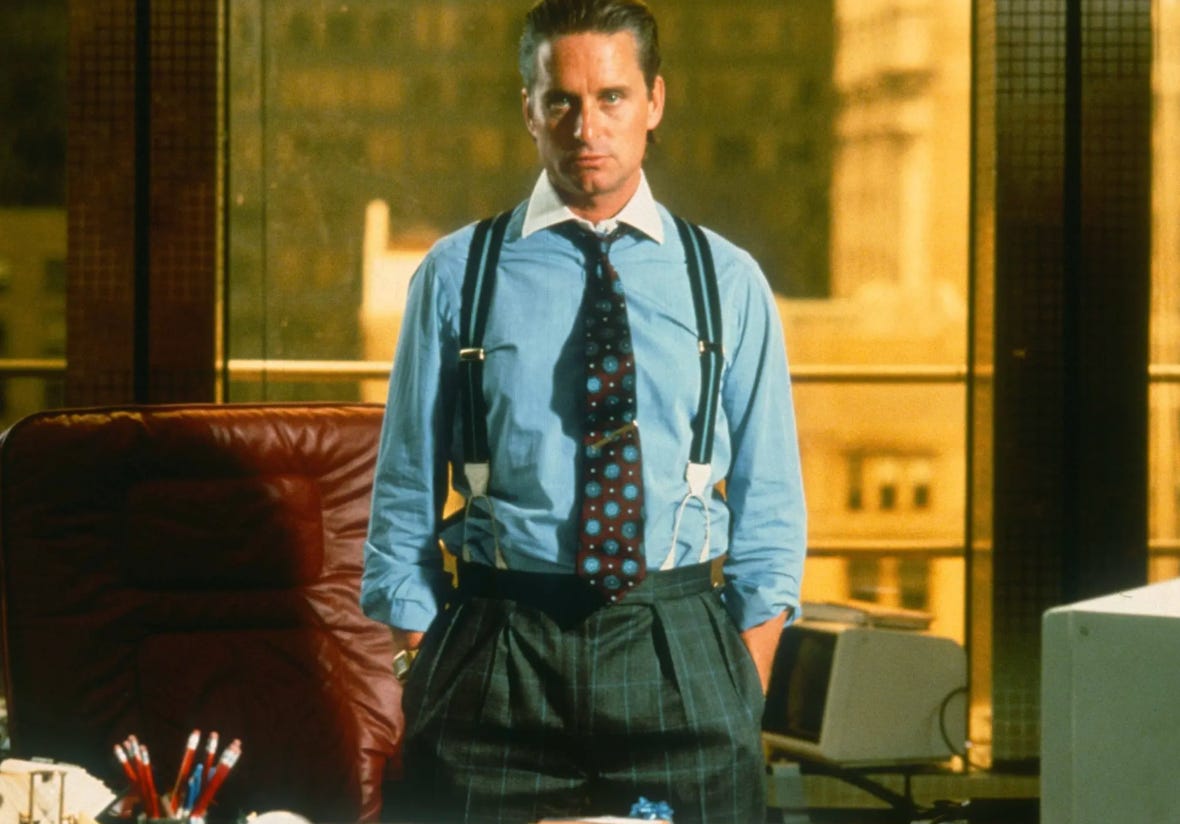
In the 1987 movie “Wall Street,” corporate raider Gordon Gekko infamously praises what some religious thinkers peg as near to the top of the list of the seven deadly sins, one behind only pride.
“The point is, ladies and gentlemen, that greed – for lack of a better word – is good,” says the character, portrayed by Michael Douglas. “Greed is right. Greed works. Greed clarifies, cuts through, and captures the essence of the evolutionary spirit. Greed … has marked the upward surge of mankind.”
Perhaps Elon Musk is proof that Gekko was speaking truth — or, maybe, he proves something else entirely.
This week Musk graduated from being the world’s richest man to becoming our first trillionaire, logging in with a net worth of about $1.1 trillion thanks to the initial public offering of SpaceX. He owns the lion’s share of the company’s stock – variously calculated at 42 percent or 46 percent – and its shares altogether are now worth $2.1 trillion.
So, given all that wealth, we might expect that Musk might also be the world’s most generous man, right? After all, he has only 14 children and doesn’t currently have a wife. He has plenty of money to give away, of course, and he’s no Gordon Gekko, right?
Curiously, however, it seems Musk routinely makes the stingy lists.
Even before SpaceX’s offering padded his pockets still more, he was reported by Forbes early this year to have given away just 0.06 percent of his net worth over his lifetime so far. Granted, that’s a half-billion dollars out of a net worth then totaling $780 billion, but everything’s relative, right? To Musk, that’s a few coins in one of his no-doubt many sofas.
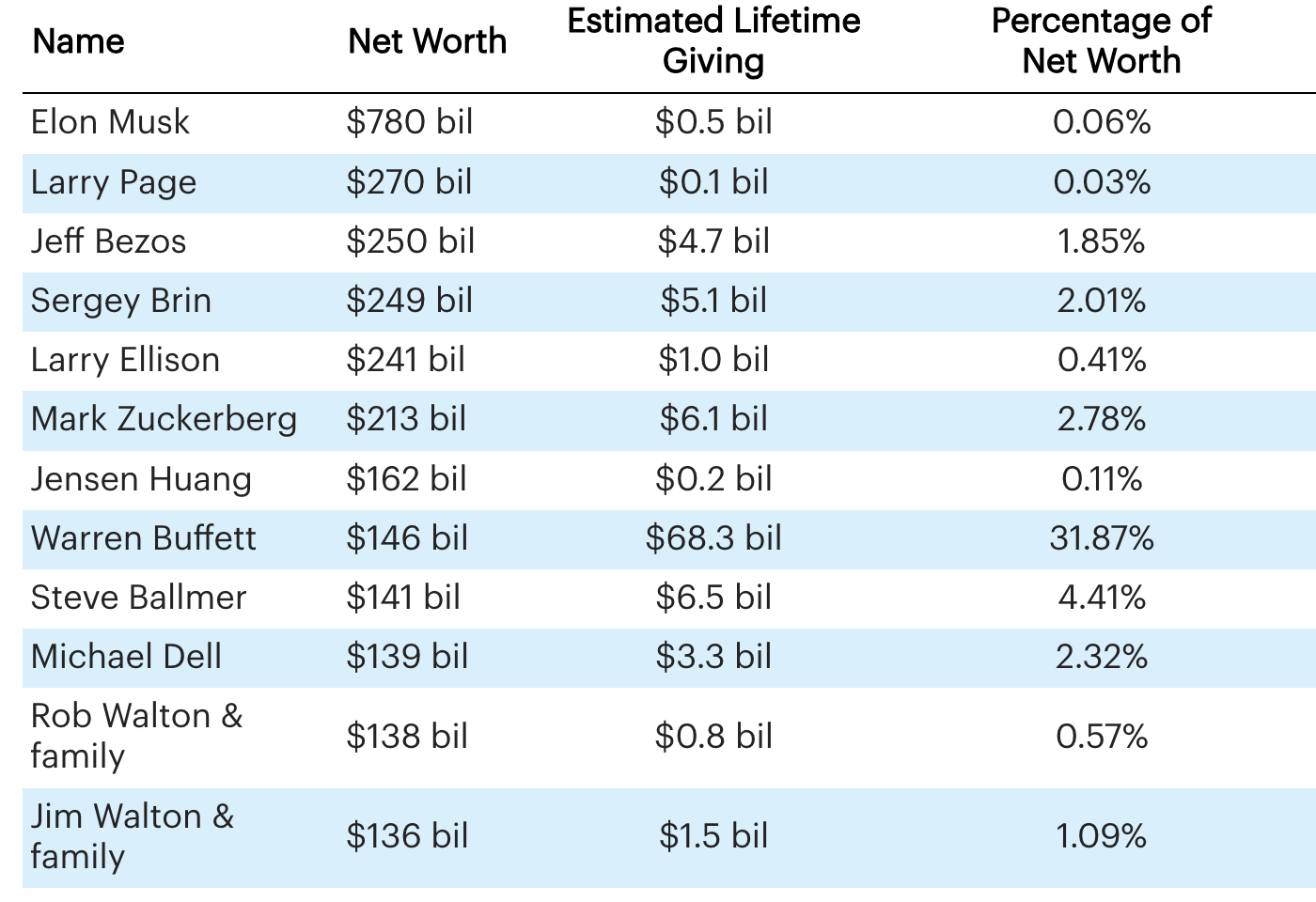
By contrast, Warren Buffett has donated nearly 32 percent of his $146 billion, or $68.3 billion. And Buffett, who is 95, has pledged to give away 99 percent of his wealth during his life or upon his death. Together with Bill and Melinda Gates, in 2010 he set up the Giving Pledge, an outfit that encourage the megarich to give away most of their money to charity.
“The reaction of my family and me to our extraordinary good fortune is not guilt, but rather gratitude,” Buffett has said. “[T]hat … 99% can have a huge effect on the health and welfare of others. That reality sets an obvious course for me and my family: Keep all we can conceivably need and distribute the rest to society, for its needs.”
Musk, it seems, has far bigger needs.
As it happens, Musk is also a signatory of The Giving Pledge – but he seems to have a long way to go to fulfill that. And some friends, such as billionaire Peter Thiel, have been urging the trillionaire to opt out of the nonbinding pledge. In recent transcripts and audio lectures given by Thiel to Reuters, Thiel warned Musk that his donations would go “to left-wing nonprofits that will be chosen by Bill Gates.”
Indeed, Thiel, who has preferred giving his money to Donald J. Trump and JD Vance, has been pressing the 250-plus megamonied on The Giving Pledge list to back away from it. “I’ve strongly discouraged people from signing it, and then I have gently encouraged them to unsign it,” said Thiel, who derides the GP outfit as an “Epstein-adjacent, fake boomer club” – whatever that means.
Musk may be heeding his rich buddy’s advice, as he finds it tough to find needy – and deserving – folks to share the largesse of his namesake foundation with. “The biggest challenge I find with my foundation is trying to give money away in a way that is truly beneficial to people,” he told interviewer Nikhil Kamath. “It’s very easy to give money away to get the appearance of goodness. It is very difficult to give money away for the reality of goodness.”
The Musk Foundation is enormous. Its resources were pegged at $14 billion in a 2025 New York Times report. “But unlike some other billionaires who have dedicated their nonprofits to broader social or political causes, Mr. Musk in recent years used his nonprofit in ways that narrowly track the interests of his for-profit businesses,” the Times noted.
For instance, more than three-fourths of the $474 million the foundation gave away in 2024 – some $370 million — went to a nonprofit in Texas led by Musk’s top aide, the newspaper reported. That nonprofit appears to provide a benefit to Musk’s business empire: It operates an elementary school in a rural area where many of his employees live, near many of Musk’s companies.
Self-interested philanthropy? Perhaps there are other words for it, and they arguably don’t meet his test of “the reality of goodness.” That is, unless goodness is defined as benefitting both some of his workers and himself. It appears it’s not in Musk’s nature to give money selflessly to needy people. Selflessness seems not to be part of his vocabulary.
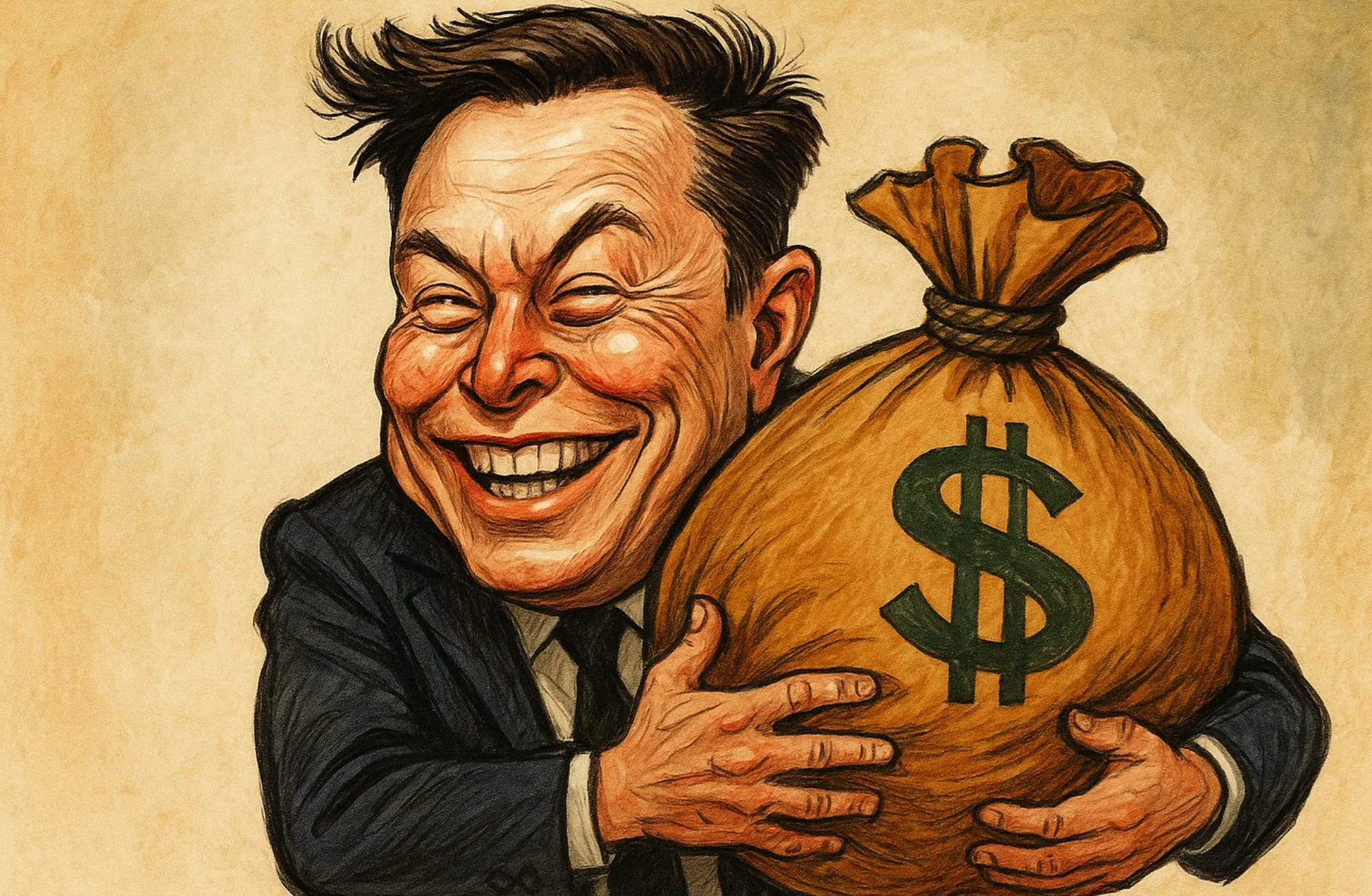
In some respects, Musk mirrors the times, reflecting a new Gilded Age that – literally – emanates from the Trump White House. It’s as if the megawealthy don’t need to bother with the little people or those in need anymore.
“This is an era of a more voracious capitalism, of billionaires trending right and getting ahead by embracing an administration that is happy to dole out favors,” The New York Times recently reported in a piece headlined The Billionaire Backlash Against a Philanthropic Dream. “Many of today’s ascendant billionaires are dismissive of philanthropy as nothing more than public relations.”
The piece quoted sociologist Aaron Horvath as calling the Giving Pledge a “time capsule” of a bygone era, albeit just 16 years ago. “It feels old school,” he said. Billionaires, he said, now think: “I can keep my head down and keep making money. I don’t have to put up with this charity charade anymore.”
Perhaps they are following Trump’s lead. Recall that the Donald J. Trump Foundation was forced to close down in 2018 after New York’s Attorney General at the time said it functioned “as little more than a checkbook to serve Mr. Trump’s business and political interests,” and engaged in “a shocking pattern of illegality” that included unlawfully coordinating with Trump’s 2016 presidential campaign.
The Trump foundation had been charged with “improper and extensive political activity, repeated and willful self-dealing transactions, and failure to follow basic fiduciary obligations or to implement even elementary corporate formalities required by law.” A couple of notable examples cited by the Times: the foundation bought a $10,000 portrait of Trump that was displayed at one of his golf clubs. And one transaction was revealed by a note in Trump’s handwriting that said $100,000 of foundation money should be directed to another charity to settle a legal dispute between the Town of Palm Beach and Trump’s Mar-a-Lago resort.
To be sure, there is a reasonable argument that one of the best ways for wealthy people to give back to society is by running successful, growing businesses that create jobs. Some 150,000 or more people work for Musk companies, for instance. With such a job base, it’s not surprising that he has said that his businesses “are philanthropy,” according to the Times.
But where does this leave people who can’t work? People with disabilities, inadequate skills or education, people who aren’t going to be software engineers or, literally, rocket scientists? Where does this leave children in disadvantaged families? Are the rich just blind to them?
Studies have shown that as people get wealthier, they not only lose touch with those on society’s margins, but they lose empathy for them. “Wealthy people are less likely than poor ones, in lab settings at least, to relate to the suffering of others,” The Atlantic reported in 2021, in a piece headlined “Research Proves It: There’s No Such Thing as Noblesse Oblige.”
Researchers hooked volunteers up to ECG machines and showed them two short videos: a “neutral” video of a woman explaining how to construct a patio wall and a “compassion” video of children receiving chemotherapy treatments for cancer, the magazine reported. Compared with wealthier subjects, poorer subjects not only reported feeling greater compassion for the kids but also exhibited a significantly larger slowdown in heart rate from one video to the next. It seems our hearts slow down when people experience compassion.
Yes, wealthy families donate significantly more money to charity on average than poor families do, but they tend to give away a smaller share of their income. “As wealth goes up, the stinginess seems to increase,” one researcher said.
And people such as Musk are unembarrassed by their lack of fellow feeling.
Notoriously, he told podcaster Joe Rogan in 2025 that “the fundamental weakness of Western civilization is empathy.” Citing a Canadian marketing professor who has written on the topic, Musk warned against “civilizational suicidal empathy,” explaining “I think you should care about other people, but you need to have empathy for, for civilization as a whole, and not commit to a civilizational suicide.”
Civilizational suicide, it seems, means having too much compassion for the less fortunate. That’s not a problem for Musk and his buddies, especially his on-again, off-again friend in the White House. Even though he’d be committing the worst of the sins, Gekko would be proud.