
The Democratic Party may be driving them out
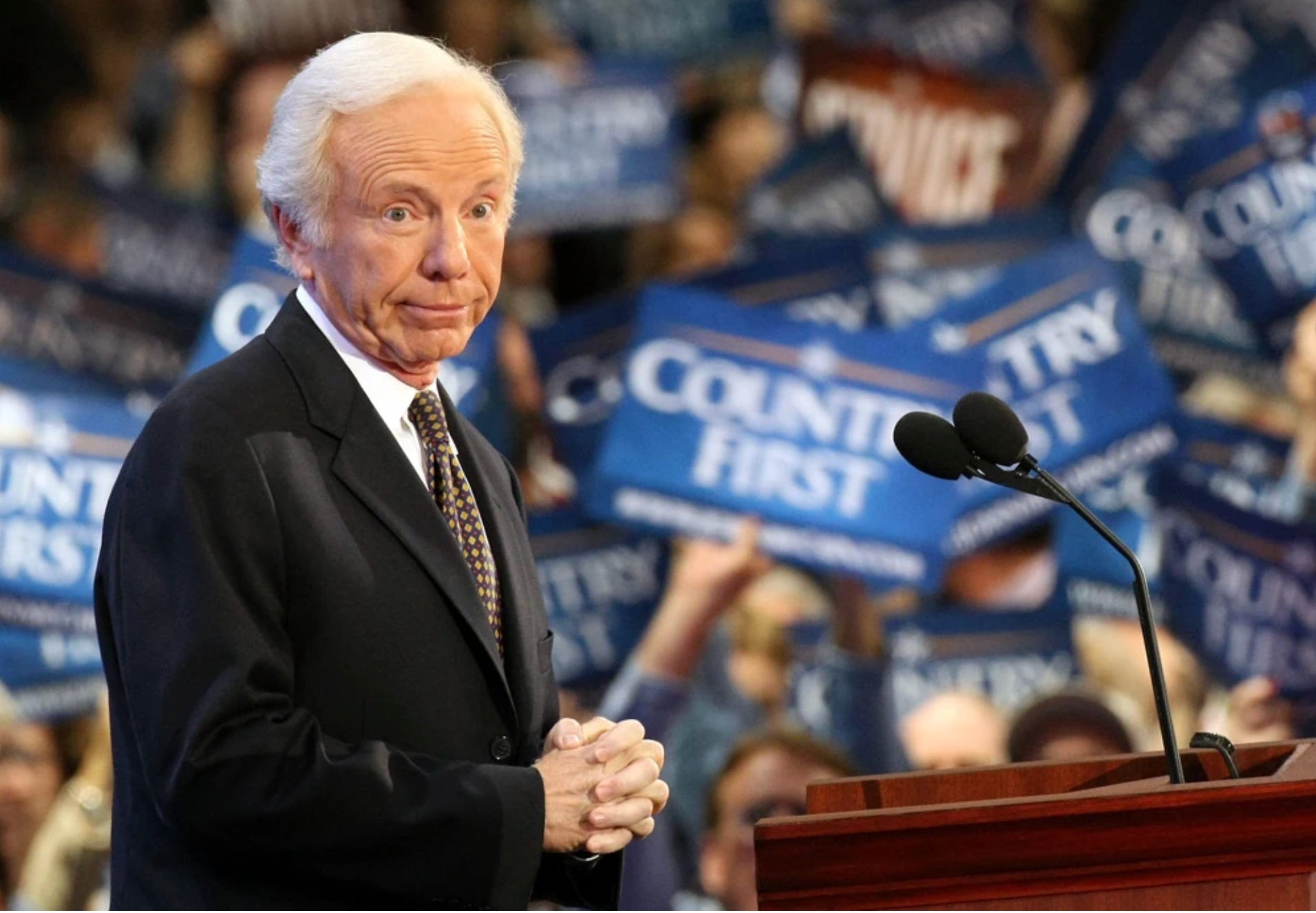
Six years after running unsuccessfully for the vice presidency as the Democratic party nominee, Joe Lieberman in 2006 lost a Democratic primary race in Connecticut for reelection to the U.S. Senate. So, he ran and won as an independent, taking his fourth term, which wrapped up in 2013. In an interview a decade later, he recalled an old quote: “I didn’t leave the Democratic Party; the Democratic Party left me.”
Lieberman stopped himself before repeating the line. Instead, he laughed and, remembering that Ronald Reagan had used the line in 1962, said: “So maybe that’s not a good person to quote to extend a bridge to my fellow Democrats.”
The 24-year senator at that time had kept his Democratic party registration but was working with No Labels, a centrist group that wanted to find an alternative to both Joseph R. Biden and Donald J. Trump in the 2024 election. He said the anger Americans felt toward both parties was unprecedented.
As often happens with third parties, the No Labels group fell apart, unable to find a suitable candidate. Then, months before the election, Lieberman died in March 2024 at 82.
More than anything, the Connecticut senator – an observant Jew who had faulted Democratic President Bill Clinton in 1999 for his “immoral” relationship with an intern — wanted the party to return to its traditional center. He was so turned off by the directions the party was taking that he backed his friend, Sen. John McCain, for president in 2008 and, of course, sought a middle-ground alternative in the year he died.
Now, anti-Israel “progressives” have notched high-profile wins in Democratic primaries in Michigan and Colorado, along with Zohran Mamdani’s rout in New York City, as well as wins by other left-wing candidates there. And many Jews are wondering the same sort of thing as Lieberman did.
Has the party that so many have long supported deserted them?
And it’s not just a matter of the victories in Michigan by Dr. Abdul El-Sayed, a Senate candidate, and House candidate William Lawrence, as well as Colorado House candidate Melat Kiros. Nor is it just the New York primary triumphs of House hopeful Brad Lander, a nuanced critic of Israel, or the more strident Claire Valdez and Darializa Avila Chevalier.
As The New York Times reported, the Democratic Party’s rapid retreat from support for Israel has shown up in polls, election results and votes in Congress. Some 49 percent of Democratic voters quizzed in a May New York Times/Sienna poll strongly oppose providing more economic and military support to the country (while 42 percent of Republicans strongly back such aid). Almost half the Democrats in the House voted in July to end aid to Israel, though the measure failed.
The elections and the opinion shift almost surely will weaken the already wobbling support among many Jews for the Democratic Party. A poll from last year showed that some 68 percent of American Jews backed the party in 2019, but the share dropped to 55 percent by last year. By contrast, roughly just one in four such Jews backed the Republican Party from 2008 to 2020, but the share rose to nearly one in three (32 percent) by last year.
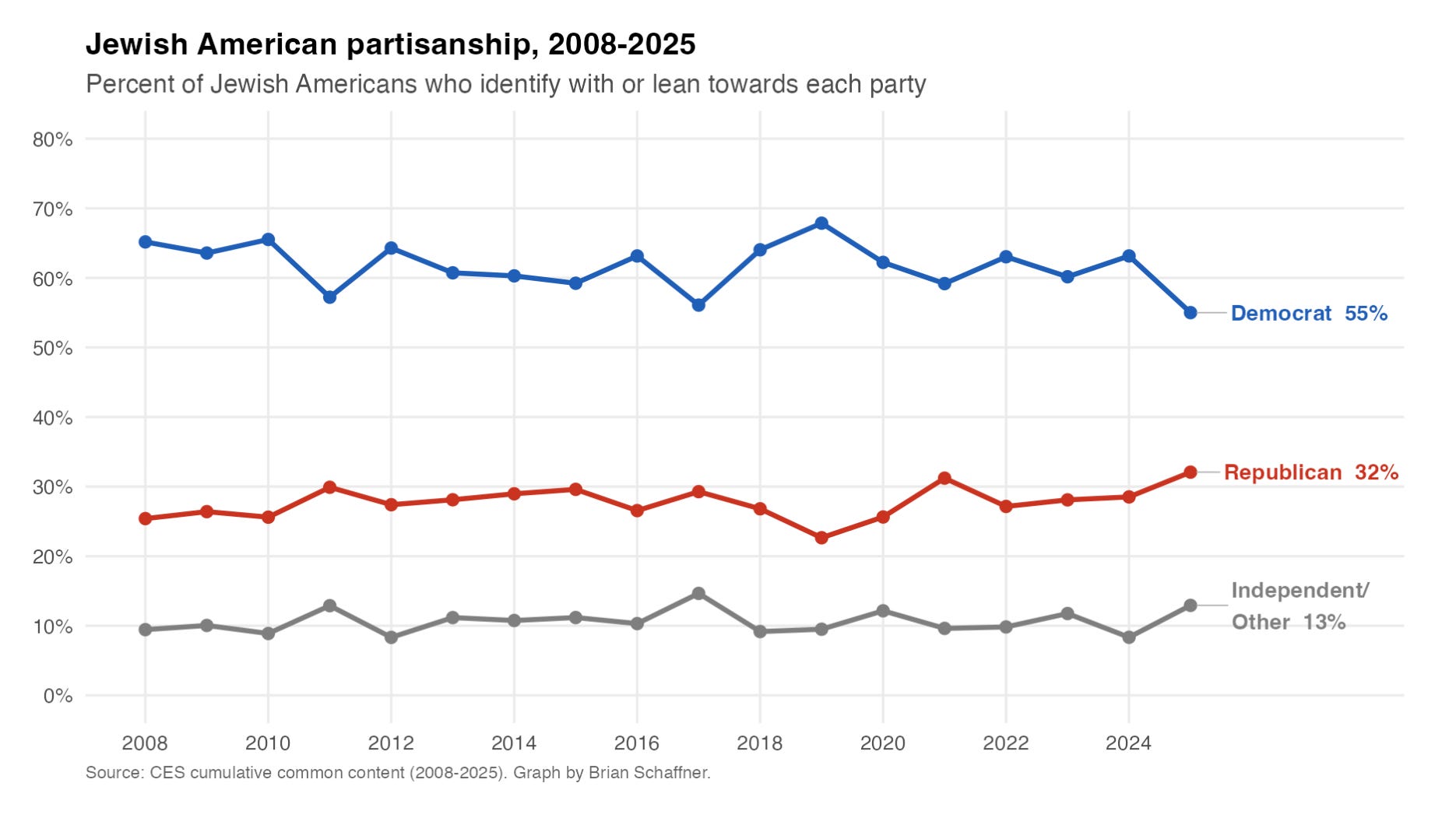
Of course, not all Jews have switched parties. The CES poll shows a rise in the share considering themselves as independents (or backers of others) to 13 percent, up from just below 10 percent in 2024. It’s possible that share includes folks who might be as mad at both parties as Lieberman said many were in 2024.
And any analysis of the changes has to be loaded with caveats. For one, while the Israel critics grabbed the headlines, plenty of moderate Democrats also won their contests. As The Week noted, the recent winners in the party’s moderate faction include Rep. Marie Gluesenkamp Perez (Wash.), who fended off a leftist challenger; former Rep. Elaine Luria (Va.) and Richmond-area prosecutor Shannon Taylor, who won swing-district primaries; and Rep. Wesley Bell (Mo.), who bested democratic socialist former Rep. Cori Bush.
Earlier, plenty of pro-Israel candidates won their races elsewhere. These include House Democratic Leader Hakeem Jeffries (who ran unopposed in New York) and Adrian Boafo in Maryland, as well as New Yorkers Yvette Clark, Laura Gillen, Gregory Meeks, Tim Kennedy and others, along with several other incumbents from Maryland, all backed by the American Israel Public Affairs Committee (AIPAC).
What’s more, it may be risky to make too much of El-Sayed’s victory. It was a narrow one, about a single percentage point higher than pro-Israel candidate Haley Stevens, and he prevailed with less than a majority at just under 48.5 percent, according to the most recent count. Moreover, it’s typically the most committed partisans – call some of them extremists– who vote in primaries, so the epidemiologist’s backers may not represent the party faithful overall.
Still, as the Times suggested, El-Sayed’s triumph was “maybe the biggest setback for pro-Israel Democrats.” And, perhaps more than anything, El-Sayed’s victory was a sharp slap in the face to AIPAC, which had spent a stunning $32 million trying to defeat him. The group, instead, gave El-Sayed ammunition, as he made attacking spending by outside groups a key part of his campaign.
Similarly, AIPAC spent heavily a few months ago to try to tarnish a Jewish Democrat in Illinois, Evanston Mayor Daniel Biss, in his race for the House. Biss considers himself a liberal Zionist who is critical of Israel’s current government, a position that is increasingly common among Democrats. AIPAC’s spending backfired when Biss made the group’s opposition a central part of his race.
Whether American Jews will turn against the Democrats overall in the midterms and later in the next presidential race is a tough call to make now. As the political science site Good Authority noted, most Jewish Democrats quizzed in 2025 said they still intended to vote Democratic in House races this year, even as their party support was weakening – though much could change yet.
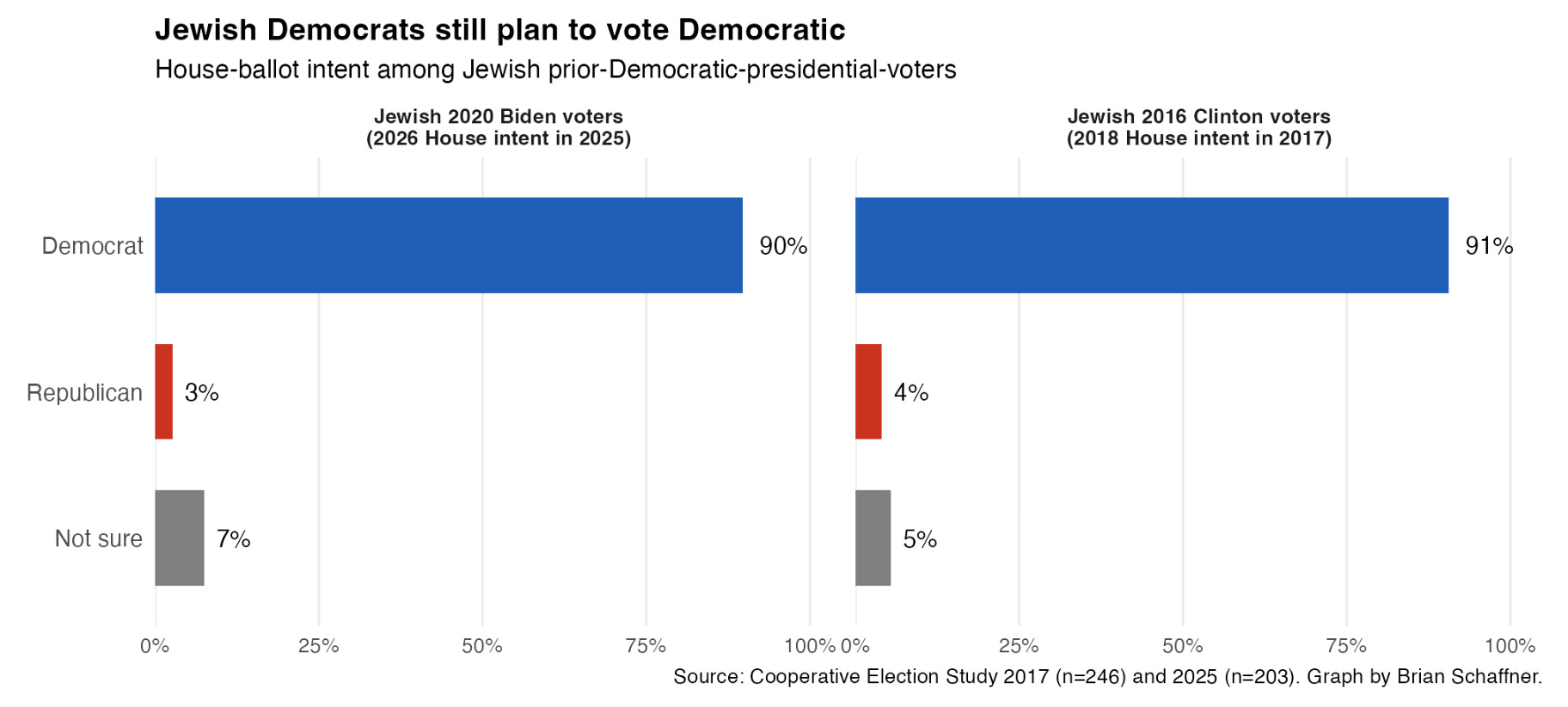
“The two signals do not point in the same direction,” the site reported. “Jewish American identification with the Democratic Party has dropped to its lowest level in nearly two decades. Jewish Democratic voters’ stated vote intention has remained much the same. Both of those things can be true at once, and the needle on either gauge can move again between now and November.”
The late Connecticut senator may have been onto something years ago. Soon enough, we’ll find out whether his insights are even more relevant now.